Quick answer
The decision flips when coordination and continuity become more expensive than the delivery work itself. Compare the same responsibility map, then weight cost, speed, ownership, SEO, integrations, scale, governance and editor experience for your situation.
Last reviewed: September 16, 2026Weighted decision scorer
Set importance from 0 (not relevant) to 5 (critical). WebDesignK editorial fit assumptions for delivery models. Change the importance weights to match your situation; do not treat the scores as market rankings.
1. Grouped criterion contribution bars
Each group shows how much the current importance weight lets each option contribute on that criterion. The overall fit summary sits above the grouped bars.
2. Weighted criteria radar
Shape shows which criteria each option satisfies under your current importance settings.
- Cost predictability: weight 3
- Speed: weight 3
- Ownership / control: weight 3
- SEO / performance: weight 3
- Integrations: weight 3
- Scale / parallelism: weight 3
- Governance: weight 3
- Editor experience: weight 3
3. Criteria contribution heatmap
Cells combine each option's disclosed fit (1–5) with your importance weight (0–5).
Assumption note: option fit values are transparent WebDesignK editorial planning assumptions, not measured market performance. The result changes only from your criterion weights and the disclosed matrix.
Tables built for the buying decision
Primary decision table
| Criterion | Agency | Freelancer | In-house | Tradeoff / who should care |
|---|---|---|---|---|
| 12-month TCO | Project/retainer spend can bundle several disciplines | Direct specialist spend; client may supply PM/QA/backup | Payroll plus hiring, management, tooling and capacity | Compare equivalent responsibilities, not invoice vs one salary |
| Launch speed | Can parallelize workstreams when staffed well | Fast on bounded work if availability aligns | Fast decisions but competes with internal priorities | Deadline-sensitive projects need capacity, not just talent |
| SEO & performance | Can bring dedicated specialists | Strong if specialist expertise matches the problem | Continuous ownership when capability exists | Ask for evidence and monitoring method |
| Ownership | Must contract for repo/accounts/handoff clearly | Usually simple but continuity can be person-dependent | Context stays close to the business | Critical for companies that expect frequent change |
| Integrations | Broader specialist bench can help | Excellent for defined integrations; backup matters | Best access to proprietary systems and owners | Integration depth often favors hybrid delivery |
| Scale / parallelism | Can add roles without the client hiring each one | Limited by one person's bandwidth | Can scale by hiring, but slowly | Parallel launch work is different from steady-state capacity |
| Security & governance | Repeatable controls vary by agency maturity | Client may need to provide more governance infrastructure | Fits existing corporate controls when expertise exists | Enterprise buyers should inspect evidence and escalation paths |
| Editorial workflow | Can design CMS/governance and train users | Efficient for straightforward publishing systems | Editors have direct access to product/engineering | Content-heavy teams need explicit day-2 ownership |
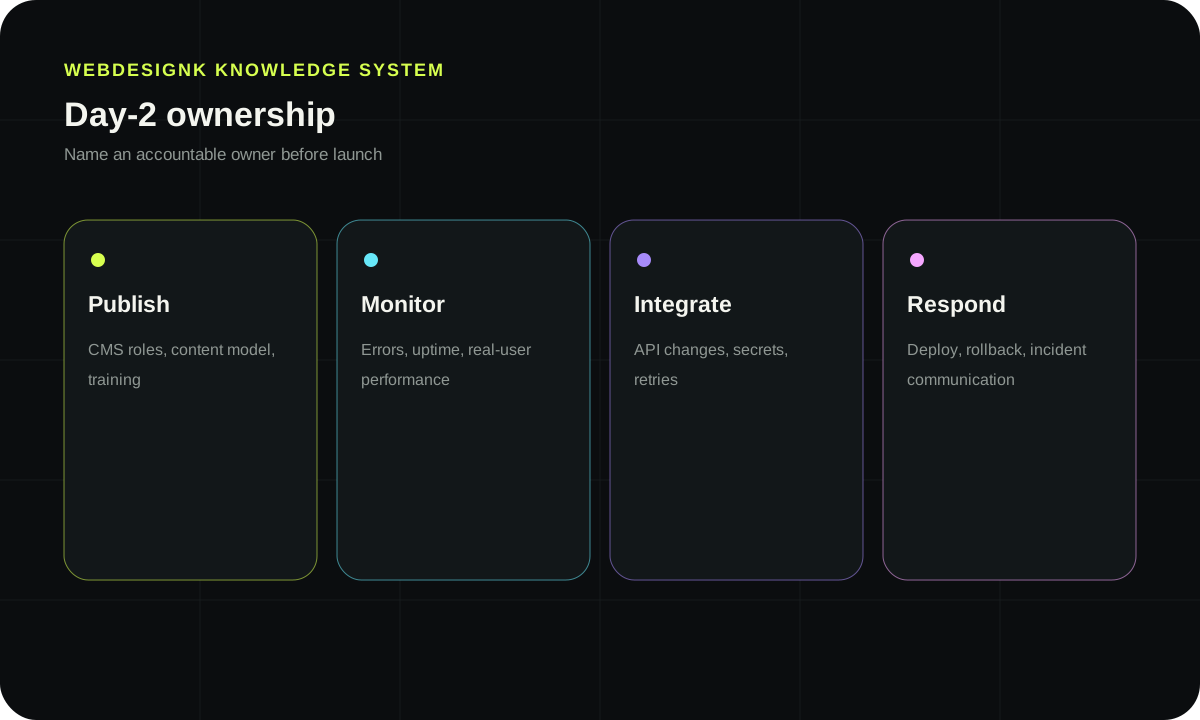
Day-2 operating ownership
| Responsibility | Question before signing | Failure if undefined |
|---|---|---|
| Publishing | Who owns CMS roles, training and content model changes? | Editors create workarounds or wait on developers |
| Monitoring | Who watches errors, uptime and real-user performance? | Regressions survive until users report them |
| Integrations | Who owns API changes and credentials? | Forms or data sync break without an escalation path |
| SEO | Who monitors crawl/index and migration issues? | Launch problems become long-lived traffic loss |
| Incidents | Who can deploy, rollback and communicate? | A technically fixable issue becomes an ownership crisis |
Sources and assumption boundaries
Fast-changing platform, pricing and AI-search claims were reviewed on September 16, 2026. Interactive scores and scenarios are clearly labeled planning models, not sourced market benchmarks.
- U.S. Bureau of Labor Statistics — Web Developers and Digital Designers May 2025 national median wage context; not a fully loaded employer-cost estimate. Reviewed September 16, 2026.
- U.S. Bureau of Labor Statistics — Software Developers, QA Analysts, and Testers May 2025 national wage context for software engineering roles. Reviewed September 16, 2026.
- Google Search Central — Core Web Vitals Official current definitions and good-experience thresholds. Reviewed September 16, 2026.
- Google Search Central — Page Experience Official guidance that page experience is multi-factor and not reducible to one score. Reviewed September 16, 2026.
Turn this planning result into a scoped review.
Send the assumptions, constraints and result summary. WebDesignK can review the architecture/content/implementation boundary, identify missing discovery inputs and return a prioritized next-step scope.
- Bring: current site/product, constraints, integrations and your tool result.
- You get: a scoped recommendation, open questions and implementation priorities.
Decision snapshot for agency vs freelancer vs in-house
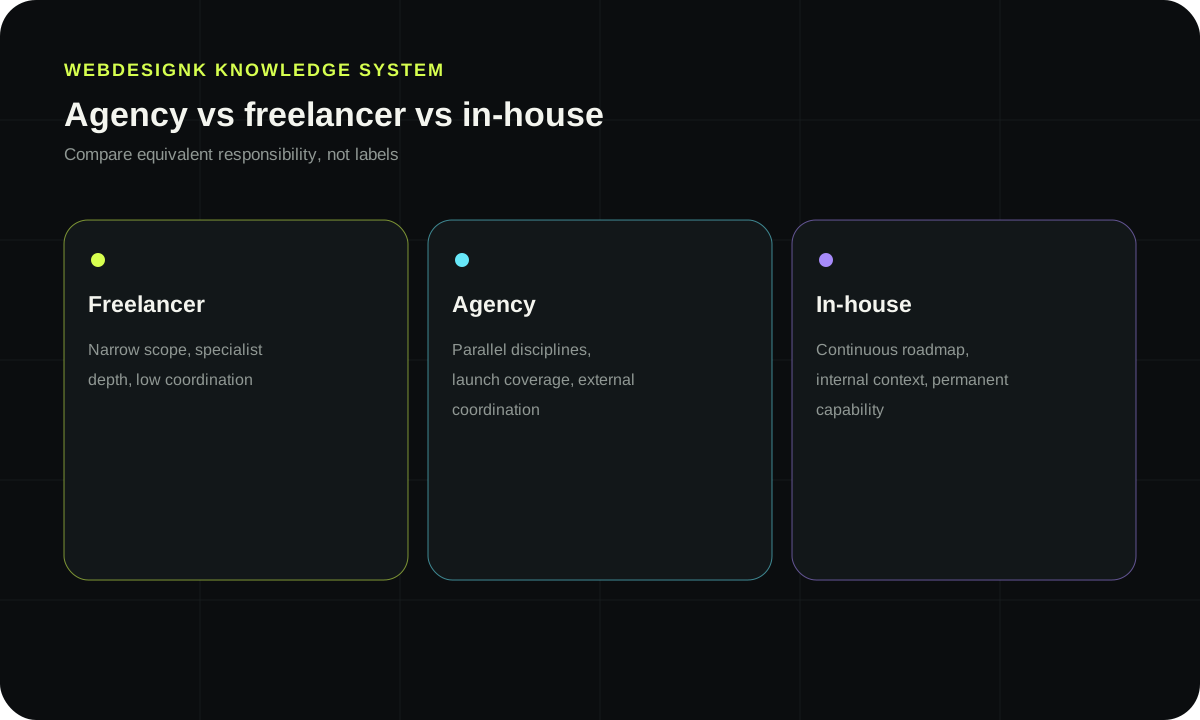
There is no universally best delivery model. A freelancer is often strongest when scope is narrow, one specialist can own most of the work and coordination needs are low. An agency becomes more attractive when the project needs several disciplines, launch accountability and coverage after go-live. An in-house team becomes more defensible when the website is a continuous product with enough recurring work to justify permanent capability. The deciding tradeoff is not day-one price; it is how much coordination, continuity and specialized capacity you need after launch.
What you will decide: which operating model best fits your current constraints, what must remain internally owned, and which responsibilities you are willing to buy externally. The interactive scorer above uses your priorities; it is a decision aid, not an objective ranking of agencies, freelancers or employees.

Quick decision summary: best-fit scenarios
Choose by the shape of the work rather than the label on the supplier. A five-page campaign site with a mature design system is a different buying decision from a multilingual redesign connected to CRM, product analytics, search, a headless CMS and an internal release process.
Freelancer: best when the problem is bounded
A freelancer can be an excellent fit when one experienced person can solve most of the problem end to end or when you need a specific capability inside an existing team. Examples include frontend implementation against approved designs, a UX audit, conversion copy, accessibility remediation or a defined performance sprint. The model becomes fragile when one person must simultaneously cover research, visual design, engineering, content migration, analytics, QA, stakeholder management and post-launch support.
Common mistake: interpreting a lower coordination footprint as lower quality. A senior freelancer can outperform a larger team on a tightly defined problem. The real question is whether the work fits one person's bandwidth and whether continuity risk is acceptable.
Agency: best when the work crosses disciplines
An agency can reduce the buyer's coordination burden when strategy, UX, design, engineering, SEO, analytics and QA need to move together. The value is not simply “more people.” It is the ability to sequence specialist work, absorb normal staffing variation and own a deliverable across several workstreams. That benefit matters most when the buyer does not want to assemble and manage multiple independent suppliers.
The downside is that an agency adds its own coordination layer. If the engagement is tiny, that layer can be unnecessary. If the agency uses a senior sales team but a disconnected delivery team, the promised breadth may not materialize. Evaluate the actual named delivery roles, decision rights and communication model rather than assuming the agency label guarantees coverage.
In-house: best when the website is continuous product work
Permanent capability makes sense when the site changes often enough to keep a cross-functional team productive: ongoing experiments, product launches, integrations, localization, design-system evolution, technical SEO, analytics and frequent release work. In-house ownership also shortens feedback loops around confidential business context and can make day-2 operations easier.
But “hire one web developer” is not equivalent to buying a complete web team. The U.S. Bureau of Labor Statistics reports May 2025 median annual wages of $92,650 for web developers and $104,000 for web and digital interface designers; software developers had a $135,980 median. Those are national occupational medians, not fully loaded employer cost and not a quote for a specific role. They illustrate why an in-house comparison must account for the set of capabilities required, not compare an agency proposal with one salary line.
Side-by-side comparison on buyer criteria
The table in this guide is deliberately qualitative. Cost, speed and quality depend on people, scope and operating discipline. Use it to surface questions rather than to declare a winner.
What this means for total cost
For a freelancer, direct project spend can be easier to see, but the buyer may provide project management, QA and specialist support. For an agency, more of those functions can be bundled into the engagement. For an internal team, payroll is only one component: recruiting, employer costs, management, equipment, tooling, learning time and idle/overloaded capacity all affect the economics. Conversely, a high-utilization internal team can become very efficient once domain knowledge and systems are established.
How to decide: compare an equivalent responsibility map. If proposal A includes research, information architecture, design, engineering, migration, analytics, accessibility QA and a 30-day support window while proposal B includes only design and build, the headline totals are not comparable.
Total cost of ownership
Website ownership continues after launch. The operating model changes who notices problems, who has access to fix them and who pays the coordination cost.
Build a 12-month responsibility ledger with at least these categories: hosting/platform, CMS, domains/DNS, analytics, consent tooling, dependency upgrades, security updates, performance monitoring, accessibility regression checks, content publishing, SEO maintenance, conversion experiments, integration maintenance and incident response. Put an owner next to every row.
Agency TCO pattern
An agency model often separates project delivery from a maintenance or optimization agreement. That can be useful because ongoing capacity is explicit, but buyers should inspect response-time commitments, included hours or outcomes, ownership of repositories and accounts, and what happens if the retainer ends. Avoid contracts where access to code, analytics, hosting or domains depends on continuing the relationship unless that arrangement is intentional and understood.
Freelancer TCO pattern
A freelancer may offer flexible maintenance with low overhead, but availability becomes part of operational risk. Ask what happens during holidays, illness, concurrent launches or a serious incident. For a low-risk marketing site, that may be acceptable. For a storefront or lead-generating system where downtime has immediate commercial impact, define backup ownership before launch.
In-house TCO pattern
Internal teams convert supplier dependency into hiring and management dependency. That can be desirable because knowledge remains close to the business. It can also create hidden bottlenecks if only one employee understands deployment, DNS, the CMS schema or a critical integration. Documentation, code review, shared credentials and runbooks matter regardless of employment status.
Speed to launch and day-2 operations
Speed is usually constrained by decisions and dependencies before it is constrained by typing speed. Content approvals, stakeholder feedback, brand assets, data migration, API access and legal review can stall any model.
A freelancer can start quickly when scope is defined and their calendar is open. An agency can parallelize design, engineering and content work, although coordination adds meetings and handoffs. An internal team can make rapid decisions when priorities are clear, but may be competing with product, campaign or operational work.
Day-2 is the better stress test
Ask who owns the first broken form, the first CMS permission issue, the first integration change, the first Core Web Vitals regression and the first urgent campaign request. Google describes Core Web Vitals as real-world experience metrics covering loading, responsiveness and visual stability; its current “good” thresholds are LCP within 2.5 seconds, INP under 200 ms and CLS under 0.1. A launch handoff that has no performance owner makes those metrics somebody else's problem the moment the project team leaves.
Create a RACI-style operating map before signing: who is responsible, accountable, consulted and informed for publishing, releases, SEO, analytics, accessibility, security, integrations and incidents. This often reveals a bad fit earlier than a portfolio review does.
SEO, performance and technical flexibility
None of the three models is inherently better for SEO or performance. Capability and incentives matter. A freelancer who specializes in Next.js performance may be stronger than a generalist agency; a specialist agency may bring deeper technical SEO coverage than a small internal marketing team; an experienced internal platform team may outperform both because it owns production continuously.
Evaluate evidence, not labels
Ask for a real performance budget, rendering/indexing strategy, redirect migration process, analytics plan and post-launch monitoring method. For SEO-heavy migrations, request examples of crawl mapping, canonical rules and redirect QA. For performance, ask how the team will control images, fonts, third-party scripts and JavaScript over time—not only how they will make Lighthouse green on launch day.
Google explicitly advises site owners to evaluate overall page experience rather than chase one perfect score. That aligns with procurement reality: choose a delivery model that can keep the site healthy after launch, not one that produces the prettiest audit screenshot during acceptance testing.
Integrations, data ownership and lock-in
Lock-in is not only a proprietary CMS. It can be undocumented code, a vendor-owned cloud account, a domain registered under the wrong party, undocumented automations, a one-person deployment process or a design system that exists only in a contractor's head.
Before work begins, list the durable assets you expect to own: domain/DNS access, source repository, deployment account, CMS tenant, analytics properties, tag manager, consent configuration, design files, component documentation, asset licenses, integration credentials and migration exports. Decide which can remain supplier-managed and how access transfers if the relationship ends.
Integration depth can flip the model
If the website touches CRM, ERP, PIM, identity, product data, billing or internal APIs, domain knowledge and support coverage become more important. A freelancer can still lead such work, but a backup engineering path and clear system ownership are valuable. An agency may supply broader integration coverage. An in-house engineering team may be the best place for proprietary system knowledge while external specialists handle the experience layer.
Best fit: hybrid ownership is common and often rational. Keep product/domain decisions, security ownership and critical credentials internally; use external specialists for bursts of strategy, design, platform migration or specialist implementation.
Security, governance and enterprise requirements
As governance requirements rise, coordination becomes part of the product. Procurement, security review, accessibility targets, SSO, data processing agreements, release approvals and audit evidence create work that may not appear in a visual design portfolio.
An agency can be attractive when it already has repeatable enterprise delivery controls and multiple specialists who can answer security and architecture questions. A freelancer can be equally capable technically but may need the client to provide more governance infrastructure. An internal team can integrate best with existing controls, provided it has the required expertise and capacity.
Questions that expose governance fit
Ask who can approve architecture changes, how secrets are handled, how dependencies are monitored, where backups live, how access is revoked, how environments are separated and what evidence is produced for launch. For accessibility, define the target and testing method rather than asking whether the site will be “accessible.” For privacy, document data flows and bring qualified counsel into legal interpretation instead of asking designers or developers to make legal determinations.
Scenario recommendations by company stage
These scenarios are examples, not rankings. Use them to recognize patterns, then adjust for your own team.
Scenario A: lean company, defined marketing launch
You have one marketing owner, a clear offer, limited integrations and a deadline. A senior freelancer or small agency can both fit. The decision turns on whether the project needs multiple disciplines at the same time and how much project management the marketing owner can absorb. If brand, UX, copy and engineering all need substantial work, an agency starts to gain leverage. If designs and content are ready and the need is primarily implementation, a freelancer can be more direct.
Scenario B: growth company, website as demand engine
You ship campaigns monthly, need CRM/analytics integration, have SEO migration risk and expect ongoing experiments. An agency with a continuing optimization model or a small internal web/product team supported by specialists can both work. The key is continuous ownership: somebody must maintain the component system, measurement plan and technical health after launch.

Scenario C: complex enterprise platform
You have multiple regions, security review, identity, data integrations, several publishing teams and formal accessibility/governance requirements. A single freelancer can still contribute specialist value, but placing the entire delivery and support dependency on one person is a material continuity risk. A capable agency or mature internal team—or a hybrid of both—usually provides more coverage. Validate named roles and escalation paths instead of relying on company size.
Migration and switching considerations
Switching models carries cost even when you own the code. The new team must learn architecture, content types, deployment, analytics, integration contracts, business rules and historical decisions.
Freelancer to agency
Preserve repository history, design files, environment documentation, credentials, deployment steps and known issues. The agency should not need to reverse engineer basic ownership. Budget for a discovery window rather than expecting day-one velocity.
Agency to in-house
Plan the transition before terminating the relationship. Identify systems that the agency owns or administers, transfer accounts, document release processes and schedule paired handover sessions. If the agency supplied strategy, design and engineering, you may need more than one internal role to absorb the work.
In-house to external partner
The risk is context loss. Write down business rules, experimentation history, analytics definitions, data owners and why key architecture decisions were made. External teams can move faster when they inherit decisions, not just code.
Decision checklist and FAQ
Before you choose, answer these questions:
- Is the work a bounded project or a permanent product capability?
- How many disciplines must work in parallel?
- Who can manage scope, approvals and dependencies internally?
- What is the commercial impact of one person's unavailability?
- Which systems and credentials must remain under company control?
- Who owns publishing, performance, analytics and incidents after launch?
- How much domain context is difficult to transfer?
- Which governance requirements need repeatable evidence?
- How often will the website change over the next 12 months?
- What would make you switch models in six months?
\n## Procurement worksheet: compare equivalent responsibility\n\nBefore requesting proposals or approving a hire, create a one-page responsibility matrix. Put strategy, research, information architecture, copy, visual design, component design, frontend, backend/integrations, CMS modeling, analytics, SEO migration, accessibility, QA, deployment and post-launch support in rows. For each model, mark included, client-owned, separate specialist, or not required. This single exercise removes much of the false price comparison between delivery models.\n\nThen add continuity questions. Who can deploy if the primary developer is unavailable? Who owns credentials? How long does a new person need to understand the stack? Is the design system documented? Can an editor publish without engineering? What happens when a third-party API changes? These answers turn “team size” into a real operating-risk discussion.\n\nFinally, define the switch trigger up front. For example: move from freelancer to agency if three specialist workstreams must run in parallel; move from agency support to internal ownership when recurring roadmap demand can sustain the team; bring an external specialist into an internal model when a migration or replatform requires expertise the team rarely needs. A model is easier to choose when you know what would make you leave it.\n
Next-step decision summary
A freelancer is not the “cheap” choice, an agency is not automatically the “safe” choice and in-house is not automatically the “strategic” choice. Match the operating model to the work. If the job is bounded and specialist, minimize coordination. If delivery crosses disciplines, buy coordination and coverage. If the website is continuously changing and strategically important, build internal ownership where sustained utilization justifies it. Then make the handoff boundary explicit so you can switch models without losing the business asset.
Frequently asked questions
Is an agency always more expensive than a freelancer?
No. Scope and responsibility determine total cost. A freelancer may be more efficient for a bounded specialist problem; an agency may bundle work the client would otherwise coordinate or buy separately.
When does in-house become worth it?
When website/product work is continuous, strategically important and substantial enough to keep the needed roles productively utilized. The calculation should include recruiting, management, tooling and capability breadth, not salary alone.
Can I mix models?
Yes. Hybrid delivery is often practical: retain internal ownership of product, security, data and critical accounts while using external specialists for redesigns, migrations or bursts of expertise.
What should never be vendor-locked?
At minimum, know who controls the domain, DNS, source repository, deployment, CMS, analytics, consent tooling, design files and integration credentials, and document how access transfers.