Quick answer
The build decision becomes credible only when you can name the differentiating workflow and the long-term operating owner. The buy decision becomes credible only when vendor constraints and exit costs are acceptable. Weight your own criteria; do not use a universal winner.
Last reviewed: September 16, 2026Weighted decision scorer
Set importance from 0 (not relevant) to 5 (critical). Build/buy fit values are disclosed WebDesignK planning assumptions. They represent tradeoffs, not measured vendor performance or ROI.
1. Grouped criterion contribution bars
Each group shows how much the current importance weight lets each option contribute on that criterion. The overall fit summary sits above the grouped bars.
2. Weighted criteria radar
Shape shows which criteria each option satisfies under your current importance settings.
- Cost predictability: weight 3
- Speed: weight 3
- Ownership / control: weight 3
- SEO / performance: weight 3
- Integrations: weight 3
- Scale / parallelism: weight 3
- Governance: weight 3
- Editor experience: weight 3
3. Criteria contribution heatmap
Cells combine each option's disclosed fit (1–5) with your importance weight (0–5).
Assumption note: option fit values are transparent WebDesignK editorial planning assumptions, not measured market performance. The result changes only from your criterion weights and the disclosed matrix.
Tables built for the buying decision
Primary decision table
| Criterion | Buy / configure | Custom build / hybrid | Tradeoff | Who should care |
|---|---|---|---|---|
| TCO | Subscription + implementation + integration + exit | Discovery + engineering + operations + maintenance | Predictability vs ownership | Finance + product |
| Launch speed | Usually faster if fit is good | Slower discovery/build path | Learning speed vs tailored behavior | Product leadership |
| Ownership | Vendor roadmap/boundaries | Direct roadmap/data/architecture control | Constraint vs responsibility | CTO/product |
| Integrations | Existing connectors/APIs | Custom contracts/orchestration | Ecosystem leverage vs exact fit | Architecture/data |
| Security/governance | Supplier + customer shared controls | Secure SDLC + direct operational controls | Vendor risk vs build responsibility | Security/legal |
| Exit | Migration from vendor model | Migration from custom architecture/knowledge | Different lock-in forms | Executive sponsor |
Three-year TCO categories
| Cost layer | Buy/configure | Build/custom | Question to ask |
|---|---|---|---|
| Acquire | Subscription/usage | Discovery/build | What starts the clock? |
| Implement | Config/migration | Product/engineering/QA | What is required before value? |
| Integrate | Connectors/custom API work | Custom integration services | Who owns failures? |
| Operate | Admin/support/vendor changes | Cloud/on-call/security/support | Who is day-2 owner? |
| Exit/change | Contract/data migration | Refactor/replatform/knowledge transfer | How do we leave? |
Sources and assumption boundaries
Fast-changing platform, pricing and AI-search claims were reviewed on September 16, 2026. Interactive scores and scenarios are clearly labeled planning models, not sourced market benchmarks.
- NIST — Secure Software Development Framework (SSDF) 1.1 Secure development lifecycle guidance; reviewed September 16, 2026.
- AWS — Well-Architected Operational Excellence Pillar Operational ownership and workload improvement guidance; reviewed September 16, 2026.
- NIST — SSDF project resources Current NIST SSDF project/publication context; reviewed September 16, 2026.
Turn this planning result into a scoped review.
Send the assumptions, constraints and result summary. WebDesignK can review the architecture/content/implementation boundary, identify missing discovery inputs and return a prioritized next-step scope.
- Bring: current site/product, constraints, integrations and your tool result.
- You get: a scoped recommendation, open questions and implementation priorities.
Decision snapshot: build only when the differentiating workflow is worth owning
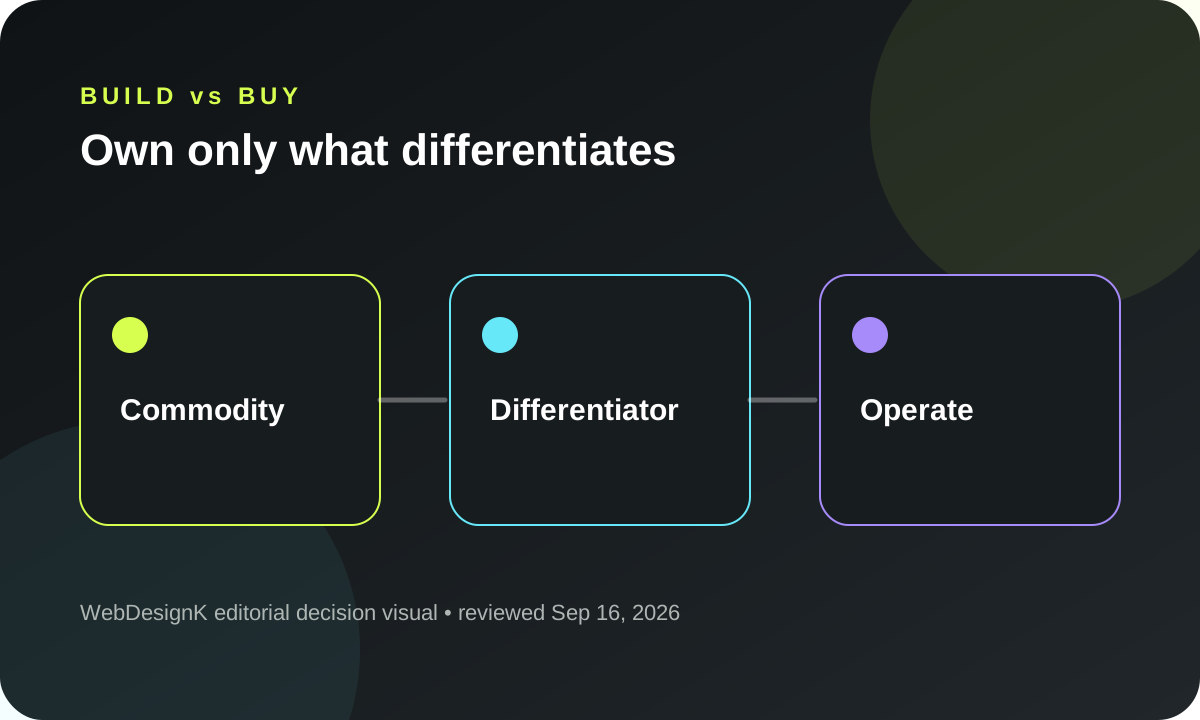
Buying software is usually the faster path when the problem is common, the vendor model fits your process and switching risk is acceptable. Building custom software becomes rational when a workflow is strategically differentiating, existing products force expensive workarounds, integration/data control is core to the business, or the accumulated cost of constraints is greater than the cost and responsibility of owning software. A hybrid approach is common: buy commodity capabilities and build the layer that creates proprietary advantage.
What you will decide: which requirements are commodity versus differentiating, how much ownership your team can carry after launch, and whether speed, control or integration depth deserves the highest weight.
Quick decision summary: best-fit scenarios
Buy/configure when time-to-value dominates, requirements match a mature category, integrations are supported and vendor constraints do not undermine your strategy. The cost is not just subscription; it includes implementation, configuration, integration, data migration, user change and exit risk.
Build custom when the workflow itself creates durable differentiation, your business model needs behavior vendors cannot support safely, or integration/data/control requirements make repeated workarounds more expensive than owning the product. The cost is not just development; it includes discovery, security, operations, support, observability, maintenance and future change.
Hybrid when a standard platform can own commodity infrastructure while custom services, workflows or UX create differentiation. The architectural boundary matters more than the label.
Side-by-side comparison on buyer criteria
Use the scorer above to make hidden assumptions explicit. Cost predictability usually favors buying at the start, while ownership/control can favor building. Speed strongly favors buying unless customization turns implementation into a pseudo-build. Integrations can favor either side: a vendor may already support your stack, or proprietary systems may make a custom orchestration layer more coherent.
Governance and scale are not automatic build advantages. A vendor can operate mature security and reliability controls at a scale that is expensive to reproduce; custom software can give you direct control but also transfers responsibility. The question is whether your organization can operate what it owns.
Total cost of ownership
Model at least a three-year horizon. For buy: licenses, usage-based fees, implementation, extensions, integrations, premium support, admin time, contract changes and exit/migration. For build: product discovery, engineering, design, QA, cloud/services, security, support, on-call, monitoring, compliance work and roadmap maintenance.
Avoid using developer salary as the sole custom-build cost. Software needs product decisions, QA, operations and ongoing maintenance. Likewise, avoid treating a vendor subscription as the sole buy cost when extensive configuration and integration work is required.
Price the constraint, not only the product
If a purchased product forces manual reconciliation, duplicate data entry, limited automation or lost revenue opportunities, quantify that operating constraint. If custom software would create a permanent maintenance burden outside your team's competence, quantify that too.
Speed to launch and day-2 operations
Buying compresses discovery and implementation only when you accept the product model. Heavy customization can erase the speed advantage while preserving vendor lock-in. Run a proof around the hardest workflow early rather than assuming a demo represents production complexity.
Building has a slower start because the team must define behavior, data, permissions, failure states, support and release processes. The benefit is that these decisions can match the business exactly. Day two is where build decisions are proven: someone must own incidents, security patches, dependencies, backups, observability and user support.
AWS Well-Architected operational guidance emphasizes organizing, preparing, operating and evolving workloads; the broader lesson is that software ownership is an operating capability, not merely a project budget.
SEO, performance and technical flexibility
For customer-facing software, technical flexibility can affect discoverability and experience, but do not overvalue theoretical control. A purchased platform with strong rendering, URL and performance capabilities may be more effective than a custom app whose team does not prioritize them. Conversely, a product whose routing or content model blocks critical acquisition requirements can impose a strategic ceiling.
The weighted decision tool includes SEO/performance because many SaaS and digital-platform builds have public acquisition surfaces. For back-office software, reduce that weight to zero and let data, integrations, governance and workflow fit drive the decision.
Integrations, data ownership and lock-in
Draw the data-flow diagram before selecting a direction. Identify systems of record, write/read authority, synchronization frequency, failure recovery, data export and audit needs. A vendor API that covers 80% of the flow can still be expensive if the missing 20% is the business-critical path.
Lock-in has several forms: contract/price, proprietary data model, workflow dependence, extension ecosystem, identity model and staff habits. Custom software also creates lock-in—to your architecture, team knowledge and maintenance choices. The objective is not zero lock-in; it is knowing which dependencies you are deliberately accepting.
Security, governance and enterprise requirements
Buying shifts some controls to a supplier but creates vendor-risk work: security review, access governance, data processing, incident obligations, audit evidence and contract/SLA boundaries. Building gives direct implementation control and creates a larger secure-development obligation.
NIST's Secure Software Development Framework provides high-level secure development practices that organizations can integrate into their lifecycle. If you build, plan these practices and evidence into delivery rather than adding “security review” at the end. If you buy, ask how the supplier's controls and evidence map to your obligations.
Scenario recommendations by company stage
Lean team / pre-PMF: buy commodity systems unless the software itself is the product or the differentiating experiment. Preserve cash and learning speed.
Growth company: use hybrid boundaries. Buy mature infrastructure such as identity, billing or commodity CRM functions when appropriate; build integrations, workflow intelligence or customer experience where differentiation is measurable.
Complex enterprise: evaluate governance, data, integration, support and exit alongside feature fit. A custom platform may be justified, but only if the organization funds long-term ownership. A vendor may be preferable even at higher subscription cost when it removes a non-differentiating operational burden.
Migration and switching considerations
Before buying, document how you would leave. Before building, document how you would replace components. Export formats, API limits, identity, attachments, audit history, workflows and integration contracts determine switching cost.
For a vendor migration, prototype data extraction and reconciliation before contract end. For a custom replacement, isolate domain boundaries so components can be retired without rewriting everything. Hybrid architectures should define which side owns canonical data and which interfaces are stable contracts.
Decision checklist and FAQ
Write a decision memo with: problem/outcome, differentiating workflows, non-negotiable constraints, three-year TCO categories, weighted criteria, integration map, security/governance needs, day-2 owner and exit plan. If the custom option cannot name an operating owner, it is not yet a build decision. If the buy option cannot explain how critical constraints are handled without brittle workarounds, it is not yet a buy decision.
Define the differentiating workflow with evidence
“Custom would fit us better” is not enough to justify a build. Describe the workflow step by step, quantify how often it runs, identify the current constraint and show how that constraint affects cost, revenue, risk or strategic learning. Then test whether configuration, integration or process change could remove the constraint without owning a new software product. Custom development becomes easier to defend when the advantage is specific and measurable.
A useful test is to ask whether customers or operators would notice if the custom capability disappeared. If the answer is no, the capability may be commodity infrastructure better purchased from a specialist provider. If the answer is that the company's unique service, margin structure or customer experience would stop working, deeper ownership may be justified.
Build a reversible architecture boundary
Custom does not have to mean building everything. Identity, billing, email delivery, observability, storage and many other capabilities can remain purchased services while your team owns the domain logic that differentiates the product. Define stable interfaces around those dependencies so a provider can be replaced without rewriting the core workflow. This is one of the strongest hybrid patterns because it concentrates engineering effort where ownership creates value.
Document which system is the source of truth for each major entity. Ambiguous ownership between a purchased platform and custom services creates synchronization bugs and difficult incident response. A clean boundary includes read/write authority, event or API contracts, retry behavior and reconciliation.
Put opportunity cost in the decision memo
Engineering assigned to a custom internal tool cannot simultaneously build customer-facing features, reliability work or other roadmap priorities. Add the best alternative use of that team to the build case. A project can have positive standalone ROI and still be a poor allocation if another initiative has materially higher strategic value.
Buying also has opportunity cost. Teams can lose time to manual workarounds, constrained workflows and vendor change requests. Capture these costs with operating evidence rather than vague frustration: hours spent reconciling data, delayed launches, repeated support cases or revenue that cannot be served by the current model.
Use staged commitment instead of one irreversible bet
Start with discovery and a thin proof of the hardest uncertainty. For a buy option, configure the most difficult workflow and integrate one critical system. For a build option, prototype the differentiating path without building the full admin, analytics and edge-case surface. Compare what you learn against the original assumptions before committing the full budget.
A staged approach is especially useful when requirements are uncertain. It gives the organization a point to stop, change direction or choose a hybrid architecture without treating sunk discovery work as a reason to continue.
Define the product owner before the first sprint
Custom software without a durable product owner tends to accumulate unresolved decisions. The owner needs authority over priorities, user research, acceptance criteria, roadmap tradeoffs and operational outcomes. Engineering can own technical quality, but it cannot substitute for business ownership. Name who will decide what not to build as clearly as who will approve features.
After launch, review dependency upgrades, incidents, security findings, support volume, infrastructure cost and product outcomes on a regular cadence. This is the maintenance burden that must be included in the original build decision.
Frequently asked questions
When is custom software worth building?
When the workflow creates strategic differentiation or constraints in available products create enough recurring cost/risk to justify owning product, engineering and operations over time.
Is buying always faster?
Only when the product model fits. Heavy customization, migration and integration can erase much of the speed advantage.
What is a hybrid build-vs-buy model?
A hybrid model buys commodity capabilities and builds a custom layer for differentiating workflows, integrations or experience, with explicit ownership boundaries.
What is the biggest cost people miss when building?
Long-term operations: maintenance, security, observability, support, dependency upgrades and roadmap ownership after the initial project ships.