Quick answer
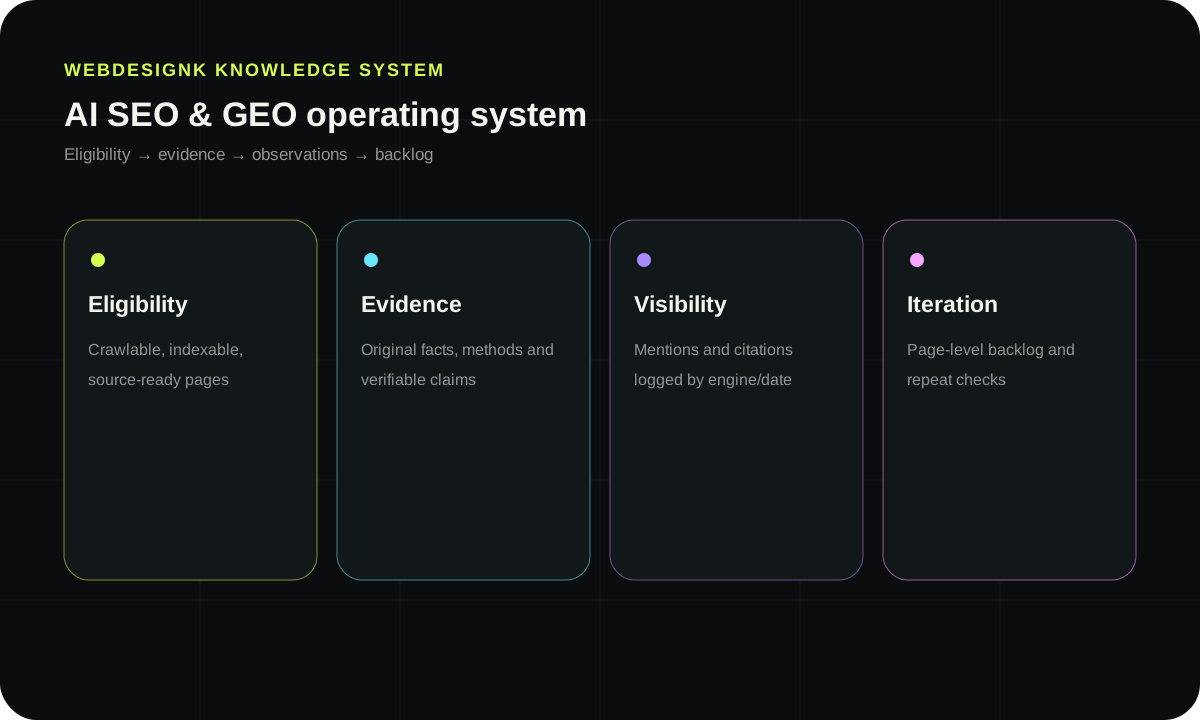
Optimize for source usefulness, not brand repetition. Track mention and owned citation as separate outcomes; then convert repeated source gaps into improvements to a specific first-party page.
Last reviewed: September 16, 2026ChatGPT source & mention tracker
Add observations you checked yourself. Nothing below is prefilled with synthetic visibility data. Records stay in this browser via localStorage.
1. Visibility status by engine
Counts come only from the observations you added.
2. Presence trend by audit date
Presence = any non-missing status in your log; it is not an engine ranking.
3. Engine × status heatmap
Darker cells mean more records in that engine/status combination.
Observation log
| Prompt | Engine | Brand mentioned? | Status | Citation URL | Competitor / source cited | Page to improve | Checked date | |
|---|---|---|---|---|---|---|---|---|
| No observations yet. Add your first checked prompt above. | ||||||||
Source note: all chart values are user-entered observations stored locally. No benchmark, market share or engine behavior is manufactured.
Tables built for the buying decision
Primary decision table
| Entity / source asset | Canonical page | What a researcher can verify | Independent corroboration to seek | Next action |
|---|---|---|---|---|
| Company identity | About / organization profile | Name, category, ownership/contact facts | Reputable profiles/partners/coverage | Remove contradictions across owned pages |
| Product capability | Product + documentation | Supported behavior and limitations | Partner docs, customer implementation evidence | Link claims to precise documentation |
| Research / data | Methodology + results | Sample, period, definitions and findings | Coverage that references the methodology | Keep source URL stable and date revisions |
| Expertise | Author/expert profile | Role, experience and authored work | Talks, publications or real third-party references | Use attributable real authors |
| Commercial facts | Pricing/plan/service page | Current scope, geography and review date | Partner/reseller docs where appropriate | Date fast-changing facts and avoid stale copies |
ChatGPT visibility observation log
| Field | Use | Interpretation guardrail |
|---|---|---|
| Prompt + intent | Represents a real buyer research question | Do not stuff every prompt with the brand |
| Engine/date | Makes observations repeatable | One result is not a durable ranking |
| Brand mentioned? | Measures response presence | Mention does not prove owned-site citation |
| Owned citation URL | Shows a first-party source surfaced | Citation does not validate every claim in the answer |
| Other source / competitor | Reveals source-quality gaps | Study evidence, do not copy formatting |
| Page to improve | Creates an owned backlog | Not every miss deserves a new URL |
Sources and assumption boundaries
Fast-changing platform, pricing and AI-search claims were reviewed on September 16, 2026. Interactive scores and scenarios are clearly labeled planning models, not sourced market benchmarks.
- OpenAI — Publishers and Developers FAQ Official guidance on public-site discovery in ChatGPT search and OAI-SearchBot; reviewed September 16, 2026.
- Google Search Central — AI features and your website Used to contrast engine-specific eligibility guidance; reviewed September 16, 2026.
- Perplexity — Perplexity Crawlers Used to show that crawler controls differ by answer/search product; reviewed September 16, 2026.
Turn this planning result into a scoped review.
Send the assumptions, constraints and result summary. WebDesignK can review the architecture/content/implementation boundary, identify missing discovery inputs and return a prioritized next-step scope.
- Bring: current site/product, constraints, integrations and your tool result.
- You get: a scoped recommendation, open questions and implementation priorities.
Decision snapshot for getting mentioned in ChatGPT answers
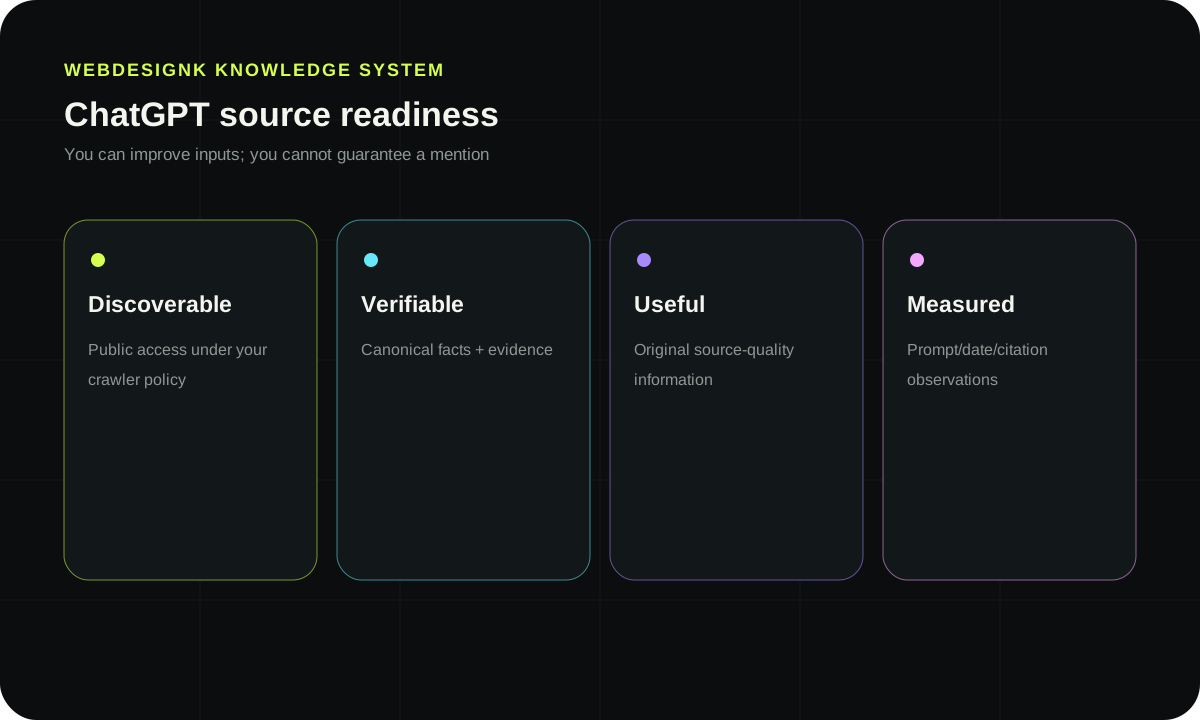
You cannot force ChatGPT to mention a business, and there is no legitimate “submit my brand for guaranteed answers” switch. The controllable work is to make your public information discoverable, consistent, specific and worth using as a source; publish primary evidence that answers real buyer questions; and monitor whether ChatGPT search mentions your brand or cites your pages for a stable set of prompts. The central tradeoff is brand promotion versus source usefulness: pages written mainly to praise the company are usually weaker source material than pages that document verifiable facts, methods, comparisons and product details.
OpenAI's publisher guidance says public websites can appear in ChatGPT search and advises sites that want discovery in summaries/snippets not to block OAI-SearchBot. That is a technical eligibility control, not a promise that a page will be selected or cited.
Classic search vs answer-engine discovery
A conventional search result encourages the user to choose among links. ChatGPT search can answer first and expose source links within the experience. For brand teams, that means “rank” is not the only useful unit. You may be named without an owned citation, cited without being described prominently, or absent while a third-party source explains your category.
The practical response is not to replace SEO with a new acronym. Maintain strong technical SEO and build an additional observation layer for answer experiences. A page must still be public, accessible and understandable. The difference is that your measurement now asks “what information did the answer expose, which sources were shown, and what page would improve this gap?”
Mentioned is not the same as cited
A mention means the brand appears in the answer. A citation means an owned URL is exposed as a supporting source. Both can be useful, but they imply different work. A mention without an owned citation may come from third-party knowledge. An owned citation without a strong brand mention may still be valuable because your page is functioning as source material. Track them separately.
How retrieval, synthesis and citation differ
Treat the system as three conceptual stages even if the product implementation evolves:
- Retrieval/discovery: candidate pages or data are found for the user's query.
- Synthesis: the model composes a response from available context and learned knowledge.
- Source presentation: the product exposes links/citations that support parts of the response.
You do not control those stages directly. You control whether your pages can be discovered under your access policy, whether they contain useful evidence, and whether the facts are coherent across your site.

Do not reverse-engineer one answer into a “ranking factor”
One prompt on one date is an observation. Product behavior, available sources, freshness, geography/account context and wording can change the result. Record the engine/date and repeat a stable set. When a competitor appears, inspect the cited page for information value—not superficial formatting. The goal is to understand what evidence your own site lacks, not clone another page.
Entity clarity and source consistency
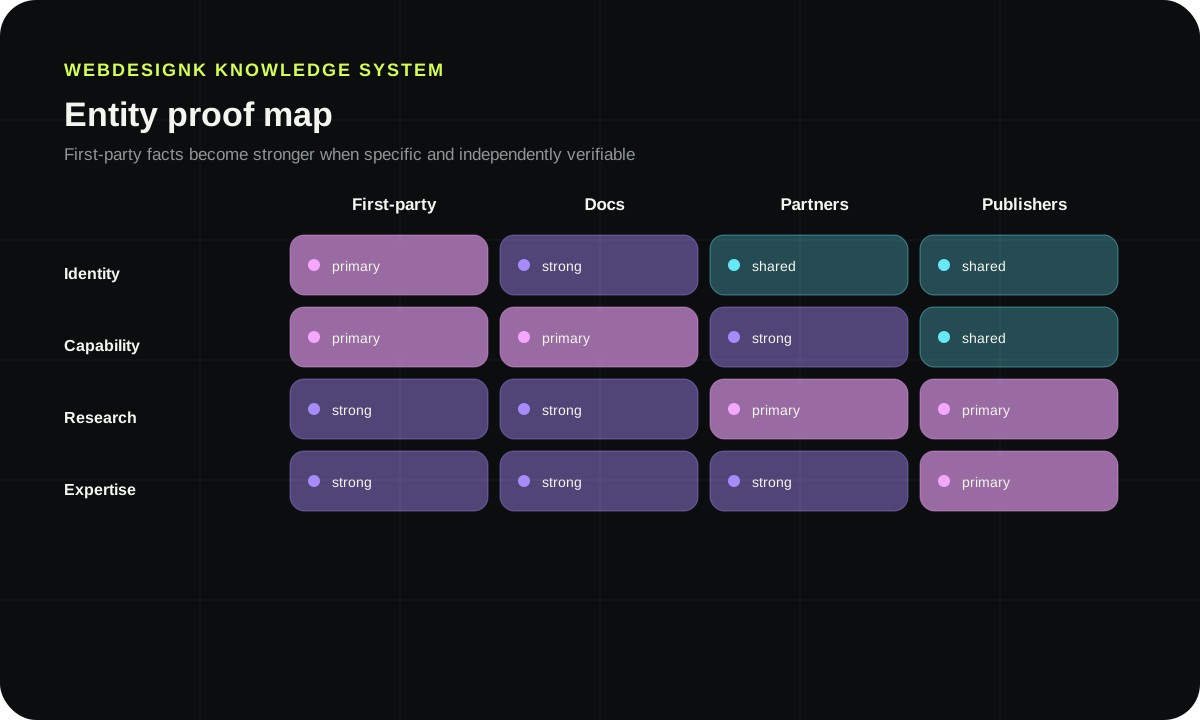
Before publishing more content, make sure the business is described consistently. Name, product category, official site, product names, leadership and key capabilities should not contradict each other across first-party pages.
Build a first-party source map
Create one canonical URL for each important fact or concept:
- company identity and “about” information;
- product/service definitions;
- documentation and supported capabilities;
- pricing or commercial model where public;
- customer/help policies;
- research and methodology;
- integration or technical specifications;
- author/expert profiles.
Then connect related pages with descriptive internal links. This reduces ambiguity for users and gives external writers a stable place to reference.
Third-party references are not something to manufacture
Independent coverage, reviews, directories, partner documentation and customer references can help establish context because they are outside your own claims. But buying low-quality mentions or creating synthetic “independent” sites undermines trust. Earn references by providing useful data, expertise, integrations, public documentation and stories that real publishers or partners have reason to mention.
Common mistake: building dozens of nearly identical pages titled “Why [brand] is the best for X.” They add volume, not independent evidence.
Extractable content structures
A source page should let a reader answer a concrete question quickly and then verify the detail.
Use a direct definition when a term is ambiguous. Put feature/constraint comparisons into tables. Pair numbers with units, geography, period and source. Put limitations next to claims. Use named headings for common evaluation questions. Publish methodology with research. Keep product documentation current.
Make commercial pages useful enough to cite
A product page can be more than a pitch. Add supported integrations, deployment/ownership model, data flows, security boundaries, setup requirements, limitations, screenshots and links to deeper documentation. A service page can explain deliverables, prerequisites, decision criteria, process and what is explicitly not included. The information should stand on its own even if a reader never contacts you.

Make editorial pages original
Do not write another generic “ten trends” summary if you want source value. Publish tested comparisons, original datasets, documented experiments, implementation templates, calculators with transparent assumptions or expert analysis that contains information not available in the top ten existing articles.
Evidence, citations and original information
A useful source distinguishes facts from marketing opinion. If you publish “customers cut onboarding time by 32%,” show where that number came from, which period it covers and whether it is one case or a broader sample. If you publish a calculator, label default values as scenarios unless they come from a named dataset.
Four source assets that can be worth building
1. Technical documentation: stable facts about what the product supports, how integrations work and where limits exist.
2. Methodology-backed research: original analysis with sample, definitions, period and enough methodology to interpret the result.
3. Decision tools: calculators or checklists whose assumptions are visible and whose output changes with user input.
4. Expert implementation guides: detailed processes written by practitioners, including failure modes and decision boundaries rather than generic advice.
The goal is not “content that AI likes.” It is content that a careful human researcher could cite without guessing.
Technical crawlability and structured data
OpenAI's current publisher FAQ says public sites can appear in ChatGPT search and recommends allowing OAI-SearchBot if you want pages discoverable in summaries/snippets. Review your robots policy intentionally; some organizations may choose different access policies for different crawlers.
Source-readiness checklist
- important URLs return HTTP 200 and are publicly accessible;
- OAI-SearchBot is not blocked when your policy is to participate in ChatGPT search;
- canonical tags point to the intended page;
- important content is present in crawlable HTML;
- the page has descriptive titles/headings and stable internal links;
- structured data matches visible content and does not invent facts;
- dates are present for time-sensitive platform, price or legal information;
- documentation and media assets have stable URLs;
- redirects preserve old useful URLs when pages move.
Structured data can clarify entity relationships and article metadata, but do not treat it as a ChatGPT citation switch. Use Article/BlogPosting, WebPage, BreadcrumbList, Organization, author and ImageObject where they accurately describe visible content. Add FAQPage only for visible FAQ content.
Build a monitoring prompt set
Your tracker should represent buyer research, not brand vanity prompts. Start with 15–30 prompts divided into navigational, category, problem, comparison and recommendation intents.
Example pattern
A cybersecurity vendor might monitor:
- navigational: “Where is [brand]'s SSO setup documentation?”
- category: “endpoint security platforms for mid-market companies”
- problem: “how to reduce alert fatigue in a small SOC”
- comparison: “managed detection vs building an internal SOC”
- recommendation: “security monitoring options for a 200-person healthcare company”
Only the first prompt names the brand. The others represent demand you want to earn relevance for.
Record source provenance, not screenshots alone
For each observation, save prompt, engine, date, status, citation URL, other source/competitor and the owned page you would improve. Screenshots can help with qualitative review, but a structured log is what lets you compare periods and build a backlog.
The interactive tracker above stores your rows locally in the browser. It begins empty so the charts cannot accidentally imply that WebDesignK measured your brand or the engines on your behalf.
Measure mentions, citations and assisted demand
A useful visibility report separates:
- percent of tracked prompts with any brand mention;
- percent with an owned citation;
- prompts where another source/competitor is cited;
- prompts with no relevant presence;
- owned URLs that earn citations repeatedly;
- repeated cited domains by topic;
- change by audit date;
- referral/assisted behavior where analytics supports attribution.
How to turn a miss into an action
A miss is not automatically a content gap. First check crawl/access and whether the query genuinely relates to your offering. Then inspect which sources are shown. If they contain stronger original evidence, decide whether you can publish something more useful. If the gap is an entity fact, improve the canonical first-party source. If you already have the right page, strengthen internal context and the specific missing evidence rather than creating another URL.
Avoid spam, fake authority and synthetic facts
Do not generate fake “independent” articles about your brand. Do not create fictitious experts, reviews or customer quotes. Do not publish unsupported market-share figures. Do not rewrite competitors' articles with synonyms. Do not add invisible FAQ/schema content. Do not promise “guaranteed ChatGPT mentions.”
These tactics create two risks: search/platform policy risk and business trust risk. They also pollute your own entity footprint with contradictions that are hard to clean up later.
What to do instead
Publish fewer pages with stronger evidence. Make experts attributable. Give partners and customers stable URLs they can reference. Keep product documentation current. Correct old facts. Use PR to distribute genuinely newsworthy research, launches and partnerships—not to manufacture dozens of templated links.
A 90-day ChatGPT mention plan
Days 1–30: source-readiness audit
Confirm OAI-SearchBot/robots policy, canonicals and public access. Map first-party entity facts and fix contradictions. Build a stable prompt set based on the buying journey. Identify the ten pages that should be the best source for your highest-value questions.
For those pages, list unsupported claims, missing definitions, missing constraints and information that lives only in sales decks or internal docs. Decide what can be published safely.
Days 31–60: publish citation-worthy assets
Upgrade commercial pages with decision information and real documentation. Publish at least one genuinely original source asset: benchmark with methodology, integration guide, technical specification, calculator, research dataset or expert implementation study. Strengthen descriptive internal links from topic hubs and related guides.
Where third parties already cover your category, provide accurate public information rather than trying to control their editorial conclusions. Correct factual errors through normal publisher channels when appropriate.
Days 61–90: repeat and prioritize
Re-run the baseline prompts, record dates and sources, and compare mention/citation changes. Find repeated source gaps that map to real commercial demand. Prioritize page improvements where another source is repeatedly used and you have first-party expertise that can add something substantive.
Connect visibility work to business outcomes: branded search, qualified visits, demo/support interactions and sales feedback. Visibility with no relevant demand is not the goal.
\n## Source-readiness backlog: what to improve before publishing more pages\n\nA brand often has enough content but not enough source-quality content. Audit the existing site before creating new URLs. For each high-value buyer question, identify the best current page and grade five things: direct answer, evidence, specificity, freshness and canonical ownership. If the page is weak on two dimensions, improve it. If no page can reasonably own the question, then create one. This prevents the common pattern of adding another article while the authoritative product/documentation page remains vague.\n\n### Convert sales knowledge into public evidence carefully\n\nSales and support teams often know the questions buyers actually ask: migration effort, supported integrations, data boundaries, implementation prerequisites, limits and comparison criteria. Much of that knowledge may live in calls or private PDFs. Work with product/security/legal owners to decide what can safely become public documentation. Publishing precise answers to recurring evaluation questions can make the site more useful to both buyers and external researchers.\n\n### Maintain a correction loop\n\nWhen you find an incorrect third-party fact, first make sure your canonical first-party page is clear and current. Then use the publisher's normal correction/contact process where appropriate. Do not launch a link campaign to drown out the mistake. A durable entity footprint is built by reliable primary facts plus legitimate independent references.\n\n### Track changes without claiming causality\n\nLog what you changed, when, and why. On the next prompt audit, record the new observation. If visibility improves, treat it as correlation unless you have stronger experimental evidence. Answer systems can change independently of your page. This discipline keeps GEO reporting credible and protects teams from turning anecdotes into invented “ranking factors.”\n\n### Use qualified demand as the final filter\n\nA mention for a broad vanity prompt can look impressive while producing no useful business outcome. Prioritize the prompts and source pages that overlap with real sales objections, high-intent searches, product evaluation and support discovery. The objective is not maximum brand frequency inside an AI interface; it is to make accurate, useful information available where qualified buyers research decisions.\n
Next-step decision summary
To improve the chance of being mentioned in ChatGPT answers, focus on becoming easier to discover, understand and verify. Allow the search crawler if that matches your policy. Maintain canonical first-party facts. Publish source-quality information. Earn independent references rather than fabricating them. Track brand mentions separately from owned citations, by prompt and date. Then improve the page behind the recurring gap. That process is slower than a “GEO hack,” but it creates a durable information asset for customers, search engines and answer systems alike.
Practical reporting rule
Keep the monthly report small enough that teams act on it: the high-value prompt set, owned citations gained or lost, repeated third-party sources, the three most important page actions, and qualified demand signals. Archive the raw observation log separately. This avoids turning an uncertain AI-search signal into a vanity dashboard and keeps the program anchored to information quality and buyer usefulness.
Frequently asked questions
Can I submit my site directly to ChatGPT for guaranteed mentions?
No guaranteed-mention mechanism is documented. OpenAI's publisher guidance focuses on public web access and OAI-SearchBot controls for ChatGPT search discovery, not guaranteed inclusion.
Should I allow OAI-SearchBot?
If your policy is to have public pages discoverable in ChatGPT search, OpenAI recommends not blocking OAI-SearchBot. Organizations should still set crawler policies intentionally according to their own content, legal and business requirements.
Do third-party mentions matter?
Independent sources can provide context and corroboration, but quality matters. Earn references through useful research, documentation, partnerships and customer outcomes rather than manufacturing low-quality mentions.
What should I track?
Track stable buyer prompts, date, brand mention, owned citation URL, other cited sources and the page-level action that follows. Keep a separate exploratory prompt set for emerging questions.