What should you budget for?
Custom SaaS development cost in 2026 is primarily a function of product scope and operational risk, not screen count. A narrow MVP with one core workflow can be a very different investment from a multi-tenant product with SSO, billing, permissions, audit logs, admin tooling, integrations and migration. Use published software-development pricing only as context; build your budget from workflows, roles, data, security, integration and operating requirements.
- Which scope tier best matches the work you actually need.
- Which requirements are likely to change delivery effort or recurring cost.
- How to compare vendor proposals without comparing different definitions of “done.”
Build your scope profile
Adjust the inputs to see which workstreams become more important. The output is a transparent planning profile, not a quote, market benchmark or guaranteed result.
Use this to frame a brief, not as a fixed quote.
Make this workstream explicit when you request estimates.
1. How effort shifts as scope gets more complex
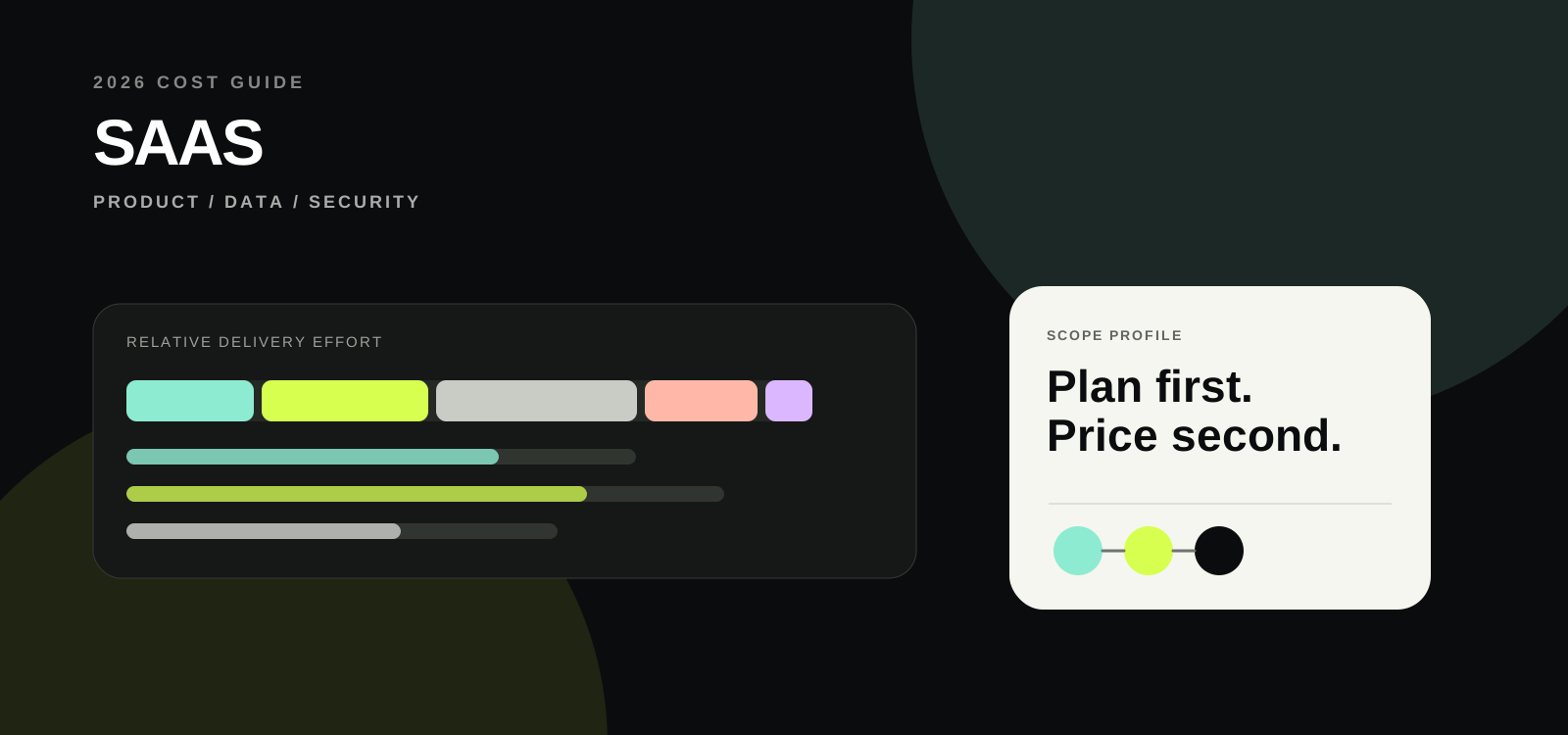
Your inputs change the workstream profile; the bars show the same transparent planning model at three complexity levels. Percentages represent relative delivery effort, not price.
Takeaway: as scope grows, engineering, integration, security or QA ownership usually becomes a larger planning concern. This is an editorial model driven by page assumptions and your inputs—not an industry-average claim.
2. SaaS complexity radar
Six current product drivers normalized from your planner inputs.
- Core workflows14/100
- Distinct user roles22/100
- Authentication / enterprise access20/100
- Subscription / usage billing100/100
- External integrations25/100
- Advanced admin / operations console100/100
Planning aid only; the radar describes your input profile, not a universal SaaS benchmark.
3. Delivery-risk timeline
Higher complexity shifts more planning attention into hardening and integration phases.
Relative planning emphasis, not elapsed weeks or a delivery promise.
See where complexity actually lives
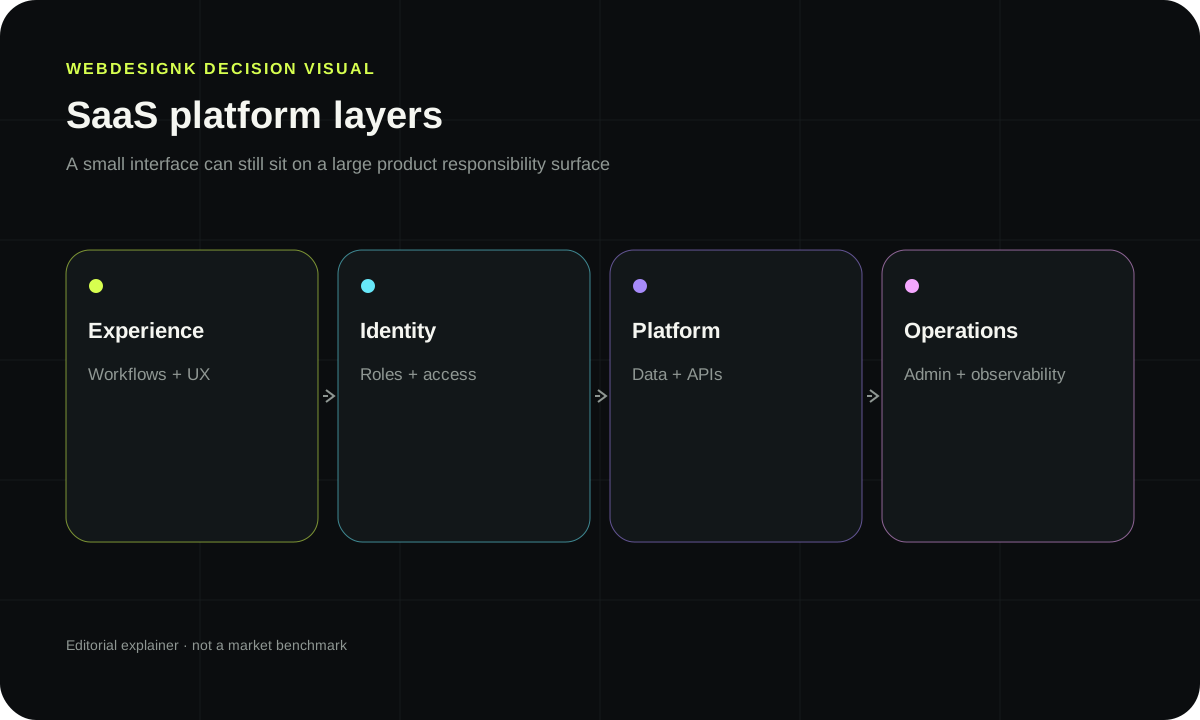
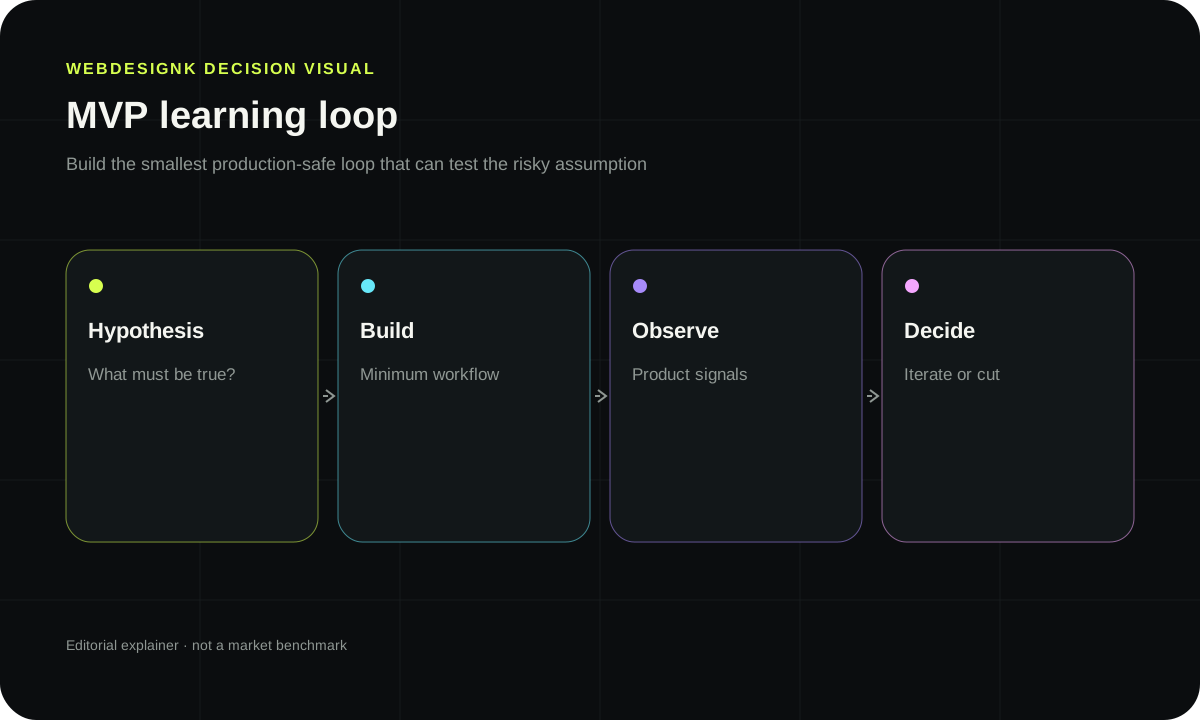
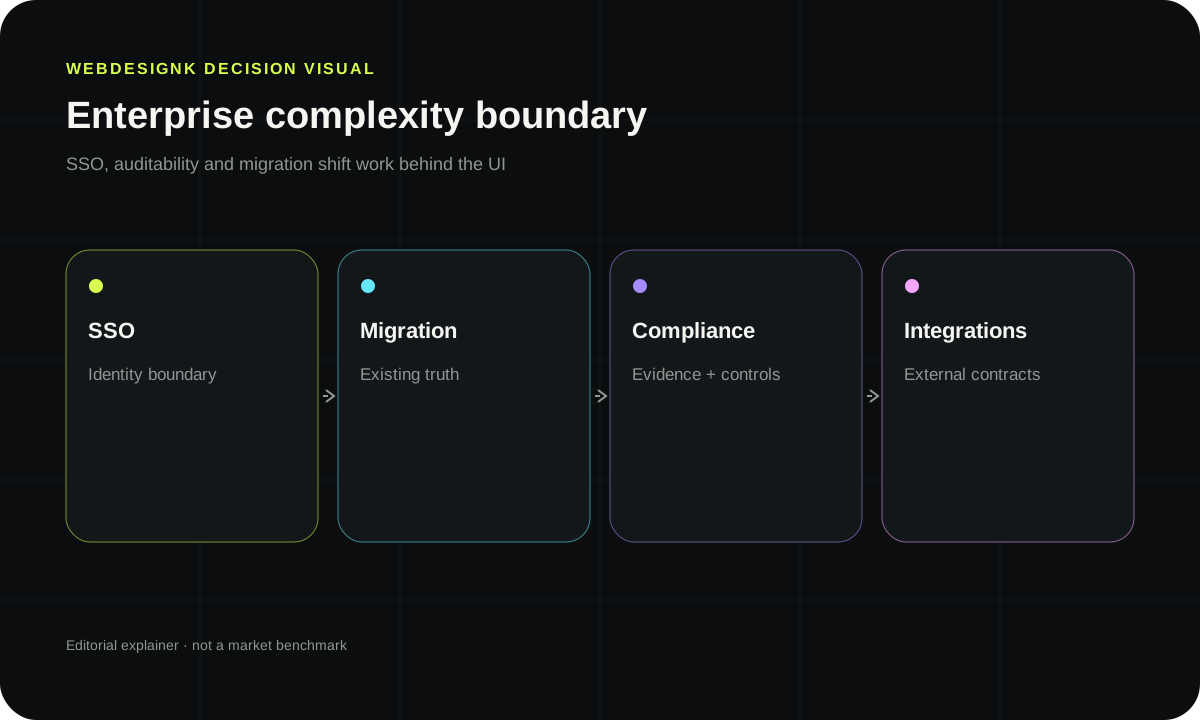
Compare scope tiers before you compare prices
| Scope tier | Typical deliverables | Team shape | Planning timeline | Major cost drivers | Best fit |
|---|---|---|---|---|---|
| Lean validation product | One core workflow, basic roles/auth, essential admin, limited integrations, production baseline | Product + UX + full-stack engineering | 8–14 weeks | Workflow clarity, existing APIs, data model | Validated problem needing a focused production MVP |
| Growth SaaS | Multiple workflows, billing, richer permissions, integrations, analytics, background jobs, robust admin | Product, UX/UI, frontend, backend, QA | 3–6 months | Billing, permissions, integration contracts, migration | Funded or revenue-stage SaaS preparing to scale |
| Complex / enterprise SaaS | SSO/SAML, RBAC, auditability, multi-region concerns, enterprise admin, migrations, deep integrations, compliance controls | Cross-functional product engineering team | 6–12+ months | Security/compliance, tenancy, data migration, SLAs, integration breadth | Enterprise SaaS or operationally critical platform |
Recurring costs to keep separate from the initial build
| Item | Why it exists | Cadence | Control lever |
|---|---|---|---|
| Cloud infrastructure | Compute, database, storage, queues, CDN and observability | Monthly | Right-size services and track unit economics |
| Third-party services | Email, auth, payments, search, AI, files, monitoring | Usage / monthly | Track per-customer variable cost |
| Product maintenance | Security updates, dependency changes, defects and platform changes | Continuous | Reserve engineering capacity explicitly |
| Support / operations | Incident response, customer support, runbooks and monitoring | Continuous | Define ownership and service expectations |
| Product iteration | New features, experiments and customer-driven improvements | Ongoing | Separate roadmap investment from maintenance |
Want a scoped recommendation instead of another generic range?
Bring the planner summary, your existing stack, constraints and business outcome. WebDesignK can turn those inputs into a concrete implementation boundary and next-step recommendation.
Direct answer and planning range framework
Clutch says reviewed software development projects commonly fall in a $10,000–$49,000 project band on its marketplace, while scope, team location and technical complexity can move costs far outside that range. A production SaaS product with multi-tenant architecture, security, billing and integrations should not be budgeted from a marketplace average alone.
For this guide, the market evidence above is separated from the interactive planning model. The calculator on this page does not estimate a guaranteed contract price. It turns your answers into a complexity profile so you can ask better questions, compare proposals and decide what needs deeper discovery.
Reviewed for the U.S. buying context on September 16, 2026. Source: Clutch Software Development Pricing Guide, updated September 16, 2026.
Budget around workstreams, not one headline number
For SaaS, define the smallest complete workflow rather than the smallest number of screens. Login → create object → collaborate → approve → bill → report may look like six screens, but each step introduces permissions, states, notifications and error recovery.
A useful budget therefore has at least three layers: initial discovery/definition, implementation and launch, and the recurring operating work that keeps the system healthy. If a proposal collapses all three into one line, ask for the assumptions behind it. That makes tradeoffs visible before a change request arrives.
Scope tiers: lean, growth and complex/enterprise
Scope tiers are planning shorthand, not product packages. The same company can have a lean first release and a complex second phase. Start by identifying what must be true on launch day, what can wait until you have real usage data, and what operational requirements cannot safely be deferred.
Lean does not mean careless
A lean scope should still include production basics: responsive behavior, accessibility appropriate to the use case, analytics, error handling, security fundamentals, QA and documented ownership. The savings come from limiting breadth and custom behavior—not from omitting the work that makes launch reliable.
Growth scope adds systems and decision paths
Growth projects typically add more audiences, workflows, reusable content structures, integrations, migration and measurement. This is where the cost of coordination begins to matter: more stakeholders and more states create more design, engineering and QA combinations.
Enterprise complexity is often governance complexity
Enterprise work is not automatically expensive because a company is large. It becomes complex when teams must satisfy security review, permissions, localization, procurement, accessibility, auditability, multiple data owners, release governance or high availability. Those constraints should be explicit in the brief.
What drives cost more than surface size alone
Tenancy, RBAC, audit logs, billing states, background jobs, file processing, notifications, search and import/export often drive engineering more than visual complexity. Product decisions that appear small can multiply backend states and QA combinations.
The best early estimate is therefore a dependency map. List user types, workflows, data sources, external systems, content owners, approvals and non-functional requirements. Page or screen count can still help with design effort, but it is a weak proxy for total delivery cost when the underlying system has meaningful behavior.
Scope-change triggers to watch
Typical triggers include adding a new market, user role, payment/billing model, data migration source, authenticated workflow, integration, localization requirement, reporting layer or compliance review. Treat each trigger as a question: does it create new data, new permissions, new failure states or new operational ownership? If yes, it deserves explicit estimation.
Team roles and delivery model
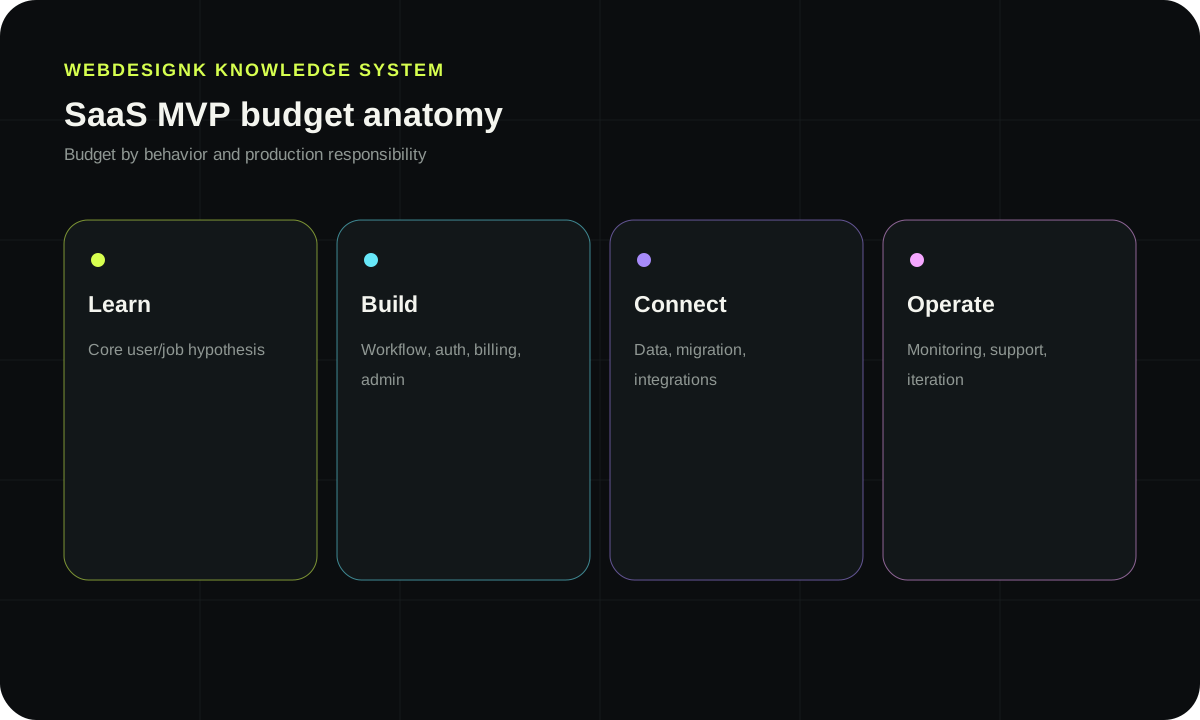
A credible proposal explains not only hours but responsibilities. Strategy/product definition reduces ambiguity; UX/UI resolves user and content states; engineering creates and integrates the system; QA tests real combinations; content/data specialists prepare inputs; and delivery leadership manages dependencies and decisions. Small teams may combine roles, but the work still exists.
Seniority changes the shape of the budget
A senior team may cost more per hour but spend less time rediscovering known failure modes. A lower rate can still be excellent when scope is clear and the team has relevant experience. Compare total delivery risk and evidence of similar work, not hourly rate in isolation.
Fixed price, time-and-materials or phased scope
Fixed pricing works best when requirements and acceptance criteria are stable. Time-and-materials fits evolving product work. A phased model—paid discovery followed by a scoped implementation—can reduce uncertainty before committing to a larger build. The contract model should match how much you genuinely know today.
Integrations, migration and data complexity
Every CRM, accounting, identity, payment or industry API has authentication, rate limits, error behavior and version changes. Integrations need retry strategy, observability and ownership—not just a successful demo call.
For every integration, document system owner, API availability, authentication method, environments, rate limits, required fields, sync direction, error handling and test credentials. For migration, add source quality, volume, transformation rules, deduplication, redirects/IDs and reconciliation. These details turn a vague line item into estimable work.
Data readiness can be more important than code readiness
Projects often stall because the source data is inconsistent, access is delayed or nobody owns a mapping decision. Make data readiness a milestone. A clean import sample or a working sandbox credential is stronger evidence than a sentence saying “integration included.”
Timeline and how urgency changes staffing
A compressed SaaS schedule usually means more parallel engineering and faster product decisions. It does not remove architecture, QA or security work. If requirements are still moving, adding people can increase coordination rather than reduce elapsed time.
If time is fixed, explicitly decide which other constraint can move: scope, staffing, review speed or launch quality. Trying to keep all of them fixed usually turns hidden uncertainty into overtime or defects.
Build the critical path before promising a date
The critical path is the sequence of dependencies that can actually delay launch: approvals, external vendors, data delivery, security review, content, legal review, app-store/payment onboarding or infrastructure access. Put those dates beside the engineering plan so everyone can see where elapsed time lives.
One-time vs recurring operating costs
Initial delivery is only the first cost bucket. Recurring costs can include infrastructure, software subscriptions, monitoring, model/API usage, content, support, security updates, analytics and optimization. Different architecture choices move spend between labor and software; neither category is automatically cheaper over a 12-month horizon.
Use a 12-month total-cost view
For each recurring item, record owner, billing cadence, unit driver and a control lever. Usage-based services should have alerts and an expected cost-per-business-outcome where possible. A monthly line that nobody reviews can quietly become more expensive than the component it replaced.
Hidden costs and scope-change traps
Hidden SaaS costs commonly include admin tooling, migration scripts, test data, observability, support workflows, email deliverability, billing edge cases, role/permission QA and operational dashboards used by your own team.
A strong statement of work has an exclusions section as well as an inclusions section. It should also define how scope changes are identified, estimated and approved. That protects both buyer and delivery team from discovering late that the same phrase meant different things.
Beware of ‘included’ without an acceptance criterion
Words such as migration, SEO, integration, analytics, accessibility, AI, optimization or support can represent a few hours or months of work. Ask what artifact or behavior proves that item is complete. If completion cannot be demonstrated, the scope is not yet precise enough to compare.
How to compare proposals on equivalent scope
Compare proposals on product outcomes and production responsibilities: which workflows are complete, what is excluded, how security is handled, who owns deployment, what monitoring exists, which integrations are production-ready and how change requests are estimated.
Normalize proposals into a common comparison sheet. Separate discovery, design, engineering, data/content, QA, launch and recurring work. Note assumptions and exclusions. Then ask which risks each vendor has already priced and which risks would become a change request later.
Questions worth asking every vendor
- What inputs must we provide before work starts?
- Which integrations have you treated as production-ready versus exploratory?
- What is your definition of done for migration and QA?
- Who owns analytics, accessibility, security and post-launch monitoring?
- What happens if an external dependency is late?
- Which assumptions would materially change the estimate?
- What recurring costs remain after your engagement ends?
Budget FAQ and next-step brief
Use the estimator and tables above to create a one-page brief. Include the business outcome, primary users, must-have workflows, content/data sources, integrations, migration, non-functional requirements, target launch window and internal owners. The goal is not to write a giant specification; it is to remove the ambiguities most likely to change budget.
If you want a second opinion, review the related WebDesignK service and bring your estimator summary to a discovery conversation. The discussion should start from your constraints and desired outcome, not from a preselected package.
Related budgeting guides
- Professional website cost in 2026
- Ecommerce website development cost in 2026
- AI chatbot development cost in 2026
A note on published pricing
Pricing guides are useful for orientation, not specification. Marketplace datasets mix projects of different sizes, locations, delivery models and definitions of “done.” When you cite a range internally, attach its source, review date and scope assumptions. Procurement becomes much easier when stakeholders can see what work is inside the number and which decisions could move it.
Keep contingency attached to uncertainty
Do not hide contingency inside an inflated line item. List the uncertainties that can change scope—data quality, integration access, migration volume, stakeholder approvals, security review or content readiness—and decide how they will be resolved. A clear discovery phase can reduce uncertainty before a fixed build commitment.
Use a decision log before the statement of work is signed
Write down the choices that materially affect scope, who made them and what assumption the estimate uses. Examples include the CMS or platform direction, number of launch markets, migration cut-off date, authentication model, integration ownership and who supplies production-ready content. A short decision log prevents teams from silently reopening settled questions halfway through delivery. It also gives vendors a fair way to identify a genuine scope change instead of arguing from memory.
Ask for acceptance evidence, not just deliverable names
A line item such as “analytics,” “migration,” “accessibility,” “SEO” or “integration” is too broad to evaluate. Ask what evidence will demonstrate completion: a reconciliation report, event specification, accessibility test results, redirect map, integration failure test, evaluation set or launch runbook. This turns procurement language into observable outcomes and exposes missing work before it becomes a late-stage surprise.
Separate launch readiness from future optimization
Not every desirable improvement belongs in version one. Label requirements as launch-critical, first-90-days or later optimization. Launch-critical items protect the customer journey, data, revenue or operations. The next 90 days should focus on learning from real use and fixing the highest-impact friction. Later optimization belongs in a measurable backlog. This sequencing keeps the first investment focused without pretending that a digital system is ever permanently finished.
Frequently asked questions
Why is SaaS pricing harder than website pricing?
A SaaS product includes persistent data, roles, workflows, business rules, background jobs, integrations, reliability and support obligations. Those systems create more state and more failure modes than a marketing site.
Can we launch an MVP cheaply and add security later?
You can defer features, but baseline security, data isolation, backups and access control should be designed early. Retrofitting tenancy or permission boundaries after customers are live can be much more expensive.
What recurring costs should a SaaS budget include?
Cloud infrastructure, third-party services, monitoring, support, security maintenance and continued product engineering should all be separated from the initial build budget.