Quick answer
The budget flips when “one workflow” starts carrying organization roles, SSO, billing states, integrations, migration or compliance. Cut product breadth aggressively, but keep the production basics required to learn safely from real users.
Last reviewed: September 16, 2026SaaS MVP complexity & effort planner
Defaults are illustrative planning assumptions, not market benchmarks. Enter your own blended hourly rate only if you want simple effort × rate arithmetic.
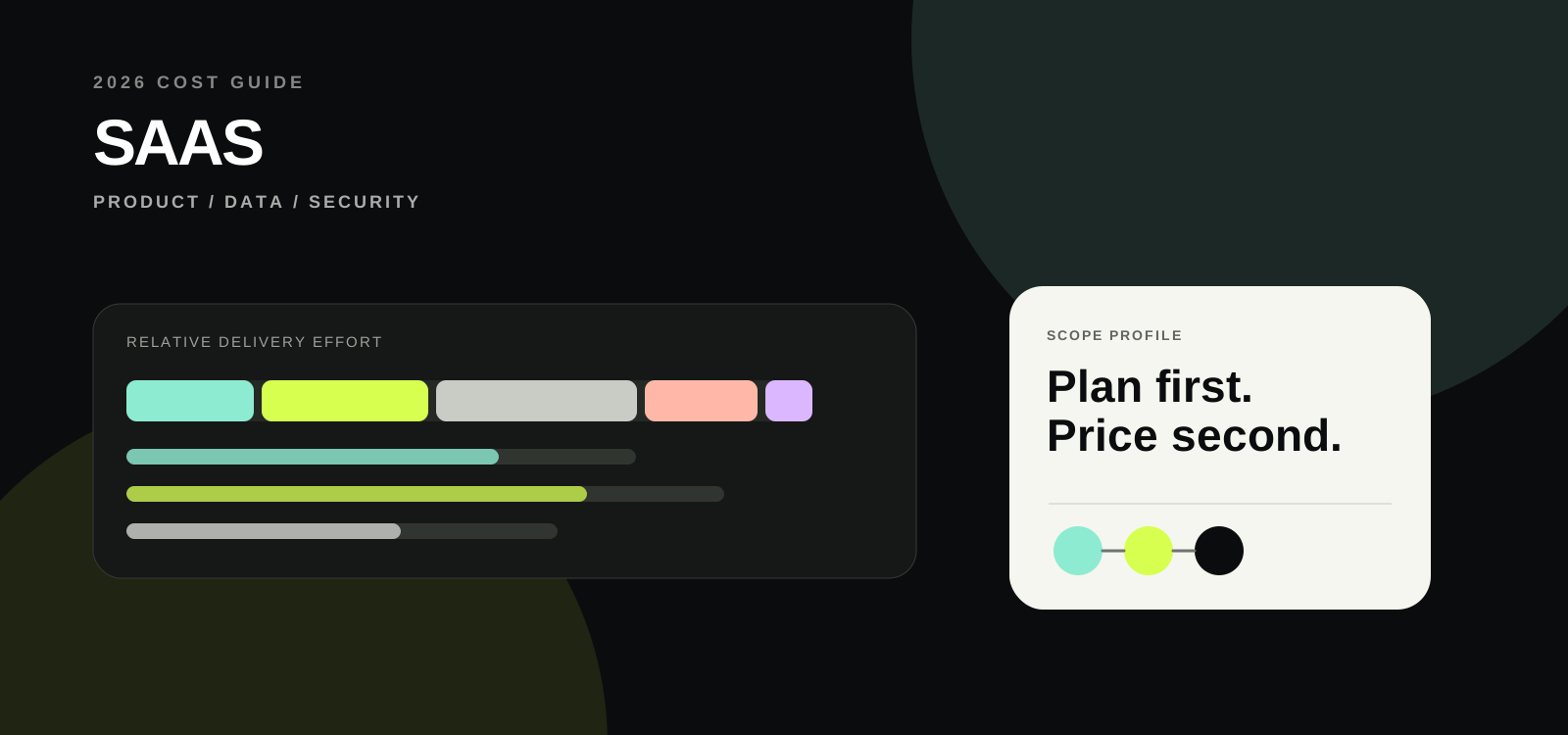
1. Illustrative scope-tier workstream shares
Editorial scenario defaults show how complexity tends to move effort; they are not benchmark data.
2. Your current workstream profile
Calculated from the inputs above using the disclosed planning model.
3. Cumulative planning effort line
Shows cumulative illustrative effort; enter a rate if you want cost arithmetic.
Assumption note: complexity coefficients, person-week conversion and scenario shares are WebDesignK planning assumptions. They are intentionally labeled and are separate from sourced market context in the article.
Tables built for the buying decision
Primary decision table
| Scope tier | Deliverables | Typical team shape | Planning timeline | Major cost drivers | Best fit |
|---|---|---|---|---|---|
| Lean MVP | 1–2 core workflows, standard auth, limited admin, basic analytics/ops | Product/UX + full-stack + QA support | Model after dependencies are known | Workflow states, auth, deployment, core data | Focused validation with a narrow user group |
| Growth MVP | Several workflows/roles, self-serve onboarding, billing, integrations, admin | Product/UX + frontend/backend + QA/delivery | Depends on integrations and content/data readiness | Roles, billing lifecycle, integrations, automation | Moving from pilot to repeatable onboarding |
| Complex / enterprise | SSO/RBAC/audit, multiple integrations, governance, migration, formal controls | Cross-functional product/engineering/QA + specialist review | Often dependency-driven | Identity, data boundaries, security review, integration contracts | First release must satisfy enterprise environment |
Recurring operating-cost control sheet
| Item | Why it exists | Cadence | Control lever |
|---|---|---|---|
| Hosting / compute / database | Runs the product and stores customer data | Monthly + usage | Architecture, caching, right-sizing, retention |
| Authentication / email / messaging | Identity and user communication | Monthly + usage | Provider tier, message volume, self-host vs managed tradeoff |
| Observability / backups | Detects failures and supports recovery | Monthly | Retention, sampling, service level |
| Support / operations | Handles customer and billing issues | Ongoing | Product UX, automation, runbooks |
| Third-party APIs / AI models | Powers external capabilities | Usage-based | Quotas, caching, model/service choice |
| Maintenance / optimization | Keeps dependencies healthy and turns learning into product changes | Monthly / sprint cadence | Dedicated capacity and prioritized backlog |
Sources and assumption boundaries
Fast-changing platform, pricing and AI-search claims were reviewed on September 16, 2026. Interactive scores and scenarios are clearly labeled planning models, not sourced market benchmarks.
- Clutch — Software Development Company Pricing Guide 2026 Marketplace project/rate context, updated September 15, 2026; not a SaaS MVP quote or neutral universal average.
- U.S. Bureau of Labor Statistics — Software Developers, QA Analysts, and Testers May 2025 national wage context; not a vendor rate or fully loaded project cost. Reviewed September 16, 2026.
Turn this planning result into a scoped review.
Send the assumptions, constraints and result summary. WebDesignK can review the architecture/content/implementation boundary, identify missing discovery inputs and return a prioritized next-step scope.
- Bring: current site/product, constraints, integrations and your tool result.
- You get: a scoped recommendation, open questions and implementation priorities.
Decision snapshot for SaaS MVP cost
A SaaS MVP does not have one defensible sticker price because “MVP” describes a learning goal, not a fixed feature set. Current software-development marketplace data can provide broad context, but a useful budget starts by decomposing the product into workflows, user roles, authentication, billing, integrations, administration, migration, compliance and operating requirements. The biggest tradeoff is learning scope versus production responsibility: cut breadth aggressively, but do not cut the reliability, security and measurement needed to learn from real customers.
The estimator above is intentionally a planning model. It converts your inputs into a complexity tier and relative workstream allocation. It does not present its output as a market quote. If you add a blended hourly rate, the displayed cost is simply your rate multiplied by transparent planning effort; it is not WebDesignK pricing or a guarantee.

Direct answer and planning range framework
Clutch's software-development pricing guide, updated September 15, 2026, says reviewed software development projects on its platform commonly fall in a $10,000–$49,000 project band and that many listed software-development companies show hourly rates of $24–$49. That is marketplace context across many project types, locations and scopes. It is not a reliable SaaS MVP estimate by itself.
A SaaS product with email login, one workflow and manual back-office operations can be materially different from a product with SSO, organizations, granular roles, usage billing, external APIs, audit logs, data import, workflow automation and compliance review. Quoting “a SaaS MVP” before those boundaries are named is mostly quoting assumptions.
Build the estimate in three layers
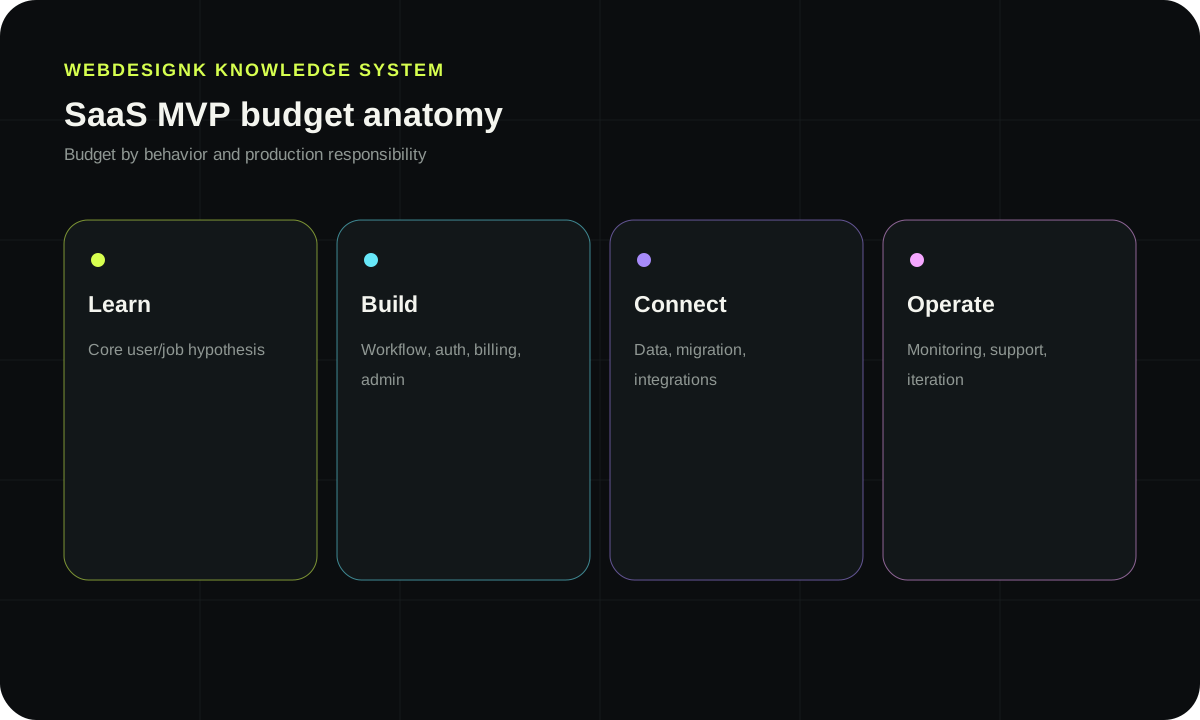
Layer 1 — product learning: what hypothesis must the release test? Define target user, core job, activation event and the smallest end-to-end workflow that produces value.
Layer 2 — production envelope: what must be true for real users to use it safely? Include authentication, authorization, data isolation, errors, backups, observability, accessibility appropriate to the product, analytics and support paths.
Layer 3 — operating model: what will the team maintain after launch? Hosting, model/API usage where relevant, email, storage, monitoring, customer support, billing operations, incident response and release management become recurring work.
A credible budget keeps those layers visible so “MVP” does not become an excuse to hide work that appears immediately after launch.
Scope tiers: lean, growth and complex/enterprise
Tiers are planning shorthand, not packages. The tool uses them to communicate relative complexity.
Lean MVP
A lean product tests one or two important workflows for a narrow user group. It may use standard authentication, a simple organization model, one billing plan or even manual billing during a private pilot, few integrations and a deliberately limited admin surface. The team still needs production basics: permissions, error handling, logging, analytics, backups and a support process.
Best fit: a founder or product team validating whether users adopt a defined workflow before investing in broader automation.
Growth MVP
A growth scope adds more roles, workflows and operational automation. Typical additions include self-serve onboarding, subscription lifecycle, team invitations, multiple integrations, structured admin tools, notifications, import/export and a stronger analytics/evaluation layer. The engineering challenge becomes the interaction between states rather than the number of screens.
Best fit: a funded team moving from pilot to repeatable customer onboarding where manual work is becoming the bottleneck.
Complex or enterprise first release
Enterprise constraints can make a first release complex even when the UI is small. SSO/SAML, SCIM, granular RBAC, audit logs, data residency, contractual SLAs, procurement evidence, approval workflows, custom integrations and security review all add design, implementation and QA states.
Common mistake: calling this scope an MVP and expecting consumer-startup delivery economics. The learning objective may be narrow, but the customer environment imposes a wider production envelope.
What drives cost more than page count alone
Screens are useful for design estimation, but SaaS cost follows behavior and state.
Workflows and roles multiply states
A workflow that looks like one form may need draft, validation, submitted, rejected, approved, expired and retry behavior. Add three user roles and you now need permission decisions across those states. Add organizations, and data boundaries become part of every query and mutation.
The estimator therefore asks about workflows and roles rather than “number of pages.” Those inputs are imperfect but closer to the engineering surface.
Authentication is a product boundary
Basic passwordless or social login can be straightforward with managed providers. Team accounts, invitations, organization switching, MFA, SSO, SCIM and fine-grained RBAC require deeper domain modeling and test coverage. Authentication is not only the login screen; authorization must be enforced consistently in APIs, jobs and admin tools.
Billing creates lifecycle states
Subscription billing introduces trial, active, past-due, canceled, upgraded, downgraded and entitlement states. Usage billing adds metering, aggregation, reconciliation and customer-visible explanation. You can defer sophisticated billing during a pilot, but you should decide deliberately what is manual and how it migrates later.
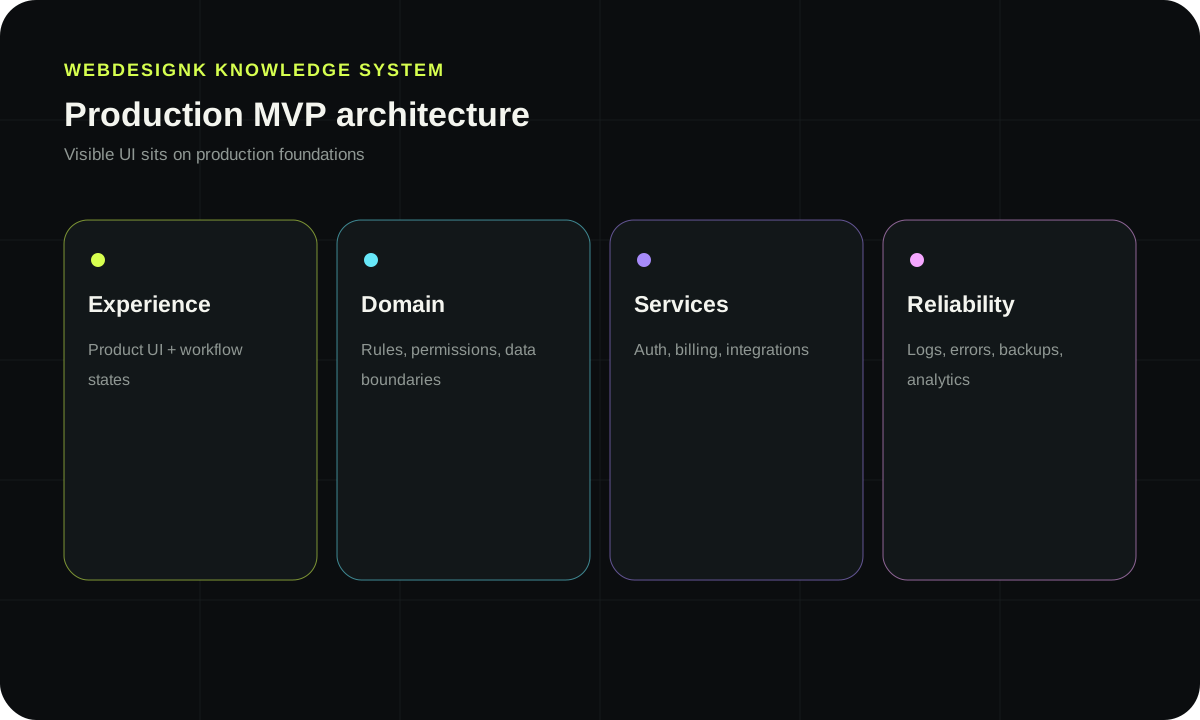
Team roles and delivery model
A SaaS MVP is rarely “just development.” Product definition decides what not to build. UX resolves states and recovery. Engineering implements domain behavior and integrations. QA validates combinations and regressions. Delivery coordination keeps dependencies moving. Security, data or domain specialists may be part-time but still necessary when the scope demands them.
The U.S. Bureau of Labor Statistics reports a May 2025 median annual wage of $135,980 for software developers. That is useful labor-market context, not a project rate and not a fully loaded employer cost. It helps explain why comparing a vendor proposal to “one developer salary” is incomplete: a launch usually requires several kinds of work, while an internal hire can also create long-term value across many releases.
Fixed price, time and materials, or phased discovery
Fixed price works best when requirements and acceptance criteria are stable. Time-and-materials works when learning changes scope frequently. A paid discovery phase can turn unknown integrations, data models and workflow states into a more comparable implementation scope before a larger commitment.
Whatever commercial model you choose, ask for assumptions. “Includes billing” is not enough. Which provider? Which plans? Coupons? Proration? Tax? Invoices? Dunning? Entitlements? Usage? Admin overrides? Assumptions are the real unit of estimation.
Integrations, migration and data complexity
An integration adds more than an API call. It adds authentication, mapping, retries, rate limits, idempotency, error visibility, test environments and an owner when the upstream system changes.
Inventory each integration by failure behavior
For every system, document:
- system owner and business purpose;
- API/webhook documentation and access method;
- source of truth for each important field;
- sync direction and expected latency;
- rate/volume constraints;
- retry and idempotency strategy;
- error queue or support path;
- sandbox/test data availability;
- privacy/security constraints;
- behavior when the dependency is unavailable.
An integration that is allowed to fail for an hour is different from one that blocks checkout, login or core workflow completion.
Migration is a product project
Importing existing users, organizations, history or documents means transforming old assumptions into a new domain model. Profile the data early. Count missing identifiers, duplicate records, unsupported states and files that do not meet current constraints. Include reconciliation after import; “script completed” is not the same as “migration was correct.”
Timeline and how urgency changes staffing
Adding people does not linearly compress a software schedule. Parallel work helps when boundaries are clear; it creates coordination cost when architecture, requirements and content are still changing.
A faster schedule often requires earlier decisions, more senior staffing, fewer simultaneous unknowns and tighter stakeholder availability. If an enterprise customer requires SSO and security review, those external dependencies may define the critical path regardless of how many frontend developers you add.
Create a dependency-first roadmap
Instead of estimating every screen, identify the critical sequence: product decisions → domain/data model → auth/roles → core workflow → integration contracts → billing/entitlements → admin/operations → launch evidence. Some UI can run in parallel, but uncertain foundation work should be resolved before dozens of components depend on it.
How to decide: if a deadline is fixed, reduce scope before assuming overtime or parallel staffing will save the date. Preserve the complete learning loop and remove secondary workflows.
One-time vs recurring operating costs
The build budget answers only “can we launch?” The 12-month view asks “can we operate and learn?”
Typical recurring categories include hosting/compute, database/storage, email/SMS, observability, authentication provider charges, payment/billing fees, support tools, analytics, third-party APIs, AI model usage where relevant, backups, security tooling and engineering maintenance. Costs may be usage-based, seat-based or flat subscription.
Do not manufacture a recurring-cost total before traffic and vendors are known. Instead, build a driver sheet: active users, requests, storage growth, emails/messages, model tokens, support seats and payment volume. Map each vendor's live pricing to those drivers at procurement time.

Optimization is a recurring cost by design
An MVP that generates no iteration budget defeats its purpose. Reserve capacity to inspect activation, errors, support requests and conversion, then change the product. That can be internal engineering time, a retained delivery team or a planned post-launch sprint. Make it visible in the 12-month model.
Hidden costs and scope-change traps
Hidden costs are usually undefined ownership or late-discovered states.
Common scope-change triggers
- adding a new user role with distinct permissions;
- introducing organizations/teams after designing for individual users;
- adding SSO or SCIM late;
- moving from one subscription plan to multiple plans/usage entitlements;
- adding an integration without a stable sandbox;
- importing historical data after the data model is “finished”;
- adding auditability or formal approval flows;
- introducing multi-region/data residency requirements;
- turning a manual admin step into customer self-service;
- adding mobile/offline behavior to a web-only assumption.
None of these is “just one field.” Each can create states, permissions, UI, data migration and QA work.
The cheapest feature is the feature you can defer cleanly
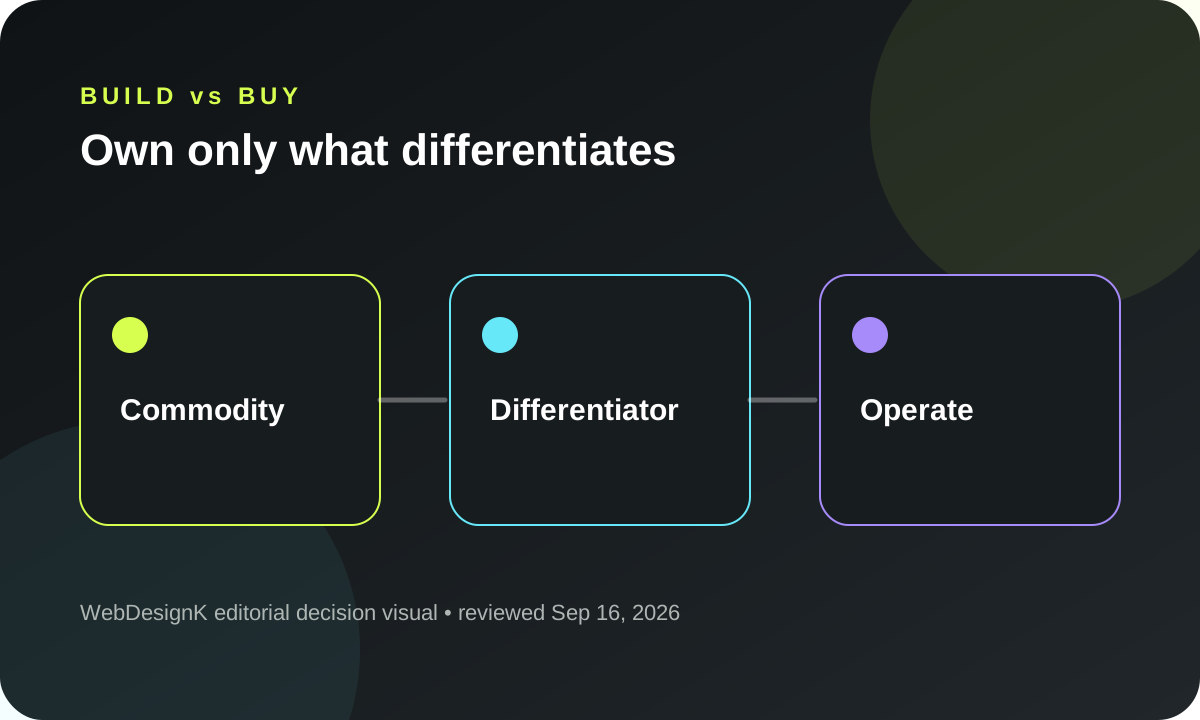
A good MVP architecture creates seams for later capability without implementing every future scenario. Use managed services where they reduce non-differentiating operations. Keep domain boundaries clear. Record deferred decisions and what would trigger them. Avoid speculative abstraction that costs today without reducing a known future risk.
How to compare proposals on equivalent scope
Ask every supplier to respond to the same scope anatomy.
Product and acceptance
Define target user, workflows, supported roles, key states and what constitutes acceptance. Include non-functional expectations such as supported browsers, accessibility target, performance budget and environments.
Architecture and ownership
List hosting/deployment, source ownership, data model, auth provider, billing provider, integrations, observability and backup responsibilities. Ask what remains under the supplier's account and how it transfers.
QA and launch
Require the test approach for critical workflows, permissions, billing, integrations and migration. Define launch support, rollback, incident ownership and the warranty/support window.
Change control
A proposal should explain what happens when an assumption changes. Is work repriced, moved from another scope item, or handled through time and materials? Good change control is not bureaucracy; it prevents silent scope growth from becoming a relationship problem.
Procurement reality: the cheapest proposal may have fewer responsibilities, not better efficiency. Normalize the scope before comparing totals.
Budget FAQ and next-step brief
Before asking for a quote, prepare a one-page brief with:
- target user and the job they need to complete;
- 3–5 core workflows and which can remain manual;
- user/organization roles and permission differences;
- authentication/SSO expectations;
- billing model and whether billing can be deferred;
- integrations and source-of-truth systems;
- migration volume and data quality concerns;
- admin/support operations required on day one;
- security/compliance constraints that are already known;
- desired launch window and what is driving it;
- analytics/learning questions the MVP must answer;
- post-launch owner and optimization capacity.
\n## MVP de-scope matrix: cut breadth without breaking the learning loop\n\nWhen a budget is too high, do not cut randomly. Classify every capability into four buckets: required to deliver core value, required for safe production, can be manual for the pilot, or defer until evidence exists. The first two buckets stay. The latter two are where an MVP becomes smaller without becoming fake.\n\nA manual process can be a strategic choice. A team might manually approve accounts instead of building a rules engine, create invoices outside the product instead of shipping complex billing, or import the first customer's data with an internal script instead of a self-serve mapper. The condition is that the manual step has an owner, acceptable volume and a clear trigger for automation. Hidden manual work with no owner simply moves cost from engineering to operations.\n\n### Preserve the measurement path\n\nNever de-scope the events needed to learn whether the core workflow works. Define activation, completion, failure and retention signals before launch. If an MVP cannot tell you where users fail, every post-launch decision becomes anecdotal. Basic product analytics and structured error logging are not “nice-to-have growth features”; they are part of the experiment.\n\n### Preserve reversibility\n\nPrefer choices that can be replaced cleanly. A managed auth provider, hosted database or billing system can accelerate validation if your domain boundaries remain clear. Avoid hard-coding business rules across UI components just because the first release is small. The right MVP architecture is not maximally abstract; it is understandable enough that the team can change the parts most likely to evolve.\n\n### Put a confidence label on estimates\n\nAn estimate for a known CRUD workflow with a documented API deserves more confidence than an estimate for an undocumented legacy integration. Mark line items high/medium/low confidence and list what would increase confidence. This turns discovery into measurable risk reduction and gives procurement a better reason for contingency than an arbitrary percentage.\n\n### Define the post-launch budget before launch\n\nReserve capacity for the first 30–90 days of fixes and learning. A launch that consumes the entire budget leaves no mechanism to act on the evidence the MVP was built to collect. Separate “build to first production use” from “operate and iterate after first production use” in the statement of work.\n
Next-step decision summary
A SaaS MVP budget becomes useful only after the learning objective and production envelope are explicit. Use market pricing reports as context, not as a quote. Estimate workstreams, states and integrations. Separate build from 12-month operations. Compare proposals on the same assumptions. Most importantly, spend complexity where it protects the learning loop or a real customer requirement—and defer the rest deliberately.
Frequently asked questions
What is the biggest SaaS MVP cost driver?
Usually the number and interaction of workflows, roles, integrations and reliability requirements—not raw screen count. Identity, billing and data migration can create large state/QA surfaces.
Can I estimate an MVP from an hourly rate?
Only after estimating effort and assumptions. An hourly rate multiplied by an undefined scope is not a budget. The tool lets you optionally enter your own rate so the arithmetic stays explicit.
Should billing be in the MVP?
Only if the learning loop requires self-serve payment or entitlement behavior. Private pilots can sometimes use manual invoicing, but decide how that evolves before customer data and contracts depend on it.
How should I compare proposals?
Normalize workflows, roles, integrations, migration, QA, launch support, ownership and change-control assumptions. A lower total can simply exclude responsibilities another proposal includes.