Quick answer
Treat chatbot privacy as a data-flow and ownership problem. Document what enters the conversation, which systems receive it, why each field is needed, how long it is kept, how it can be found or deleted, and who owns each decision. Do not assume consent is always the right lawful basis or that a vendor’s “GDPR compliant” statement settles your obligations.
Last reviewed: October 2, 2026Chatbot privacy data-flow mapper
Map what your chatbot collects, why it is needed, which system processes it, where it is stored, how long it is kept and how it can be deleted. This is a planning worksheet for your privacy owner/counsel, not a compliance score or legal opinion. Inputs stay in this browser.
- Conversation transcript: document the specific purpose.
- Conversation transcript: identify the processor/system and any downstream handoff.
- Conversation transcript: confirm the processing/storage region.
- Conversation transcript: define or confirm the retention rule.
- Conversation transcript: document the deletion/DSAR path.
- Conversation transcript: assign an accountable owner.
- Email / account identifier: document the specific purpose.
- Email / account identifier: identify the processor/system and any downstream handoff.
- Email / account identifier: confirm the processing/storage region.
- Email / account identifier: define or confirm the retention rule.
- Email / account identifier: document the deletion/DSAR path.
- Email / account identifier: assign an accountable owner.
Plus 6 additional items in the copied summary.
1. Data categories mapped by lifecycle stage
Counts come only from the rows you enter; they show documentation coverage, not legal compliance.
Takeaway: Collection 3/3, Purpose 0/3, Processor 0/3, Storage region 0/3, Retention 0/3, Deletion path 0/3, Owner 0/3.
2. Open review items by field
Use this backlog to focus vendor, engineering and privacy-review questions.
Takeaway: the largest bar is the field with the most unmapped data categories.
3. Per-category lifecycle completeness
Each bar is the number of documented lifecycle fields out of seven for that category.
Text fallback: Conversation transcript 1/7, Email / account identifier 1/7, Human-handoff context 1/7
Source/assumption note: the visualizations count only fields in this worksheet. They do not decide lawful basis, consent requirements, transfer mechanisms, DPIA obligations or whether a vendor arrangement is compliant; those questions require case-specific review.
Tables built for the buying decision
Primary decision table
| data category | purpose | source | processor/system | region | retention | deletion path | owner |
|---|---|---|---|---|---|---|---|
| Conversation transcript | Support context and quality review if justified | User conversation | Chat application + model/retrieval vendors | Confirm actual processing/storage regions | Define from purpose and operational need | Search/export/delete workflow across primary and downstream systems | Product + privacy |
| Account identifier | Authenticate or associate a support request with an account | Authenticated session or user input | Identity provider + CRM/support tool | Confirm account and vendor regions | Follow account/support retention policy | Account/CRM deletion or rights-request workflow | Identity/support owner |
| Contact details | Follow up on a user-requested sales or support action | User-provided form/chat fields | CRM, help desk or lead-routing system | Confirm destination and subprocessors | Keep only for the documented follow-up purpose | CRM/help-desk deletion or suppression workflow | Sales/support ops |
| Uploaded file or document | Answer a user request that requires the file | User upload | Object storage, OCR/parser, retrieval pipeline, model vendor if sent | Confirm every processing hop | Short default unless there is a justified need | Delete object, derived text/index entries and downstream copies | Product/security |
| Human-handoff context | Allow an agent to continue the case without making the user repeat everything | Chatbot escalation event | Help desk/contact center | Confirm help-desk region and integrations | Align with ticket retention and privacy policy | Ticket/CRM rights-request workflow | Support operations |
Vendor diligence questions before production
| vendor | role | DPA/SCC | training use | sub-processors | open question |
|---|---|---|---|---|---|
| Model/API provider | Usually processor/service provider for your deployment context; verify contract and actual purposes | Is an Article 28 DPA available? Are transfer terms needed for your flow? | Can prompts/outputs be used for model improvement by default, by opt-in, or not at all? | Is a current subprocessor list available with change notices? | What data is logged outside the API response path and for how long? |
| Vector database / search service | Processor for indexed content and metadata | Does the agreement cover stored embeddings, metadata and support access? | Is customer content excluded from unrelated training/use? | Which cloud/storage providers can access the service? | How are records and backups deleted after a rights request? |
| Help desk / CRM | Processor or separate controller depending on the actual arrangement | Does the contract match the handoff and contact use? | Is conversation data reused for vendor analytics or AI features? | Which enrichment, email and analytics subprocessors receive data? | Can the team locate/export/delete every handoff record tied to one person? |
| Analytics / observability | Processor if it receives personal data; avoid sending data it does not need | Are data-processing and transfer terms documented? | Is payload content used beyond service delivery? | Which log, tracing and error vendors receive payloads? | Can identifiers and message bodies be redacted before logging? |
| File/OCR provider | Processor for user-uploaded content | Do terms cover transient files and derived text? | Are files or extracted text retained or used for training? | Where do OCR/vision requests route? | What is the verified deletion behavior for originals, derivatives and backups? |
Turn this planning result into a scoped review.
Send the assumptions, constraints and result summary. WebDesignK can review the architecture/content/implementation boundary, identify missing discovery inputs and return a prioritized next-step scope.
- Bring: current site/product, constraints, integrations and your tool result.
- You get: a scoped recommendation, open questions and implementation priorities.
Decision snapshot for GDPR and AI chatbots
The fastest way to make an AI chatbot privacy review concrete is to stop talking about “the chatbot” as one box. A production assistant is usually a chain: browser or app, identity context, orchestration code, model API, retrieval layer, vector store, CRM/help desk, analytics, logs and human handoff. Each hop can change the privacy question.
What you’ll learn / decide
- which chatbot data categories and conversation jobs actually need personal data;
- where controller, processor and vendor roles need to be documented instead of assumed;
- when consent is a question to review rather than a default answer;
- how to define retention, training-use and deletion controls;
- how to check international transfers and subprocessors;
- how a DSAR/deletion request should move through chatbot and downstream systems;
- how to preserve useful handoff context without turning logs into an unnecessary transcript archive.
The single most important tradeoff is operational usefulness versus unnecessary collection. A support assistant may need an order number to retrieve a user-authorized order. It probably does not need that identifier copied into every analytics event, model trace and long-lived debug log. Start from the job to be done, then minimize the data path.
This guide is informational, not legal advice. GDPR analysis is fact-specific. Use the interactive mapper as a discovery artifact for your DPO/privacy owner or qualified counsel.
1. Map every personal-data touchpoint in the chatbot
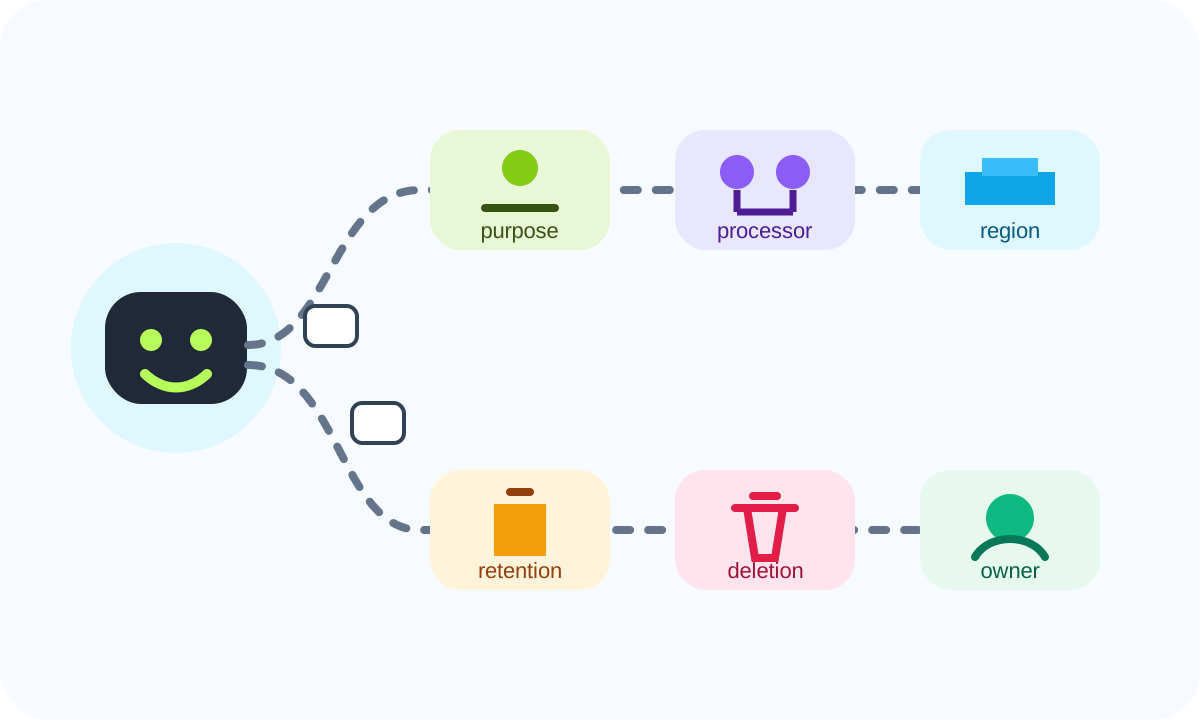
Before choosing a lawful basis, retention period or vendor clause, draw the flow. List the data category, the moment it is collected, the reason it is needed, every processor or internal system that receives it, region, retention trigger, deletion path and owner.
A useful map is specific enough that an engineer can verify it. “Chat data goes to AI” is not specific. “Authenticated account ID is added by our orchestration API, order status is fetched from commerce API, conversation text is sent to model provider, handoff summary is written to help desk, and redacted telemetry is sent to observability” is reviewable.
Separate conversation jobs before mapping fields
Discovery, support, qualification, onboarding and transactional conversations do different work. They should not automatically collect the same fields.
- Discovery: often needs little or no identity data. The bot can explain capabilities from public knowledge.
- Support: may need authenticated account context or a ticket identifier, but only after the user asks for account-specific help.
- Qualification: may collect business contact details, but the fields should map to a clear follow-up purpose.
- Onboarding: may need workspace, role or configuration context; avoid copying secrets into chat.
- Transactional actions: require stronger authorization boundaries because the bot may invoke APIs that change records, place orders or access private data.
The privacy map should therefore follow the conversation state, not only the UI fields visible in the opening message.
Draw the knowledge boundary
Define three answer paths:
- Retrieval-only: public or permission-filtered knowledge can answer the question.
- Tool/API required: account/order/ticket data is fetched only after authorization and only for the requested action.
- Escalate: sensitive, ambiguous, high-risk or out-of-policy requests go to a human or specialist workflow.
This boundary reduces accidental over-collection because the bot does not need to preload every possible personal field “just in case.”
2. Controller, processor and vendor roles to clarify
The GDPR roles depend on who determines purposes and essential means, not only on the label in a SaaS contract. The EDPB’s controller/processor guidance is useful because a single chatbot stack can contain several relationships.
Your organization will often be the controller for the customer-support or lead-qualification purpose. A hosted model API, vector database, help desk or observability platform may act as a processor when it processes personal data on documented instructions. But do not treat that sentence as a universal classification: some vendors may process certain data for their own purposes, and roles can differ by feature.
Questions that expose role ambiguity
Ask each vendor and internal owner:
- Which party decides why the data is processed?
- Which party decides essential elements such as categories of people/data or disclosure?
- Does the vendor use prompts, outputs, support tickets or telemetry for product improvement, abuse detection, analytics or model training beyond your instructions?
- Can optional AI features change the vendor’s purpose?
- Which subprocessors are involved?
- Does the contract describe the same behavior you observed in the product and technical documentation?
A procurement spreadsheet should link the answer to evidence: contract section, DPA, product setting or official documentation. “Sales said GDPR compliant” is not a data-flow control.
3. Lawful-basis and consent questions to review
A chatbot needs a lawful basis for personal-data processing, but consent is not automatically the right basis. The GDPR lists several bases, and the appropriate one depends on the purpose and context. If you rely on consent, the EDPB’s consent guidance emphasizes conditions such as being freely given, specific, informed and unambiguous, with withdrawal possible.
Start with purpose. “Run an AI chatbot” is too broad. Examples of narrower purposes include answering a requested support question, authenticating an account-specific request, following up on a sales enquiry, preventing abuse, or retaining a short-lived security log.
Avoid consent theatre
A checkbox does not fix an unnecessarily broad data flow. If the chatbot cannot explain what the consent covers, the downstream uses are bundled, or the service is conditioned on consent that is not actually optional, the design needs review.
Also separate the legal basis for the conversation service from optional secondary uses such as model improvement, marketing follow-up or analytics. One conversation can contain multiple processing purposes.
Make the interface support the decision
At the point where data collection becomes materially different, tell the user what is changing. For example, a public FAQ bot that transitions to authenticated support should make that boundary visible. If a file upload may be sent to additional processors, the upload flow should not hide that architectural change.
4. Data minimization and purpose limitation
Data minimization becomes practical when each field has a sentence explaining why it exists. If the team cannot complete “we need this field because…,” do not collect it by default.
A useful engineering pattern is progressive disclosure:
- begin with anonymous/public conversation when possible;
- request identity only when account-specific work starts;
- fetch sensitive context through a tool call instead of placing the full record in the prompt;
- return only the minimum fields needed for the answer;
- remove transient tool results from long-lived logs unless a separate need is documented.
Minimize derived data too
Teams often review obvious fields such as email and name but forget derived artifacts: embeddings, conversation summaries, intent labels, sentiment tags, safety classifications, tool traces and debug payloads. Some of these may still relate to an identifiable person.
The mapper should include derived records if they can be linked back to a user, account, ticket or session. The same is true for uploaded files and extracted text.
5. Training, retention and transcript controls
Ask a separate question for vendor training use and your own retention. They are not the same control.
For vendor training, verify the current product/API terms and settings for the exact service you use. Do not assume the policy for a consumer chat product is identical to the API or enterprise offering. Document whether prompts or outputs can be used for model improvement, whether opt-out/opt-in controls exist, and which diagnostic data remains.
For your own retention, define a trigger instead of writing “90 days” because another company uses it. The retention rule should be connected to the documented purpose, legal requirements where applicable, support operations, security investigations and backup behavior.
Treat backups and indexes as part of deletion design
A deletion path should answer:
- where is the primary transcript?
- was a summary copied to CRM/help desk?
- are embeddings or search-index entries created?
- are attachments stored separately?
- what happens to backups and disaster-recovery copies?
- does the vendor expose deletion APIs or account-level deletion workflows?
- how will completion be recorded?
If the answer is “we can delete the ticket but not find the vector-store record,” the architecture is not operationally ready for rights requests.
6. International transfer and vendor diligence
International transfers are a data-flow question. First establish which entities receive personal data and from where. Then review the applicable transfer mechanism and vendor documentation with your privacy team.
The European Commission publishes the current Standard Contractual Clauses materials. SCCs may be relevant in some transfer arrangements, but inserting “SCC” into a spreadsheet is not the end of diligence. The team still needs to know the transfer chain, subprocessor locations, technical measures and whether the contract matches the actual deployment.
Vendor review should follow the feature configuration
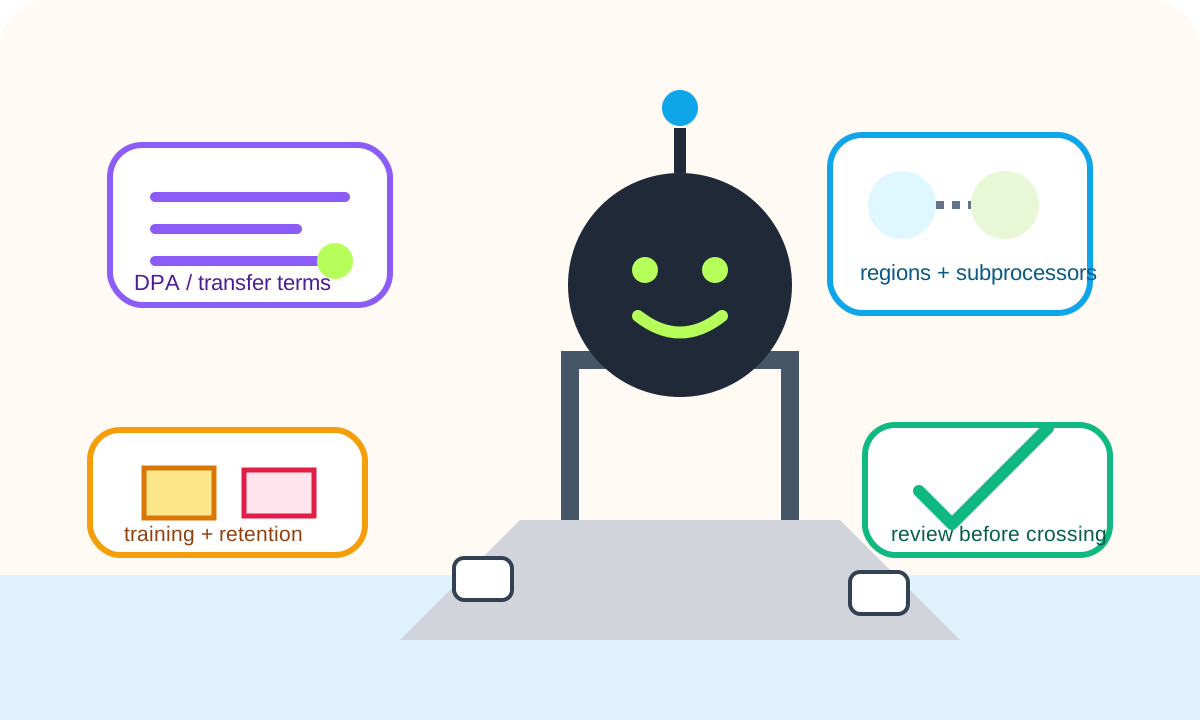
A vendor can have multiple regions, logging modes, AI add-ons and support-access models. Record the configuration you actually enable. If the answer changes when an administrator turns on “improve with customer data,” “AI summaries” or a new analytics integration, that setting belongs in change management.
Use the vendor diligence table below as a starting point, then replace generic rows with your real vendors.
7. DSAR, deletion and user-rights workflow
A privacy notice can promise rights, but engineering has to make those rights executable. For a chatbot, the hard part is often identity resolution across systems.
Create a test request before launch: “Find and delete/export the records associated with this test user.” Follow it through chat storage, CRM/help desk, model/vendor logs where applicable, object storage, vector index and analytics. Note where automation stops and a manual step begins.
Do not let the chatbot make legal determinations
The bot can collect a request and route it, but it should not independently decide whether an exception applies or whether identity evidence is sufficient. That is an owned business/privacy process.
The handoff record should include the request type, verified identifiers available, systems likely involved, timestamp and responsible queue. Avoid copying more transcript content than the reviewer needs.
8. Human handoff and sensitive-data escalation
A strong chatbot knows when to stop. Define escalation triggers for sensitive categories, vulnerable-user situations, account disputes, payment issues, legal requests, security incidents and any domain where policy requires a trained person.
The handoff should preserve enough context to avoid making the user repeat the entire conversation:
- user goal;
- reason for escalation;
- concise conversation summary;
- relevant authenticated identifiers;
- consent/preference state if it matters to the next step;
- tool actions already attempted;
- links to records rather than copied sensitive payloads where possible.
Test five conversation classes
Your evaluation set should include:
- Happy path: routine request answered with the intended minimum data.
- Ambiguous: user asks something that could be public or account-specific.
- Stale data: retrieval content conflicts with a newer source.
- Permission boundary: user asks for another person’s/account’s data.
- Adversarial: prompt attempts to extract hidden context, system instructions or records.
For each test, record whether the bot retrieved, used a tool, abstained or escalated. Privacy failures often appear as routing failures before they appear as policy text problems.
9. Security logging without over-collection
Logs are useful for availability, security, abuse and debugging, but they are also a common place where personal data spreads. Design observability so the default event is structured and minimal.
Prefer fields such as event type, request ID, model/tool name, latency, outcome code and pseudonymous session reference. Add prompt/response content only when there is a documented debugging need, with access controls and short retention.
Redact before export
If telemetry leaves your application boundary, redact or tokenize sensitive values before the logging SDK sends them. It is much harder to clean data after it has reached multiple log processors and backups.
Create separate log levels for production troubleshooting versus sampled content review. A blanket “log everything because we may need it later” policy conflicts with minimization and makes incident response harder.
10. Pre-launch privacy checklist and documentation
Before production, the engineering, product, security and privacy owners should be able to answer the same architecture questions.
Data flow
- Every personal-data category has a purpose, source, processor/system, region, retention rule, deletion path and owner.
- Tool/API calls are permission-aware and return minimum necessary fields.
- Derived data such as summaries, embeddings and traces is included where relevant.
Vendor controls
- Processor roles and DPAs are documented where applicable.
- Subprocessors and regions are known for the enabled configuration.
- Training/product-improvement use is verified for the exact product tier/API.
- International-transfer questions have been reviewed with the privacy owner.
User rights
- A test user can be found across chatbot and downstream systems.
- Export/deletion steps are documented, including indexes, attachments and handoff records.
- Human reviewers—not the chatbot—own exception and identity-verification decisions.
Operational safety
- Sensitive-data and permission-boundary prompts are in the evaluation set.
- Human handoff preserves reason, context and identity/consent state without dumping unnecessary data.
- Logs are redacted, access-controlled and retained for a defined purpose.
- Changes to vendors, regions, AI features or logging trigger a privacy review.
Keep a change log after launch
Privacy review is not a one-time launch gate. Record changes that alter the data flow: a new model or retrieval vendor, an added support integration, a different hosting region, longer transcript retention, a new analytics SDK, a file-upload feature or a setting that permits additional vendor use. For each change, note the owner, reason, affected data categories and whether the DPA, transfer analysis, notice, security controls or deletion workflow needs another review.
Schedule periodic reality checks against production configuration. Compare the documented map with enabled vendor settings, network destinations, log payloads and support workflows. This is especially useful after teams enable new AI features in tools that were originally approved for a narrower purpose. The goal is simple: the diagram, contracts and running system should describe the same flow.
Use the mapper as a review packet
Complete the interactive data-flow mapper, copy its review summary and bring it to your privacy owner or counsel together with the vendor diligence table, architecture diagram and actual product settings. That turns a vague “Is our chatbot GDPR compliant?” meeting into a list of concrete, answerable questions.
If you need engineering help implementing the boundary—permission-aware retrieval, tool calls, redaction, deletion workflows, human handoff and observability—see AI chatbot development or continue with RAG chatbot architecture, AI chatbot vs live chat, and AI marketing automation boundaries.
Last reviewed: October 2, 2026. Vendor behavior, regulatory guidance and product settings change; verify current official documentation before launch.
Frequently asked questions
Do AI chatbots always need user consent under GDPR?
No. GDPR requires a lawful basis for each processing purpose, but consent is only one possible basis and it has strict conditions. The correct basis depends on the specific purpose and relationship, so document the purpose first and review it with your privacy owner or counsel.
Can we keep chatbot transcripts indefinitely for quality improvement?
Indefinite retention is difficult to reconcile with storage limitation without a specific, documented need. Define why transcripts are retained, who can access them, whether they can be minimized or anonymized, and a deletion trigger that matches the purpose.
Is a vendor DPA enough for GDPR compliance?
No. A DPA is important when a vendor acts as your processor, but you still need to understand the actual data flow, instructions, security, subprocessors, transfers, retention and rights-request operations.
What should happen when a user asks the chatbot to delete their data?
The chatbot can capture the request, but the operational workflow must locate relevant records across the chat system and downstream processors, authenticate the requester where appropriate, route the request to the responsible team and document completion or any lawful exception.
Should chatbot logs contain full prompts and responses?
Not automatically. Logs should be designed around a defined troubleshooting or security purpose. Prefer structured events, pseudonymous identifiers, redaction and short retention where full conversation content is not necessary.
Does this article determine whether our chatbot is GDPR compliant?
No. It is an engineering and procurement planning guide. GDPR obligations are fact-specific and can depend on jurisdiction, purpose, data categories, scale, vendors and other factors. Use the mapper to prepare a better review with your DPO/privacy owner or qualified counsel.
Sources and assumption boundaries
Fast-changing platform, pricing and search claims were reviewed on October 2, 2026. Interactive scores and scenarios are clearly labeled planning models, not sourced market benchmarks.
- EUR-Lex — Regulation (EU) 2016/679 (GDPR) Official GDPR text used for the principles, lawful-basis, processor, security, transfer and data-subject-rights references in this guide.
- EDPB — Guidelines 07/2020 on controller and processor concepts Final EDPB guidance on identifying controller, joint-controller and processor roles and the substance-over-label approach.
- EDPB — Guidelines 05/2020 on consent Official EDPB guidance on the conditions for valid consent under the GDPR.
- European Commission — Standard Contractual Clauses publications Official Commission source for SCCs used in controller/processor arrangements and international transfer scenarios.
- EDPB — Opinion 28/2024 on personal data in the context of AI models EDPB opinion on anonymity, legitimate interest and consequences of unlawful personal-data processing in AI-model development and deployment.