Quick answer
The core tradeoff is answer coverage versus answer boundary: more retrievable content is useful only if the system knows what a user may access, when sources are stale and when it must use a tool, abstain or hand off.
Last reviewed: September 16, 2026RAG architecture planner
document ingestion → chunking + metadata → hybrid retrieval → reranking → permission-aware filtering → citation rendering → scheduled re-indexing → tool/API boundary → evaluation harness
Pilot evaluation inputs (%)
1. Pilot evaluation bars
Empty defaults intentionally start at 0 until you enter pilot data.
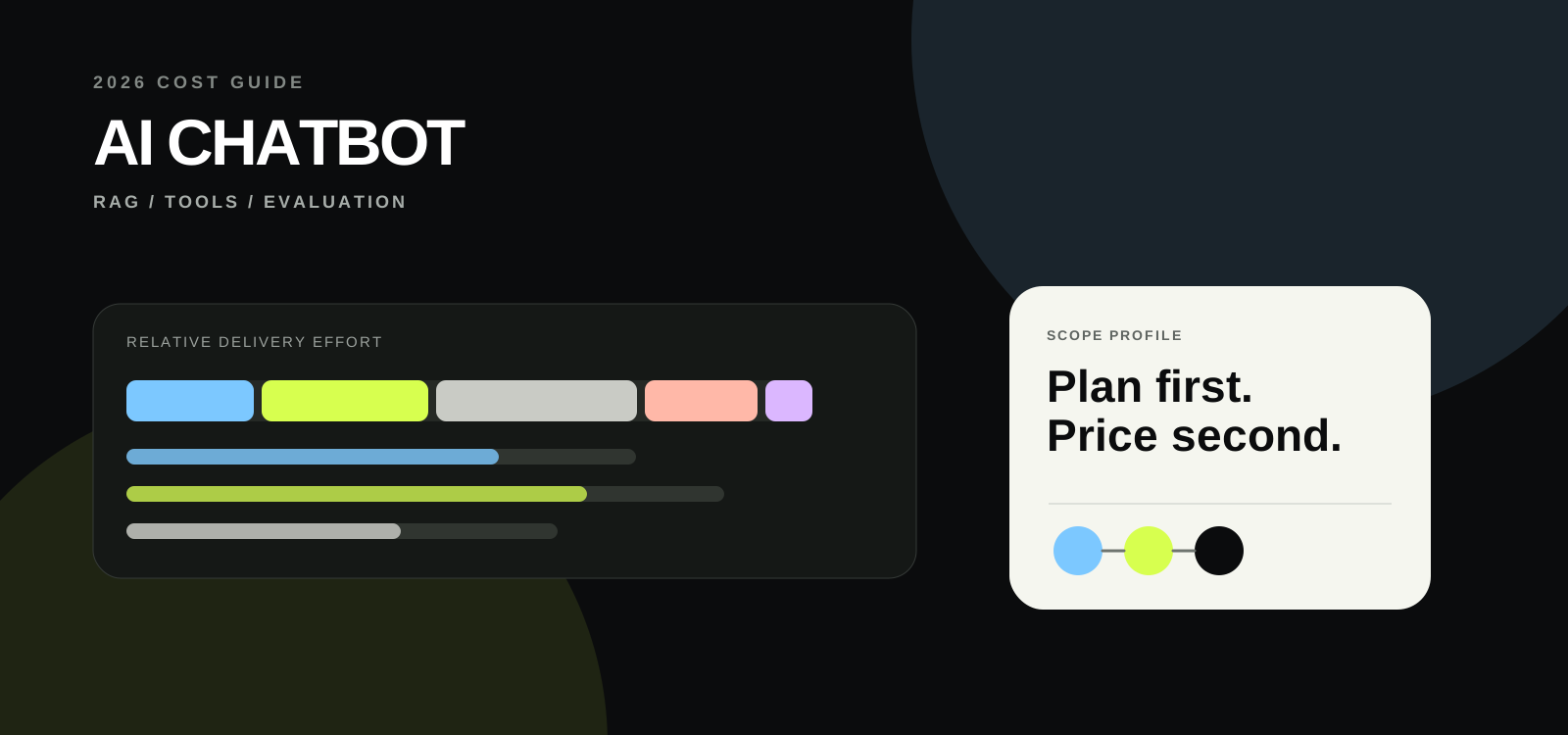
2. Architecture complexity profile
3. RAG production flow
Evaluation values are yours. Architecture scores are labeled planning complexity, not quality benchmarks.
Tables built for the buying decision
Primary decision table
| Intent | Source data | Bot action | Tool/integration | Confidence boundary | Human handoff | KPI |
|---|---|---|---|---|---|---|
| Discovery | Approved product/docs | Explain with sources | Usually none | Source coverage | Complex fit question | Useful next-step rate |
| Support | Knowledge base | Retrieve + troubleshoot | Ticketing optional | Evidence present | Unresolved/risky issue | Resolution + acceptance |
| Qualification | Offer + qualification rules | Ask/answer | CRM | Required fields complete | High-value/complex | Qualified handoff |
| Transactional | Live account state | Explain boundary | Order/billing API | Tool success | Tool failure/risk | Task completion |
| Onboarding | Docs + account context | Guide steps | Product API optional | Permission-safe | Blocked user | Activation step |
RAG evaluation dimensions
| Dimension | Question | Failure category |
|---|---|---|
| Retrieval | Was the supporting source retrieved? | miss / wrong chunk |
| Factuality | Does the answer match the evidence? | unsupported/conflict |
| Permissions | Was only authorized data accessible? | boundary breach |
| Latency | Which stage dominates response time? | retrieval/rerank/model/tool |
| Handoff | Was context preserved on escalation? | repetition/context loss |
Sources and assumption boundaries
Fast-changing platform, pricing and AI-search claims were reviewed on September 16, 2026. Interactive scores and scenarios are clearly labeled planning models, not sourced market benchmarks.
- OpenAI API — Retrieval Current OpenAI retrieval/vector-store documentation; reviewed September 16, 2026.
- OpenAI API — File search Current hosted file-search tool documentation; reviewed September 16, 2026.
- NIST — AI Risk Management Framework Governance reference for AI risk management; reviewed September 16, 2026.
Turn this planning result into a scoped review.
Send the assumptions, constraints and result summary. WebDesignK can review the architecture/content/implementation boundary, identify missing discovery inputs and return a prioritized next-step scope.
- Bring: current site/product, constraints, integrations and your tool result.
- You get: a scoped recommendation, open questions and implementation priorities.
Decision snapshot for RAG chatbots
Retrieval-augmented generation (RAG) gives a language model selected context from an external knowledge source at answer time. In a business chatbot, the important design problem is not simply “connect documents to an LLM.” You must define what may be retrieved, how access is enforced, how freshness and deletion work, when an answer must cite or abstain, and when a transactional request should call a tool or hand off to a person. The core tradeoff is answer coverage versus answer boundary.
What you will decide: which conversation jobs belong in retrieval, which require live APIs, which must escalate, how documents are ingested and filtered, what pilot evaluation data to collect, and which production controls are necessary for freshness, permissions and quality.
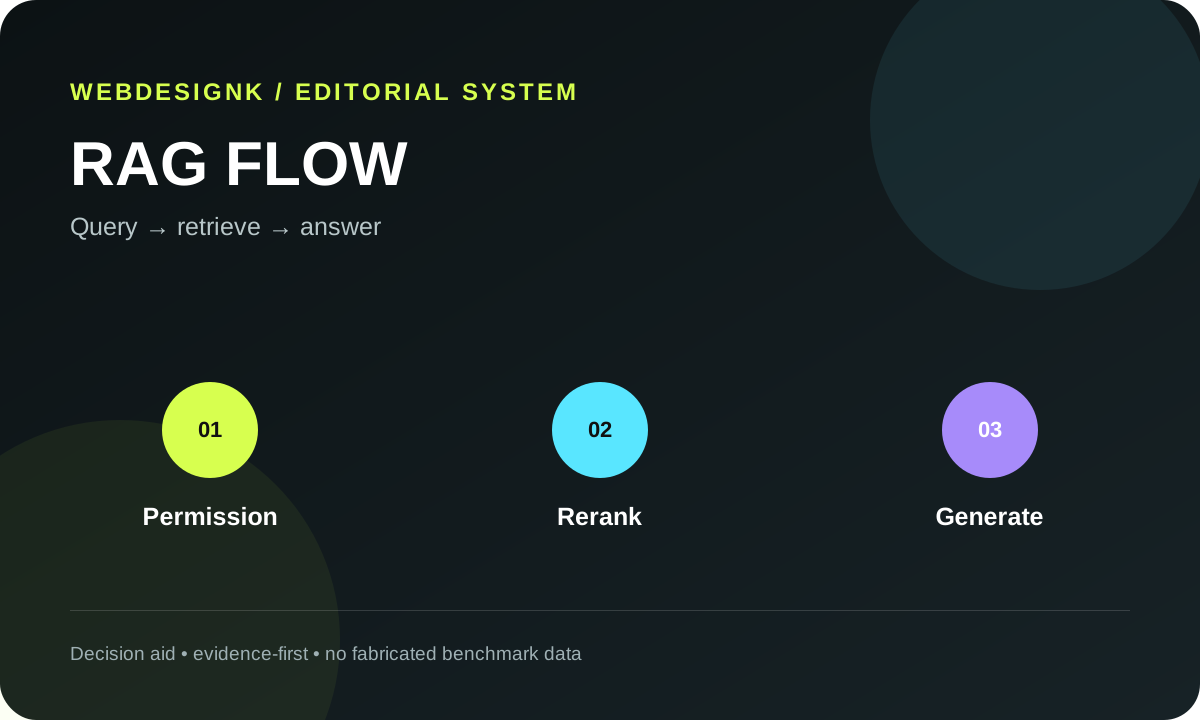
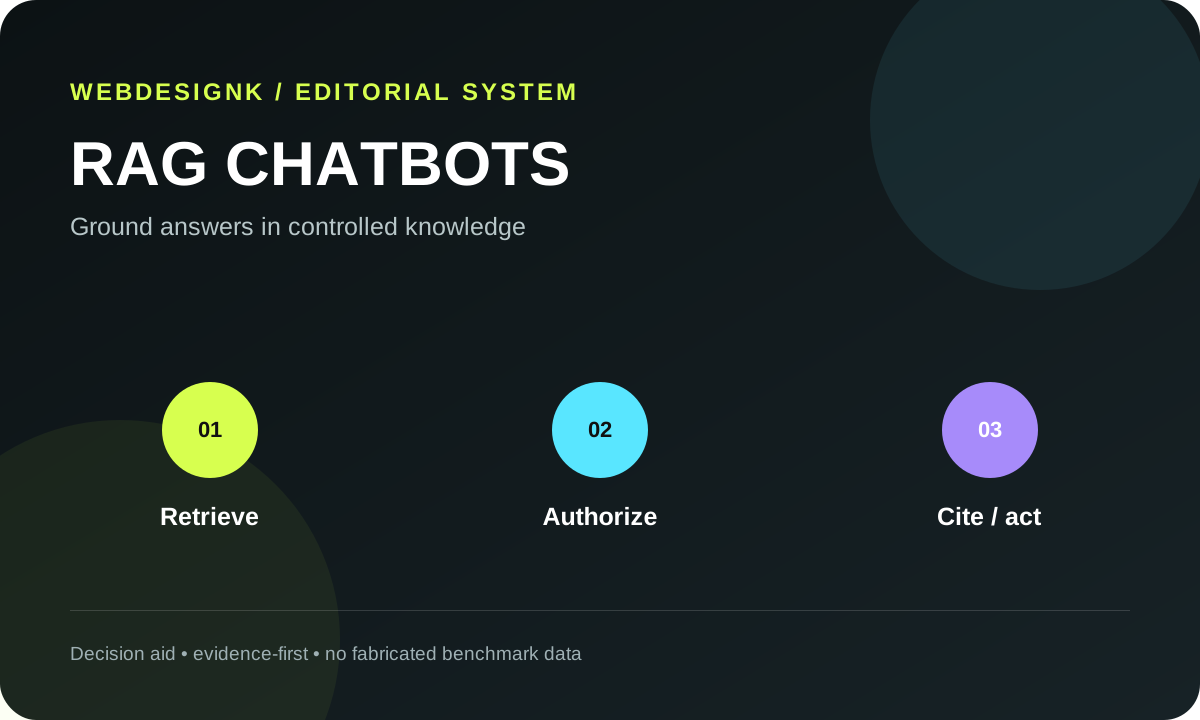
RAG in one diagram: query → retrieval → context → generation
A typical RAG interaction starts with the user query and conversation context. The application applies identity and access rules, creates a search representation, retrieves candidate chunks from an indexed corpus and optionally reranks them. The selected passages are inserted into the model context with instructions describing answer boundaries. The model produces an answer, citations or an abstention; application logic may instead route the request to a tool or human workflow.

OpenAI’s current Retrieval documentation describes vector stores as containers that power semantic search over uploaded files. That is one implementation pattern, not a complete RAG product architecture. A production business system still needs source governance, permissions, deletion, evaluation, observability and clear transactional boundaries.
Retrieval is not the same as tool use
Retrieval is useful for knowledge that can be safely represented as searchable content: product documentation, policies, manuals, approved enablement content or support articles. A tool/API is better when the user needs live or account-specific state—order status, inventory, booking availability, billing actions, CRM updates. Do not stuff rapidly changing transactional records into a document index merely because the chatbot already has retrieval.
When RAG is appropriate vs direct prompting or tools
Use direct prompting when the necessary information can be provided safely in the prompt or the task is transformational rather than factual. Use RAG when the answer depends on a corpus that is too large or dynamic to include directly and needs source-specific grounding. Use tools when the task needs authoritative live data or an action. Use human handoff when the risk, ambiguity or customer context exceeds the automated boundary.
The architecture planner above forces these decisions into modules instead of assuming every chatbot needs the same stack.
Document ingestion, chunking and metadata
Ingestion is where many later retrieval problems begin. Preserve source identifiers, document version, owner, timestamps, access classification and semantic structure. Clean repeated navigation, headers and boilerplate before indexing. Chunk boundaries should respect the structure of the source rather than blindly slicing every file at the same character count.
Metadata should support the filters your application actually needs: tenant, product, region, language, effective date, content type or permission group. Do not add dozens of fields without a retrieval use case because metadata also becomes something the content pipeline must keep accurate.

Retrieval strategy and reranking
Semantic search can surface conceptually related passages even when exact keywords differ. Keyword or hybrid retrieval can still be valuable for identifiers, error codes and product names. Reranking adds another selection step when the initial candidate set is broad. The right choice depends on your corpus and evaluation set, not on an architecture trend.
Measure retrieval separately from final answer quality. If the relevant source was never retrieved, prompt changes cannot repair the missing evidence. If the right source was retrieved but the answer was wrong, investigate context construction, conflicting passages and model behavior.
Permissions and tenant-aware retrieval
Never rely on the model to “remember not to mention” data it should not have received. Apply authorization before retrieval or filter results using trusted identity/tenant metadata so prohibited content does not enter model context. Test cross-tenant and role-boundary cases explicitly.
For internal bots, permission complexity can be higher than public support bots because knowledge often follows team, account or customer boundaries. Decide how permission changes propagate to the index and what happens to cached results.
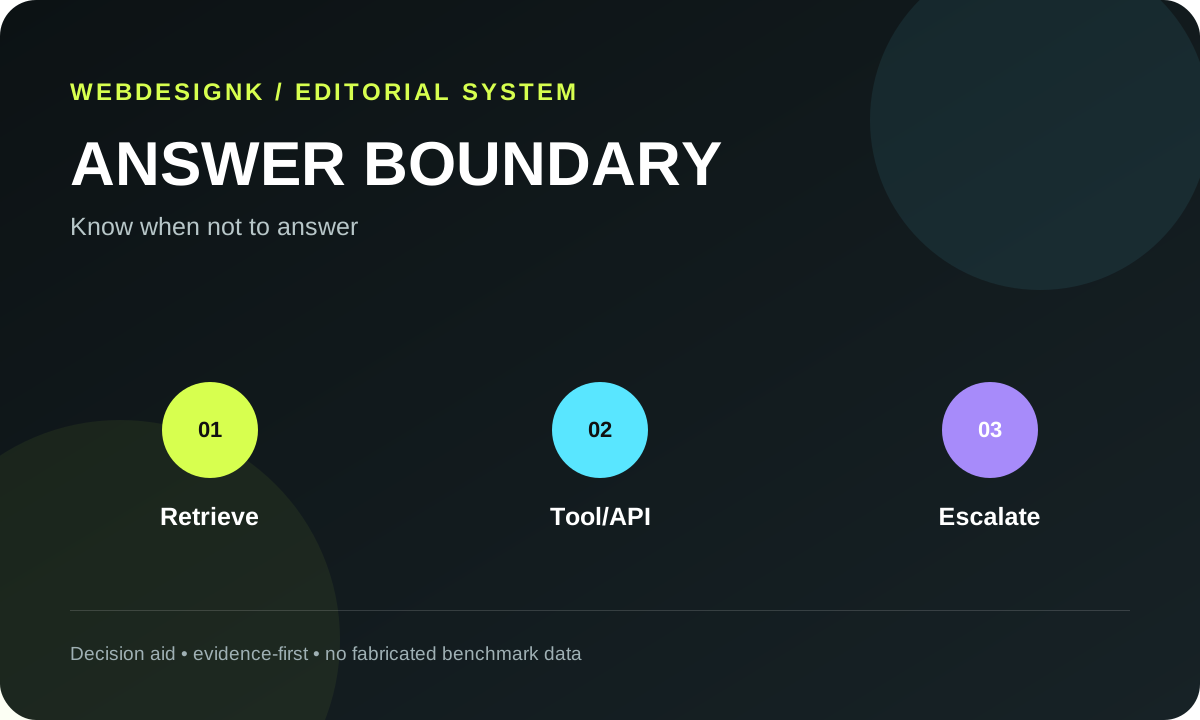
Citations, answer boundaries and abstention
A citation should help the user inspect the source that supports the answer. Preserve enough metadata to display source title, deep link and version where useful. Define when the bot must cite, when it may summarize without citation and when it should say that available sources are insufficient.

Abstention is a product feature, not a failure. A bot that invents a confident answer when retrieval fails is less useful than one that requests clarification, links the relevant source or escalates.
Freshness, re-indexing and deletion
Freshness strategy should follow the source. Monthly policy documents may tolerate scheduled ingestion; fast-changing catalog or knowledge content may need event-driven updates. Record source version and indexed timestamp. Deletion must remove material from retrieval, not only hide it in the source UI.
Test stale-data scenarios deliberately: update a source, remove a source and change a user permission. Then verify what the bot can retrieve after each event. This is more useful than assuming a successful initial ingestion proves lifecycle correctness.
Edge case: conflicting or superseded sources
Business knowledge is rarely perfectly consistent. Two policies may describe different effective dates; product documentation may lag a release; support articles may conflict with contractual terms. Preserve source priority and effective-date metadata so retrieval can prefer the authoritative version. When conflicting passages are retrieved, the assistant should not silently merge them into a confident answer. Surface the conflict, prefer the designated authority or hand off according to policy.
Edge case: tables, PDFs and visual documents
Document extraction quality matters before embedding. Tables can lose row/column relationships, PDF reading order can be wrong and screenshots may contain critical text that a text-only pipeline never indexes. Test representative documents from each source type and preserve structural cues in chunks. A clean extraction pipeline often improves retrieval more than changing embedding models.
Build queries from conversation state carefully
Follow-up questions such as “what about enterprise?” may depend on earlier context. Query rewriting can make the retrieval request self-contained, but it can also inject assumptions that were never stated. Log rewritten queries during evaluation and compare them with the user’s actual intent. For high-value workflows, include tests where the previous turn changes the correct source or permission boundary.
Hybrid retrieval and identifiers
Semantic similarity is useful for conceptual questions, while exact lexical matching can be critical for SKUs, error codes, policy IDs and names. A hybrid strategy can combine both signals before reranking. Evaluate with your real corpus; architecture diagrams should explain the mechanism, not imply that one retrieval recipe is universally best.
Separate retrieval, answer and workflow success
Use at least three labels when reviewing pilot conversations. Retrieval success asks whether the right evidence was available to the model. Answer success asks whether the response was faithful, useful and appropriately cited. Workflow success asks whether the user completed the business job, including correct tool execution or escalation. A system can retrieve perfectly and still fail the workflow; a useful answer can still violate a permission boundary.
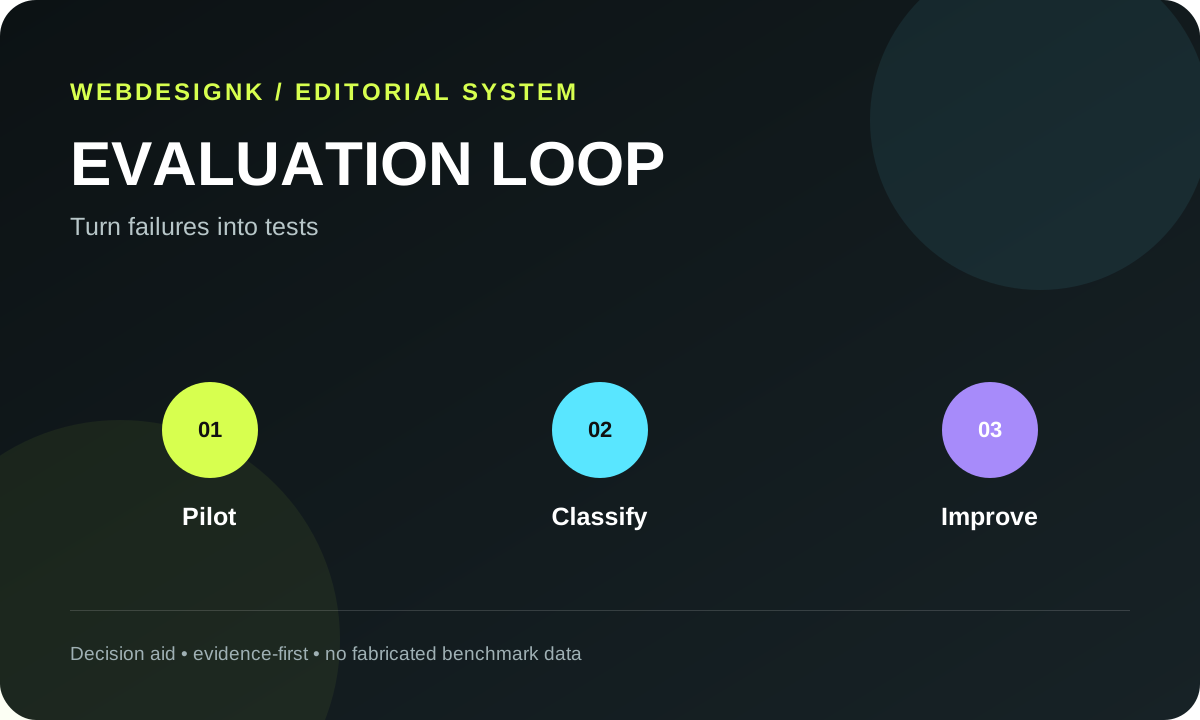
Create regression cases from every serious failure. Store the prompt, expected source or action, user/tenant context and acceptance rule. Re-run the set when ingestion, ranking, prompts, models or tools change. This turns production incidents into durable quality controls instead of one-off prompt patches.
Privacy, retention and source lifecycle
Decide which conversations, retrieved chunks, tool outputs and evaluation traces are retained and for how long. Keep the minimum data needed for quality and incident review, separate production logs from evaluation datasets, and ensure deletion requirements can propagate through source stores, indexes and caches. Sensitive source classes may require additional controls or exclusion from automated evaluation exports.
A retrieval system should also detect broken source links and stale owners. If a source has no accountable owner, its authority will degrade even if embeddings remain technically searchable.
Evaluation dataset and failure categories
Build an evaluation set from real conversation jobs: discovery, support, qualification, onboarding and transactional intents. Include happy-path questions, ambiguous wording, missing information, stale content, conflicting sources, permission boundaries, adversarial instructions and requests that should invoke a tool.
Score retrieval hit separately from answer acceptance. Track escalation or containment according to the use case rather than treating lower escalation as universally better. For high-risk scenarios, a correct escalation can be the success condition.
Latency and cost controls
Latency accumulates across authentication, query transformation, retrieval, reranking, tool calls and model generation. Instrument stages so the team knows where time is spent. Cache only where freshness and permissions make it safe. Limit retrieved context to useful evidence rather than sending large redundant passages.
Cost analysis should use your traffic, retrieval operations, model usage and infrastructure. The article intentionally avoids a universal “cost per RAG answer” because architecture and usage vary materially.
Production rollout checklist
Before rollout, verify source ownership, ingestion monitoring, permission enforcement, citation links, abstention behavior, tool boundaries, deletion, evaluation datasets, human handoff payload, latency tracing and incident ownership. Start with a bounded conversation job and a reversible pilot. Expand only when observed failure categories are understood and the team has a process for turning them into tests.
When handing off to a person, preserve the conversation summary, reason for escalation, sources already shown, authenticated identity or consent state when applicable, and any tool actions already attempted. Do not make the customer repeat the entire problem simply because automation reached its boundary.
Frequently asked questions
Is RAG the same as fine-tuning?
No. RAG supplies retrieved context at answer time; fine-tuning changes model behavior through training examples. They solve different problems.
Does every business chatbot need a vector database?
No. Small/static tasks may use direct context, while live account actions need tools. Retrieval infrastructure should follow the knowledge job.
How should tenant permissions be enforced?
Keep authorization outside the model and prevent unauthorized material from entering retrieval results or model context.
What should a RAG pilot measure?
Measure retrieval hit, answer acceptance/factuality, correct escalation or containment, goal completion, latency and failure categories using your own pilot data.