Quick answer
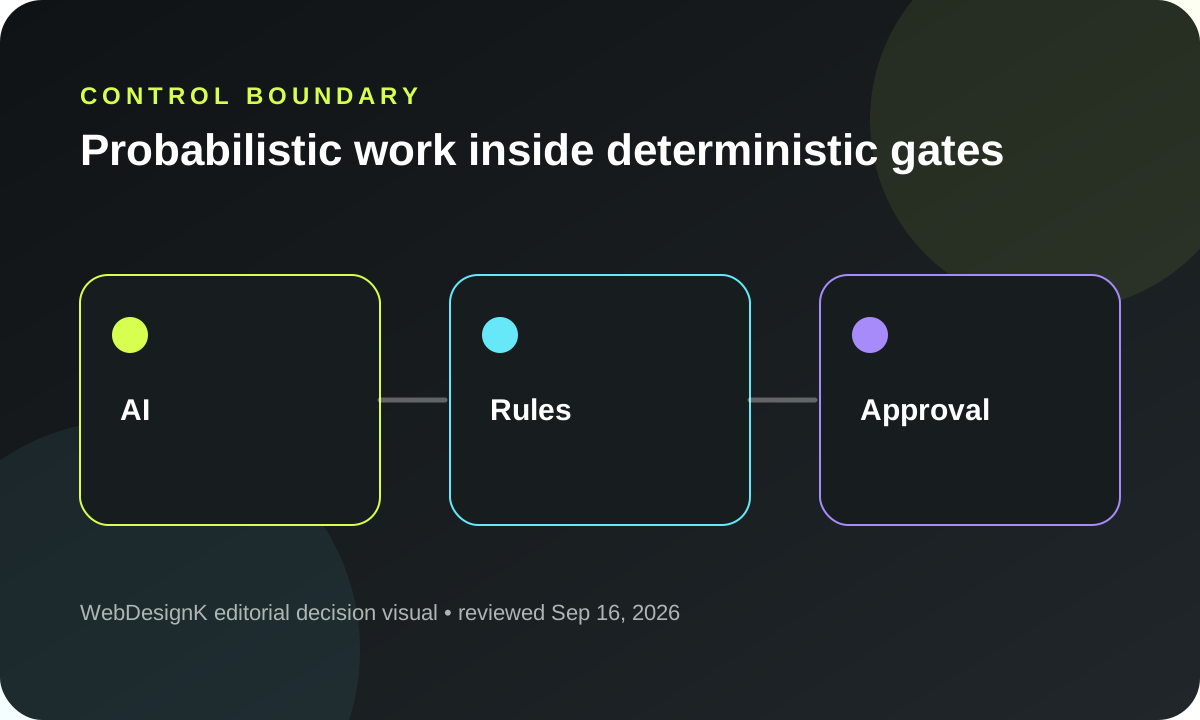
Prioritize workflows by frequency, manual effort and business value, then subtract risk and review burden. AI should handle probabilistic interpretation; deterministic rules should protect exact constraints; humans should retain accountability where downside is material.
Last reviewed: September 16, 2026Automation opportunity scorer
The three starting rows are labeled illustrative examples so the charts are understandable before input. Replace them with your workflows. “Human-led” is flagged when both error risk and review requirement are 4–5.
1. Impact vs effort scatter
Takeaway: high-impact, lower-effort workflows are better pilot candidates; high-risk/review work stays toward human control.
2. Manual vs modeled assisted hours
Takeaway: time savings are only useful after adding review overhead and your own reduction assumption.
3. Risk × review control map
Takeaway: workflows in the high-risk/high-review corner should remain human-led or require strict deterministic gates.
Ranked workflows
Assumption note: priority score is an explicit decision-aid formula, not an industry benchmark. Assisted-hours math uses each row’s own editable reduction assumption plus a review-overhead factor tied to the entered review requirement.
Tables built for the buying decision
Primary decision table
| Workflow | Trigger | AI step | Deterministic step | Human approval | Data | KPI | Risk | Impact / effort |
|---|---|---|---|---|---|---|---|---|
| Lead enrichment | New qualified inbound | Summarize firm/context | Validate/dedupe/territory rules | Exceptions / high-value leads | CRM + public business data | Routing time + accepted enrichment | Wrong entity/data | High / medium |
| Campaign brief draft | Approved campaign request | Draft angles/brief | Required claims/fields/brand rules | Strategist approves | Brief + product evidence | Prep time + revision rate | Unsupported claim | Medium / low |
| Analytics commentary | Reporting close | Summarize changes/hypotheses | Metric calculation stays deterministic | Analyst validates explanation | Warehouse/BI outputs | Analysis time + correction rate | False causal story | Medium / low |
| Public brand response | Mention/escalation | Suggest response options | Policy/escalation rules | Human required | Social/support context | Response time + quality | Brand/legal harm | High / high |
Pilot promotion and rollback gates
| Gate | Evidence before promotion | Rollback signal |
|---|---|---|
| Quality | Reviewed sample + categorized errors | Material error category exceeds tolerance |
| Review burden | Measured review minutes below baseline gain | Review time erases saved time |
| Integration | Retries/reconciliation tested | Duplicate/lost writes or queue instability |
| Business KPI | No material negative downstream signal | Conversion/quality/support metric degrades |
| Governance | Owner, log, change process, rollback documented | No accountable owner / undocumented change |
Sources and assumption boundaries
Fast-changing platform, pricing and AI-search claims were reviewed on September 16, 2026. Interactive scores and scenarios are clearly labeled planning models, not sourced market benchmarks.
- NIST — AI Risk Management Framework 1.0 Voluntary AI risk-management framework; reviewed September 16, 2026.
- NIST — Generative AI Profile (NIST AI 600-1) Generative-AI risk profile; page updated April 2026 and reviewed September 16, 2026.
- NIST — AI RMF resources Framework, playbook and related resources; reviewed September 16, 2026.
Turn this planning result into a scoped review.
Send the assumptions, constraints and result summary. WebDesignK can review the architecture/content/implementation boundary, identify missing discovery inputs and return a prioritized next-step scope.
- Bring: current site/product, constraints, integrations and your tool result.
- You get: a scoped recommendation, open questions and implementation priorities.
Decision snapshot: automate repetitive judgment support, not unbounded accountability
AI marketing automation works best when the workflow is frequent, measurable and reversible, the model adds value beyond deterministic rules, and a human can review outcomes where error costs are meaningful. Keep brand-defining, legally sensitive, high-impact or ambiguous decisions human-led unless you have strong deterministic gates and evidence that the automation is safe. The core tradeoff is throughput versus control: faster generation is not useful if review time, correction rate or downstream errors erase the gain.
What you will decide: which workflows deserve a pilot, where simple rules are enough, what must be human-approved, and how to measure saved time together with quality and business impact.
Start with the business outcome
Do not begin with “where can we add AI?” Begin with a measurable outcome: reduce lead-routing delay, increase research coverage, shorten campaign preparation, improve content reuse, speed reporting commentary or lower manual enrichment work. Define the unit of work and baseline before automating it. If nobody knows how long the workflow takes, how often it runs or what quality means, automation economics will be guesswork.
The scorer above uses frequency, manual time, business value, error risk and review requirement. Those are intentionally operational variables. The score is not a benchmark; it is a way to rank your own workflow candidates consistently.
Separate assistance from autonomy
Many valuable use cases are assisted, not autonomous. AI can classify, summarize, draft or recommend while deterministic code validates required fields and a human approves high-impact output. This often captures most of the speed benefit without delegating final accountability.
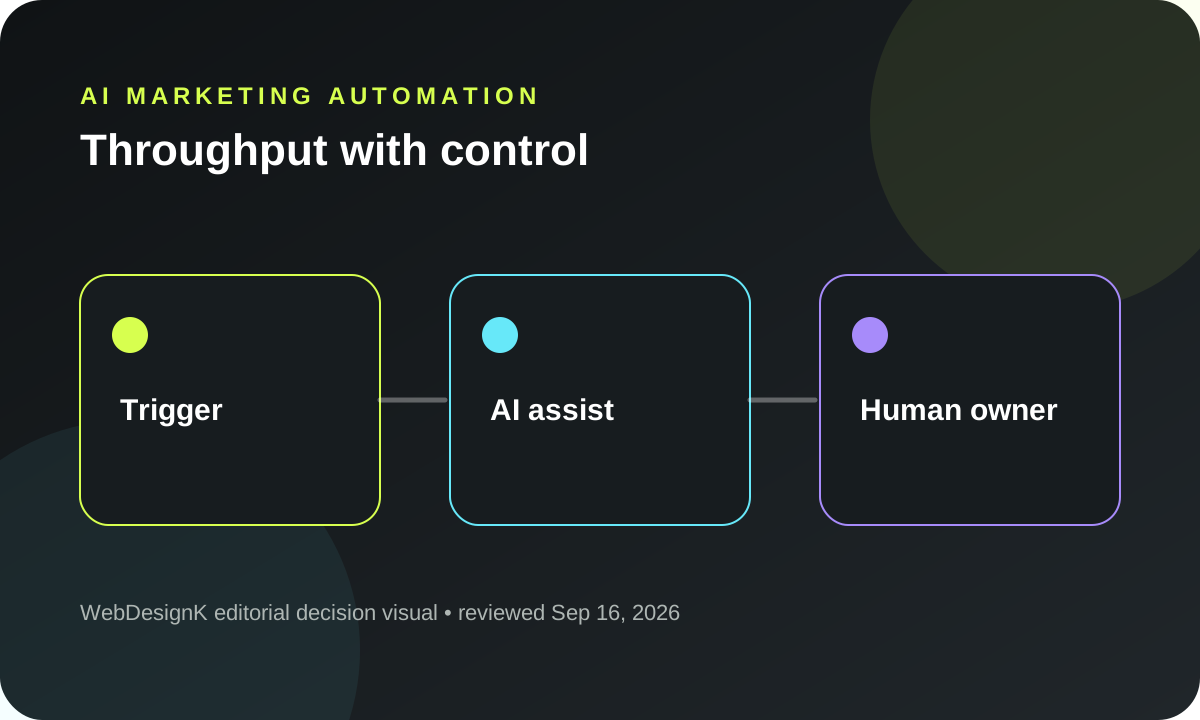
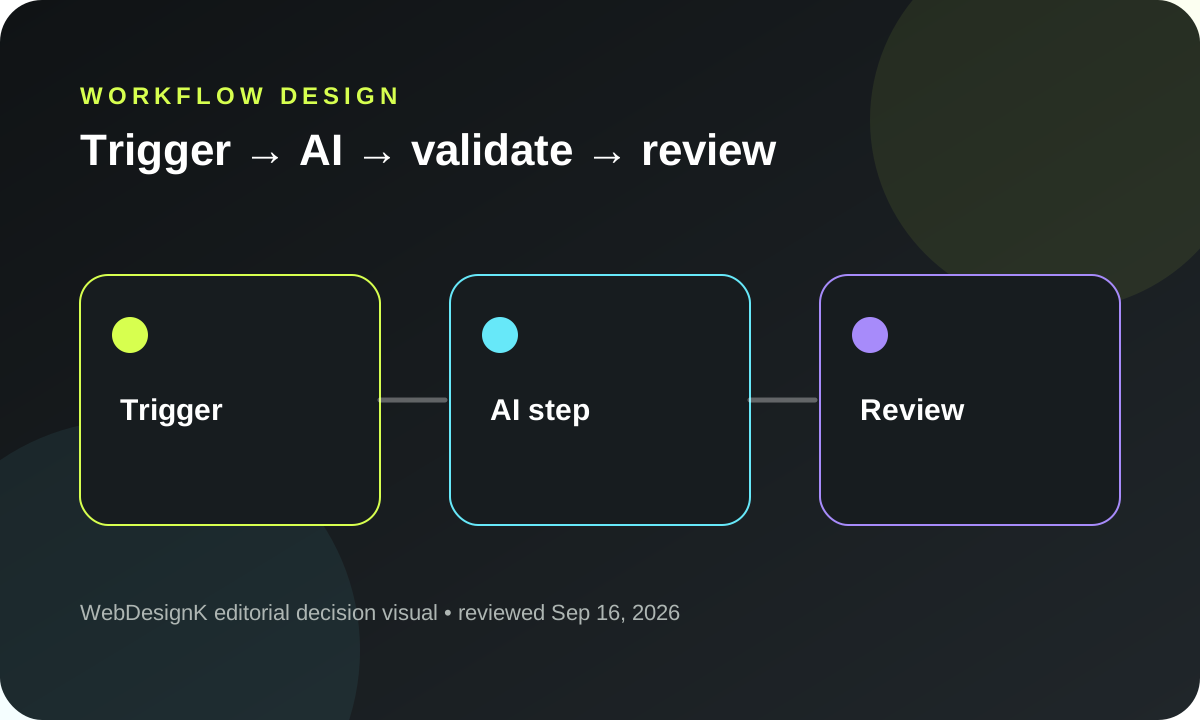
Map trigger → AI step → deterministic step → human review
For every workflow, draw four boxes. Trigger: what event starts work? AI step: what probabilistic interpretation/generation is useful? Deterministic step: what rules, validation, permissions or calculations must be exact? Human review: what decision still needs accountable judgment?
Example: a demo request arrives (trigger); AI summarizes company/context (AI); code validates email/domain, deduplicates CRM records and applies territory rules (deterministic); an SDR or marketing ops owner approves routing exceptions (human). The model is useful without becoming the system of record.
Data and systems prerequisites
Automation quality is bounded by data quality and access design. Identify the systems of record, fields the model may read, fields it may write, sensitive data restrictions, retention rules and audit requirements. Use the minimum data necessary for the task. Separate prompts/context from secrets and enforce permissions outside the model.
The integration layer needs idempotency, retries, dead-letter/error handling and a reconciliation path for business-critical writes. A marketing workflow that silently creates duplicate CRM records or overwrites attribution can cost more than the manual process it replaced.
Where AI adds leverage versus simple rules
Use deterministic logic when the decision can be expressed reliably as rules: required-field validation, exact thresholds, permissions, routing tables, date arithmetic, deduplication and allow/deny lists. Use AI when the value comes from interpretation of unstructured text, summarization, classification with nuance, synthesis or draft generation.
If a five-line rule can solve the problem, an LLM often adds cost and uncertainty. Conversely, forcing nuanced research or content transformation into brittle rules creates maintenance overhead. The workflow map should show why each step uses its chosen mechanism.
Human-in-the-loop and brand controls
Human review should be proportional to downside. Low-risk internal summaries may use sampling. Public brand claims, regulated topics, sensitive personalization or expensive campaign actions need stronger review. Define who can approve, what evidence they see and what conditions force escalation.
NIST's AI RMF and Generative AI Profile emphasize risk management across the lifecycle rather than treating model deployment as the endpoint. Operationally, that means documented use cases, testing, monitoring and clear ownership for failures and changes.
CRM, analytics, content and messaging integrations
Map read/write boundaries for CRM, CDP/warehouse, analytics, CMS/DAM, email/SMS and ad platforms. Prefer a small number of stable integration contracts over one-off prompt automations that directly mutate many systems. Log the input, model/version where appropriate, output, validation result, human decision and downstream action for workflows that need auditability.
For content automation, keep source attribution and version history. For lead workflows, preserve original inbound data before enrichment. For analytics commentary, distinguish observed metrics from model-generated explanation.
Quality, attribution and failure monitoring
Measure four things together: throughput, review time, correction/error rate and business outcome. A workflow that saves 100 drafting hours but creates 80 hours of review and frequent rework may not be a win. Track failure categories rather than only an aggregate “accuracy” score: wrong entity, unsupported claim, malformed output, policy violation, stale data, routing error or integration failure.
Create rollback criteria before the pilot. If error rate exceeds the agreed threshold, downstream KPI deteriorates, or review burden rises beyond the baseline, revert to the manual path while investigating.
Throughput, cost and ROI model
Start with current monthly volume × manual minutes. Then model assisted time using your own expected reduction and add review overhead. Add model/API/tool cost, engineering/operations time and exception handling. Compare that with the business value of faster response, increased coverage or avoided manual work.
The charts above deliberately use your entered values plus clearly labeled assumptions. They do not convert generic “AI productivity” claims into fake ROI. If you cannot attach a measurable baseline and outcome to the workflow, keep it in discovery until you can.
Pilot and rollout sequence
Choose a reversible workflow with moderate volume, clear quality criteria and limited downside. Run a shadow phase where the automation produces recommendations without taking action. Compare to human outcomes, categorize errors and tune deterministic gates. Then allow assisted execution with review. Only after stable evidence should you increase automation authority.
Use promotion gates: minimum sample size appropriate to your process, acceptable error categories, review-time target, integration reliability and no material negative business signal. Document the exact rollback switch and owner.
Governance and 90-day roadmap
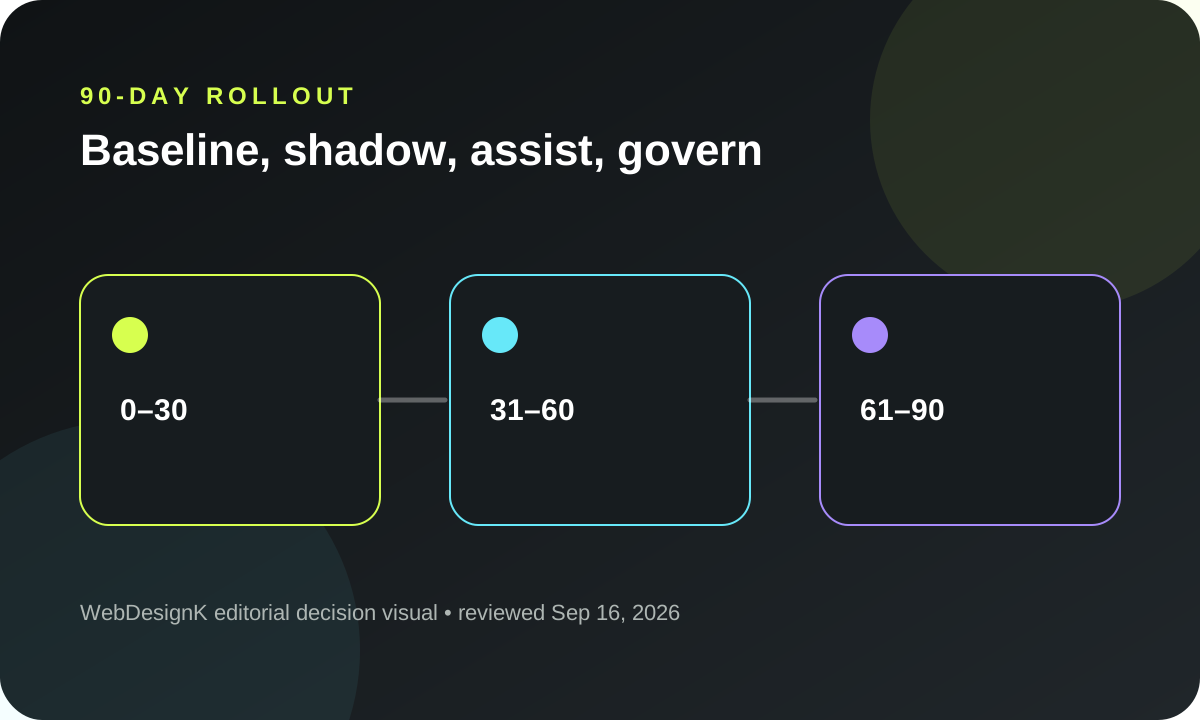
Days 0–30: inventory workflows, capture baselines, classify data/risk, choose one pilot and design deterministic boundaries. Days 31–60: run shadow/assisted mode, log outcomes, measure review burden and categorize failures. Days 61–90: promote only if evidence supports it, add monitoring/alerts, document owner/version/change process and choose the next opportunity.
Keep a registry of production automations: purpose, owner, data sources, systems written, model/provider, deterministic controls, human review, KPI, known risks and rollback. Governance should make useful automation easier to operate, not create paperwork nobody uses.
Build a small evaluation set before increasing autonomy
Collect representative examples of the workflow, including ordinary cases and the edge cases most likely to create harm. For enrichment that might include ambiguous company names, subsidiaries and sparse websites. For content it might include products with strict claim boundaries, outdated source material and conflicting inputs. For routing it might include duplicate records, territory exceptions and missing fields. Run the automation against this set whenever the prompt, model, integration or business rule changes.
The evaluation set should measure the error categories that matter to the business, not a generic model score. Track false matches, unsupported claims, missed required fields, policy violations, malformed output, wrong routing and human overrides separately. A stable aggregate can hide a dangerous increase in one failure type.
Log enough context to investigate failures
When privacy and security constraints permit, retain the workflow version, model/provider identifier, relevant input references, output, deterministic validation result, human decision and downstream action. Do not log secrets or unnecessary personal data just because debugging is easier. The goal is reproducibility: an operator should be able to explain why a workflow took an action and what changed between two versions.
Tie every production automation to an owner who receives alerts and can disable it. A workflow with no operational owner should remain in assisted or shadow mode.
Distinguish model failure from integration failure
A correct model output can still produce a bad business result if the CRM write fails, a webhook retries twice, a stale cache supplies context or a downstream API interprets a field differently. Monitor the whole workflow. Use deterministic IDs and idempotency where writes can repeat, and add reconciliation for records that matter commercially.
Conversely, do not blame the integration for a prompt/model issue. Categorizing failures by layer—data, AI output, deterministic validation, human review, integration, downstream business rule—makes improvement much faster than treating all errors as “AI accuracy.”
Measure quality economics in the same dashboard as time savings
A credible automation review shows manual baseline hours, assisted execution time, human review time, correction time, tool/API cost and a downstream quality or business metric. If the team only reports generated volume or minutes saved, it can accidentally optimize for producing more low-quality work. Include the rate of human rejection or rewrite so the system cannot hide work by moving it from creation to review.
For marketing content, sample factual accuracy, brand compliance and usefulness. For lead operations, track routing corrections and accepted enrichment. For analytics, track whether human reviewers agree with the explanation and whether unsupported causal claims appear.
Make change management part of the technical design
People need to know when automation is active, which decisions it can take, what remains their responsibility and how to report a failure. Update SOPs, training and escalation routes when authority changes. If a workflow moves from shadow to assisted or from assisted to automated execution, treat that as a production release with its own evidence and rollback condition.
This is especially important when different teams share the workflow. Marketing may own the business goal, engineering the integration, security the data constraints and sales the downstream process. The automation registry should make those ownership boundaries visible.
Frequently asked questions
What marketing tasks should be automated first?
Frequent, measurable and reversible workflows with meaningful manual effort and limited downside are good pilot candidates, especially when AI interpretation adds value beyond deterministic rules.
What should remain human-led?
High-risk public claims, sensitive personalization, legally consequential decisions and ambiguous brand judgments should remain human-led unless controls and evidence justify more automation.
How do I calculate AI automation ROI?
Use your actual workflow volume and manual time, subtract modeled assisted/review time, add tool/engineering/operations cost, then measure downstream business outcomes and correction cost.
Do I need an AI agent for every automation?
No. Many workflows are better as deterministic automation with one narrow AI classification or drafting step. Use the simplest mechanism that reliably solves each step.