Quick answer
Choose AI-first when availability and repeatability dominate, live-first when human judgment and trust dominate, and hybrid when the same funnel contains both. The decisive implementation variable is often handoff quality: escalation must preserve context, respect permissions and reach a staffed owner. The weighted scorer below changes only from your criteria weights and a disclosed planning matrix; it does not claim objective conversion superiority.
Last reviewed: 2026-09-19T11:18:00.000ZWeighted decision scorer
Set importance from 0 (not relevant) to 5 (critical). AI chatbot/live-chat fit values are transparent WebDesignK planning assumptions about operating tradeoffs—not measured conversion rates. Your importance weights drive the result; validate the choice against your own traffic, staffing, intent mix and pilot outcomes.
1. Grouped criterion contribution bars
Each group shows how much the current importance weight lets each option contribute on that criterion. The overall fit summary sits above the grouped bars.
2. Weighted criteria radar
Shape shows which criteria each option satisfies under your current importance settings.
- Cost predictability: weight 3
- Speed: weight 3
- Ownership / control: weight 3
- SEO / performance: weight 3
- Integrations: weight 3
- Scale / parallelism: weight 3
- Governance: weight 3
- Editor experience: weight 3
3. Criteria contribution heatmap
Cells combine each option's disclosed fit (1–5) with your importance weight (0–5).
Assumption note: option fit values are transparent WebDesignK editorial planning assumptions, not measured market performance. The result changes only from your criterion weights and the disclosed matrix.
Tables built for the buying decision
Primary decision table
| Criterion | AI chatbot | Live chat | Hybrid | Tradeoff / who should care |
|---|---|---|---|---|
| TCO | Automation/inference + knowledge, evaluation, integration and monitoring | Staffing coverage + training, routing, QA and expert time | Both systems; can reserve people for high-judgment work | Teams should model conversation mix and review/escalation burden, not seat/model price alone |
| Launch speed | Fast demo; production readiness depends on knowledge, evaluation and handoff | Fast if staffed team/routing already exist | More setup because routing/escalation must be designed across both | Deadline-sensitive teams should launch the smallest bounded useful path |
| SEO / performance | Useful content must remain crawlable; global script/model dependencies need performance review | Same: chat does not replace crawlable website content | Same plus more integration code | Marketing/SEO owners should keep chat additive to the page |
| Ownership | Knowledge, model behavior, integrations, evaluations and incident response | Staffing, training, quality, scheduling and routing | Shared operational ownership | Teams without named day-2 owners should avoid over-automating |
| Integrations | Can automate reads/actions but permission surface grows | Human can use existing back-office tools; context may fragment | AI collects/routs, human resolves with context | Operations/security teams should define read/write boundaries and handoff payload |
| Scale | High parallel availability for eligible intents | Limited by staffed concurrency and schedule | Automation absorbs repeatable volume; humans handle exceptions | High-volume/after-hours journeys benefit most from automation coverage |
| Security / governance | Adds model, retrieval, tool and prompt-injection boundaries | Human access/data handling still requires controls | Both plus transfer/audit rules | Enterprise/regulatory teams should gate sensitive/high-impact actions |
| Editorial workflow | Requires maintained knowledge, instructions and evaluation examples | Requires macros, playbooks, training and current knowledge | One source-of-truth should feed both | Content/support teams should avoid divergent bot vs human answers |
Handoff design: when automation should transfer
| Trigger | AI behavior | Human destination | Context to carry | Validation |
|---|---|---|---|---|
| Visitor explicitly asks for a person | Stop trying to retain automation; acknowledge transfer | Appropriate staffed sales/support queue | Intent, transcript summary, collected identifiers/fields | Confirm queue/staffing and do not loop back to bot |
| Low confidence / unsupported knowledge | State limitation and transfer or safe fallback | Subject specialist or async ticket | Question, searched sources, missing evidence | Sample false-confidence and unresolved cases |
| Sensitive / high-risk topic | Avoid autonomous advice/action outside policy | Qualified human process | Minimum necessary context and risk flag | Security/compliance-approved escalation path |
| Commercial negotiation / high-value opportunity | Collect useful qualification without making unsupported commitments | Sales/account owner | Company/use case, qualification fields, key questions | Verify owner mapping and duplicate handling |
| Tool/API failure | Do not pretend action succeeded | Operations/support fallback | Attempted action, error state, correlation ID where safe | Idempotency/retry policy and visible failure message |
| Repeated failure or frustration | Stop repeating the same answer path | Human service queue | Previous attempts and explicit unresolved point | Monitor repeat-contact and transfer-completion rate |
Sources and assumption boundaries
Fast-changing platform, pricing and search claims were reviewed on 2026-09-19T11:18:00.000Z. Interactive scores and scenarios are clearly labeled planning models, not sourced market benchmarks.
- Intercom — Hand over Fin AI Agent conversations to another support tool Current official documentation for collecting context and handing AI conversations to human/external support workflows; reviewed September 19, 2026.
- Intercom Developer Platform — Fin Agent API Official developer documentation for programmatic Fin conversations and escalation to a human teammate; reviewed September 19, 2026.
- HubSpot — Set up and customize the customer agent handoff process Official HubSpot documentation for immediate/delayed human handoff and centralized handoff guidelines; reviewed September 19, 2026.
- Zendesk — Configuring escalation strategies and flows for AI agents Official 2026 guidance for escalation of complex, urgent or sensitive AI-agent conversations; reviewed September 19, 2026.
- NIST — AI Risk Management Framework Cross-sector AI risk-management framework and Generative AI Profile reference; used for governance context, not conversion claims; reviewed September 19, 2026.
Turn this planning result into a scoped review.
Send the assumptions, constraints and result summary. WebDesignK can review the architecture/content/implementation boundary, identify missing discovery inputs and return a prioritized next-step scope.
- Bring: current site/product, constraints, integrations and your tool result.
- You get: a scoped recommendation, open questions and implementation priorities.
Decision snapshot for AI Chatbot vs Live Chat
Neither AI chatbot nor live chat converts better in every business. Live chat is strongest when the conversation is high-value, ambiguous or trust-sensitive and a qualified person is actually available. AI chatbots are strongest when visitors need immediate answers, qualification or routing at any hour and the knowledge base is reliable. The key tradeoff is coverage and consistency versus human judgment. Many teams should design a hybrid journey rather than force every visitor into one mode.
What you’ll learn / decide: when AI, live chat or a hybrid model fits; what each option costs to operate after launch; which conversion conditions can flip the choice; how human handoff should work; and which data, security and editorial responsibilities remain after the widget is installed.
Quick decision summary: best-fit scenarios
Use live chat first when a conversation often requires negotiation, nuanced discovery, regulated or sensitive judgment, account-specific context that should not be exposed to an automated model, or a high-value sales/support specialist who can respond within the promise shown to the visitor.
Use an AI chatbot first when a large share of demand consists of repeatable questions, product discovery, qualification, troubleshooting or routing; visitors arrive outside staffed hours; the organization owns a maintained knowledge source; and incorrect answers can be detected, constrained and escalated.
Use a hybrid model when the same journey contains both repeatable and high-judgment moments. Current product documentation from Intercom, HubSpot and Zendesk all describes human-handoff or escalation patterns for AI-assisted conversations. That does not prove hybrid converts better; it does show that practical AI service systems are designed around escalation rather than assuming automation can resolve every case.
The exact conditions that flip the choice
The choice flips toward AI when unanswered demand is common, first-response speed matters, knowledge is structured, common intents repeat and the business can validate the answer source. It flips toward live chat when the visitor’s value or risk is high, the question is novel, human empathy or negotiation matters, or the information needed to answer should not be exposed to the automation layer.
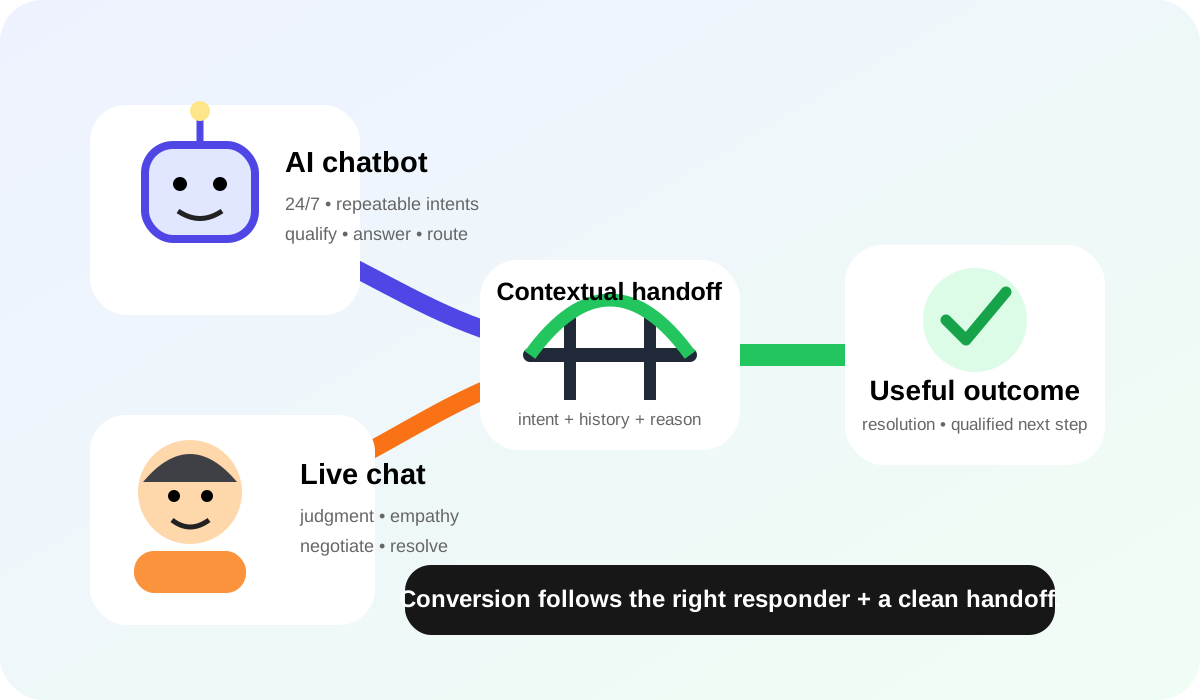
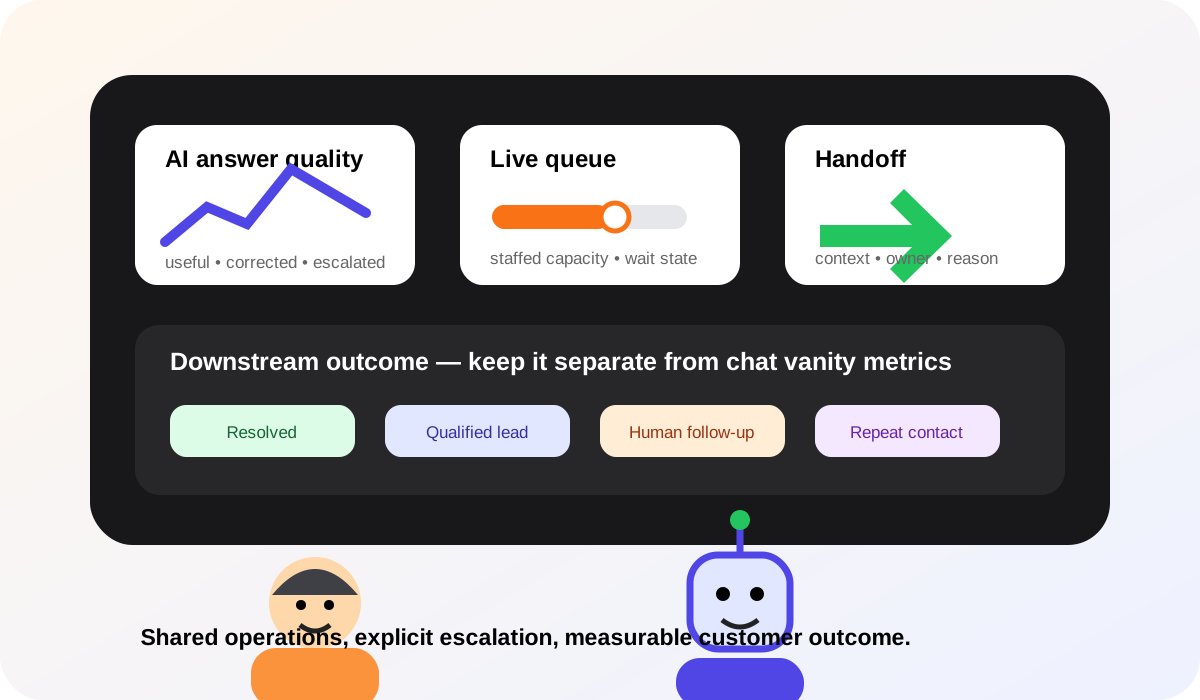
A hybrid becomes the default when availability and judgment vary inside one funnel. Let AI handle discovery, FAQs, data collection and low-risk steps; transfer to a person with the conversation summary and collected context when a threshold is reached. The quality of that transition can matter more than the label on the first responder.
Side-by-side comparison on buyer criteria
The primary decision table compares operating models rather than vendor marketing promises. “AI chatbot” here means a generative or retrieval-enabled assistant with defined knowledge and tool boundaries. “Live chat” means a human teammate responding synchronously or near-synchronously. “Hybrid” combines automation with an explicit human escalation path.
The interactive scorer below lets you change the importance of cost predictability, launch speed, ownership/control, performance, integrations, scale, governance and editor experience. The option-fit values are disclosed WebDesignK planning assumptions. They are not measured conversion rates and are not a universal platform ranking.
Conversion is a system outcome, not a widget feature
A chat surface can only convert traffic that reaches it and receives a useful next step. Measure the journey from invitation to resolution or qualified handoff: eligible sessions, starts, answered conversations, useful resolutions, escalations, wait time, handoff completion, qualified lead creation and downstream conversion. A low chat-start rate can mean poor targeting; a high start rate with weak downstream outcomes can mean the bot or staffing model creates friction.
Do not compare an always-on AI assistant with a live team that is online only eight hours and then conclude “AI converts better” from raw conversation volume. Likewise, do not compare an expert enterprise rep handling only high-intent accounts with a broad automated bot and conclude “human chat converts better” from close rate. Define the eligible population and intent before comparing outcomes.
Total cost of ownership
TCO is more than seat price or model usage. Count the operating system behind the chat experience.
For live chat, recurring cost includes staffing coverage, training, scheduling, quality review, routing, supervision, knowledge maintenance and the opportunity cost of expert time spent on repeat questions. If the business promises fast responses, coverage gaps become an operational commitment.
For an AI chatbot, cost includes implementation, model/inference or vendor usage, knowledge ingestion, integration maintenance, evaluation, prompt/instruction changes, monitoring, escalation design, security review and human review for failed or high-risk conversations. The marginal cost of handling another simple conversation may be lower than staffing another human session, but that does not make the system cheap if knowledge and integrations are complex.
For a hybrid, you pay for both systems but can reserve human capacity for conversations that benefit from judgment. The important TCO question is whether automation meaningfully reduces repetitive workload without increasing correction, escalation or customer-friction costs.
Build the model from your own conversation mix
A defensible planning model begins with current data: conversations per month, share occurring outside staffed hours, top intent categories, median handling time by intent, escalation rate, repeat-contact rate, qualified-lead rate and the percentage of conversations that require account-specific action.
Then estimate which intents are eligible for automation and measure the pilot. Do not assign a universal “AI resolves 70%” number because platform, knowledge, product complexity, language mix and customer behavior differ. Vendor case studies can be useful examples but should not be treated as your forecast.
Speed to launch and day-2 operations
A basic live-chat widget can launch quickly if staff, routing and operating hours already exist. The hard part is day 2: who is online, what response promise is shown, how conversations are assigned, how transcripts are reviewed and how repeated questions become better documentation.
An AI chatbot can also launch quickly as a demo, but production readiness depends on the knowledge boundary, evaluation set, failure behavior and handoff. Intercom documents configurable handoff paths and external ticket creation; HubSpot documents centralized handoff rules for its customer agent; Zendesk recommends designing escalation strategies for complex, urgent or sensitive inquiries. These are operational controls, not optional polish.
Day-2 ownership for AI should include:
- Knowledge owner: keeps public product, policy and support facts current.
- Conversation-quality owner: samples resolutions, failures and escalations.
- Integration owner: monitors CRM, ticketing, product and identity connections.
- Security/privacy owner: reviews data exposure, retention and permissions.
- Business owner: decides which intents may automate and which must transfer.
Live chat needs similar ownership but concentrates more of the judgment inside the teammate’s session rather than the preconfigured automation layer.
Incident response is different
For live chat, an incident may be queue overload, unavailable staffing, a routing rule failure or a teammate using outdated information. For AI, add knowledge-source failures, tool/API failures, model behavior changes, retrieval quality issues and escalation loops. Your runbook should identify how to switch the AI to read-only, disable an action, route all traffic to humans or show an alternative contact path.
SEO, performance and technical flexibility
Neither chat type is an SEO substitute. The useful content that answers important buyer questions should still exist as crawlable, linkable website content rather than only inside a chat transcript. A chatbot can help users find that content, but hiding product details, policies or documentation exclusively behind an interactive layer weakens discoverability and accessibility.
Performance matters because chat scripts often load globally. Audit JavaScript cost, third-party network requests, layout shifts and mobile interaction. Lazy-load nonessential functionality where possible and avoid blocking the primary page experience while waiting for a chat vendor or model service.
Chat should enrich the page, not obscure it
Use page context to make the conversation relevant, but keep the visitor in control. Do not cover essential content with an oversized launcher, force a modal before users can read the page, or auto-open on every visit. If proactive chat is used, trigger it from meaningful behavior rather than arbitrary delay alone.
An AI chatbot can be technically flexible when it has APIs and controlled tools, but every capability expands the security and testing surface. Live chat can be simpler because the human uses existing back-office tools directly, although it may require more agent workspace integration to avoid tab-switching and missing context.
Integrations, data ownership and lock-in
The most important integration question is not “Does it connect to our CRM?” but what does it read, what can it write, and what survives if we switch vendors?
Keep a normalized conversation export if practical: timestamp, channel, visitor/customer identifier where lawful, intent/category, responder type, resolution state, escalation reason, handoff result and downstream outcome identifiers. Store business-critical knowledge in systems you control instead of only inside a proprietary bot editor.
When AI can take actions, narrow permissions to the smallest useful capability. Reading order status is different from issuing a refund. Creating a lead note is different from changing ownership or lifecycle stage. High-impact writes should have deterministic validation and, where appropriate, human approval.
Handoff context is part of the integration contract
A poor hybrid experience asks the customer to repeat everything. Intercom’s current developer documentation describes escalation that can carry a summary into the human helpdesk; its help documentation also describes collecting information before handing off to another support tool. The design principle is portable: when switching responder, transfer the intent, relevant collected fields, attempted answer/action and reason for escalation without leaking unnecessary sensitive context.
Switching cost is lower when conversations, knowledge, intents and analytics are exportable. It rises when routing logic, proprietary scores, content and customer identity mappings exist only inside one vendor.
Security/governance/enterprise requirements
Live chat and AI chat both process customer data, but AI can add model, retrieval and tool-call boundaries that must be governed explicitly. NIST’s AI Risk Management Framework and Generative AI Profile are useful cross-sector references for identifying, measuring and managing AI risk; they are not chatbot conversion standards.
For enterprise deployment, review:
- authentication and identity propagation for logged-in users;
- least-privilege tool/API access;
- transcript and event retention;
- regional/data-processing requirements relevant to your organization;
- redaction or exclusion of sensitive fields from model context;
- approved knowledge sources and update ownership;
- audit logs for automated actions;
- escalation rules for high-risk, regulated or sensitive topics;
- prompt-injection and tool-abuse scenarios where the AI can take actions;
- a disable/fallback route when the AI or integration is unhealthy.
Human escalation is a safety control and a customer-experience control
Zendesk’s 2026 guidance explicitly recommends escalation strategies for complex, urgent or sensitive inquiries, while HubSpot lets teams define immediate or delayed human transfer rules. Intercom documents automatic and configured handoff patterns as well. The important takeaway is not that one vendor is safer; it is that mature designs treat escalation as a first-class workflow.
For legal, medical, financial or other regulated guidance, involve qualified counsel/compliance professionals and set conservative automation boundaries. This article is product/architecture guidance, not legal advice.
Scenario recommendations by company stage
Scenario 1: lean B2B team with limited coverage
A small SaaS team has one support/generalist person, frequent repeat questions and prospects arriving from multiple time zones. Documentation is reasonably current, but the team cannot promise immediate human response all day.
Best starting architecture: AI-first for documented FAQs, qualification and routing; asynchronous human follow-up or live escalation during staffed hours. The choice flips toward pure live chat if most conversations are high-value discovery calls that require product-fit judgment rather than repeatable information.
Scenario 2: growth ecommerce or SaaS team
The company has meaningful conversation volume, a staffed support/sales desk, clear product data and a CRM/helpdesk. Many questions are repetitive, but purchase blockers, billing disputes and complex product-fit discussions need people.
Best starting architecture: hybrid. Use AI for discovery, order/account-safe lookups, common support flows and information collection; route sales-ready, frustrated, sensitive or low-confidence conversations to humans with context. The choice flips toward more automation only after measured quality and escalation burden show that the additional intents are safe and useful to automate.
Scenario 3: complex enterprise or regulated environment
The organization has multiple regions, role-based data, regulated claims, strict identity/security requirements and specialized support queues. A wrong automated action or answer can create material risk.
Best starting architecture: live or tightly bounded hybrid. AI can triage, retrieve approved knowledge, summarize and collect structured context, but high-impact advice/actions remain gated. The choice flips toward broader automation only when identity, permissions, auditability, evaluations and escalation controls are mature enough for the specific intent.
Migration and switching considerations
Moving from live chat to AI does not mean replacing the inbox. Preserve transcripts, routing rules, team ownership and knowledge sources. Add an intent taxonomy, evaluation set, escalation reasons and an explicit list of tools/actions the bot may use. Run shadow or draft mode before routing substantial customer volume to the new automation.
Moving from AI to live chat requires preserving context too. Export conversation history and intent labels, keep the knowledge improvements the bot project produced, and ensure the live team sees the fields previously collected automatically. If the AI handled after-hours traffic, decide what promise replaces it when staff are unavailable.
Vendor switching checklist
When changing AI or live-chat vendors, inventory:
- widget/SDK installation and consent configuration;
- identity/customer mapping;
- conversation transcripts and analytics events;
- knowledge sources, instructions and macros;
- routing and escalation logic;
- CRM/helpdesk/ticket integrations;
- automated actions and permissions;
- saved reports, qualification fields and attribution links;
- team roles and access controls;
- fallback/incident procedures.
Run the old and new paths in a controlled overlap if possible, but avoid double-triggering users or creating duplicate tickets. Migration success is not “the widget appears”; it is continuity of context, measurement and ownership.
Decision checklist and FAQ
Before choosing the operating model, answer these questions:
- What percentage of conversations map to repeatable, documented intents?
- When are qualified humans actually available?
- Which intents require judgment, negotiation or sensitive data?
- Can the bot cite or ground answers in maintained knowledge?
- Which actions may automation perform, and which require approval?
- Is there a clear low-confidence / explicit-human-request escalation path?
- Does the handoff preserve useful context without over-sharing data?
- Can conversation and knowledge data be exported if the vendor changes?
- Are chat events connected to downstream qualified-lead/support outcomes?
- Is there a tested fallback when AI, integrations or staffing are unavailable?
Does AI chat convert better than live chat?
There is no universal answer. AI can improve availability and immediate response for repeatable intents; live chat can outperform where expertise, empathy, negotiation or trust matters. Compare the same eligible traffic and downstream outcome, not raw conversation volume.
Is hybrid always the safest choice?
Not automatically. Hybrid adds routing and operational complexity. It is valuable when distinct intents genuinely need different responders and the handoff is well designed. A simple live-chat or simple AI experience can be better than a poorly integrated hybrid.
What should an AI chatbot hand off to a person?
Common triggers include explicit requests for a person, low-confidence or unsupported answers, repeated failure, sensitive/high-risk topics, account-specific exceptions, commercial negotiation and actions outside the bot’s permissions. Configure thresholds from your own risk and service model.
Should the AI chatbot be connected to the CRM?
Only when the use case needs it. Start with read-only or narrow write capabilities, validate identifiers deterministically and log writes. Creating a lead note is lower risk than changing ownership, issuing credits or altering entitlements.
What metrics should we compare?
Use a funnel appropriate to the intent: eligible sessions, starts, answer/response time, useful resolution, escalation, handoff completion, qualified lead or task completion, repeat contact and downstream conversion. Segment by intent and responder type so averages do not hide different jobs.
What is a sensible pilot?
Choose two or three high-volume, low-risk documented intents plus one deliberate human-handoff path. Measure answer usefulness, escalation reasons, review/correction workload and downstream outcome against the existing process. Expand only when the observed quality and operating burden justify it.
Final decision rule
Choose AI-first when availability and repeatability dominate. Choose live-first when judgment and trust dominate. Choose hybrid when your funnel contains both conditions and you can operate the handoff well. The best conversion architecture is the one that gets the right visitor to a useful resolution with the least avoidable friction—not the one with the most fashionable responder.
Frequently asked questions
Does AI chat convert better than live chat?
There is no universal answer. AI can improve availability for repeatable intents, while people can be stronger for complex, trust-sensitive or negotiated conversations. Compare equivalent traffic and downstream outcomes.
Is a hybrid chatbot/live-chat model always better?
No. Hybrid adds routing and operational complexity. It is useful when different intents genuinely need different responders and the handoff is well designed.
When should an AI chatbot hand off to a human?
Typical triggers include an explicit human request, low confidence, repeated failure, sensitive/high-risk topics, account-specific exceptions, negotiation or actions outside the bot's permissions.
Should an AI chatbot connect to the CRM?
Only when the use case requires it. Prefer narrow permissions, deterministic identity validation and auditable writes. Start read-only or draft-first for higher-risk workflows.
Which conversion metrics should be compared?
Track eligible sessions, conversation starts, useful resolution, escalation, handoff completion and the downstream outcome appropriate to the intent. Segment by responder and intent rather than relying on one blended rate.
What is a sensible pilot?
Use a few high-volume, low-risk documented intents plus a deliberate human-handoff path. Measure usefulness, escalation reasons, review/correction burden and downstream outcome before expanding.