Quick answer
Do not compare “Shopify subscription” with “custom build quote” as if they are equivalent totals. Compare the same business scope across platform fees, implementation, integrations, migration, extensions, hosting/operations, security responsibility, change cost and internal staffing. The decision flips when platform constraints repeatedly collide with a strategically important workflow.
Last reviewed: 2026-09-19T00:00:00.000ZWeighted decision scorer
Set importance from 0 (not relevant) to 5 (critical). WebDesignK editorial architecture-fit assumptions. Scores help expose tradeoffs from your weights; they are not objective Shopify/custom benchmarks.
1. Grouped criterion contribution bars
Each group shows how much the current importance weight lets each option contribute on that criterion. The overall fit summary sits above the grouped bars.
2. Weighted criteria radar
Shape shows which criteria each option satisfies under your current importance settings.
- Cost predictability: weight 3
- Speed: weight 3
- Ownership / control: weight 3
- SEO / performance: weight 3
- Integrations: weight 3
- Scale / parallelism: weight 3
- Governance: weight 3
- Editor experience: weight 3
3. Criteria contribution heatmap
Cells combine each option's disclosed fit (1–5) with your importance weight (0–5).
Assumption note: option fit values are transparent WebDesignK editorial planning assumptions, not measured market performance. The result changes only from your criterion weights and the disclosed matrix.
Tables built for the buying decision
Primary decision table
| Scope tier | Typical deliverables | Team shape | Timeline driver | Major cost drivers | Best fit |
|---|---|---|---|---|---|
| Lean managed commerce | Theme/system configuration, catalog, payments, analytics, core integrations | Commerce lead + design/dev + content/QA | Content/migration readiness | Platform, theme/dev, migration, apps/integrations | Standard commerce model with few differentiating workflows |
| Growth commerce | Custom theme/components, richer merchandising, CRM/ERP/PIM, markets, experimentation | Product/commerce + design + engineering + data/QA | Integration/data dependencies | Platform, custom dev, integration, migration, tooling | Growing team needing speed plus selected customization |
| Complex/enterprise | Multi-market/B2B, advanced identity/data/integration, high governance | Product + architecture + multiple engineering/data/security roles | Architecture, migration, governance | Platform or custom runtime, integrations, operations, security, support | Complex operating model where constraints must be explicit |
Recurring-cost map
| Item | Why it exists | Cadence | Control lever |
|---|---|---|---|
| Platform/license | Managed commerce capabilities and vendor operation | Contract/monthly | Plan/term/architecture choice |
| Payments/transactions | Payment processing and provider model | Per transaction | Provider/region/payment mix |
| Apps/extensions | Capabilities not built into chosen configuration | Recurring/usage | Consolidate or custom-build strategic functions |
| Hosting/runtime | Custom/headless front end or full custom stack | Usage/contract | Architecture, caching, traffic, provider |
| Integration operations | ERP/PIM/CRM/OMS/data pipelines | Ongoing engineering/vendor | Reduce coupling, observability, contracts |
| Monitoring/support | Incident detection and recovery | Ongoing | SLO/support model/automation |
| Internal engineering | Change, reliability, platform ownership | Ongoing payroll/vendor | Managed vs owned responsibility boundary |
Sources and assumption boundaries
Fast-changing platform, pricing and search claims were reviewed on 2026-09-19T00:00:00.000Z. Interactive scores and scenarios are clearly labeled planning models, not sourced market benchmarks.
- Shopify Help Center — Shopify Plus plan Official Plus pricing and feature/plan details; reviewed September 19, 2026.
- Shopify — Plus pricing Official Shopify Plus commercial pricing page; reviewed September 19, 2026.
- Shopify Help Center — B2B features by plan Official B2B plan differences; reviewed September 19, 2026.
- Shopify Help Center — B2B and Markets Official B2B Markets behavior and plan context; reviewed September 19, 2026.
Turn this planning result into a scoped review.
Send the assumptions, constraints and result summary. WebDesignK can review the architecture/content/implementation boundary, identify missing discovery inputs and return a prioritized next-step scope.
- Bring: current site/product, constraints, integrations and your tool result.
- You get: a scoped recommendation, open questions and implementation priorities.
Choose Shopify Plus when the operating advantage of a managed commerce platform, checkout ecosystem, admin workflows and built-in capabilities outweighs the value of owning every layer. Choose a custom commerce stack when differentiating workflows, data control or integration constraints justify designing and operating more software yourself. As of September 19, 2026, Shopify lists Plus starting at $2,500 USD/month on a one-year term or $2,300 USD/month on a three-year term; implementation, apps, payments and custom development are separate cost drivers.
What you'll learn / decide
- How to compare total cost rather than headline platform fees
- Which flexibility constraints can justify custom commerce
- How B2B, markets, checkout and integrations affect scope
- How to compare proposals on an equivalent operating model
Decision snapshot for Shopify Plus vs Custom Ecommerce
The most important tradeoff is responsibility. Shopify Plus buys a managed commerce operating layer and a supported extension model; custom commerce buys deeper control while moving more reliability, security and change responsibility onto your organization.
Make the decision with explicit inputs rather than inherited assumptions. Record what is known, what still needs discovery, who owns the next decision, and what evidence will prove that a phase is complete. This matters because the same label can hide very different systems: “SaaS,” “ecommerce,” or “migration” may range from a narrow workflow to a multi-market, integration-heavy operating platform.
Separate one-time implementation from continuing operations. Architecture, content/data ownership, releases, monitoring, security, vendor/platform changes and incident response continue after launch. A good plan therefore evaluates day-two responsibilities at the same time as launch scope, and it keeps irreversible choices behind stronger evidence than reversible ones.
Use scenarios and calculators as planning aids only. They can expose dependencies, relative effort and the arithmetic consequence of user-entered assumptions, but they cannot guarantee a launch date, ranking, conversion lift or revenue outcome. Validate the actual result with production evidence and revise the backlog when observations disagree with the plan.
Direct answer and planning range framework
Build a same-scope cost model. Start with current official platform fees where applicable, then add implementation, migration, integrations, apps/extensions, custom front end/runtime, payments, data tooling, observability, support and internal product/engineering time.
Make the decision with explicit inputs rather than inherited assumptions. Record what is known, what still needs discovery, who owns the next decision, and what evidence will prove that a phase is complete. This matters because the same label can hide very different systems: “SaaS,” “ecommerce,” or “migration” may range from a narrow workflow to a multi-market, integration-heavy operating platform.
Separate one-time implementation from continuing operations. Architecture, content/data ownership, releases, monitoring, security, vendor/platform changes and incident response continue after launch. A good plan therefore evaluates day-two responsibilities at the same time as launch scope, and it keeps irreversible choices behind stronger evidence than reversible ones.
Use scenarios and calculators as planning aids only. They can expose dependencies, relative effort and the arithmetic consequence of user-entered assumptions, but they cannot guarantee a launch date, ranking, conversion lift or revenue outcome. Validate the actual result with production evidence and revise the backlog when observations disagree with the plan.
Scope tiers: lean, growth and complex/enterprise
A lean store with standard catalog/checkout needs should not be modeled like a multi-market B2B program. Growth scope adds integration and merchandising depth. Complex scope may add company-specific pricing, identity, data synchronization, governance, high-volume operations and staged migration.
Make the decision with explicit inputs rather than inherited assumptions. Record what is known, what still needs discovery, who owns the next decision, and what evidence will prove that a phase is complete. This matters because the same label can hide very different systems: “SaaS,” “ecommerce,” or “migration” may range from a narrow workflow to a multi-market, integration-heavy operating platform.
Separate one-time implementation from continuing operations. Architecture, content/data ownership, releases, monitoring, security, vendor/platform changes and incident response continue after launch. A good plan therefore evaluates day-two responsibilities at the same time as launch scope, and it keeps irreversible choices behind stronger evidence than reversible ones.
Use scenarios and calculators as planning aids only. They can expose dependencies, relative effort and the arithmetic consequence of user-entered assumptions, but they cannot guarantee a launch date, ranking, conversion lift or revenue outcome. Validate the actual result with production evidence and revise the backlog when observations disagree with the plan.
What drives cost more than page count alone
Commerce cost follows product/catalog complexity, checkout/business rules, markets, taxes/duties, fulfillment, returns, B2B, subscriptions, promotions, content model, integrations and migration quality. A small number of storefront templates can still sit on a difficult operating model.
Make the decision with explicit inputs rather than inherited assumptions. Record what is known, what still needs discovery, who owns the next decision, and what evidence will prove that a phase is complete. This matters because the same label can hide very different systems: “SaaS,” “ecommerce,” or “migration” may range from a narrow workflow to a multi-market, integration-heavy operating platform.
Separate one-time implementation from continuing operations. Architecture, content/data ownership, releases, monitoring, security, vendor/platform changes and incident response continue after launch. A good plan therefore evaluates day-two responsibilities at the same time as launch scope, and it keeps irreversible choices behind stronger evidence than reversible ones.
Use scenarios and calculators as planning aids only. They can expose dependencies, relative effort and the arithmetic consequence of user-entered assumptions, but they cannot guarantee a launch date, ranking, conversion lift or revenue outcome. Validate the actual result with production evidence and revise the backlog when observations disagree with the plan.
Team roles and delivery model
Managed platforms reduce some infrastructure/platform responsibilities but do not eliminate product ownership, data integration, QA, analytics, content operations or incident coordination. Custom stacks require stronger architecture and runtime ownership because more failure modes are yours to diagnose and repair.
Make the decision with explicit inputs rather than inherited assumptions. Record what is known, what still needs discovery, who owns the next decision, and what evidence will prove that a phase is complete. This matters because the same label can hide very different systems: “SaaS,” “ecommerce,” or “migration” may range from a narrow workflow to a multi-market, integration-heavy operating platform.
Separate one-time implementation from continuing operations. Architecture, content/data ownership, releases, monitoring, security, vendor/platform changes and incident response continue after launch. A good plan therefore evaluates day-two responsibilities at the same time as launch scope, and it keeps irreversible choices behind stronger evidence than reversible ones.
Use scenarios and calculators as planning aids only. They can expose dependencies, relative effort and the arithmetic consequence of user-entered assumptions, but they cannot guarantee a launch date, ranking, conversion lift or revenue outcome. Validate the actual result with production evidence and revise the backlog when observations disagree with the plan.
Integrations, migration and data complexity
Inventory, products, prices, customers, orders, ERP, PIM, CRM, OMS, tax and fulfillment systems create coupling. Model source-of-truth rules, IDs, retries, reconciliation and rollback before choosing on storefront aesthetics.
Make the decision with explicit inputs rather than inherited assumptions. Record what is known, what still needs discovery, who owns the next decision, and what evidence will prove that a phase is complete. This matters because the same label can hide very different systems: “SaaS,” “ecommerce,” or “migration” may range from a narrow workflow to a multi-market, integration-heavy operating platform.
Separate one-time implementation from continuing operations. Architecture, content/data ownership, releases, monitoring, security, vendor/platform changes and incident response continue after launch. A good plan therefore evaluates day-two responsibilities at the same time as launch scope, and it keeps irreversible choices behind stronger evidence than reversible ones.
Use scenarios and calculators as planning aids only. They can expose dependencies, relative effort and the arithmetic consequence of user-entered assumptions, but they cannot guarantee a launch date, ranking, conversion lift or revenue outcome. Validate the actual result with production evidence and revise the backlog when observations disagree with the plan.
Timeline and how urgency changes staffing
Urgency can justify parallel work only where dependencies permit it. Migration mapping, integration contracts and acceptance decisions often stay sequential. A fixed date should trigger scope prioritization and rehearsal rather than skipping reconciliation or checkout validation.
Make the decision with explicit inputs rather than inherited assumptions. Record what is known, what still needs discovery, who owns the next decision, and what evidence will prove that a phase is complete. This matters because the same label can hide very different systems: “SaaS,” “ecommerce,” or “migration” may range from a narrow workflow to a multi-market, integration-heavy operating platform.
Separate one-time implementation from continuing operations. Architecture, content/data ownership, releases, monitoring, security, vendor/platform changes and incident response continue after launch. A good plan therefore evaluates day-two responsibilities at the same time as launch scope, and it keeps irreversible choices behind stronger evidence than reversible ones.
Use scenarios and calculators as planning aids only. They can expose dependencies, relative effort and the arithmetic consequence of user-entered assumptions, but they cannot guarantee a launch date, ranking, conversion lift or revenue outcome. Validate the actual result with production evidence and revise the backlog when observations disagree with the plan.
One-time vs recurring operating costs
Separate implementation from the cost to change and operate the system for years. Include vendor/platform contracts, apps, infrastructure, observability, integration maintenance, security work, support and internal engineering. Compare the ownership boundary, not only monthly invoices.
Make the decision with explicit inputs rather than inherited assumptions. Record what is known, what still needs discovery, who owns the next decision, and what evidence will prove that a phase is complete. This matters because the same label can hide very different systems: “SaaS,” “ecommerce,” or “migration” may range from a narrow workflow to a multi-market, integration-heavy operating platform.
Separate one-time implementation from continuing operations. Architecture, content/data ownership, releases, monitoring, security, vendor/platform changes and incident response continue after launch. A good plan therefore evaluates day-two responsibilities at the same time as launch scope, and it keeps irreversible choices behind stronger evidence than reversible ones.
Use scenarios and calculators as planning aids only. They can expose dependencies, relative effort and the arithmetic consequence of user-entered assumptions, but they cannot guarantee a launch date, ranking, conversion lift or revenue outcome. Validate the actual result with production evidence and revise the backlog when observations disagree with the plan.
Hidden costs and scope-change traps
Common traps include assuming every legacy customization should be rebuilt, discovering data quality late, treating apps as zero-maintenance, underestimating B2B exception rules, building custom infrastructure for commodity capability, or forcing a platform through a strategically important unsupported workflow.
Make the decision with explicit inputs rather than inherited assumptions. Record what is known, what still needs discovery, who owns the next decision, and what evidence will prove that a phase is complete. This matters because the same label can hide very different systems: “SaaS,” “ecommerce,” or “migration” may range from a narrow workflow to a multi-market, integration-heavy operating platform.
Separate one-time implementation from continuing operations. Architecture, content/data ownership, releases, monitoring, security, vendor/platform changes and incident response continue after launch. A good plan therefore evaluates day-two responsibilities at the same time as launch scope, and it keeps irreversible choices behind stronger evidence than reversible ones.
Use scenarios and calculators as planning aids only. They can expose dependencies, relative effort and the arithmetic consequence of user-entered assumptions, but they cannot guarantee a launch date, ranking, conversion lift or revenue outcome. Validate the actual result with production evidence and revise the backlog when observations disagree with the plan.
How to compare proposals on equivalent scope
Give every bidder the same catalog/market/integration/migration/checkout/B2B/content/analytics/operations assumptions. Ask them to state exclusions, recurring dependencies, data ownership, extension approach, test evidence, release model and post-launch responsibilities.
Make the decision with explicit inputs rather than inherited assumptions. Record what is known, what still needs discovery, who owns the next decision, and what evidence will prove that a phase is complete. This matters because the same label can hide very different systems: “SaaS,” “ecommerce,” or “migration” may range from a narrow workflow to a multi-market, integration-heavy operating platform.
Separate one-time implementation from continuing operations. Architecture, content/data ownership, releases, monitoring, security, vendor/platform changes and incident response continue after launch. A good plan therefore evaluates day-two responsibilities at the same time as launch scope, and it keeps irreversible choices behind stronger evidence than reversible ones.
Use scenarios and calculators as planning aids only. They can expose dependencies, relative effort and the arithmetic consequence of user-entered assumptions, but they cannot guarantee a launch date, ranking, conversion lift or revenue outcome. Validate the actual result with production evidence and revise the backlog when observations disagree with the plan.
Budget FAQ and next-step brief
Prepare a one-page brief with annual revenue model only if needed for vendor pricing, catalog/SKU scale, markets, B2B/D2C mix, checkout differences, systems of record, migration volume, critical integrations, availability/support needs and the workflows that actually differentiate the business.
Make the decision with explicit inputs rather than inherited assumptions. Record what is known, what still needs discovery, who owns the next decision, and what evidence will prove that a phase is complete. This matters because the same label can hide very different systems: “SaaS,” “ecommerce,” or “migration” may range from a narrow workflow to a multi-market, integration-heavy operating platform.
Separate one-time implementation from continuing operations. Architecture, content/data ownership, releases, monitoring, security, vendor/platform changes and incident response continue after launch. A good plan therefore evaluates day-two responsibilities at the same time as launch scope, and it keeps irreversible choices behind stronger evidence than reversible ones.
Use scenarios and calculators as planning aids only. They can expose dependencies, relative effort and the arithmetic consequence of user-entered assumptions, but they cannot guarantee a launch date, ranking, conversion lift or revenue outcome. Validate the actual result with production evidence and revise the backlog when observations disagree with the plan. Close the loop with a named owner and review date so the plan remains operational after launch.
Sources and assumptions
Official documentation in the source list was reviewed on September 19, 2026. Vendor plan limits and pricing can change. Any planning scenario not explicitly sourced is an editorial framework, not a quote, benchmark or guarantee.
Frequently asked questions
What does Shopify Plus cost in the US in 2026?
Shopify currently lists $2,500 USD/month for a one-year term and $2,300 USD/month for a three-year term as starting pricing, with variable fees possible for more complex businesses. Re-check before purchase.
Is custom ecommerce always more flexible?
It can provide more control, but flexibility has an operating cost: your team owns more architecture, security, reliability, upgrades and integration behavior.
Does Shopify Plus include B2B?
Shopify supports B2B across plans in 2026, with additional Plus capabilities such as unlimited B2B market catalogs and direct company catalog assignment. Verify the current plan matrix for your exact requirement.
When is custom checkout logic a warning sign?
When a revenue-critical workflow cannot be expressed safely through the platform’s supported extension model and workarounds create persistent operational risk.
Is headless the same as fully custom commerce?
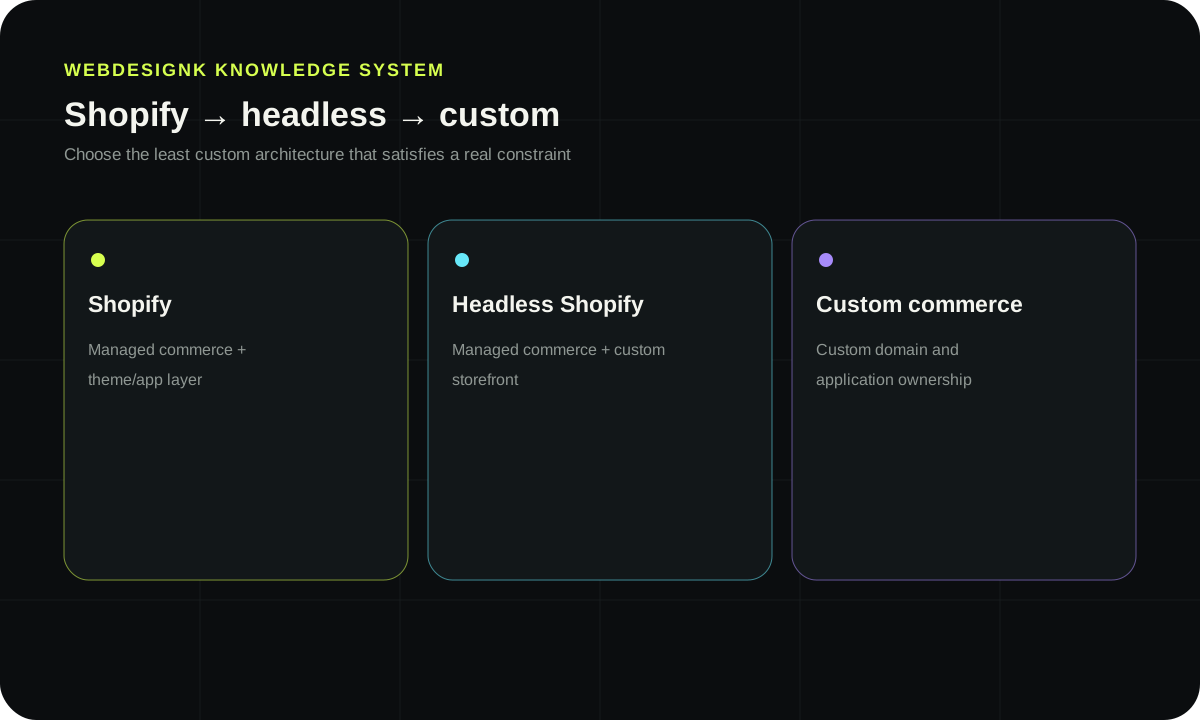
No. A headless storefront can still use Shopify as the commerce backend; fully custom commerce implies owning more backend capabilities too.
How should proposals be compared?
Normalize the same business scope, migration, integrations, data ownership, support, operations and recurring costs before comparing totals.