Quick answer
Weight cost, speed, ownership, SEO, integrations, scale, governance and merchandiser experience. The scorer uses disclosed editorial fit assumptions; it is a planning aid, not a universal platform ranking.
Last reviewed: 2026-09-19T13:04:00.000ZWeighted decision scorer
Set importance from 0 (not relevant) to 5 (critical). Shopify and Adobe Commerce / Magento fit values are transparent WebDesignK editorial planning assumptions informed by current official documentation. They model operating tradeoffs—not measured speed, security, conversion, SEO, price or market ranking. Your weights drive the result.
1. Grouped criterion contribution bars
Each group shows how much the current importance weight lets each option contribute on that criterion. The overall fit summary sits above the grouped bars.
2. Weighted criteria radar
Shape shows which criteria each option satisfies under your current importance settings.
- Cost predictability: weight 3
- Speed: weight 3
- Ownership / control: weight 3
- SEO / performance: weight 3
- Integrations: weight 3
- Scale / engineering headroom: weight 3
- Governance: weight 3
- Editor / merchandiser experience: weight 3
3. Criteria contribution heatmap
Cells combine each option's disclosed fit (1–5) with your importance weight (0–5).
Assumption note: option fit values are transparent WebDesignK editorial planning assumptions, not measured market performance. The result changes only from your criterion weights and the disclosed matrix.
Tables built for the buying decision
Primary decision table
| Criterion | Shopify | Adobe Commerce / Magento | Tradeoff | Who should care |
|---|---|---|---|---|
| TCO | Managed platform reduces some infrastructure ownership; apps/integration/implementation remain | More application, extension and lifecycle ownership; commercial model varies by edition | Predictability vs control of more cost layers | CFO, ecommerce lead, engineering |
| Launch speed | Fast when requirements fit native platform patterns | Fast with a mature reference architecture; custom builds add release complexity | Standardization vs bespoke architecture | Program owner, PMO |
| SEO / performance | Managed commerce runtime with theme/headless choices | Deep template/cache/index/infrastructure control | Managed defaults vs tuning ownership | SEO, performance engineering |
| Ownership | SaaS core with owned themes/apps/integrations around it | Greater application/deployment/infrastructure control | Less platform operation vs more architectural control | CTO, platform engineering |
| Integrations | APIs, apps and Functions cover broad patterns | APIs/extensions plus deeper application customization | Extension boundaries vs application-level freedom | ERP/PIM/OMS teams |
| Scale | Core platform capacity is managed; custom layers still need architecture | Scale depends on deployment, cache, search, indexing and operations | Vendor-managed core vs self-managed complexity | SRE, architecture |
| Security / governance | Core SaaS operated by Shopify; merchant governs users/apps/code/integrations | Adobe publishes patches; merchant/partner executes app lifecycle and testing | Reduced infrastructure burden vs direct patch lifecycle | Security, compliance, IT |
| Editorial workflow | Standardized centralized merchandising/admin experience | Powerful scoped admin; customization can increase operational complexity | Simplicity vs configurable enterprise workflows | Merchandising, content ops |
Migration map: what must be translated, not just copied
| Layer | Magento / Adobe Commerce → Shopify | Shopify → Adobe Commerce / Magento | Validation before cutover |
|---|---|---|---|
| Catalog model | Map product types/attributes/categories into products, variants, metafields and collections | Map products/variants/metafields into Magento attributes, categories and product types | SKUs, variants, media, attributes, category membership |
| B2B | Translate companies, catalogs/pricing and purchasing rules into Shopify B2B or supported extensions | Translate companies/locations/catalogs into company/shared-catalog structures where applicable | Real buyer accounts and price visibility |
| Checkout rules | Rebuild modules as native config, Functions, apps or external services | Rebuild Shopify app/Function behavior as modules/services | Edge carts, discounts, tax, shipping, payment |
| Integrations | Reconnect ERP/PIM/OMS/WMS to Shopify APIs/webhooks/apps | Reconnect to Magento/Adobe APIs/events/custom services | Retries, idempotency, reconciliation |
| SEO | Map URLs and redirects; validate canonical/schema/indexation | Same in reverse | Crawl old/new URLs and redirect coverage |
| Orders/customers | Migrate supported history or archive with service access plan | Same principle | Totals, identities, support lookup requirements |
Sources and assumption boundaries
Fast-changing platform, pricing and search claims were reviewed on 2026-09-19T13:04:00.000Z. Interactive scores and scenarios are clearly labeled planning models, not sourced market benchmarks.
- Shopify Help Center — Catalogs and pricing in B2B Official Shopify documentation for B2B catalogs, company/location assignment, product availability and pricing; reviewed September 19, 2026.
- Shopify Help Center — Expansion stores for Shopify Plus organizations Official Shopify documentation for organization-level expansion-store patterns and centralized user/billing management; reviewed September 19, 2026.
- Shopify Dev — Function APIs Official Shopify developer documentation for backend commerce extensions such as discounts, delivery options and checkout validation; reviewed September 19, 2026.
- Adobe Commerce — Company accounts Official Adobe Commerce B2B documentation for company accounts, roles and purchasing workflows; reviewed September 19, 2026.
- Adobe Commerce — Shared catalog overview Official Adobe Commerce B2B documentation for shared catalogs and company-specific catalog pricing; reviewed September 19, 2026.
- Adobe Commerce — Multiple websites or stores Official Adobe Commerce documentation for multi-website, store and store-view architecture; reviewed September 19, 2026.
- Adobe Commerce — Commerce on Cloud Infrastructure Official Adobe documentation for cloud infrastructure, Git-based build/deploy workflow and managed services; reviewed September 19, 2026.
- Adobe Commerce — Upgrade process overview Official Adobe upgrade guidance covering patch-cycle planning, security and PCI-related lifecycle responsibilities; reviewed September 19, 2026.
- Adobe Commerce — Security Official Adobe Commerce and Magento Open Source security guidance including 2FA, CAPTCHA/reCAPTCHA and security scanning; reviewed September 19, 2026.
Turn this planning result into a scoped review.
Send the assumptions, constraints and result summary. WebDesignK can review the architecture/content/implementation boundary, identify missing discovery inputs and return a prioritized next-step scope.
- Bring: current site/product, constraints, integrations and your tool result.
- You get: a scoped recommendation, open questions and implementation priorities.
Decision snapshot for Magento vs Shopify
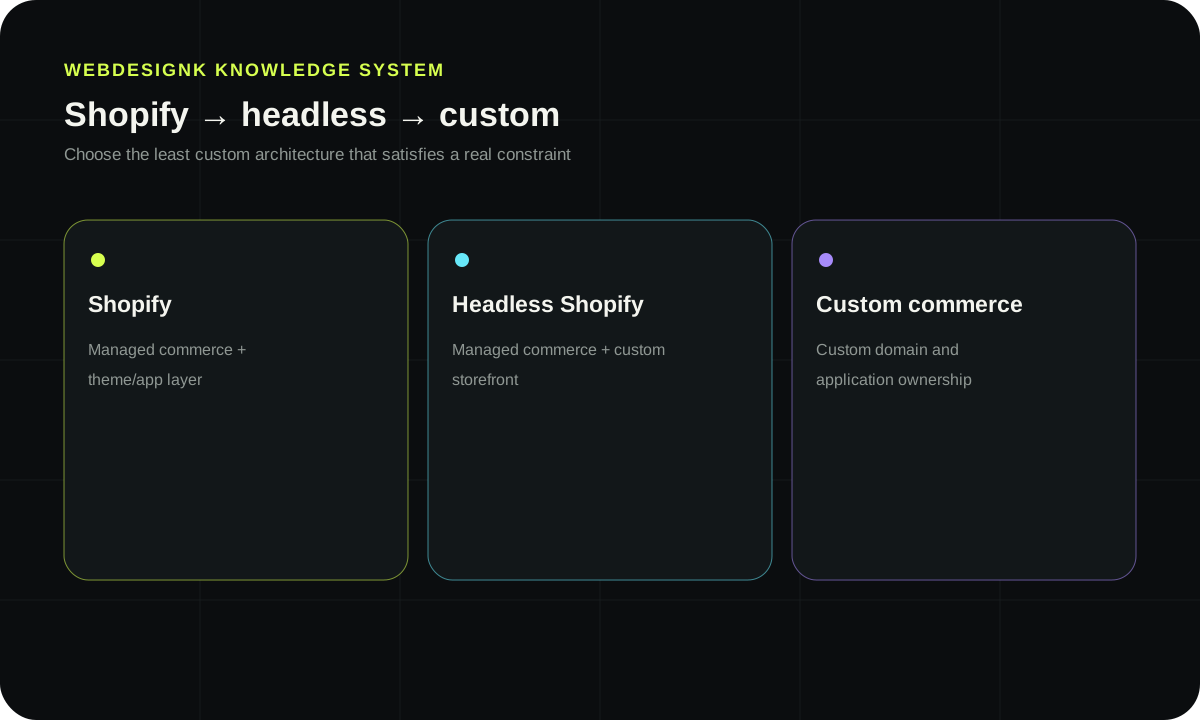
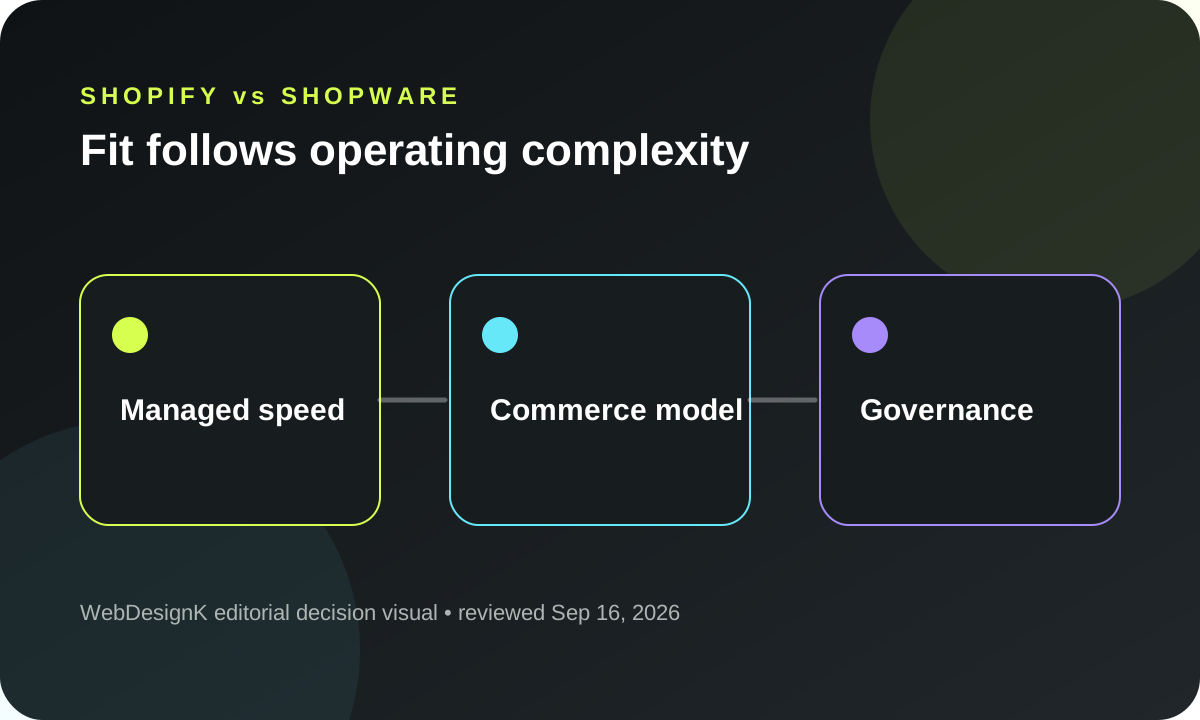
For mid-market and enterprise teams, the choice is usually less about feature checklists than about where operational responsibility lives. Shopify moves more hosting, platform maintenance and standard commerce operations into a managed service. Adobe Commerce / Magento gives engineering teams deeper control over application behavior, deployment, data models and multi-site architecture, but that control creates more ownership. The choice flips when custom commerce logic and platform control become more important than minimizing day-2 engineering work.
Last reviewed: September 19, 2026. “Magento” is often used loosely. In this guide, enterprise-specific B2B, cloud and support capabilities are attributed to Adobe Commerce when that is the product documented by Adobe. Magento Open Source should not be assumed to include every Adobe Commerce capability mentioned here.
Quick decision summary: best-fit scenarios
Choose Shopify when the business wants a managed commerce platform, a fast path to standard DTC or B2B workflows, strong merchandiser autonomy and less infrastructure ownership. It is especially attractive when the requirement can be expressed through Shopify’s native capabilities, apps, APIs and Functions rather than by changing the core commerce runtime.
Choose Adobe Commerce / a Magento-based stack when the organization has a mature engineering function and genuinely needs control over the commerce application: custom catalog behavior, bespoke integrations, unusual pricing or account structures, tightly coupled ERP/PIM/OMS workflows, multiple sites under one codebase, or deployment architecture the team must govern itself. Adobe Commerce’s current documentation supports company accounts and shared catalogs for B2B, multi-website/store structures and a cloud deployment model with Git-based build/deploy workflows.
The decision boundary
The choice usually flips toward Shopify when these conditions are true: most revenue flows through conventional catalog/cart/checkout patterns; the team wants SaaS-style operations; marketers and merchandisers need to move quickly without release engineering; and custom logic can live in supported extension surfaces. It flips toward Adobe Commerce / Magento when business advantage depends on commerce rules that are hard to fit into a managed platform’s extension model, the organization accepts a larger application-operations footprint, and engineering ownership is a strategic capability rather than an unwanted cost.
A company being “enterprise” does not automatically make Magento the answer. Shopify supports organization-level management, B2B catalogs and extensibility. Likewise, a desire for customization does not automatically make Shopify unsuitable. Shopify Functions, APIs and custom storefront options can cover many advanced needs. The important question is whether your specific complexity fits those supported extension boundaries.
Side-by-side comparison on buyer criteria
The comparison table below is designed for a buying committee, not as a universal scorecard. Read the tradeoff column first: it identifies what you are actually accepting with each choice.
| Criterion | Shopify | Adobe Commerce / Magento | Tradeoff | Who should care |
|---|---|---|---|---|
| TCO | More platform cost is bundled into a managed service; implementation, apps and integration work remain | Licensing/hosting model varies by edition; engineering, upgrades, extensions and operations can be substantial | Predictability versus control of more cost layers | CFO, ecommerce lead, engineering |
| Launch speed | Often faster when requirements fit native platform patterns | Can be fast with a mature reference architecture, but bespoke implementations create more moving parts | Standardization versus custom architecture | Program owner, agency, PMO |
| SEO / performance | Managed storefront stack plus theme/headless choices; implementation quality still matters | Deep control over templates, caching, indexing and infrastructure; tuning is your responsibility | Managed defaults versus tunable system ownership | SEO, performance engineering |
| Ownership | SaaS platform with owned theme/app/integration code around it | Greater ownership of application code, deployment and infrastructure choices | Less platform operation versus more architectural control | CTO, platform engineering |
| Integrations | Rich APIs/app ecosystem; Functions extend backend commerce logic in supported surfaces | Extensive API and extension possibilities with deeper application-level customization | Extension boundaries versus application-level freedom | ERP/PIM/OMS teams |
| Scale | Platform capacity is managed; architecture still matters for apps/headless layers | Scale depends on deployment architecture, caching, indexing and operational discipline | Vendor-managed core versus self-managed complexity | SRE, architecture |
| Security / governance | Shopify operates the core SaaS platform; your organization governs users, apps, custom code and connected systems | Adobe publishes patch/security guidance; your team or provider owns upgrade and patch execution for your stack | Reduced infrastructure burden versus direct lifecycle responsibility | Security, compliance, IT |
| Editorial workflow | Strong centralized admin and merchandising workflow | Powerful admin with configurable catalog/site scopes; customizations can increase training/operational complexity | Simplicity versus configurable enterprise workflows | Merchandising, content ops |
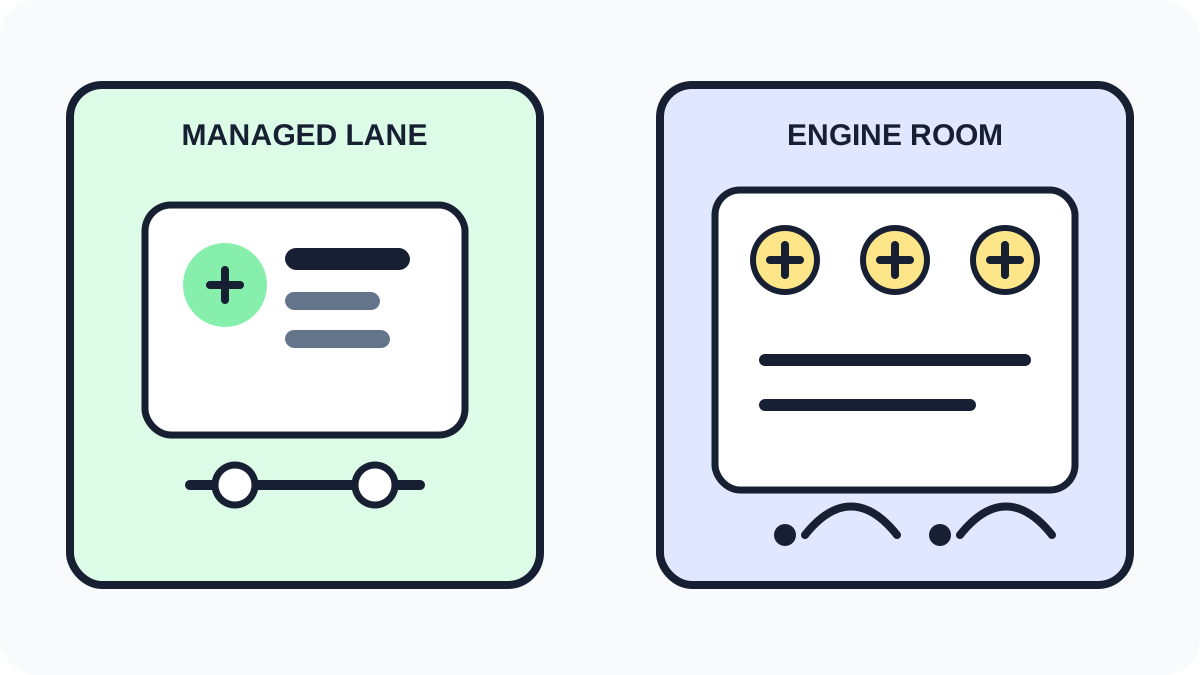
The weighted decision lab on this page uses the same eight criteria. Its fit matrix is a disclosed WebDesignK planning model—not measured platform performance. Move the sliders to expose how your priorities change the result. A buying team should then validate the highest-weight criteria in a proof of concept or architecture review.
Total cost of ownership
A meaningful TCO comparison must include more than subscription or license price. For a U.S. mid-market or enterprise buyer, map at least five cost layers: platform/commercial agreement, implementation and migration, extensions/apps, integrations and data operations, and ongoing ownership after launch. Do not compare a Shopify plan line item with an Adobe Commerce implementation budget and call the difference “platform cost.” They are different cost surfaces.
Shopify TCO is not only the platform fee
Shopify reduces some classes of infrastructure and platform maintenance because the core is delivered as a managed service. That does not eliminate implementation cost. Enterprise programs may still include complex theme or headless work, app subscriptions, custom apps, ERP/PIM/OMS integration, data migration, B2B setup, analytics and ongoing optimization. The financial advantage appears when the business can use the managed platform without rebuilding a large parallel engineering layer around it.
Adobe Commerce / Magento TCO is strongly architecture-dependent
Adobe Commerce can centralize sophisticated business logic and multi-site structures in the commerce application, but teams need to budget for lifecycle work. Adobe’s current upgrade guidance explicitly treats patch cadence as part of keeping stores secure and compliant. Cloud infrastructure provides managed platform services and automated build/deploy workflows, but the merchant or implementation partner still owns application code, extensions, configuration and release quality.
If comparing Magento Open Source, separate software license assumptions from hosting and engineering. If comparing Adobe Commerce, use the actual commercial proposal for your organization. Prices, support terms and contract structures can change; this article intentionally does not invent a representative annual figure.
A practical TCO worksheet
Model three years and assign an owner to each recurring line: platform agreement, cloud/hosting outside the platform, premium apps/extensions, support retainers, release engineering, observability, security patching, performance work, integration maintenance and merchandising administration. If a cost has no named owner, it is not yet a credible forecast.
Speed to launch and day-2 operations
Launch speed matters, but day-2 operations often decide whether a platform still feels like the right choice twelve months later.
With Shopify, the team generally spends less time operating the underlying commerce platform. Merchandisers work in a standardized admin; engineers focus on theme/headless storefronts, apps, Functions and integrations. Shopify Functions currently support custom backend logic in areas such as checkout validation, discounts and delivery-related behavior. That creates meaningful extensibility without handing the merchant the core platform runtime.
With Adobe Commerce / Magento, the engineering team owns more of the application lifecycle. Adobe Commerce on cloud infrastructure provides a Git-based workflow with automated build and deploy, and its deployment documentation emphasizes environment-aware testing. Extensions, custom modules, indexing, caches, search services, deployment configuration and patch compatibility become part of release management.
Day-2 ownership matrix
| Operational task | Shopify owner pattern | Adobe Commerce / Magento owner pattern | Question to settle before signing |
|---|---|---|---|
| Core platform upgrades | Mostly platform-managed | Merchant/partner plans application upgrades and patches | Who owns regression testing? |
| Merchandising | Ecommerce/content team | Ecommerce/content team, sometimes with more scoped configuration | Can merchandisers work without developer tickets? |
| Custom commerce logic | App/Function/integration developers | Module/application developers | Is the required logic inside supported extension boundaries? |
| Integrations | App/integration team | Integration/application team | Where is orchestration and retry logic owned? |
| Monitoring | Storefront/apps/integrations | Storefront + commerce app + services/infrastructure | Who is on call for checkout incidents? |
| Security lifecycle | Apps, users, custom code, connected systems | Those layers plus application patch/upgrade execution | Is patch cadence staffed and tested? |
A platform that launches four weeks earlier but requires an operating model your company cannot sustain is not actually faster. The realistic speed metric is time to a stable release process, not only time to the first production URL.
SEO, performance and technical flexibility
Both platforms can support strong technical SEO. Neither grants rankings automatically. The buyer should evaluate routing, metadata, canonical logic, structured data, faceted navigation, internationalization, redirects, rendering, image delivery and performance using the actual implementation plan.
Shopify standardizes more of the commerce runtime. That can reduce infrastructure choices while still leaving meaningful control in themes, storefront APIs, apps and custom storefronts. The tradeoff is that some deep platform behavior must be implemented through supported APIs and extension points rather than arbitrary changes to the core application.
Adobe Commerce / Magento gives teams more direct control over application and deployment architecture. A single Adobe Commerce instance can support multiple websites, stores and store views with different domains, languages, catalogs and currencies. That flexibility is valuable for complex organizations, but Adobe’s own multi-site cloud guidance warns that additional stores can increase indexing time and affect uncached response performance. More flexibility means more architecture work, not free scale.
What to test in a proof of concept
Do not benchmark empty demo stores. Test your real hardest cases: a high-variant product, your largest category, logged-in B2B pricing, search/filter behavior, checkout customizations, international routes, a representative ERP sync and the content workflow for a campaign launch. Measure page behavior and operational effort together.
Integrations, data ownership and lock-in
Both choices create switching costs, just in different places.
Shopify gives you APIs, apps and custom code, but the platform’s internal commerce runtime remains vendor-operated. Shopify Plus organizations can centrally manage stores, and Shopify’s B2B catalogs can assign products and pricing to companies and locations. These capabilities can simplify common enterprise patterns. But if critical processes depend on a specific app, checkout extension or proprietary integration, those dependencies are part of your lock-in map.
Adobe Commerce / Magento gives deeper control over the commerce application and data model, but custom modules and extension ecosystems can also create coupling. A heavily customized implementation may technically be “owned” while still being expensive to move because business rules are embedded across code, database structures and integration contracts.
Data ownership is not the same as migration simplicity
Ask for export and migration plans for products, variants, media, customers, company accounts, price lists/catalogs, orders, gift cards/credits, discounts, redirects, content, metafields/custom attributes and consent records. Then identify what cannot be migrated one-for-one because the destination uses a different data model.
Security/governance/enterprise requirements
Security is an operating model, not a platform checkbox. Shopify reduces the amount of infrastructure the merchant directly administers, but organizations still govern identity, permissions, apps, API credentials, custom code, domains, integrations and data-handling practices. Shopify Plus supports organization-level permissions and centralized store management, which can help larger teams separate responsibilities.
Adobe Commerce exposes more lifecycle responsibility. Adobe publishes security patches, upgrade guidance, two-factor authentication controls and security scanning guidance for Adobe Commerce and Magento Open Source. Its upgrade documentation recommends planning patch cycles and testing before production deployment. That is a concrete governance requirement for the team running the stack.
For regulated or high-risk environments, map controls rather than relying on product labels: SSO/identity model, privileged access, auditability, change approval, secret management, release segregation, incident response, backup/restore, vendor risk and data residency requirements. Legal and compliance questions should be reviewed with qualified counsel and your security team.
Scenario recommendations by company stage
Scenario 1: lean mid-market ecommerce team
A 15-person ecommerce organization has a small engineering team, standard DTC checkout, common SaaS integrations and frequent campaign launches. Their scarce resource is developer attention. The decision boundary usually points toward Shopify because managed operations and merchant autonomy match the constraint. A Magento-based stack would need a specific business reason—such as unusual commerce logic that cannot be supported cleanly through Shopify’s extension surfaces—to justify the heavier ownership model.
Scenario 2: growth team with B2B and ERP complexity
A manufacturer sells DTC and to thousands of business buyers. It needs company-specific catalogs/pricing, ERP synchronization, approval-like purchasing workflows and multiple regional stores. This is not automatically a Magento win. Shopify’s current B2B tooling includes company/catalog pricing patterns, while Adobe Commerce B2B supports company accounts and shared catalogs with company-specific pricing. The team should prototype the hardest pricing, account and ERP flows in both architectures, then compare operational burden.
Scenario 3: complex enterprise with commerce as a software platform
A global enterprise has dedicated platform engineering, several brands, highly customized order orchestration, legacy integrations and strict release governance. If the commerce layer must behave like an internally governed application platform, Adobe Commerce / Magento can align with that ownership model. Shopify can still be viable—especially when the enterprise is willing to redesign processes around supported platform primitives—but the fit test should focus on extension boundaries and integration architecture, not on brand size.
Scenario 4: enterprise trying to simplify after years of customization
A company may already run Magento successfully but want to reduce upgrade and extension burden. In that case Shopify deserves evaluation even if revenue and catalog size are large. The key migration question is whether old customizations represent true competitive requirements or accumulated implementation history. Replatforming is often a chance to delete unnecessary complexity, not replicate every old module.
Migration and switching considerations
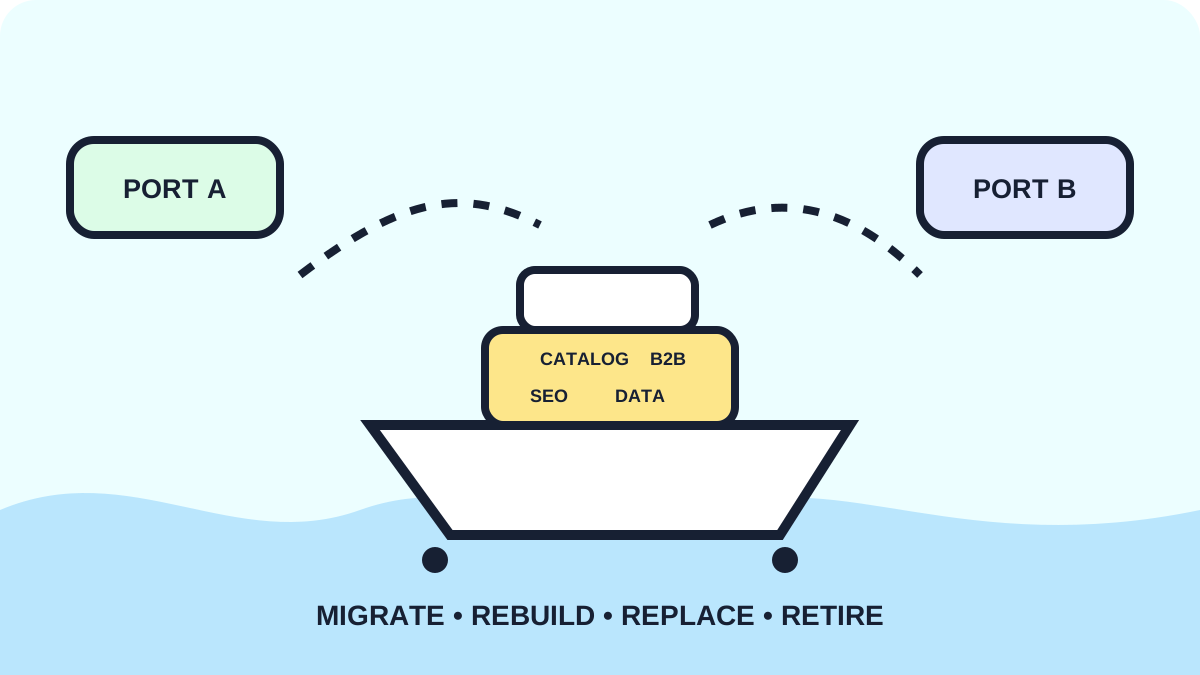
Replatforming risk concentrates in business rules, data semantics and SEO continuity—not in moving the homepage design.
| Migration layer | Magento / Adobe Commerce → Shopify | Shopify → Adobe Commerce / Magento | Validation before cutover |
|---|---|---|---|
| Catalog model | Map configurable/simple products, attributes, categories, media and URLs to Shopify product/variant/metafield structures | Map products/variants/metafields into Magento attributes, categories and product types | SKU/variant counts, images, attributes, category membership |
| B2B | Translate companies, catalogs/pricing and purchasing rules to Shopify B2B capabilities or apps/custom logic | Translate companies/locations/catalogs into Adobe Commerce company/shared-catalog structures where applicable | Real buyer accounts, price visibility, ordering permissions |
| Checkout/business rules | Rebuild custom modules in native Shopify configuration, Functions, apps or external services | Rebuild Shopify app/Function behavior as Magento modules/services | Edge-case carts, discounts, tax/shipping/payment behavior |
| Integrations | Reconnect ERP/PIM/OMS/WMS to Shopify APIs/webhooks/apps | Reconnect systems to Magento/Adobe Commerce APIs/events/custom services | Retries, idempotency, reconciliation, failure handling |
| SEO | Preserve URL intent with redirects; validate canonical/indexation/schema | Same requirement in reverse | Crawl old/new URLs, redirect map, canonical/schema parity |
| Orders/customers | Migrate what destination and policy permit; archive history when needed | Same principle | Totals, customer identity, service-team lookup needs |
Do not promise a “like-for-like” migration until the models are mapped
A feature with the same business name can have a different technical representation. Product bundles, company hierarchies, price rules, store scopes, metafields/attributes and app/module behavior need explicit mapping. The safest plan inventories the current system, labels each item migrate / rebuild / replace / retire, then assigns test evidence for each critical flow.
Protect SEO as a release workstream
Build a source-to-destination URL inventory, preserve high-value paths where practical, implement redirects before launch, verify canonicals and structured data, update internal links and monitor crawl/indexation after cutover. Do not wait until launch week to discover that platform-specific URL structures differ.
Decision checklist and FAQ
Before selecting a platform, get written answers to these questions:
- Which five commerce workflows create competitive advantage versus commodity operations?
- Which requirements must run inside checkout or pricing, and which can live in external services?
- Who owns platform upgrades, patches, apps/extensions and regression testing?
- Can merchandisers launch common campaigns without engineering releases?
- Which ERP/PIM/OMS/WMS integrations are revenue-critical, and what are their failure modes?
- How many brands, regions, catalogs and B2B account structures must the architecture support?
- What data and business rules would be expensive to move in three years?
- What proof-of-concept scenario would falsify the preferred architecture?
The decision scorer above is most useful after the buying committee agrees on these facts. Set high weights only on criteria that have a named business consequence. Then copy the result into discovery as a hypothesis—not as a procurement verdict.
FAQ: Is Shopify only for smaller companies?
No. Shopify provides enterprise-oriented organization, B2B and extension capabilities. Company size alone is not a useful decision rule. The meaningful constraint is whether your commerce model fits Shopify’s supported platform and extension surfaces.
FAQ: Is Magento Open Source the same as Adobe Commerce?
No. They share a product lineage, but Adobe Commerce includes commercial capabilities and services that should not be assumed to exist in Magento Open Source. Always verify the exact edition behind a feature claim.
FAQ: Is Adobe Commerce always more customizable?
It offers deep application-level customization and deployment control, but “more customizable” is incomplete without the cost of owning that customization. Shopify also supports significant customization through themes, APIs, apps, Functions and custom storefront architectures.
FAQ: Which is better for B2B?
Both can support serious B2B use cases. Shopify documents B2B catalogs, company/location assignment, quantity rules and volume pricing. Adobe Commerce B2B documents company accounts and shared catalogs. Your hardest pricing, approval, account and ERP workflows should decide the fit.
FAQ: Which platform is better for SEO?
Neither platform guarantees better organic performance. Technical SEO depends on the implementation: information architecture, rendering, templates, crawl controls, redirects, schema, content and performance. Compare the exact storefront architecture you plan to ship.
FAQ: When should we get an architecture review?
Before committing when replatforming touches multiple brands, B2B, custom checkout or pricing, large integration estates, headless storefronts, complex data migration or strict governance. A short architecture review can identify which requirements truly differentiate the platforms before implementation contracts are signed.
Frequently asked questions
Is Shopify only for smaller companies?
No. Shopify provides enterprise-oriented organization, B2B and extension capabilities. Company size alone is not a useful decision rule; requirements and operating model matter more.
Is Magento Open Source the same as Adobe Commerce?
No. They share a product lineage, but enterprise-specific commercial capabilities and services documented for Adobe Commerce should not automatically be attributed to Magento Open Source.
Is Adobe Commerce always more customizable?
It offers deep application-level control, but that customization carries ownership and lifecycle cost. Shopify also supports substantial customization through themes, APIs, apps, Functions and custom storefronts.
Which is better for B2B?
Both can support serious B2B patterns. Validate your hardest company, catalog, pricing, permissions and ERP workflows against the exact edition and architecture you plan to buy.
Which platform is better for SEO?
Neither guarantees stronger rankings. Technical SEO depends on the storefront implementation, information architecture, rendering, redirects, schema, crawl controls, content and performance.
When should we get an architecture review?
Before committing when the program involves multi-brand or international structures, B2B, custom checkout/pricing, complex integrations, headless storefronts, heavy migration or strict governance.