Quick answer
Start with the highest-intent, highest-volume friction you can verify: product clarity, trust, cart and checkout recovery, mobile usability, payment/shipping expectations, or performance. Preserve guardrails such as margin, refunds, support load and lead/order quality. The calculator is a scenario tool, not a forecast.
Last reviewed: 2026-09-19T00:00:00.000ZRevenue-impact scenario calculator
Enter your own eligible traffic or leads, observed conversion rate, modeled conversion rate, average order/deal value and margin. The defaults are illustrative placeholders only—not market benchmarks. Results are arithmetic scenarios, not promised uplift.
1. Conversion scenario across traffic checkpoints
Takeaway: the gap scales with your eligible volume only because the modeled rate is applied consistently to your own traffic input.
2. Baseline vs modeled revenue
Takeaway: revenue follows conversions × your average order/deal value; no extra uplift assumption is added.
3. Modeled revenue composition
Takeaway: margin changes the economic value of a conversion without changing the conversion count itself.
Scenario table generated from your inputs
| Measure | Current | Modeled | Difference |
|---|---|---|---|
| Conversion rate | 2% | 2.5% | 0.5 pp |
| Conversions | 200 | 250 | 50 |
| Revenue | $40,000 | $50,000 | $10,000 |
| Gross profit | $20,000 | $25,000 | $5,000 |
Important: this calculator does not estimate causality or probability. A modeled conversion rate is a planning assumption until a valid experiment or other evidence supports the change.
Tables built for the buying decision
Primary decision table
| Change | Funnel area | Evidence to look for | Primary metric | Guardrail | Effort |
|---|---|---|---|---|---|
| Clarify product value above the fold | Product page | Search terms, recordings, support questions | Product-to-cart progression | Bounce quality / returns | Low |
| Put shipping and returns expectations before checkout | Product/cart | Exit points, support tickets | Cart-to-checkout progression | Refunds / margin | Low |
| Show total-cost surprises earlier | Cart | Checkout exits after fees | Checkout completion | Margin | Medium |
| Improve variant selection clarity | Product page | Variant errors, unavailable combinations | Add-to-cart success | Wrong-item returns | Medium |
| Make stock state explicit | Product page | Backorder contacts, failed adds | Qualified add-to-cart | Cancellations | Low |
| Use descriptive product media and alt text | Product page | Zoom use, accessibility audit | Product engagement | Performance | Medium |
| Make mobile tap targets and controls easier | Mobile PDP/cart | Misclicks, rage taps | Mobile task completion | Desktop parity | Medium |
| Reduce nonessential checkout fields | Checkout | Field abandonment, CRM needs | Checkout completion | Fraud / fulfillment data | Medium |
| Use correct input types and autofill | Checkout | Mobile entry errors | Form completion | Data quality | Low |
| Place validation beside the failing field | Checkout | Repeat validation errors | Error recovery | Support contacts | Low |
| Keep cart state stable across navigation | Cart | Cart-loss reports | Return-to-cart completion | Storage/privacy | Medium |
| Explain payment options before the last step | Cart/checkout | Payment-step exits | Payment progression | Payment cost | Low |
| Audit payment failures by reason | Payment | Gateway error logs | Successful payment | Fraud / chargebacks | Medium |
| Compress/defer heavy media and third parties | Sitewide | Field performance, waterfall | Target-task completion | Visual quality / analytics | High |
| Make search tolerant of buyer language | Search | Zero-result queries | Search-to-product progression | Relevance | Medium |
| Improve category filters for real attributes | Collection | Filter usage, search terms | Product discovery | Indexability | Medium |
| Keep filtering state understandable on mobile | Collection | Back-button loss, reset confusion | Collection progression | Performance | Medium |
| Add decision-useful proof near CTA | PDP | Objections in reviews/support | Qualified add-to-cart | Page density | Low |
| Make delivery dates contextual and honest | PDP/cart | Shipping questions | Checkout start | Promise accuracy | Medium |
| Reduce coupon-code distraction | Cart | Coupon search exits | Checkout start | Promotion strategy | Low |
| Provide recovery after out-of-stock selection | PDP | Dead-end exits | Alternative selection | Inventory accuracy | Medium |
| Persist meaningful errors after rerender | Checkout | Lost error messages | Recovery completion | Accessibility | Low |
| Segment landing pages by campaign intent | Landing page | Source-message mismatch | Qualified product progression | Campaign consistency | Medium |
| Instrument funnel events consistently | Measurement | Missing/duplicate events | Measurement completeness | PII / consent | Medium |
| Review post-purchase friction too | Post purchase | Cancellations, tickets, returns | Net order value / retention signal | Support load | Medium |
Experiment prioritization record
| Hypothesis | Segment | Evidence | Change | Primary metric | Guardrail | Owner | Decision date |
|---|---|---|---|---|---|---|---|
| Shipping uncertainty blocks mobile buyers | Mobile paid traffic | Exit + support evidence | Expose delivery/returns before cart | Qualified checkout starts | Refunds / margin | Growth + product | After sufficient measured exposure |
| Form friction creates avoidable errors | Mobile checkout | Validation logs | Improve inputs/autofill/error placement | Checkout completion | Fraud/data quality | Product + engineering | After QA and measured release |
Sources and assumption boundaries
Fast-changing platform, pricing and search claims were reviewed on 2026-09-19T00:00:00.000Z. Interactive scores and scenarios are clearly labeled planning models, not sourced market benchmarks.
- Google Analytics — Ecommerce measurement Official GA4 guidance for ecommerce actions, value and currency; reviewed September 19, 2026.
- Google Analytics — Traffic acquisition report Official acquisition-report definitions used for source and intent segmentation; reviewed September 19, 2026.
- web.dev — Core Web Vitals Official performance guidance for user-centered web performance signals; reviewed September 19, 2026.
- W3C WAI — Forms tutorial Accessibility guidance for labels, instructions, validation and usable forms; reviewed September 19, 2026.
Turn this planning result into a scoped review.
Send the assumptions, constraints and result summary. WebDesignK can review the architecture/content/implementation boundary, identify missing discovery inputs and return a prioritized next-step scope.
- Bring: current site/product, constraints, integrations and your tool result.
- You get: a scoped recommendation, open questions and implementation priorities.
Ecommerce conversion optimization works best when you stop treating every “best practice” as a universal fix. Define the purchase decision, measure the current funnel by device and source, identify friction with behavioral and operational evidence, then prioritize changes by impact, confidence, effort and risk. Model potential revenue arithmetically, but validate actual uplift through measured releases or experiments rather than promising a percentage in advance.
What you'll learn / decide
- How to turn observed friction into a ranked CRO backlog
- Which 25 changes are worth checking before cosmetic redesign work
- How to segment the funnel so averages do not hide device or traffic problems
- How to model revenue consequences without claiming guaranteed uplift
Decision snapshot for Ecommerce Conversion Optimization
The core decision is not which “25 hacks” to install. It is which verified friction deserves scarce product, design and engineering time first. Start where buyer intent and business value are high, where the failure is observable, and where the change can be measured without damaging margin, returns, fraud or support load.
A useful decision here starts with evidence from your own funnel, product or delivery environment rather than an industry average. Define the user or business outcome first, document the current state, and name the constraint that would make a recommendation change. This keeps the work falsifiable: the team can point to the observation behind a priority and can later check whether the change solved the intended problem.
Treat the plan as a sequence of reversible decisions. Separate facts you can verify now from assumptions that need measurement, then assign an owner, validation method and guardrail. Avoid turning a planning scenario into a promise. A model can show arithmetic consequences, effort or dependency order, but it cannot prove future conversion, revenue or delivery speed before the work is shipped and observed.
For implementation, prefer the smallest change that can answer the next important question without creating avoidable migration or maintenance debt. Record the baseline, ship with instrumentation, inspect the result by meaningful segments, and keep the next action tied to what the evidence actually says.
Define the visitor decision and business outcome
Name the exact decision: choose a product, trust the merchant, understand delivery, select a variant, start checkout, pay successfully, or return for another purchase. Different decisions need different evidence and denominators; a sitewide conversion percentage is too blunt to diagnose them.
A useful decision here starts with evidence from your own funnel, product or delivery environment rather than an industry average. Define the user or business outcome first, document the current state, and name the constraint that would make a recommendation change. This keeps the work falsifiable: the team can point to the observation behind a priority and can later check whether the change solved the intended problem.
Treat the plan as a sequence of reversible decisions. Separate facts you can verify now from assumptions that need measurement, then assign an owner, validation method and guardrail. Avoid turning a planning scenario into a promise. A model can show arithmetic consequences, effort or dependency order, but it cannot prove future conversion, revenue or delivery speed before the work is shipped and observed.
For implementation, prefer the smallest change that can answer the next important question without creating avoidable migration or maintenance debt. Record the baseline, ship with instrumentation, inspect the result by meaningful segments, and keep the next action tied to what the evidence actually says.
Capture the baseline before changing anything
Freeze the measurement definition before you optimize. Document eligible sessions/users, event names, device, geography, acquisition source, new/returning status and major merchandising periods. Confirm that duplicate events, consent behavior and payment redirects are not corrupting the baseline.
A useful decision here starts with evidence from your own funnel, product or delivery environment rather than an industry average. Define the user or business outcome first, document the current state, and name the constraint that would make a recommendation change. This keeps the work falsifiable: the team can point to the observation behind a priority and can later check whether the change solved the intended problem.
Treat the plan as a sequence of reversible decisions. Separate facts you can verify now from assumptions that need measurement, then assign an owner, validation method and guardrail. Avoid turning a planning scenario into a promise. A model can show arithmetic consequences, effort or dependency order, but it cannot prove future conversion, revenue or delivery speed before the work is shipped and observed.
For implementation, prefer the smallest change that can answer the next important question without creating avoidable migration or maintenance debt. Record the baseline, ship with instrumentation, inspect the result by meaningful segments, and keep the next action tied to what the evidence actually says.
Find the highest-friction moments
Combine quantitative drop-offs with qualitative and operational evidence: zero-result searches, repeated validation errors, support questions, payment failures, returns reasons and observed dead ends. A high drop-off alone is not proof of a UX defect; some steps naturally filter low intent.
A useful decision here starts with evidence from your own funnel, product or delivery environment rather than an industry average. Define the user or business outcome first, document the current state, and name the constraint that would make a recommendation change. This keeps the work falsifiable: the team can point to the observation behind a priority and can later check whether the change solved the intended problem.
Treat the plan as a sequence of reversible decisions. Separate facts you can verify now from assumptions that need measurement, then assign an owner, validation method and guardrail. Avoid turning a planning scenario into a promise. A model can show arithmetic consequences, effort or dependency order, but it cannot prove future conversion, revenue or delivery speed before the work is shipped and observed.
For implementation, prefer the smallest change that can answer the next important question without creating avoidable migration or maintenance debt. Record the baseline, ship with instrumentation, inspect the result by meaningful segments, and keep the next action tied to what the evidence actually says.
Message, proof, CTA and form/checkout design
Improve clarity before adding persuasion. Product benefit, price context, availability, delivery/returns, proof and the next action should be legible in the moment the buyer needs them. Forms should ask only for fields the operation actually uses and explain recoverable errors near the source.
A useful decision here starts with evidence from your own funnel, product or delivery environment rather than an industry average. Define the user or business outcome first, document the current state, and name the constraint that would make a recommendation change. This keeps the work falsifiable: the team can point to the observation behind a priority and can later check whether the change solved the intended problem.
Treat the plan as a sequence of reversible decisions. Separate facts you can verify now from assumptions that need measurement, then assign an owner, validation method and guardrail. Avoid turning a planning scenario into a promise. A model can show arithmetic consequences, effort or dependency order, but it cannot prove future conversion, revenue or delivery speed before the work is shipped and observed.
For implementation, prefer the smallest change that can answer the next important question without creating avoidable migration or maintenance debt. Record the baseline, ship with instrumentation, inspect the result by meaningful segments, and keep the next action tied to what the evidence actually says.
Mobile-specific friction
Audit with real narrow viewports and touch behavior. Pay attention to sticky elements covering content, variant selectors, keyboard types, address entry, error recovery, filter drawers, cart editing and payment handoffs. Mobile optimization is not just making desktop components smaller.
A useful decision here starts with evidence from your own funnel, product or delivery environment rather than an industry average. Define the user or business outcome first, document the current state, and name the constraint that would make a recommendation change. This keeps the work falsifiable: the team can point to the observation behind a priority and can later check whether the change solved the intended problem.
Treat the plan as a sequence of reversible decisions. Separate facts you can verify now from assumptions that need measurement, then assign an owner, validation method and guardrail. Avoid turning a planning scenario into a promise. A model can show arithmetic consequences, effort or dependency order, but it cannot prove future conversion, revenue or delivery speed before the work is shipped and observed.
For implementation, prefer the smallest change that can answer the next important question without creating avoidable migration or maintenance debt. Record the baseline, ship with instrumentation, inspect the result by meaningful segments, and keep the next action tied to what the evidence actually says.
Segment by source and intent
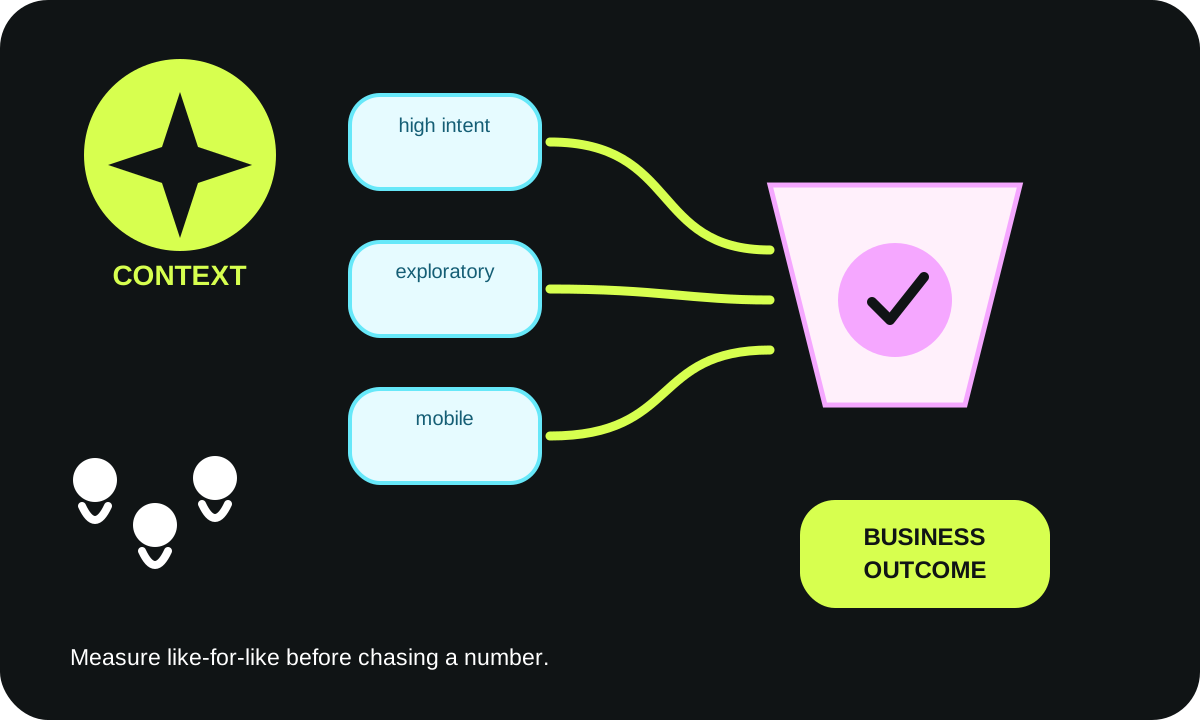
Paid campaign traffic, branded search, category discovery, email return visits and direct high-intent buyers can behave differently. Diagnose within comparable segments before concluding that a page is “bad.” Use stable event definitions so segment comparisons remain interpretable.
A useful decision here starts with evidence from your own funnel, product or delivery environment rather than an industry average. Define the user or business outcome first, document the current state, and name the constraint that would make a recommendation change. This keeps the work falsifiable: the team can point to the observation behind a priority and can later check whether the change solved the intended problem.
Treat the plan as a sequence of reversible decisions. Separate facts you can verify now from assumptions that need measurement, then assign an owner, validation method and guardrail. Avoid turning a planning scenario into a promise. A model can show arithmetic consequences, effort or dependency order, but it cannot prove future conversion, revenue or delivery speed before the work is shipped and observed.
For implementation, prefer the smallest change that can answer the next important question without creating avoidable migration or maintenance debt. Record the baseline, ship with instrumentation, inspect the result by meaningful segments, and keep the next action tied to what the evidence actually says.
Prioritized experiment backlog
Write each item as a hypothesis with evidence, segment, change, primary metric, guardrail, effort and owner. Confidence should describe evidence quality, not enthusiasm. A small, well-instrumented repair can outrank a dramatic redesign when it answers an important question faster.
A useful decision here starts with evidence from your own funnel, product or delivery environment rather than an industry average. Define the user or business outcome first, document the current state, and name the constraint that would make a recommendation change. This keeps the work falsifiable: the team can point to the observation behind a priority and can later check whether the change solved the intended problem.
Treat the plan as a sequence of reversible decisions. Separate facts you can verify now from assumptions that need measurement, then assign an owner, validation method and guardrail. Avoid turning a planning scenario into a promise. A model can show arithmetic consequences, effort or dependency order, but it cannot prove future conversion, revenue or delivery speed before the work is shipped and observed.
For implementation, prefer the smallest change that can answer the next important question without creating avoidable migration or maintenance debt. Record the baseline, ship with instrumentation, inspect the result by meaningful segments, and keep the next action tied to what the evidence actually says.
Model revenue impact without promising uplift
Scenario modeling is useful for deciding whether a problem is economically worth investigating. Enter traffic, baseline conversion, a modeled rate and average order value; if margin matters, include it. The output is multiplication, not evidence that the modeled rate will occur.
A useful decision here starts with evidence from your own funnel, product or delivery environment rather than an industry average. Define the user or business outcome first, document the current state, and name the constraint that would make a recommendation change. This keeps the work falsifiable: the team can point to the observation behind a priority and can later check whether the change solved the intended problem.
Treat the plan as a sequence of reversible decisions. Separate facts you can verify now from assumptions that need measurement, then assign an owner, validation method and guardrail. Avoid turning a planning scenario into a promise. A model can show arithmetic consequences, effort or dependency order, but it cannot prove future conversion, revenue or delivery speed before the work is shipped and observed.
For implementation, prefer the smallest change that can answer the next important question without creating avoidable migration or maintenance debt. Record the baseline, ship with instrumentation, inspect the result by meaningful segments, and keep the next action tied to what the evidence actually says.
Measurement and guardrail metrics
Use one primary decision metric plus guardrails that catch harmful side effects: revenue per eligible session, margin, refunds, cancellations, fraud, support contacts, error rate, page performance or accessibility. Interpret short-term wins carefully when merchandising, campaigns or inventory changed at the same time.
A useful decision here starts with evidence from your own funnel, product or delivery environment rather than an industry average. Define the user or business outcome first, document the current state, and name the constraint that would make a recommendation change. This keeps the work falsifiable: the team can point to the observation behind a priority and can later check whether the change solved the intended problem.
Treat the plan as a sequence of reversible decisions. Separate facts you can verify now from assumptions that need measurement, then assign an owner, validation method and guardrail. Avoid turning a planning scenario into a promise. A model can show arithmetic consequences, effort or dependency order, but it cannot prove future conversion, revenue or delivery speed before the work is shipped and observed.
For implementation, prefer the smallest change that can answer the next important question without creating avoidable migration or maintenance debt. Record the baseline, ship with instrumentation, inspect the result by meaningful segments, and keep the next action tied to what the evidence actually says.
90-day optimization roadmap
Sequence work into measurement repair, high-confidence friction fixes, controlled experiments and follow-up. The roadmap should stay editable: when evidence disproves a hypothesis, remove it rather than defending the original plan. Keep a decision log so future teams know why a change was made.
A useful decision here starts with evidence from your own funnel, product or delivery environment rather than an industry average. Define the user or business outcome first, document the current state, and name the constraint that would make a recommendation change. This keeps the work falsifiable: the team can point to the observation behind a priority and can later check whether the change solved the intended problem.
Treat the plan as a sequence of reversible decisions. Separate facts you can verify now from assumptions that need measurement, then assign an owner, validation method and guardrail. Avoid turning a planning scenario into a promise. A model can show arithmetic consequences, effort or dependency order, but it cannot prove future conversion, revenue or delivery speed before the work is shipped and observed.
For implementation, prefer the smallest change that can answer the next important question without creating avoidable migration or maintenance debt. Record the baseline, ship with instrumentation, inspect the result by meaningful segments, and keep the next action tied to what the evidence actually says. That final review loop is what turns a one-time project into an operating system the team can maintain.
Sources and assumptions
The source list below is used for platform and measurement definitions. Planning ranges, prioritization language and scenarios in this guide are editorial frameworks, not promised performance. Re-check vendor pricing, plan limits, legal requirements and product documentation before committing budget or architecture.
Frequently asked questions
What is ecommerce CRO?
A disciplined process for improving the proportion of eligible visitors who complete valuable ecommerce actions while protecting business guardrails.
Should I copy competitor checkout patterns?
Use competitors for questions, not proof. Validate changes against your own customers, platform constraints and measurement.
What is the best first CRO test?
The first useful test targets a high-impact friction point supported by evidence and measurable with a clear primary metric and guardrail.
Does faster performance guarantee more sales?
No. Performance can remove friction, but revenue impact depends on traffic, offer, intent and many other factors.
How should revenue impact be modeled?
Use traffic, baseline conversion, modeled conversion and order value as transparent scenario inputs; label the result as arithmetic, not guaranteed uplift.
How often should the backlog be reviewed?
Review after meaningful releases, new evidence or changes in traffic/product mix rather than on an arbitrary cadence alone.