Quick answer
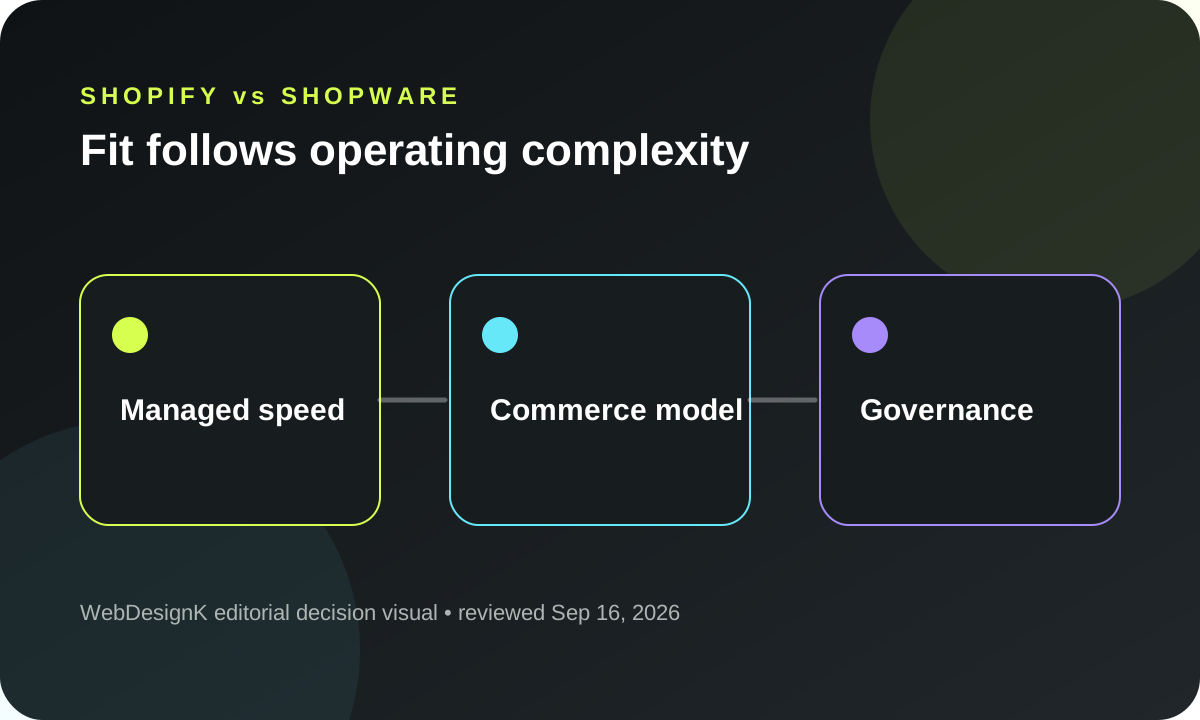
The decision boundary is ownership. More custom architecture gives more control, but it also moves rendering, integrations, monitoring, QA and incident responsibility onto your team. Choose the least custom system that satisfies a real business constraint.
Last reviewed: September 16, 2026Weighted decision scorer
Set importance from 0 (not relevant) to 5 (critical). WebDesignK editorial architecture-fit assumptions. Scores help expose tradeoffs from your weights; they are not objective Shopify/custom benchmarks.
1. Grouped criterion contribution bars
Each group shows how much the current importance weight lets each option contribute on that criterion. The overall fit summary sits above the grouped bars.
2. Weighted criteria radar
Shape shows which criteria each option satisfies under your current importance settings.
- Cost predictability: weight 3
- Speed: weight 3
- Ownership / control: weight 3
- SEO / performance: weight 3
- Integrations: weight 3
- Scale / parallelism: weight 3
- Governance: weight 3
- Editor experience: weight 3
3. Criteria contribution heatmap
Cells combine each option's disclosed fit (1–5) with your importance weight (0–5).
Assumption note: option fit values are transparent WebDesignK editorial planning assumptions, not measured market performance. The result changes only from your criterion weights and the disclosed matrix.
Tables built for the buying decision
Primary decision table
| Criterion | Standard Shopify | Headless Shopify | Custom commerce | Tradeoff / who should care |
|---|---|---|---|---|
| TCO | Platform subscription + implementation/apps/integrations | Shopify + custom frontend engineering/hosting | Infrastructure/services + broader engineering ownership | Merchants should compare 12-month operating layers, not license alone |
| Launch speed | Most platform behavior already exists | More frontend work and API integration | Most domain behavior must be designed/built | Deadline-sensitive teams benefit from platform leverage |
| SEO / performance | Known platform conventions; theme/app discipline matters | Deep rendering control; team owns implementation | Maximum control and maximum implementation responsibility | SEO-sensitive migrations need explicit technical ownership |
| Ownership | Platform owns more commerce infrastructure | Shopify owns commerce core; team owns storefront | Team owns most application behavior | Engineering capacity is the limiting factor |
| Integrations | Large ecosystem + APIs | Flexible frontend and service composition | Any model possible, but every contract is yours | ERP/PIM/WMS complexity can flip the decision |
| Scale | Managed platform capabilities | Managed commerce + custom frontend scaling | Depends on architecture/ops maturity | Do not equate custom with automatic scale |
| Security / governance | Smaller directly operated surface; apps/integrations still yours | Additional frontend/deployment surface | Broad security/operations responsibility | Regulated or enterprise teams need evidence and controls |
| Editorial workflow | Native admin/theme model | Shopify plus optional external CMS | Must be designed and maintained | Content-heavy teams should test editor workflows before committing |
Current Shopify public pricing context (U.S., reviewed Sep 16, 2026)
| Plan | Monthly billing | Annual-billing equivalent shown | Use in this guide |
|---|---|---|---|
| Basic | $39 USD/month | $29 USD/month | Official subscription context only; not a project quote |
| Grow | $105 USD/month | $79 USD/month | Add apps, implementation and operations separately |
| Advanced | $399 USD/month | $299 USD/month | Evaluate features and payment economics on live pricing page |
| Plus | Starts at $2,300 USD/month | Not shown as an annual equivalent | Enterprise context; verify current commercial terms with Shopify |
Sources and assumption boundaries
Fast-changing platform, pricing and AI-search claims were reviewed on September 16, 2026. Interactive scores and scenarios are clearly labeled planning models, not sourced market benchmarks.
- Shopify — U.S. pricing Official current plan pricing and feature comparison; reviewed September 16, 2026. Pricing can change.
- Shopify Developers — Storefront API getting started Official documentation that the Storefront API is GraphQL and framework-agnostic; reviewed September 16, 2026.
- Shopify Developers — Storefront API reference Official Storefront API scope and current 2026-04 reference; reviewed September 16, 2026.
- Shopify Developers — Hydrogen Official description of Shopify's React-based headless stack; reviewed September 16, 2026.
Turn this planning result into a scoped review.
Send the assumptions, constraints and result summary. WebDesignK can review the architecture/content/implementation boundary, identify missing discovery inputs and return a prioritized next-step scope.
- Bring: current site/product, constraints, integrations and your tool result.
- You get: a scoped recommendation, open questions and implementation priorities.
Decision snapshot for Shopify vs custom ecommerce
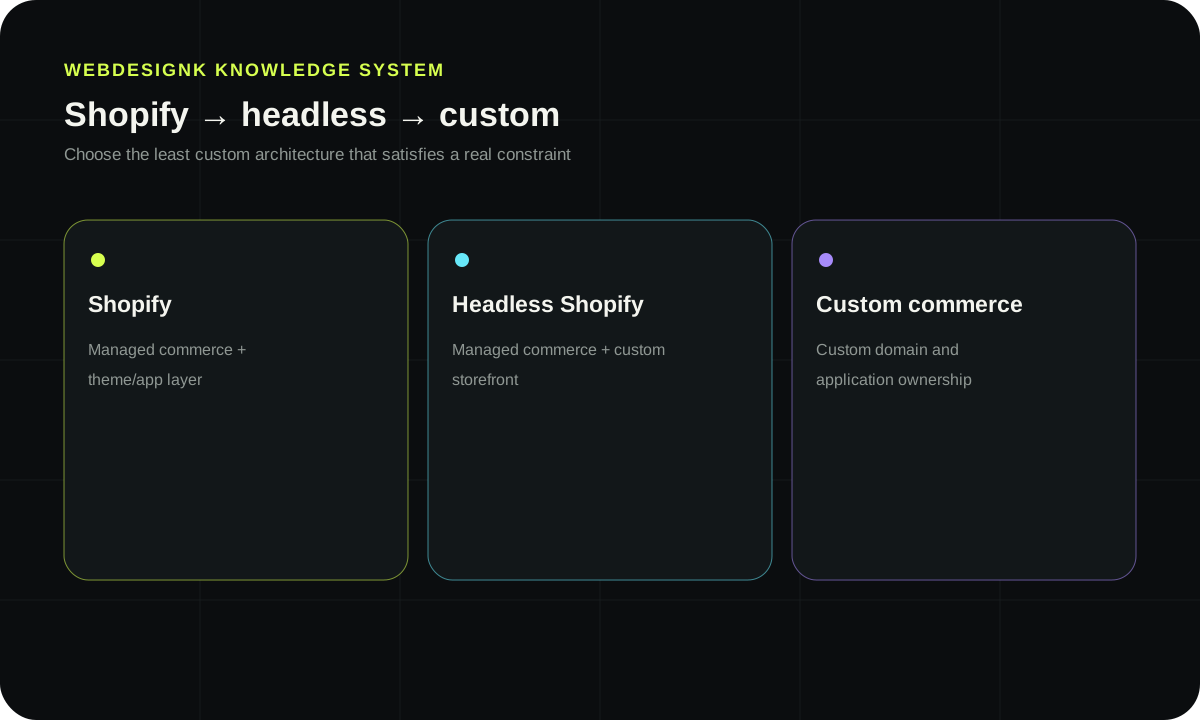
For most growing merchants, the first question should not be “platform or custom?” but which parts of commerce are actually differentiating. Shopify is usually the lower-operational-burden choice when catalog, checkout, payments, promotions, orders and common integrations fit the platform model. Custom commerce becomes more defensible when proprietary buying workflows, unusual data relationships, regulated processes or differentiated product configuration are core to the business. A headless Shopify architecture can sit between those extremes: Shopify remains the commerce system while the storefront becomes custom.
The key tradeoff: platform leverage versus system ownership. Every capability you build yourself creates flexibility, but it also creates code, QA, security, observability and upgrade responsibility that your team must own after launch. The weighted tool above uses your priorities and an explicit WebDesignK planning matrix; it does not claim that one platform is objectively better for every merchant.

Quick decision summary: best-fit scenarios
Choose standard Shopify when platform leverage is the goal
A Shopify theme/storefront is a strong default when your differentiation is primarily assortment, brand, merchandising, content, customer service or operations rather than the mechanics of cart and checkout. You gain a managed commerce core, a large app ecosystem and an admin model familiar to many ecommerce teams. The decision still requires technical work—theme architecture, performance, analytics, taxonomy, integrations and content governance do not solve themselves—but you are not building every commerce primitive from zero.
Choose headless Shopify when experience constraints exceed the theme layer
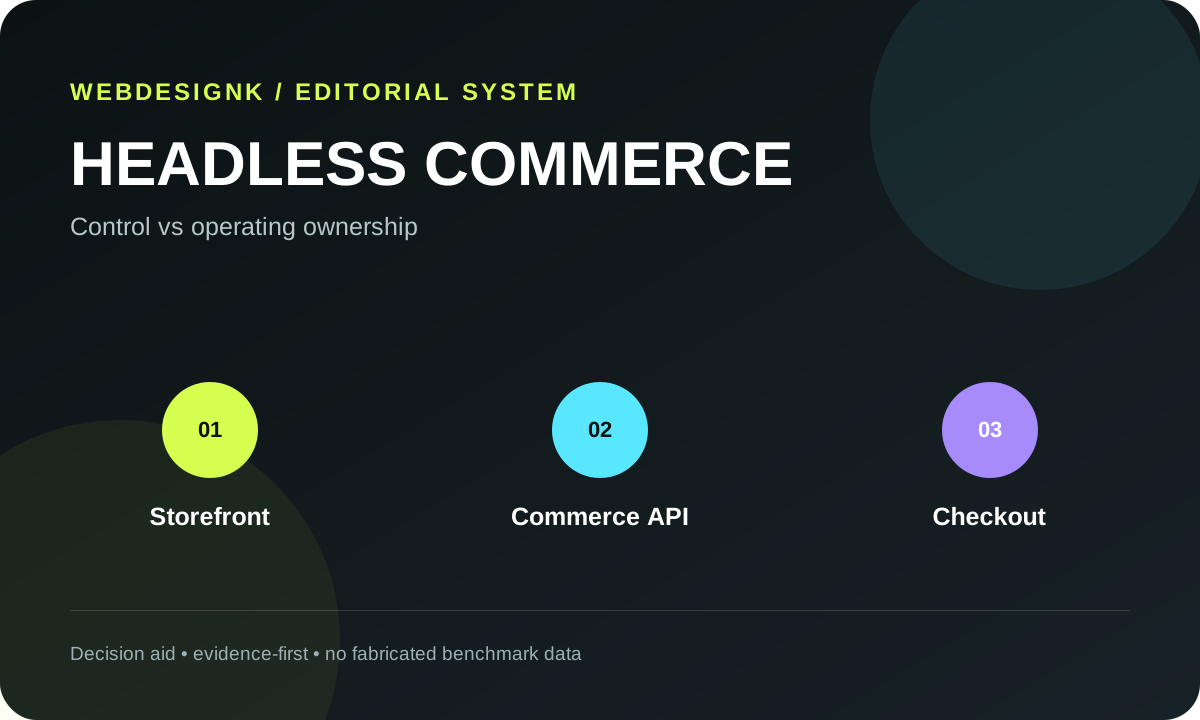
Shopify's Storefront API is GraphQL and framework-agnostic; its current documentation explicitly supports custom storefronts built with Hydrogen, Next.js and other frameworks. Hydrogen is Shopify's official React-based headless stack. This middle path can make sense when you want Shopify to remain the system for products, cart/checkout and commerce operations while you need a highly custom presentation layer, multi-source content, unusual routing or deeper frontend control.
Headless does not mean “faster by definition.” It transfers more rendering, caching, deployment, monitoring and frontend integration responsibility to your engineering team. The advantage is control; the cost is ownership.
Choose a substantially custom commerce system when the workflow is the product
Custom can be justified when standard platform assumptions repeatedly fight the business: complex configuration, marketplace-style multi-party flows, proprietary pricing, unusual entitlement logic, regulated approval chains, highly specialized B2B workflows or a commerce experience that must coordinate several systems in real time. Even then, “custom” should be decomposed. You may still use managed payments, tax, search, identity or fulfillment services instead of rebuilding mature infrastructure unnecessarily.
Side-by-side comparison on buyer criteria
The comparison table separates three architectural choices: standard Shopify, headless Shopify, and substantially custom commerce. That is more useful than treating “Shopify” and “custom” as binary opposites because Shopify itself supports custom storefront architectures.
Current Shopify pricing is only one piece of TCO
As of September 16, 2026, Shopify's U.S. public pricing page lists annual-billing equivalents of $29/month for Basic, $79/month for Grow and $299/month for Advanced; monthly billing is listed at $39, $105 and $399 respectively. Shopify Plus is shown starting at $2,300/month. Plan details, payment rates, add-ons and regional billing can change, so use Shopify's live pricing page for procurement rather than copying a number into a long-lived budget model.
Those subscription prices should not be compared with a custom build estimate as if they represented the same scope. A Shopify project still has implementation, apps, integration, content, migration, design, analytics and ongoing optimization costs. A custom system may avoid some platform constraints but adds engineering and operational ownership. The tool in this article therefore asks what you value; it does not manufacture a “five-year savings” benchmark.
Total cost of ownership
TCO should be mapped by layers:
- Commerce platform: subscription or infrastructure that powers catalog, cart, checkout, orders and administration.
- Storefront: theme or custom frontend design, development, hosting and monitoring.
- Apps/services: search, reviews, subscriptions, loyalty, personalization, tax, consent, fraud or analytics.
- Integrations: ERP, PIM, WMS, CRM, marketplace, support and data warehouse connections.
- Operations: merchandising, releases, incident handling, dependency updates and ongoing experimentation.
- Change cost: what it takes to add a market, payment method, product model, promotion rule or channel.
Shopify TCO pattern
Platform cost is explicit, but app and integration choices can compound. Audit overlapping subscriptions and verify whether an app stores critical business data, changes storefront performance or becomes a hard migration dependency. The right question is not “how many apps is too many?” It is whether each app owns a capability you would otherwise have to build and maintain, and whether its operational cost remains justified.
Custom TCO pattern
Infrastructure may look inexpensive at first, but the recurring cost is engineering responsibility. Authentication, payment integrations, webhook retries, catalog indexing, cache invalidation, observability, admin tools and incident response all need owners. Custom should earn its cost by enabling a workflow, economics or experience that materially matters—not simply by eliminating a platform subscription.
Speed to launch and day-2 operations
A theme-based Shopify project usually starts from more existing commerce behavior. A headless build adds a frontend application and API contracts. A custom system adds even more decisions about domain modeling, administration, payments, promotions, order lifecycle and operational tooling.
Speed still depends heavily on catalog quality, content, integrations and stakeholder decisions. A merchant with clean product data and known fulfillment rules can move quickly on any architecture. A merchant with duplicate SKUs, unclear tax ownership, custom B2B pricing and three inconsistent ERP feeds will not become simple because the frontend uses a template.
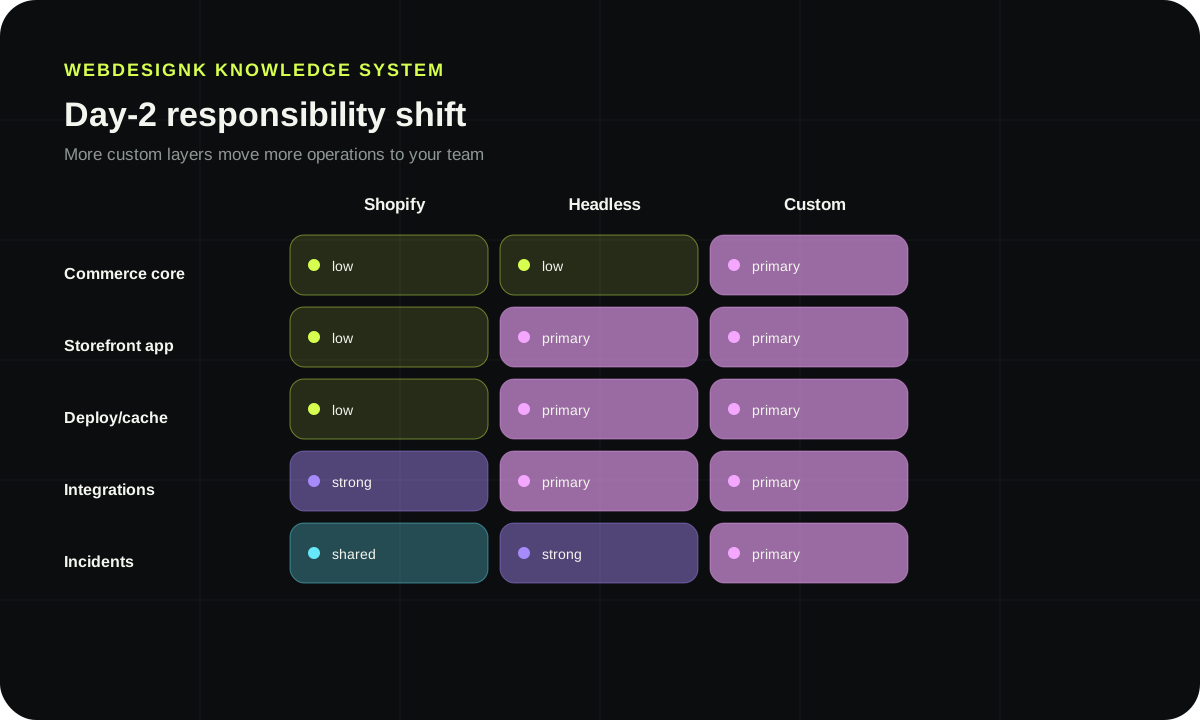
Day-2 ownership is where custom architecture becomes visible
For standard Shopify, the platform carries more infrastructure and commerce-core responsibility. Your team still owns theme/app choices, integrations, content, analytics and business configuration. For headless Shopify, you additionally own the storefront application, deployment, caching strategy, API error handling and frontend monitoring. For custom commerce, you own much more of the underlying application behavior and its failure modes.
Ask who gets paged when inventory is stale, checkout events stop reaching analytics, an ERP API changes, a promotion calculates incorrectly or a deployment breaks a market. If nobody can answer, the architecture is not production-ready regardless of how polished the storefront looks.
SEO, performance and technical flexibility
Shopify, headless Shopify and custom commerce can all be made crawlable and performant. None receives an automatic SEO advantage merely because of the architecture label.
A standard Shopify storefront gives you known URL/content conventions and managed infrastructure, but theme/app choices can create performance or duplication issues if unmanaged. Headless gives deeper rendering and frontend control, but the team must implement metadata, canonicals, structured data, pagination, redirects, image optimization and crawlable rendering correctly. Custom gives the broadest control and the broadest opportunity to make mistakes.
How to decide whether headless is justified
Use headless when the storefront genuinely needs capabilities the conventional theme layer cannot support cleanly: complex composition from multiple content/data sources, bespoke interaction models, shared frontend architecture across channels, or strict engineering standards that matter to the organization. Do not choose it merely because “headless is faster.” Performance comes from implementation quality, data access patterns, caching and payload discipline.
Shopify's current documentation describes the Storefront API as framework-agnostic and supports custom storefronts through the Headless channel. That means the real architectural boundary is not “Shopify or React.” You can keep Shopify commerce while owning a custom React/Next.js frontend.
Integrations, data ownership and lock-in
Every commerce architecture has dependencies. Platform lock-in is visible because APIs and data models are documented. Custom lock-in can be less visible: undocumented internal services, proprietary schemas, bespoke deployment processes or one engineer who knows how pricing rules work.
Map systems of record before choosing architecture
For products, price, inventory, customers, orders, promotions, content and analytics, define the authoritative system. If ERP is the source of inventory, Shopify or your custom database may be a distribution surface rather than the source. If PIM owns product enrichment, decide which fields sync and how conflicts resolve. If customer identity lives elsewhere, document authentication boundaries.
Integration complexity can be a reason to use Shopify, a reason to use headless, or a reason to go custom. The correct choice depends on which system should orchestrate the workflow. Avoid making the storefront an accidental integration hub when a dedicated backend service would be more reliable.
Security, governance and enterprise requirements
A managed platform can reduce the surface area your team directly operates, but it does not transfer every security obligation. Your team still controls apps, staff access, custom code, integrations, customer-data handling and business configuration.
Custom systems create more control and more responsibility. Document authentication, authorization, secrets, payment boundaries, audit logs, deployment approvals, backups, vulnerability management and incident response. Where payment-card scope or privacy obligations matter, involve the appropriate security/privacy specialists; this article is architectural guidance, not legal advice.
Governance questions that often flip the decision
- Does the business need checkout behavior unavailable through supported extension points?
- Are there hard data-residency or deployment constraints?
- Must multiple business units ship independently with separate governance?
- Does proprietary pricing or entitlement logic belong outside the storefront?
- Are there internal systems that cannot safely expose the APIs a headless build needs?
- Does the team have production engineering capacity to own what custom architecture adds?
If the answer to the last question is no, technical possibility is not enough.
Scenario recommendations by company stage
Scenario A: growing DTC brand with standard commerce mechanics
You have hundreds or a few thousand products, standard checkout, a marketing team that merchandises frequently and several common SaaS tools. Start by exhausting the value of standard Shopify. Custom theme/components, careful app selection and strong integrations can create substantial differentiation without replacing the commerce core.
Scenario B: content-rich brand with multiple systems and bespoke frontend
You need editorial experiences from a headless CMS, product data from Shopify, personalization from another service and an application shell shared with non-commerce experiences. Headless Shopify may fit because it preserves a managed commerce backend while giving the frontend team control over composition and rendering. Budget for the engineering operations that a custom frontend introduces.

Scenario C: commerce workflow is proprietary
You run configuration or pricing logic that cannot be represented cleanly in platform constraints, orders move through unusual approval/entitlement states, or your business is closer to a marketplace/application than a conventional store. A custom domain layer may be warranted. Still decide which mature services to retain—payments, tax, search or identity may not be the place to differentiate.
Migration and switching considerations
Migration cost is the cost of assumptions becoming data work. Product identifiers, variant structure, URLs, customer accounts, orders, discounts, redirects, images, metafields, app-owned data and analytics history may all need explicit handling.
Shopify to headless Shopify
The backend can remain Shopify, reducing some migration scope, but the storefront still needs a complete SEO and analytics implementation: routing, canonicals, structured data, redirects, consent, events, search, product discovery, cart behavior and error handling. Preserve URL equity deliberately rather than allowing frontend routes to drift.
Shopify to custom commerce
Exportability is only the beginning. Rebuild or replace operational capabilities the platform supplied: admin workflows, promotions, tax/payment integrations, order management, email triggers, fraud controls, customer service visibility and reporting. Migration plans that list only products/customers/orders are incomplete.
Custom commerce to Shopify
The hard work is translating bespoke concepts into platform concepts. Identify which custom rules can map to native configuration, which need extensions/apps and which should remain in external services. Do not reproduce years of accidental complexity simply because it exists today.
Decision checklist and FAQ
Before selecting architecture, write down:
- Which commerce behaviors genuinely differentiate the business?
- Which system owns product, inventory, price, customer and order truth?
- Which checkout or B2B behaviors are non-negotiable?
- How many external systems must be synchronized?
- Who will operate a custom storefront or backend after launch?
- Which capabilities are currently supplied by apps?
- Which markets, languages and currencies are planned next?
- What must be migrated, including URLs and app-owned data?
- What is the acceptable dependency on Shopify-specific APIs/extensions?
- What business event would justify moving to a more custom architecture later?
\n## Architecture boundary worksheet: what should the platform own?\n\nA productive Shopify-versus-custom workshop starts with capabilities, not vendor names. Put catalog, product modeling, inventory, promotions, checkout, payments, customer accounts, search, content, personalization, tax, fulfillment, order management, subscriptions, B2B pricing and analytics in rows. For each one, ask four questions: is this differentiating, is there a hard constraint, who operates it, and what happens when it fails?\n\nIf a capability is non-differentiating and a mature managed service satisfies the requirement, building it yourself usually needs a stronger justification than “we want control.” Control has operating cost. If the capability is differentiating—perhaps a configuration engine, approval workflow or proprietary pricing model—custom ownership may be exactly where engineering effort belongs.\n\n### Separate storefront freedom from commerce-core freedom\n\nMany teams over-customize because they mix two needs. “We need a completely bespoke editorial/product experience” is a storefront requirement. It does not automatically mean “we need to own cart, checkout, orders and payments.” Shopify's headless options exist precisely because those layers can be separated. Conversely, if the constraint lives inside pricing, entitlement, checkout or order lifecycle, a custom frontend alone may not solve it.\n\n### Model the failure domain\n\nFor every custom layer, name the on-call owner and the business impact of failure. If a custom recommendation widget fails, perhaps the store can still sell. If a proprietary pricing service fails, the buyer may be unable to order. Design graceful degradation where possible. This failure-domain view often leads to a hybrid architecture: custom where differentiation is valuable, managed where reliability and commodity operations matter more.\n\n### Make the exit plan part of architecture\n\nRecord how product data, customer data, URLs, content, app-owned data and integration contracts could move later. You do not need a full migration project today, but avoiding opaque identifiers and undocumented transformations reduces future switching cost. Architecture quality includes the ability to change your mind.\n
Next-step decision summary
Treat Shopify as a set of managed commerce capabilities, not as the opposite of custom development. Start with the least custom architecture that satisfies the business. Move toward headless when storefront control has a clear payoff. Move toward deeper custom commerce when proprietary workflows are important enough to justify permanent engineering ownership. The best architecture is the one whose day-2 responsibilities your team is prepared to own.
Frequently asked questions
Is custom ecommerce always more flexible?
It usually offers more theoretical control, but usable flexibility depends on your team's ability to build, test and operate the system. Platform extension points can be more than sufficient for many businesses.
Does headless Shopify mean leaving Shopify?
No. Shopify's Storefront API supports custom storefronts, including Hydrogen and other frameworks such as Next.js, while Shopify can remain the commerce backend.
Is headless automatically faster?
No. It provides more frontend control, but performance depends on rendering, caching, data fetching, JavaScript, media and implementation discipline.
When should a growing store consider custom commerce?
When proprietary workflows or constraints repeatedly conflict with supported platform models and the commercial value is high enough to justify ongoing engineering and operational ownership.