Quick answer
Treat tenant isolation as a first-class architecture concern that is separate from basic login and role checks. Pooled resources reduce fleet overhead but require stronger logical isolation and tenant-aware observability; dedicated resources make some boundaries easier to explain but multiply deployment, migration and support work. A practical default is a pooled core with explicit tenant context, then a documented path to hybrid or siloed resources when contractual, regional, security or workload requirements justify the extra operational burden.
Last reviewed: September 19, 2026Multi-tenant architecture decision builder
Choose the constraints that describe your product. The checklist, open decisions and charts update from transparent planning rules in this page; scores are not security ratings, benchmarks or compliance certification. Inputs stay in this browser.
Reference architecture checklist
- Resolve the tenant from a trusted identity/session boundary, carry tenant context through every request, job and event, and never trust a client-supplied tenant ID by itself.
- Keep shared application and data resources tenant-aware: tenant-owned records need an explicit tenant key, centralized query scoping and isolation tests; database row-level security can be defense-in-depth where it fits the stack.
- Model users, memberships, roles and tenant permissions separately. Authentication establishes identity; authorization and tenant isolation must still be enforced on the resource being accessed.
- Record security-sensitive administrative actions and isolation failures with tenant-aware audit context; keep secrets and sensitive values out of logs.
- Treat integrations as tenant-scoped contracts: isolate credentials, sign/verify webhooks where supported, use idempotency keys and make retries observable without mixing tenant context.
- Use tenant-aware queues/workers with idempotency, retry budgets, dead-letter handling, backpressure and per-tenant observability; define ordering only where the business process actually requires it.
- Measure per-tenant load and preserve an upgrade path to partitioning or deployment stamps before noisy-neighbor behavior becomes an emergency migration.
- Make logs, metrics, traces and audit events tenant-aware by design, while preventing sensitive payloads from becoming the observability strategy.
- Use expand/contract schema changes and resumable per-tenant migration checkpoints so a partially upgraded fleet can be observed, paused and safely retried.
Unresolved decisions
- Which isolation checks live in repository/service code, database policies, or both—and how will cross-tenant negative tests prove the boundary?
- What are the explicit degraded-mode behaviors when identity, queueing, a critical integration or the audit pipeline is unavailable?
1. Component planning burden
Higher bars mean the selected constraints put more design and operational attention on that component.
2. Constraint pressure profile
This simply translates your selected low/medium/high-style inputs onto one visual scale.
3. Boundary attention map
Planning aid showing where the selected constraints concentrate architecture work—not how much code belongs in each layer.
Assumption note: all scores are deterministic WebDesignK planning coefficients derived from the seven selections above. They are intentionally bounded 0–100 for visualization and must not be interpreted as market benchmarks, security grades or compliance scores.
Tables built for the buying decision
Primary decision table
| Decision | Option | Strengths | Constraints | Operational burden | Choose when |
|---|---|---|---|---|---|
| Tenant isolation | Pooled | One shared fleet; simple rollout and capacity pooling | Logical isolation must be consistently enforced in every path | Lower fleet count; higher application/data-control rigor | Tenants have compatible requirements and the team can prove logical isolation |
| Tenant isolation | Hybrid / bridge | Pool by default while isolating selected tenants or components | Routing, promotion and version compatibility become product capabilities | Moderate; both shared and dedicated paths must be operated | Some tenants need regional, contractual or workload isolation |
| Tenant isolation | Silo / dedicated | Coarse resource boundary and smaller cross-tenant blast radius for isolated components | More stacks, migrations, secrets, backups and rollout coordination | High fleet automation burden | Requirements explicitly justify dedicated resources and the fleet can be automated |
| Data enforcement | Tenant key + scoped repositories | Visible in domain code and portable across data stores | One missed query path can break isolation | Testing and code-review discipline | Pooled relational/data models with centralized access abstractions |
| Data enforcement | Database policy / RLS as defense-in-depth | Adds a database-enforced row policy for supported access paths | Owners/bypass roles and privileged paths need careful testing | Policy design plus production-role verification | The database and connection model support policy enforcement without hiding domain authorization |
| Identity | App membership + enterprise federation | Separates external identity from internal tenant/resource authorization | Provisioning, linking and deprovisioning rules must be explicit | Connection registry, role mapping and lifecycle support | B2B SaaS serves organizations with SSO or multiple IdPs |
| Async work | Tenant-aware queue + idempotent workers | Retries and burst isolation can be controlled and observed | Ordering, deduplication and dead-letter ownership require design | Queue policy, worker limits and operational tooling | Jobs, imports, webhooks or long-running tasks cannot safely stay synchronous |
| Scale boundary | Deployment stamps / partitions | Limits blast radius and supports regional or workload distribution | Rebalancing and fleet versioning become explicit | Routing, automation and per-stamp observability | Shared capacity or regional requirements outgrow one deployment boundary |
Failure behavior and observability
| Failure mode | Symptom | Prevention | Observability |
|---|---|---|---|
| Cross-tenant read/write | A valid object from another tenant is returned or mutated | Trusted tenant context, deny-by-default authorization, scoped data access and negative isolation tests | Security audit event, denied-access metrics, test evidence; do not log sensitive payloads |
| Stale membership or role | Revoked user retains access through cache/session state | Short-lived authorization state where appropriate, revocation strategy and resource-level recheck | Auth decision reason, session/token age, revocation failures |
| Queue retry storm | Backlog/latency grows and one tenant consumes worker capacity | Bounded retries, idempotency, backoff, dead-letter ownership and per-tenant controls | Queue age, retry count, DLQ volume and tenant workload tags |
| Integration outage or duplicate webhook | Repeated side effects, stuck sync or delayed tenant workflow | Verified tenant binding, idempotency keys, durable delivery state and degraded mode | Delivery attempts, provider response class, tenant-scoped failure state |
| Noisy neighbor | One tenant degrades latency or capacity for others | Rate/concurrency limits, partitioning and promotion path to isolated resources | Per-tenant saturation/latency signals and rate-limit events |
| Partial schema/fleet migration | Some tenants run old schema or application behavior | Expand/contract changes, resumable per-tenant checkpoints and version compatibility | Tenant migration version, checkpoint, failure reason and fleet drift |
| Audit pipeline unavailable | Security/admin actions occur without durable evidence | Define whether to buffer, fail closed or use a durable secondary path based on requirement | Audit delivery health, backlog age and explicit evidence-gap alert |
Sources and assumption boundaries
Fast-changing platform, pricing and search claims were reviewed on September 19, 2026. Interactive scores and scenarios are clearly labeled planning models, not sourced market benchmarks.
- AWS SaaS Architecture Fundamentals — Tenant isolation Official AWS guidance distinguishing tenant isolation from authentication/authorization and describing explicit tenant-resource boundaries; reviewed September 19, 2026.
- AWS SaaS Tenant Isolation Strategies — Core isolation concepts Official AWS treatment of silo, pool, bridge/tier patterns and identity as part of an isolation model; reviewed September 19, 2026.
- Azure Architecture Center — Tenancy models for a multitenant solution Official Microsoft guidance framing isolation as a spectrum and explaining shared versus isolated resource tradeoffs; reviewed September 19, 2026.
- Azure Architecture Center — Multitenant resource organization Official Microsoft guidance on tenant isolation, scale-out, quotas, resource organization and mixed isolation approaches; reviewed September 19, 2026.
- Azure Architecture Center — Tenant integration and data access Official Microsoft guidance to evaluate integration points independently, including direction and tenant-specific requirements; reviewed September 19, 2026.
- OWASP Authorization Cheat Sheet OWASP guidance on least privilege, deny-by-default and validating permissions on every request; reviewed September 19, 2026.
- PostgreSQL Documentation — Row Security Policies Official PostgreSQL documentation on row-level security policy behavior and default-deny when RLS is enabled without an applicable policy; reviewed September 19, 2026.
Turn this planning result into a scoped review.
Send the assumptions, constraints and result summary. WebDesignK can review the architecture/content/implementation boundary, identify missing discovery inputs and return a prioritized next-step scope.
- Bring: current site/product, constraints, integrations and your tool result.
- You get: a scoped recommendation, open questions and implementation priorities.
Decision snapshot for Multi-Tenant SaaS Architecture
A good multi-tenant SaaS architecture makes tenant context an explicit security and operational boundary, not a convention developers are expected to remember. The first decision is not “microservices or monolith?” It is how much infrastructure and data each tenant shares, what must be isolated, and which team will operate those boundaries. Pooled, hybrid and siloed designs can all be valid when the isolation model, authorization path, failure behavior and migration strategy are deliberate.
What you’ll learn / decide
- where tenant identity and isolation must be enforced;
- when pooled, hybrid or dedicated resources make operational sense;
- how data, APIs, queues, integrations and audit trails carry tenant context;
- which failure modes need retries, degraded modes or hard stops;
- how to evolve an early architecture without rewriting the product.
The practical rule is simple: share infrastructure only where you can still prove isolation, observe tenant impact and recover safely. A shared database can be appropriate; a dedicated database can be appropriate. Neither choice removes the need for application-level authorization, tenant-aware jobs, auditability and operational controls.
Executive architecture summary
A useful SaaS reference architecture has two conceptual planes. The control plane owns tenant onboarding, subscription or entitlement state, identity connections, configuration, metering and fleet-level operations. The application/data plane handles user requests, domain workflows, tenant data, background work and integrations. These planes do not need to be separate deployables on day one, but separating the responsibilities in the model keeps tenant lifecycle operations from becoming scattered application conditionals.
AWS describes tenant isolation as distinct from basic authentication and authorization: a user can be authenticated and authorized for an application capability and still cross a tenant boundary if resource access is not scoped by tenant context. Azure similarly treats isolation as a spectrum, from highly shared resources to dedicated resources, and explicitly supports mixing models across components. Those two ideas are a stronger starting point than choosing a fashionable framework.
For many products, the initial architecture can remain intentionally boring: a stateless web/API layer, a relational database, an identity provider, an object store, a queue for asynchronous work, a small integration layer and centralized observability. The multi-tenant work is in the boundaries: how the tenant is resolved, how every resource lookup is scoped, how jobs preserve context, how credentials are isolated and how tenant-specific load is observed.
A reference request path
- Authenticate the user or machine identity.
- Resolve an internal tenant membership from trusted claims or server-side state.
- Authorize the requested action and resource for that tenant.
- Execute tenant-scoped data access.
- Attach tenant context to downstream jobs, events, logs and audit records.
- Reject ambiguous or missing tenant context instead of silently falling back to global access.
That flow is more important to tenant safety than whether the service is deployed as one process or twenty.
Requirements and constraints to define first
Architecture decisions become expensive when the team starts with infrastructure and discovers the real constraints later. Before choosing a tenancy model, document the business and technical forces that can actually change the boundary.
Start with tenant shape. How many organizations are expected? Are most similar, or can one tenant be orders of magnitude busier than another? Do enterprise customers require their own data region, encryption key, identity provider, maintenance window or deployment cadence? Does the product need self-serve onboarding, or are tenants provisioned through a sales and implementation process?
Then define data sensitivity and contractual constraints. Avoid turning “enterprise” into a vague proxy for security. Write down the specific requirement: separate database, region pinning, customer-managed key, audit export, configurable retention, privileged-access approval or a documented isolation test. Legal and regulatory requirements can depend on customer, geography and data category; this article is architecture guidance, not legal advice, and qualified counsel or a compliance specialist should validate obligations that affect contracts or regulated data.
Define identity and authorization separately. Authentication answers who the principal is. Authorization answers what that principal can do. Tenant isolation answers which tenant’s resources are in scope. Treating those as one check is a common source of cross-tenant defects.
Finally, define the team’s operational budget. A silo-per-tenant design can make the isolation story easy to explain, but it creates a fleet: migrations, backups, secrets, alerts, releases and emergency fixes now need automation across many stacks. A pooled design reduces fleet overhead but raises the standard for tenant-aware application and data controls. The correct model is the one your team can operate and prove.
Reference architecture and boundaries
A robust reference architecture assigns each responsibility to the layer best able to enforce it consistently.
Application code should resolve tenant context, apply domain authorization, propagate context to downstream work and expose tenant-safe APIs. Central middleware can reject requests without a valid tenant, but middleware alone is not enough: authorization still needs the resource and action being requested.
Managed services can remove undifferentiated operational work such as identity protocol handling, queue durability, managed databases, object storage and secret storage. Managed does not mean tenant-aware by default. The application must still define how tenants map to resources, credentials, partitions or policies.
The data layer owns durable tenant boundaries. In a pooled relational model, tenant-owned rows normally need an explicit tenant key and consistent query scoping. PostgreSQL row-level security can add a database-enforced policy layer, but teams must understand ownership and bypass behavior and test the actual connection roles used in production. RLS is defense-in-depth, not permission to stop reviewing application authorization.
Operational tooling needs tenant-aware signals: logs, traces, queue depth, rate-limit events, migration progress, audit records and cost attribution where useful. Avoid logging secrets or sensitive payloads just to make tenant debugging easier.
Pooled, hybrid and siloed boundaries
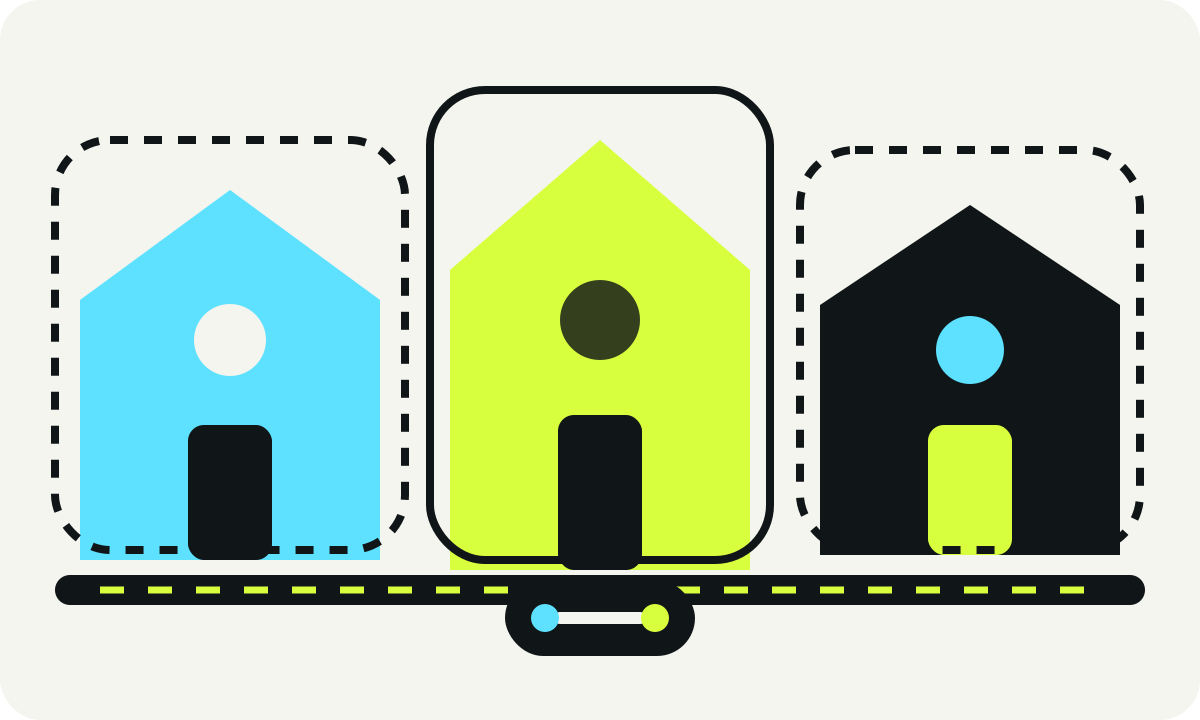
A pooled model shares most compute and storage. It is efficient to operate but demands strong logical isolation. A siloed model dedicates substantial resources to a tenant. It makes some boundaries coarse-grained but increases fleet operations. A hybrid model keeps a shared control plane and pooled defaults while promoting specific tenants or workloads to dedicated databases, queues, regions or deployment stamps.
Hybrid architecture is often a capability, not a midpoint. If you choose it, define the promotion rule before a sales exception creates a one-off stack. The rule might be contractual isolation, regional residency, workload characteristics or a supported product tier. The exact threshold should come from your product and telemetry, not an arbitrary benchmark copied from another SaaS company.
Data model / tenancy / identity implications
The data model should make accidental cross-tenant access difficult to write and easy to test. In a pooled database, an unscoped findById(id) is a dangerous abstraction because the method can return a valid object without proving it belongs to the active tenant. Prefer APIs whose shape carries the boundary, such as findForTenant(tenantId, id), or repository/session patterns that bind tenant context before a query is possible.
Use globally unique identifiers because they reduce collision problems and make migrations easier, but do not confuse unguessable IDs with authorization. OWASP explicitly warns that hiding or randomizing identifiers is not a substitute for checking permission to the underlying object.
Pooled data
Pooled tables are operationally attractive when tenants have similar requirements. Tenant keys should participate in relevant uniqueness constraints and indexes so the database model matches the application boundary. Background jobs, exports and reporting paths need the same scoping discipline as interactive requests. Administrative cross-tenant queries should use a deliberately privileged path rather than turning normal tenant queries into “sometimes global” functions.
Schema-per-tenant or database-per-tenant
Separate schemas or databases can create clearer administrative boundaries and make tenant-specific backup/restore easier, but they move complexity into connection routing, schema migration and fleet observability. A database-per-tenant model is not automatically more secure if credentials are overprivileged, routing is wrong or an operator can connect tenants through the same unsafe tooling.
Identity and membership
A user may belong to one tenant, many tenants or a parent organization with delegated administration. Model membership explicitly rather than placing a single tenantId on the user record unless the business model truly guarantees one tenant forever. For enterprise SSO, map a verified issuer/connection to the internal tenant. Do not trust an email domain supplied by the browser as proof of tenant membership. Define account linking, invitations, role mapping and deprovisioning before the first enterprise customer exposes the edge cases.
API, events, jobs and integrations
Tenant context must survive every hop. An HTTP request can be perfectly scoped and still cause a cross-tenant incident if the queue message, webhook, scheduled job or integration credential loses the boundary.
For APIs, resolve tenant context server-side and validate authorization on every request. OWASP recommends deny-by-default and permission validation on every request because one missed path is enough to bypass a control. For machine-to-machine APIs, bind credentials or token claims to the tenants they may access and make privileged cross-tenant APIs explicit.
For events and queues, include a stable tenant identifier in the envelope that is generated by trusted application code. Consumers should validate that context before loading tenant data. Design handlers for retries: idempotency keys, deduplication where necessary, bounded retries and dead-letter handling should be part of the business process rather than generic queue decoration.
For webhooks, tenant ownership applies in both directions. Incoming endpoints should map the provider connection or verified signature to the internal tenant instead of believing a tenant field in the payload. Outgoing webhooks need tenant-specific endpoints, signing secrets and delivery logs. Retries should preserve the same event identity so a provider outage does not create duplicate side effects.
Azure’s multitenant integration guidance recommends considering each integration point independently because the same two systems can have different requirements depending on direction and workflow. That is a useful design habit: a synchronous price lookup, nightly export and event notification should not inherit one integration pattern just because they share a vendor name.
Degraded mode must be intentional
When an optional analytics integration is down, the product may continue and queue work. When the authorization dependency cannot establish tenant scope, fail closed. When a webhook destination is down, persist delivery state and retry without blocking unrelated tenants. “Retry everything forever” is not resilience; it is an outage amplifier.
Security, permissions and auditability
The security model should make the tenant boundary visible in code review and test output. A practical rule is deny by default, then grant the smallest tenant-scoped capability required for the request.
Use roles for broad product capabilities and attributes or resource checks where decisions depend on tenant, ownership, plan, region or object state. Avoid letting UI visibility become the permission model. Server-side authorization must protect the endpoint even if the button is hidden.
Test horizontal access explicitly. For each tenant-owned resource type, negative tests should try a valid identifier from Tenant B while authenticated as Tenant A and expect denial. Include APIs that are easy to forget: exports, attachments, search, background task status, admin support tools, signed download URLs and bulk endpoints. Isolation failures often happen in secondary paths, not the main CRUD screen.
Audit logs should answer: who acted, for which tenant, on what resource, what changed, when, and through which trusted actor or integration. Decide which events are security/audit evidence versus diagnostic logs. The retention, immutability and export requirements depend on customer and regulatory context; do not promise “compliance” because an audit table exists.
Privileged support access deserves its own design. If staff can impersonate or inspect tenant data, use explicit elevation, reason capture, time limits where appropriate and auditable actions. Cross-tenant administrative tools should not reuse ordinary tenant sessions with a magic “isAdmin” bypass that disables the boundary everywhere.
For high-assurance environments, threat-model tenant context itself: claim tampering, stale role caches, confused-deputy integrations, background jobs created before membership revocation, object-store paths, cache keys and analytics pipelines can all become alternative routes around an otherwise correct API.
Scalability/performance/reliability tradeoffs
Multi-tenancy changes capacity planning because load is not evenly distributed. A pooled service can be healthy in aggregate while one tenant exhausts a queue partition, hot database key, search shard or third-party quota. Azure and AWS both discuss isolation as relevant not only to security but also to noisy-neighbor behavior.
Design tenant-aware observability before you need it. Useful signals include request latency/error rate by tenant tier, queue age by tenant or partition, database saturation, rate-limit events, worker concurrency, integration failures and migration progress. High-cardinality telemetry can be expensive, so the implementation may aggregate or sample, but the operating model still needs a way to identify a tenant causing or suffering a capacity problem.
Use fair-use controls where product semantics support them: concurrency caps, rate limits, job quotas or per-tenant work queues can prevent a burst from consuming the whole shared budget. Those controls are product behavior and should be documented, observable and tested under retry conditions.
Deployment stamps or partitioned fleets are a common growth path when a single shared environment becomes too large or when tenants need different regions or isolation. The important architectural property is mobility: can a tenant’s data, configuration and traffic be moved to another stamp without changing every domain object or API contract? Stable tenant identifiers and a routing/control-plane abstraction make that evolution easier.
Reliability also means deciding blast radius. A fully pooled database has a larger shared blast radius but fewer copies to patch. Many dedicated databases reduce some cross-tenant impact but increase the chance of configuration drift or partial rollout. Choose the failure mode you can automate, detect and rehearse.
Build vs managed-service decisions
Managed services are most valuable when they remove operational work without hiding a tenant boundary you still need to control. Identity providers can handle OIDC/SAML protocol mechanics; managed databases can handle backups and replication primitives; queues can provide durable delivery; secret managers can protect credentials. Your product still owns tenant mapping, authorization semantics, retry policy, data model and customer-facing behavior.
Build custom infrastructure when the tenant-specific behavior is genuinely part of the product or when a managed service cannot meet a documented requirement. Do not build an in-house identity provider simply because enterprise SSO is important. Conversely, do not assume a managed authorization product understands your domain’s tenant/resource rules unless you have modeled and tested them.
Evaluate each boundary with four questions:
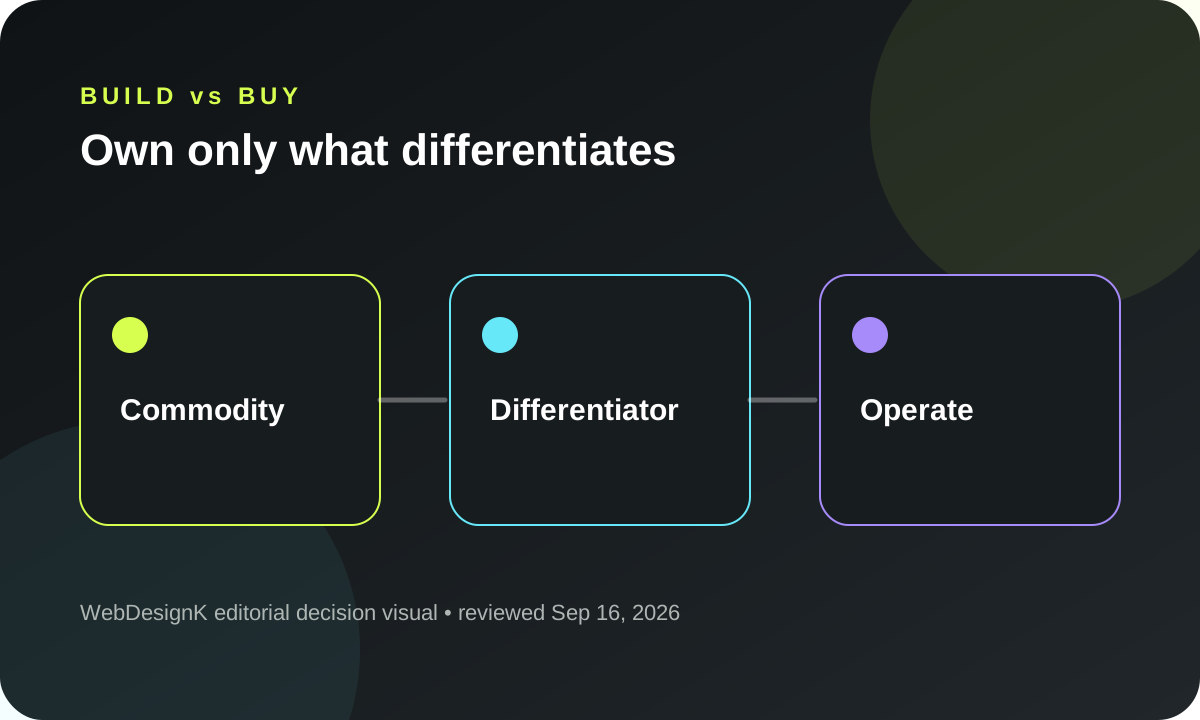
- Is this capability differentiating product logic or undifferentiated operations?
- What tenant context must the service receive, store or return?
- Can we test isolation and failure behavior through the managed boundary?
- What is the exit or migration path if the service becomes a constraint?
The architecture builder above raises “managed services” attention when team capacity is constrained. That is an editorial planning heuristic, not a recommendation to outsource every subsystem.
Migration/versioning/operability
A multi-tenant system should evolve without requiring every tenant to be upgraded atomically. Database changes, entitlement changes, identity migrations and background reprocessing need explicit versioning and progress tracking.
Use expand/contract migrations where practical: add compatible structures first, deploy code that can work across the transition, backfill with resumable tenant-aware jobs, verify, then remove the old path later. A migration job should record tenant, version, checkpoint and failure reason so operators can retry one tenant instead of rerunning the entire fleet.
For dedicated databases or deployment stamps, fleet automation becomes a first-class product capability. Track which tenants are on which version and prevent a failed migration from disappearing inside a generic deployment log. Progressive rollout can reduce blast radius, but only if compatibility rules are documented and the control plane knows which versions can coexist.
Evolving from pooled to hybrid
You can preserve a simpler first version by introducing indirection early. Keep a stable tenant ID, put tenant-to-resource routing behind a small resolver, avoid leaking physical database names into domain code, and make storage/integration clients tenant-aware. Later, a routing record can point most tenants at a shared database while selected tenants use a dedicated database or stamp.
The same principle applies to queues and object storage. The application can address a logical tenant-scoped interface while infrastructure routing evolves underneath. This does not eliminate migration work, but it changes a rewrite into a controlled relocation.

Architecture review checklist
Before approving a multi-tenant design, review the boundary as an end-to-end path rather than a diagram of services.
Tenant context
- Is the tenant derived from trusted server-side identity or routing state?
- Can any normal request execute without a resolved tenant?
- Is tenant context propagated into queues, events, object storage, caches and integrations?
Authorization and data
- Does every tenant-owned resource access check both action permission and tenant scope?
- Are cross-tenant negative tests present for secondary paths, not only primary CRUD?
- If database RLS or similar policy enforcement is used, are production roles and bypass behavior tested?
Failure behavior
- Which dependencies fail closed, which degrade, and which queue work for later?
- Are retries bounded and idempotent?
- Can one tenant’s burst or broken integration exhaust shared capacity?
Audit and operations
- Can operators identify tenant impact without exposing sensitive data in logs?
- Are privileged support actions distinct and auditable?
- Can migrations be resumed per tenant and can the fleet report version drift?
Evolution
- Can a tenant move from pooled to isolated resources without changing its logical identity?
- Are resource routing and tenant lifecycle operations centralized enough to automate?
- Is the chosen architecture small enough for the current team to operate safely?
If those questions have concrete answers, the architecture is reviewable. If they are answered with “the framework handles it,” “the database is private,” or “admins are trusted,” the design still has unresolved tenant-boundary work. Use the interactive builder to turn those gaps into a discovery list, then validate the result with the actual security, contractual and operational constraints of the product.
Frequently asked questions
What is the safest multi-tenant database model?
There is no universal safest model. Pooled, schema-separated and database-per-tenant designs each move risk and operational work to different layers. Safety depends on enforceable tenant context, authorization, data access controls, production-role configuration, negative isolation tests and an operating model that matches the chosen boundary.
Is a database per tenant required for enterprise SaaS?
No. Some customers or requirements may justify dedicated databases or stacks, but enterprise features such as SSO, auditability and granular authorization do not automatically require full physical isolation. Document the actual contractual, regional, security and workload requirement before increasing fleet complexity.
Can PostgreSQL row-level security replace application authorization?
No. RLS can be a valuable database enforcement layer for row visibility and modification, but application authorization still decides whether a principal may perform a specific action. Teams also need to understand table-owner and bypass behavior for the actual production database roles.
Should tenant ID come from the request body or URL?
Treat client-provided tenant identifiers as routing hints, not proof of authority. The server should resolve or validate tenant membership from trusted identity/session state and then authorize the requested resource for that tenant.
When should a SaaS move from pooled to hybrid isolation?
When a documented requirement—such as region, contract, security boundary, workload behavior or supported product tier—cannot be handled safely in the pooled model. Design tenant-to-resource routing early so promotion is relocation rather than a product rewrite.
How do you test multi-tenant isolation?
Add negative tests that authenticate as one tenant and attempt to access valid identifiers, exports, attachments, jobs and integrations belonging to another tenant. Combine application tests with database/policy tests where relevant, and include privileged/admin paths rather than testing only the main CRUD endpoints.