Quick answer
Treat trust as an evidence system, not a badge collection. Define the visitor decision, record the baseline and guardrails, map objections across hero, service evaluation, pricing/decision and contact, then verify whether credible proof exists where the buyer needs it. Use the audit to generate a missing-proof backlog and the scenario calculator only for reader-entered arithmetic; it does not attribute uplift to trust changes.
Last reviewed: September 23, 2026Trust-signal audit and missing-proof backlog
Audit proof by buyer objection and funnel stage. A row counts as verified only when proof is available, documented, placed, current and verified. Starter rows are prompts—not claims about your site. Your inputs stay in this browser via localStorage.
| Stage | Buyer objection | Proof available? | Proof / evidence | Placement | Freshness | Verification | Status | Action |
|---|---|---|---|---|---|---|---|---|
| Backlog | ||||||||
| Backlog | ||||||||
| Backlog | ||||||||
| Backlog | ||||||||
| Backlog | ||||||||
| Backlog | ||||||||
| Backlog | ||||||||
| Backlog |
| Stage | Objection | Gap | Existing placement |
|---|---|---|---|
| Hero | Credibility | proof unavailable, freshness unknown, proof unverified | Hero / first viewport |
| Hero | Fit | proof unavailable, freshness unknown, proof unverified | Hero / offer summary |
| Service evaluation | Delivery risk | proof unavailable, freshness unknown, proof unverified | Process / case evidence |
| Service evaluation | Support / accountability | proof unavailable, freshness unknown, proof unverified | Service detail |
| Pricing / decision | Commercial clarity | proof unavailable, freshness unknown, proof unverified | Pricing / proposal step |
| Pricing / decision | Credibility | proof unavailable, freshness unknown, proof unverified | Decision proof block |
| Contact | Security / privacy | proof unavailable, freshness unknown, proof unverified | Contact form |
| Contact | Support / accountability | proof unavailable, freshness unknown, proof unverified | Contact confirmation |
1. Verified proof coverage by funnel stage
Verified proof present versus missing, using only the audit rows above.
Takeaway: prioritize stages with decision-critical objections and missing verified proof; the bars are your audit coverage, not a conversion benchmark.
2. Missing-proof heatmap by buyer objection
Darker cells mean more unresolved audit rows for that objection.
Text fallback: Credibility 2; Fit 1; Delivery risk 1; Commercial clarity 1; Security / privacy 1; Support / accountability 2.
3. Audit verification share
A part-to-whole view of checks that meet every verification rule.
Takeaway: 0 of 8 checks meet the audit's full evidence standard.
Source/assumption note: these visuals contain no market benchmark. They summarize only the proof status, freshness, verification and placement you enter above.
Model a business scenario without claiming trust caused it
Enter your own traffic, action rates and optional value per action. This is simple scenario arithmetic for planning; changing trust signals does not guarantee the scenario rate.
| Scenario | Sessions | Action rate | Modeled actions | Value / action | Modeled value |
|---|---|---|---|---|---|
| Baseline | 10,000 | 2% | 200.0 | $0 | $0 |
| Reader-entered scenario | 10,000 | 2% | 200.0 | $0 | $0 |
| Arithmetic difference | — | 0.0 pp | 0.0 | — | $0 |
Assumption note: rates and value are reader inputs. The difference is not attributed to trust signals, design changes or any other cause.
Tables built for the buying decision
Primary decision table
| friction hypothesis | page/step | change | primary metric | guardrail | effort | confidence |
|---|---|---|---|---|---|---|
| Visitors may doubt whether the service fits their use case because proof is generic | Service evaluation | Place a relevant named case/example beside the capability claim | Qualified CTA clicks among service-page sessions | Qualified-lead rate and page performance | Medium | Set from interviews + behavior evidence |
| Form starters may hesitate because the next step and data use are unclear | Contact | Add concise next-step and privacy explanation beside the form | Valid form completions / form starts | Spam rate, lead quality, accessibility | Low | Set from abandonment + feedback evidence |
| Commercial buyers may pause because scope boundaries are vague | Pricing / decision | Clarify inclusions, exclusions and how estimates are produced | Proposal/request progression among eligible visitors | Sales acceptance and support questions | Medium | Set from sales objections |
| Mobile visitors may miss proof placed far below the CTA | Hero / mobile | Move one decision-relevant proof summary nearer the claim and CTA | CTA progression among mobile eligible visitors | Bounce context, CLS/LCP, accessibility | Low | Set from mobile recordings + funnel evidence |
| Anonymous testimonial treatment may look unverifiable | Service evaluation | Add attributable context or replace with verifiable case evidence | Evidence-detail engagement or downstream CTA progression | Compliance review and page clarity | Medium | Set from proof provenance audit |
Trust evidence verification rubric
| evidence type | what to verify | freshness question | placement question | red flag |
|---|---|---|---|---|
| Customer testimonial | Real source, actual experience, material relationship/disclosure where applicable | Does the experience still represent the offer? | Is it beside the claim it supports? | Anonymous praise, copied wording, unverifiable identity |
| Case study / result | Scope, context, source and what was actually delivered | Is the product/service context still current? | Can an evaluating buyer reach it before contact? | Unexplained numbers or implied causality |
| Certification / partner mark | Issuer and valid scope/status | Is certification/partnership active? | Is verification reachable where the mark appears? | Badge implies a broader approval than exists |
| Security/privacy proof | Policy, control, attestation or factual data-handling statement | Has policy/control changed? | Is it visible before sensitive data is requested? | Generic lock icon with no explanation |
| Pricing / commercial proof | Current price/range logic, inclusions, exclusions and terms | When was pricing last reviewed? | Does it appear before commitment? | Hidden fees or outdated ranges |
| Team/contact proof | Real people/company identity and reachable contact path | Are roles and contact details current? | Can a buyer find ownership/support quickly? | Stock identities or dead contact channels |
Turn this planning result into a scoped review.
Send the assumptions, constraints and result summary. WebDesignK can review the architecture/content/implementation boundary, identify missing discovery inputs and return a prioritized next-step scope.
- Bring: current site/product, constraints, integrations and your tool result.
- You get: a scoped recommendation, open questions and implementation priorities.
Decision snapshot: trust reduces uncertainty when proof is specific
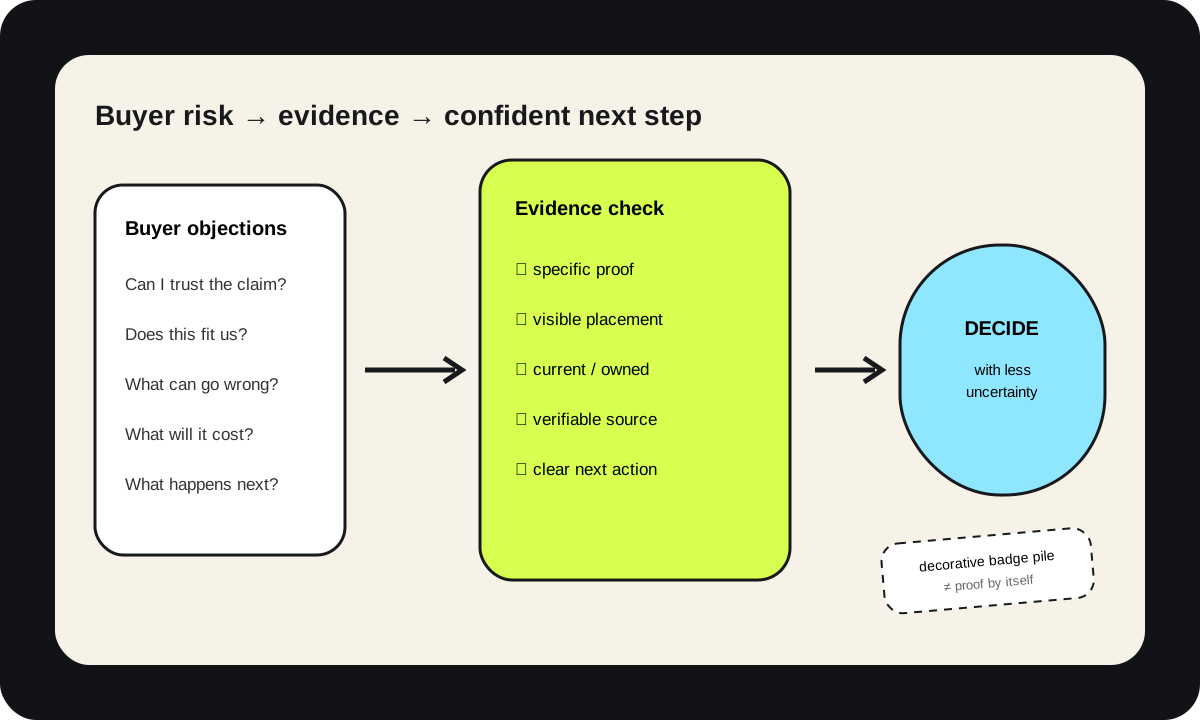
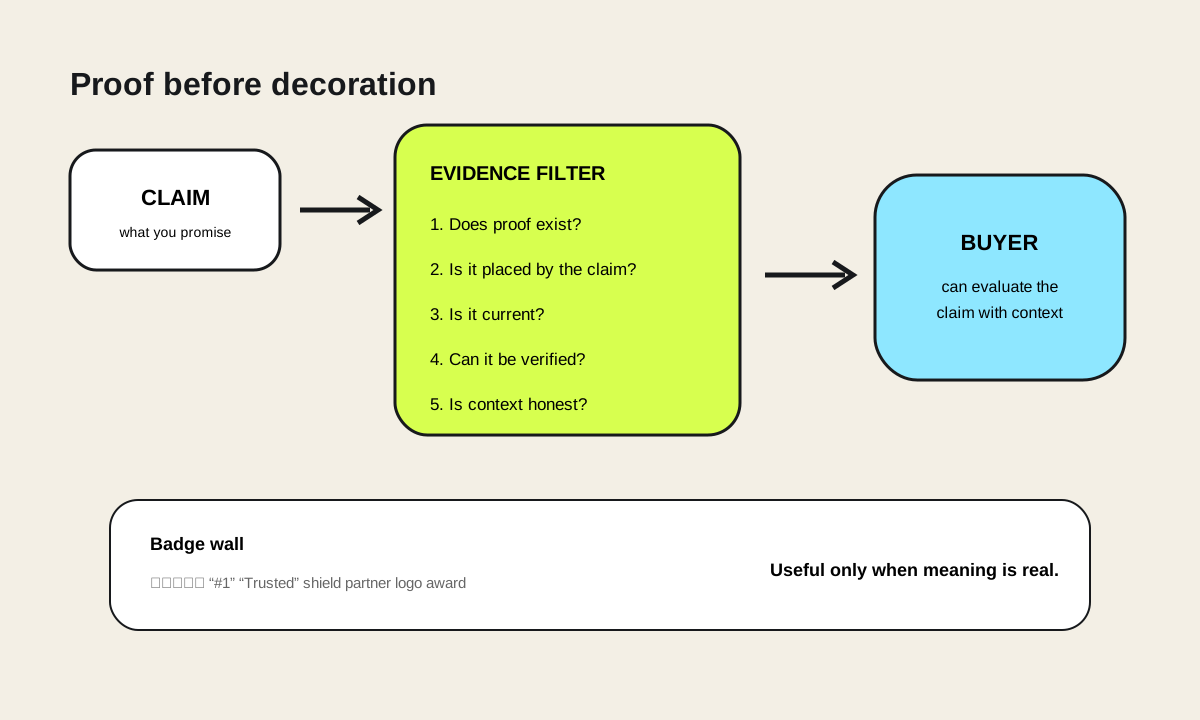
Trust signals work when they answer a real buyer objection with evidence at the moment that objection matters. A logo strip, badge, testimonial or security icon is not automatically persuasive. The useful question is whether a visitor can verify who you are, what you will deliver, what the risk is, what happens next and whether the proof is current. Treat trust as an evidence-and-placement system, then test changes against your own baseline.
What you’ll learn / decide
- which buyer decisions and objections your site must support;
- how to capture a baseline before changing proof, message or forms;
- how to audit proof availability, placement, freshness and verification by funnel stage;
- how to turn missing proof into an experiment backlog with metrics and guardrails;
- how to model a business scenario from your own traffic without claiming a trust change caused the result.
The practical goal is not “add more trust badges.” It is to make credible evidence easy to find before the buyer has to take a risky step. For one visitor that may mean a named case study beside a service claim. For another it may mean clear pricing boundaries, a privacy explanation next to a form, delivery ownership, a return/refund policy, or a believable way to contact a real team.
Define the visitor decision and business outcome first
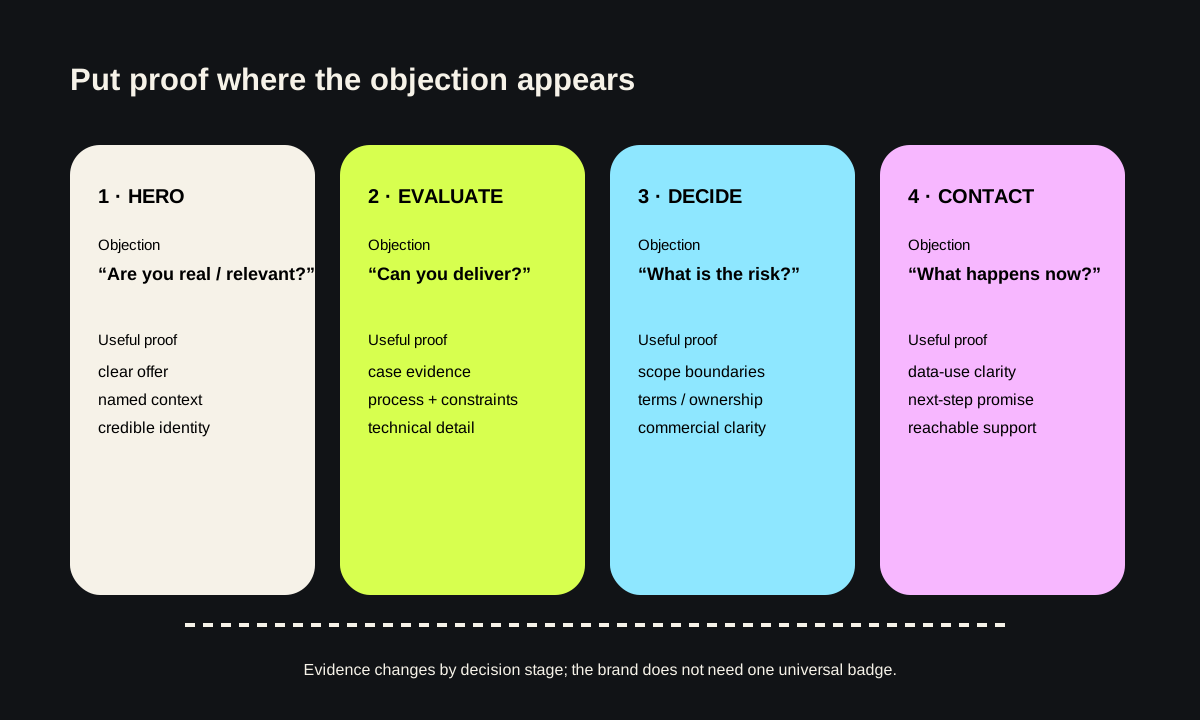
Start with the decision the page asks the visitor to make. A homepage may ask, “Is this company relevant enough to explore?” A service page may ask, “Can this team solve my problem?” A pricing or proposal step asks, “Is the commercial risk acceptable?” A contact form asks, “Is sharing my information worth it, and what will happen after I submit?”
Write the decision in one sentence and pair it with a business outcome you can observe. Examples include reaching a service page, starting a qualified inquiry, completing a checkout, requesting a demo, or booking a consultation. Do not jump directly to a revenue claim. Revenue is downstream and can be affected by traffic mix, seasonality, sales follow-up, pricing, product availability and many other variables.
Then list the objections that could prevent the decision. Useful categories are credibility, fit, delivery risk, commercial clarity, security/privacy and support/accountability. These categories are prompts, not universal truths. Interview sales, support and customers; review calls, form questions, lost-deal notes and on-site behavior to identify the objections that actually appear in your market.
Match proof to the objection
“Trusted by thousands” does not answer “Can you integrate with our ERP?” A five-star widget does not answer “Who owns the migration if something breaks?” A security logo does not answer “What data do you collect in this contact form?” Trust gets stronger when the evidence matches the question.
A useful proof record includes the claim or objection, the actual evidence, where the evidence appears, when it was last reviewed, and how it can be verified. That is why the audit tool on this page does not award credit for a badge alone. It asks whether proof exists, where it is placed, whether it is current and whether it is verified.
Capture the baseline before changing anything
A conversion experiment without a baseline makes interpretation difficult. Capture enough context to know what “before” means for the page or funnel you are changing. At minimum record the date range, traffic source mix, device mix, denominator, primary action and any important business constraints during that period.
The denominator matters. A “contact conversion rate” could mean submissions divided by all sessions, submissions divided by service-page sessions, or submissions divided by form starts. Those answer different questions. Define the denominator before the test and keep it stable when you compare periods.
For a lead-generation site, baseline fields might include service-page sessions, CTA clicks, form starts, valid form submissions, qualified leads and obvious spam. For ecommerce, the chain could include product sessions, add-to-cart, checkout start, payment attempt and completed order. For a SaaS demo flow, the relevant denominator may be eligible visitors rather than every anonymous pageview.
Also record guardrails. A shorter form might increase submissions but reduce lead quality. A more aggressive guarantee might increase clicks but create support or refund risk. A proof-heavy hero might distract from the primary proposition on mobile. Guardrails make those tradeoffs visible.
If you need a benchmark for context, treat it as external context rather than a target. The more useful baseline is your own funnel under a defined traffic mix. See the related guide on website conversion-rate benchmarks and context for a framework that separates market references from site-specific decisions.
Find the highest-friction moments, not the emptiest design spaces
Trust work should begin where the buyer has something meaningful to lose: time, money, personal data, political capital inside their company, implementation capacity, or the risk of choosing the wrong vendor. These moments often cluster around first impression, evaluation, commercial decision and contact/checkout.
Do not infer friction from visual emptiness. A clean page can be trustworthy if it answers the decision clearly. A crowded page can be weak even with dozens of logos. Use evidence: user interviews, sales objections, search terms, support tickets, form abandonment, session recordings where lawful and consented, funnel drop-off, and direct feedback.
Audit the four funnel stages
At the hero stage, buyers need basic relevance and legitimacy: what you do, for whom, and why the claim is believable. At service evaluation, they need fit, process, capability, constraints and evidence. At pricing/decision, they need commercial clarity, risk boundaries, terms, ownership and confidence that the offer is real. At contact, they need to understand why information is requested, how it will be used, what happens after submission and how to get help.
The interactive audit maps proof across those four stages. A missing row is not automatically a design defect; it is a prompt for investigation. If the objection is irrelevant to your buyer, remove it. If it matters, either document the proof you already have or create a backlog item to obtain and place credible evidence.
Design message, proof, CTA, forms and checkout as one decision system
Trust is not a component library. It emerges from whether message, evidence and action agree with each other.
Message: make the claim falsifiable enough to evaluate
Specific claims are easier to judge than vague superlatives. “We build custom SaaS” is a category statement. “We design and implement multi-tenant SaaS products with authentication, billing and admin workflows” gives a technical buyer something concrete to test against their needs. Avoid numbers you cannot substantiate and avoid turning internal estimates into public facts.
Proof: use evidence with provenance
Case studies are stronger when they name the context, scope and what was actually done. Testimonials are more useful when the visitor can understand who gave them and what experience they refer to. Certifications or partner marks should link to a verification source when one exists and should not imply a broader certification than was granted.
U.S. businesses using reviews and testimonials should also treat authenticity as a compliance issue, not merely a design preference. The FTC's Consumer Reviews and Testimonials Rule has been in effect since October 21, 2024 and addresses fake or false reviews, certain conditioned incentives, review suppression and related practices. FTC guidance also distinguishes consumer reviews from testimonials and explains that a business disseminating fake or false testimonials on its own website can face liability. Use the official guidance for the facts of your situation rather than copying a competitor's review treatment.
CTA: tell the visitor what the next step means
“Submit” reveals almost nothing. “Request a 30-minute scope review” communicates a clearer exchange. If a CTA leads to a sales call, do not make it look like a free instant audit. If it sends a form, explain whether the visitor should expect email, phone, a calendar or a proposal.
Forms: reduce uncertainty as well as fields
Form trust is partly information design. Label controls, state required information, explain unusual data requests, surface validation errors and avoid asking for data you do not need. WCAG 2.2 includes requirements for labels/instructions and error identification, and the W3C forms guidance emphasizes clear labels and instructions. Accessibility is a user requirement in its own right; it also prevents avoidable ambiguity at a high-intent step.
For WebDesignK projects, the relevant service bridge is web design and development: proof architecture should be implemented together with the information hierarchy, forms, responsive behavior and measurement—not pasted on after the page is finished.
Treat mobile friction as a separate trust review
A desktop proof section can fail on mobile without any content being “wrong.” Logos may become unreadable, long testimonials can bury the CTA, sticky bars can cover form controls, tables can overflow, and accordions can hide the one answer a buyer needs before submitting.
Audit the actual mobile sequence at a realistic viewport. Can the visitor identify the offer and next action without hunting? Is proof close enough to the claim it supports? Are tap targets comfortable? Are form labels visible when fields contain text? Are error messages connected to the correct input? Can a buyer open terms, privacy or evidence links without losing their progress?
Do not solve mobile by removing all evidence. Re-prioritize it. A short proof summary with a link to the full case study may be better than a giant logo wall. A compact privacy explanation next to the form can be more useful than a distant footer link when the buyer is deciding whether to share information.
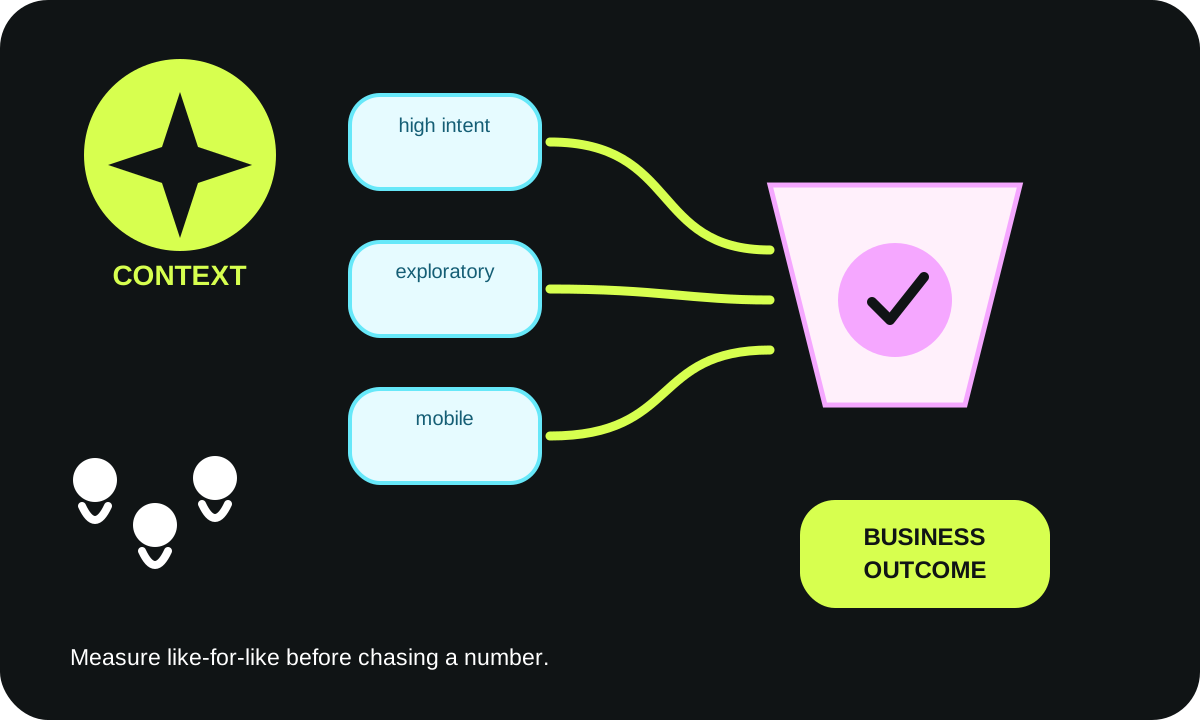
Segment by source and intent before you interpret results
Visitors arrive with different prior knowledge. A branded search visitor may already trust the company but need pricing or implementation detail. A non-branded search visitor may need category education and evidence. A referral from a partner may arrive with borrowed credibility. A paid campaign may promise something specific that the landing page must prove quickly.
Segment analysis by dimensions that plausibly change the decision: source/medium, campaign, landing page, device, new/returning status and—where you have lawful business data—customer type or account segment. Keep sample size and privacy constraints in mind. Segmentation is useful for diagnosis; slicing until one tiny segment “wins” is not a sound experiment method.
Intent also changes which proof matters. A technical evaluator may prioritize architecture, security, integrations and ownership. A commercial buyer may care about scope, timeline, pricing logic and references. An operator may care about support and change management. The site does not need a different brand identity for each person, but it should make the relevant evidence discoverable.
Build a prioritized experiment backlog
Turn friction findings into testable hypotheses. Each experiment should contain the friction hypothesis, page or step, proposed change, primary metric, guardrail, effort and confidence. The decision table below uses exactly those fields.
A good hypothesis is directional and falsifiable: “Visitors reaching the contact form may hesitate because the next step and data use are unclear. Test a concise ‘what happens next’ block and privacy explanation beside the form. Primary metric: valid form completion among form starters. Guardrails: qualified-lead rate, spam rate and support complaints.”
That wording does not promise a lift. It states the suspected mechanism and how you will observe it.
Prioritize evidence quality, not novelty
Confidence should rise when several sources point to the same friction—sales objections, user interviews and funnel behavior, for example. Effort includes design, engineering, content, legal review, analytics and QA. Impact should represent business importance if the hypothesis is correct, not the size of the UI change.
Define a stopping rule before launching where possible. That may be a pre-agreed sample requirement, a time window that spans normal operating conditions, a statistical test appropriate to your experimentation system, or an operational rule such as stopping immediately if a security/privacy guardrail fails. The exact method depends on your traffic and tooling; document it so the team cannot move the goalposts after seeing the result.
Model revenue impact without promising uplift
Trust improvements can matter commercially, but the page should not invent the size of the effect. Use a scenario model to understand what a different action rate would mean if it occurred, then keep causality separate.
The calculator above asks for sessions, a baseline action rate, a reader-entered scenario rate and optional value per action. If 10,000 sessions at a 2% baseline produce 200 modeled actions, changing the scenario input to 2.4% produces 240 modeled actions. That 40-action difference is arithmetic—not evidence that a testimonial, redesign or trust signal will create the change.
If you add value per action, use a number your business can defend. For ecommerce that might be observed average order value for a defined period. For lead generation, “value per lead” is often much less direct; use a documented expected-value model or leave the value field at zero. Do not convert every form submission into revenue at the full deal value.
This is the same causal restraint used in the related conversion-rate benchmark guide: external rates can frame questions, but your own denominator, traffic mix and funnel define the decision.
Measurement and guardrails
Measure three layers separately: implementation, behavior and business quality.
Implementation checks ask whether the intended proof exists and is actually visible at the right breakpoint and state. Verify links, images, form labels, error states, analytics events and responsive layout immediately after release.
Behavior metrics depend on the experiment. They might include CTA click-through, form-start-to-complete rate, checkout progression or consultation booking among eligible visitors. Preserve the denominator and segment definition from the baseline.
Business-quality guardrails protect against false wins. Examples include qualified-lead rate, cancellation/refund rate, support contacts, spam, average order value, sales acceptance, page performance and accessibility regressions. If a change drives more low-quality submissions, the primary metric alone is misleading.
Track proof maintenance too
Trust decays when evidence becomes stale. Add owners and review dates for case studies, customer quotes, security documents, pricing explanations, team/contact details and certifications. The audit's freshness field exists because a once-valid proof item can become misleading later.
Review authenticity as well as age. FTC guidance on reviews and testimonials is especially relevant if a marketing workflow imports, incentivizes, filters or republishes customer feedback. Keep records of the source and any material relationship or incentive that requires disclosure under applicable rules. This article is not legal advice; use counsel for fact-specific compliance decisions.
A practical 90-day roadmap
Days 1–30: baseline and evidence inventory. Define the high-value visitor decisions, funnel denominators and guardrails. Run the trust-signal audit across hero, service evaluation, pricing/decision and contact. Interview sales/support for recurring objections. Verify the provenance and freshness of existing testimonials, logos, claims, policies and case evidence. Fix obvious accuracy or accessibility defects before experimentation.
Days 31–60: place proof and run focused experiments. Choose the highest-confidence friction hypotheses. Improve proximity between claim and proof, clarify CTAs and form expectations, and test one meaningful variable at a time where your traffic allows. QA mobile separately. Instrument article_tool_*-style events or your equivalent analytics taxonomy so exposure and actions can be distinguished.
Days 61–90: evaluate, operationalize and expand. Compare results using the pre-defined denominator and stopping rule. Review guardrails and segment differences without cherry-picking. Promote validated patterns into reusable components or CMS fields. Assign owners and review dates for proof. Add unresolved evidence needs to the content, sales-enablement or product backlog instead of fabricating substitutes.
The result after 90 days should be more than a redesigned proof strip. You should have a maintained trust evidence system: known buyer objections, mapped proof, verification/freshness ownership, a measurement baseline and an experiment backlog. That system is harder to fake—and more useful—than accumulating decorative badges.
Frequently asked questions
What are the best trust signals for a website?
The best signal is the one that resolves a real buyer objection with credible evidence. Depending on the decision, that may be a named case study, clear process, current pricing boundary, security/privacy explanation, authentic review, certification verification or a clear accountable contact path.
Do trust badges increase conversion?
A badge can help, do nothing or distract depending on audience, placement, meaning and credibility. Do not assume a universal uplift. Establish your baseline, define the hypothesis and metric, and test the specific change with guardrails.
Why can testimonials look fake?
Testimonials look weak when they are anonymous, overly polished, disconnected from a real experience, repeated without provenance or inconsistent with the rest of the offer. In the U.S., fake or false reviews/testimonials can also create FTC compliance risk.
Where should trust signals appear?
Place proof close to the claim or risky step it supports: relevance/legitimacy near the hero, delivery evidence during service evaluation, commercial clarity near the decision, and privacy/next-step clarity near contact or checkout.
How often should trust proof be reviewed?
Use an owner and review date appropriate to the evidence. Pricing, team details, certifications, security statements and policies may need frequent review; case studies can remain useful longer but should still be checked when the offer or facts change.
How do we estimate the revenue impact of a trust experiment?
Use your own sessions, baseline action rate, reader-entered scenario rate and defensible value per action. Treat the result as scenario arithmetic. Only a properly designed measurement process can support a causal conclusion about the change.
Sources and assumption boundaries
Fast-changing platform, pricing and search claims were reviewed on September 23, 2026. Interactive scores and scenarios are clearly labeled planning models, not sourced market benchmarks.
- FTC — Consumer Reviews and Testimonials Rule: Questions and Answers Official FTC staff guidance on the Consumer Reviews and Testimonials Rule, including distinctions between reviews and testimonials and conduct covered by the rule.
- FTC — Endorsements, Influencers, and Reviews Official FTC business-guidance hub for endorsements, reviews, testimonials and related disclosure/compliance resources.
- W3C — Web Content Accessibility Guidelines (WCAG) 2.2 Normative WCAG 2.2 accessibility requirements, including input assistance, labels/instructions and error identification.
- W3C WAI — Labeling Controls Practical W3C WAI guidance for labeling form controls and associating labels with inputs.