Quick answer
A production SaaS API should keep resource modeling separate from transport mechanics, enforce tenant authorization server-side, make retryable writes idempotent, paginate large collections predictably, communicate quotas, treat webhooks as signed retryable delivery, expose stable errors/request IDs and test backward compatibility before releases.
Last reviewed: October 3, 2026API contract planner
Select the constraints your API must support. The planner turns them into contract, security, reliability and operational modules plus unresolved decisions. Scores are transparent WebDesignK planning weights, not benchmark hours or SLA claims. Inputs stay in this browser.
- Resource contract + error envelope — Contract; phase: Foundation.
- Authentication + scoped authorization — Security; phase: Foundation.
- Request IDs, metrics + structured API logs — Operations; phase: Foundation.
- Cursor pagination + stable ordering — Contract; phase: Foundation.
- Idempotency key store + replay semantics — Reliability; phase: Reliability.
- Signed webhook delivery pipeline — Reliability; phase: Reliability.
- Webhook delivery log + replay tooling — Operations; phase: Reliability.
- Quota policy + response headers + backoff guidance — Operations; phase: Scale.
- Partner docs + sandbox examples — Operations; phase: Scale.
- Define the canonical resource identifiers, error envelope and request-correlation fields.
- Define OAuth scopes, token audience, tenant context and least-privilege grant model.
- Choose a stable sort key and cursor invalidation behavior for mutable collections.
- Define idempotency-key scope, retention window and response replay semantics for writes.
- Define signature scheme, retry schedule, replay protection, event ordering assumptions and manual replay workflow.
- Define quota dimensions, burst behavior, response headers and retry guidance per consumer tier.
- Define backward-compatibility tests for field additions, enum expansion, pagination and error changes.
1. Architecture component planning scores
Complexity and operational burden are summed only from modules triggered by your inputs.
Takeaway: webhook delivery, delegated auth and public API support add operational burden beyond resource CRUD.
2. Implementation phase weight
Relative points group generated modules into foundation, reliability and scale work.
Text fallback: Foundation 13 points, Reliability 12 points, Scale 7 points.
3. Module count by domain
Counts show which API responsibilities expand under the selected constraints.
Takeaway: contract shape, security, delivery reliability and developer operations should be explicit layers rather than one middleware stack.
Source/assumption note: planner scores are WebDesignK editorial planning weights disclosed in code. They are not performance benchmarks, capacity limits or vendor guarantees. Validate retry, authentication, quota and versioning behavior against your threat model and current provider/platform documentation.
Tables built for the buying decision
Primary decision table
| Resource / endpoint | Method / event | Auth scope | Idempotent? | Pagination | Rate limit | Versioning |
|---|---|---|---|---|---|---|
| Projects collection | GET /projects | projects:read | HTTP safe/idempotent | Cursor for growing collections | Read quota / burst policy | Additive fields by default |
| Create project | POST /projects | projects:write | Idempotency key recommended for retryable create | Not applicable | Write quota | Contract-compatible within version |
| Update known project | PUT/PATCH /projects/{id} | projects:write | PUT is idempotent by HTTP semantics; PATCH policy documented | Not applicable | Write quota | Field semantics protected |
| Invite member | POST /members/invitations | members:invite | Application idempotency key useful | Not applicable | Sensitive-action quota | Scope and error compatibility |
| Audit events | GET /audit-events | audit:read | HTTP safe/idempotent | Cursor + stable time/id ordering | Potentially stricter expensive-query quota | Additive event fields |
| Webhook delivery | event to customer endpoint | webhook endpoint secret | Consumer deduplicates event ID | Not applicable | Delivery/retry policy | Event schema compatibility |
Webhook reliability matrix
| Event | Retry | Signature | Replay protection | Delivery log |
|---|---|---|---|---|
| resource.created | Backoff schedule defined by product | Signed raw payload / timestamped scheme | Stable event ID + consumer dedupe | Attempt status, response, latency, next retry |
| resource.updated | Retry transient failures | Same verified signature contract | Do not assume event ordering | Keep correlation/resource references |
| resource.deleted | Retry with same event identity | Reject invalid/expired signatures per policy | Handler makes repeated notification safe | Terminal state + manual replay |
| integration.test | Limited/test delivery policy | Production-equivalent signing | Test event clearly identified | Visible in endpoint delivery history |
| manual replay | New delivery attempt for existing event | Re-sign according to current endpoint secret policy | Original event ID retained | Actor/reason + new attempt record |
Turn this planning result into a scoped review.
Send the assumptions, constraints and result summary. WebDesignK can review the architecture/content/implementation boundary, identify missing discovery inputs and return a prioritized next-step scope.
- Bring: current site/product, constraints, integrations and your tool result.
- You get: a scoped recommendation, open questions and implementation priorities.
Decision snapshot for SaaS API design
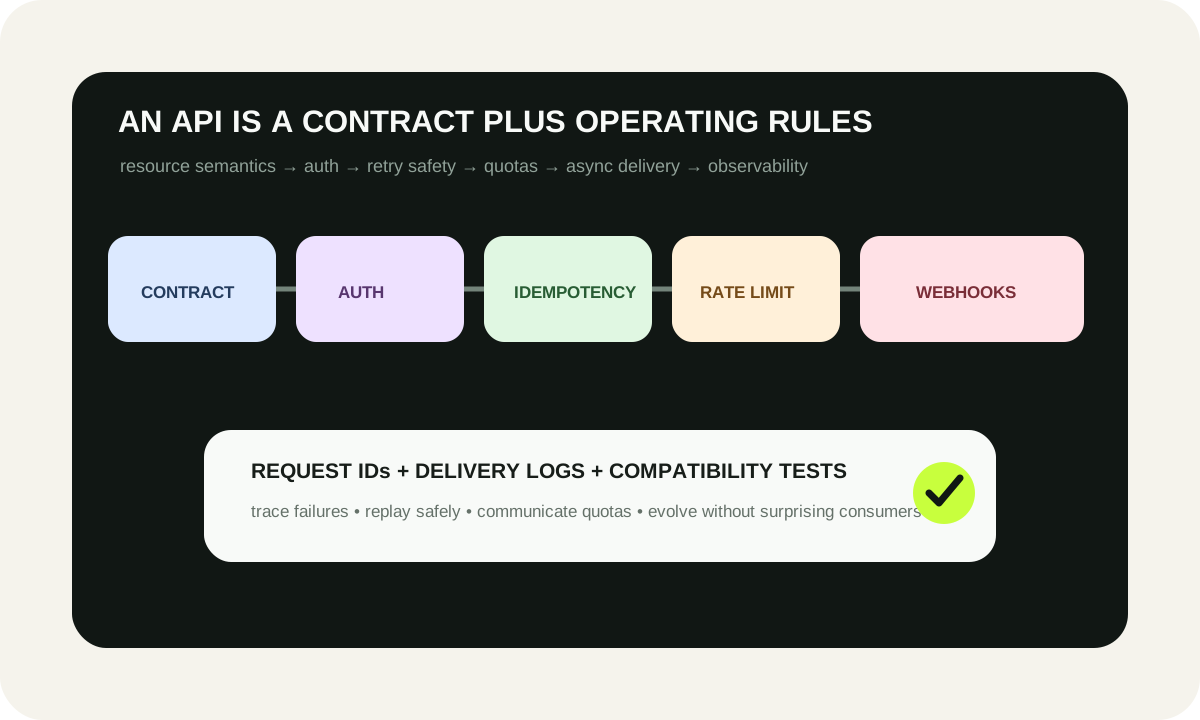
A durable SaaS API is a public contract plus operating rules: resource semantics, authentication and tenant authorization, retry safety, pagination, quotas, asynchronous delivery, version compatibility and observable failure behavior. The most important tradeoff is speed of change versus consumer stability. Internal code can sometimes change in lockstep; partner and public APIs cannot. Design the contract so consumers can retry safely, understand limits, diagnose errors and survive additive evolution without depending on undocumented behavior.
What you'll learn / decide
- which consumers the API is actually designed for;
- how resource shape and versioning affect long-term compatibility;
- where authentication ends and tenant/resource authorization begins;
- when write endpoints need idempotency keys;
- how to design pagination for mutable collections;
- how rate limits should be communicated;
- how signed webhook delivery, retry and replay tooling fit together;
- how error taxonomy and request IDs improve support;
- when SDKs are worth maintaining;
- how to test backward compatibility before changes ship.
1. API contract and consumer types
Start by identifying consumers. An API used only by your own frontend has different compatibility and onboarding needs than one exposed to selected partners or a public developer ecosystem.
Internal consumers can often migrate with the server because the same team owns both sides. Partner consumers need explicit documentation, sandbox examples and notice before breaking changes. Public APIs need the strongest contract discipline because you usually cannot coordinate every deploy with every consumer.
Define the contract before the endpoint list
An API contract includes more than paths and JSON fields. Define resource identifiers and ownership, method semantics, authentication method, authorization scope, tenant context, pagination behavior, idempotency behavior, error envelope, request/correlation identifiers, quota/rate-limit signals, version compatibility and deprecation communication.
The contract should say what a consumer may rely on. Implementation details that are not part of the contract should remain free to change.
Keep admin and automation use cases explicit
Admin dashboards, automation workers, customer integrations and third-party apps may all call the same business capabilities but require different credentials and scopes.
Do not create one broad admin API key simply because internal tooling needs many endpoints. Model operational clients as first-class consumers with least-privilege scopes and auditable credentials.
2. Resource modeling and versioning strategy
Good resource modeling starts with stable nouns and predictable relationships. A consumer should understand whether it is interacting with accounts, members, projects, invoices or jobs without reverse-engineering internal tables.
Avoid endpoints that encode UI actions instead of resource semantics when a stable resource transition is clearer. A projects/{id}/archive command may be valid when archive is a meaningful domain transition; dozens of verbs that mirror buttons usually indicate the contract is coupled to one interface.
Additive evolution is the cheapest versioning strategy
Prefer changes existing consumers can ignore:
- add optional request fields;
- add response fields;
- add new endpoints;
- add new event types;
- add enum values only when consumers are told to handle unknown values safely.
Breaking changes deserve an explicit lifecycle.
GitHub's current REST documentation is a useful example of date-based API versioning: clients can specify a version, and breaking changes are associated with new API versions while additive changes remain available across supported versions. The exact scheme is less important than the principle: compatibility rules and migration windows must be documented.
Avoid versioning every small change
Putting /v2 in a path does not solve compatibility if behavior changes unpredictably inside that version. Conversely, an API can evolve for a long time without a new major version if its compatibility rules are disciplined.
Choose path, header or media-type versioning based on your ecosystem and tooling. The real requirement is deterministic behavior and a visible deprecation path.
3. Authentication and authorization
Authentication establishes which client or user made the request. Authorization decides whether that actor can perform the requested action on the target resource within the current tenant.
API keys can work well for server-to-server integrations when keys are scoped, rotatable and attributable. OAuth is useful when a third-party application acts on behalf of users or organizations and needs delegated scopes and consent.
Tenant scope must be enforced server-side
Do not trust a tenant ID because the client supplied it. Resolve membership, installation or credential scope and verify the requested resource belongs to the allowed tenant.
A correct API request may still be unauthorized even when the token is valid.
For high-value operations, design scopes around business actions such as projects:read, projects:write, members:invite, billing:read, billing:write and audit:read.
Avoid a single token scope that silently grants unrelated administrative capabilities.
Credential operations need their own admin surface
Expose creation time, last-used time, owner, scopes and rotation/revocation controls for API keys or OAuth applications. Secret values should not be repeatedly recoverable after creation unless the provider architecture explicitly supports that safely.
4. Idempotency and safe retries
Networks fail in ambiguous ways. A client can send a request, lose the connection before seeing the response, and not know whether the server applied the operation.
RFC 9110 defines PUT, DELETE and safe methods as idempotent in HTTP semantics. POST is not automatically idempotent, but application protocols can design retry-safe POST operations when they have a mechanism to identify repeated intent.
Use idempotency keys for retryable writes
For operations such as creating an invoice, starting a job, provisioning a tenant or submitting a payment-like action, accept a client-generated idempotency key.
Store enough information to determine key scope, actor/tenant, normalized request identity, processing status, original response/result and retention window.
If the same key is reused for a different payload, reject it rather than guessing.
Stripe's API documentation provides a well-known production example of idempotency keys for retry-safe requests. Your API does not need to copy Stripe's exact storage policy, but it should document its own.
Retry policy belongs in the contract
Document which failures consumers may retry and how. Timeouts and selected 5xx responses may be retryable; validation errors usually are not. For 429 responses, communicate when or how to retry rather than forcing clients to invent aggressive loops.
5. Pagination, filtering and partial responses
Unbounded list endpoints eventually become performance and reliability problems.
Offset pagination is easy to understand but can behave poorly when large collections change between requests. Cursor pagination can provide more stable traversal when it is based on a deterministic ordering.
Cursor design needs a stable ordering
A cursor should represent position in an ordered result set, not just expose an internal database offset.
Decide the sort field and tie-breaker, default and maximum page size, forward/backward traversal, cursor lifetime and behavior when records are deleted or updated.
Do not promise snapshot semantics unless you actually implement them.
Filtering must remain indexable and explainable
Expose filters that map to supported query paths. Avoid a generic filter-any-field mechanism unless the datastore and authorization model can support it safely.
For expensive objects, partial-response or field-selection mechanisms can reduce payload cost, but they increase contract complexity. Start with well-shaped resources before adding a query language.
6. Rate limits and quota communication
Rate limiting protects availability and gives consumers a predictable fairness boundary.
There is no universal requests-per-second number that fits every SaaS API. Limits should reflect endpoint cost, authentication identity, tenant plan, abuse risk and infrastructure capacity.
GitHub's REST API demonstrates why consumers need rate-limit signals: its current documentation exposes response headers that communicate current quota state and distinguishes primary and secondary limits. Your limits may be simpler, but the consumer experience should be similarly explicit.
Communicate the policy in responses
Useful signals may include limit, remaining quota, reset time/window, Retry-After for throttled requests and a quota dimension or policy identifier.
Use standard HTTP semantics where they fit and document any custom headers.
Separate abuse protection from commercial quota
An entitlement such as 100,000 API calls per month is not the same as a protective burst rate limit.
Commercial quota answers what the customer purchased. Rate limiting answers how quickly traffic may arrive safely. Keep both visible so support can explain whether a request failed because of a plan limit, burst control or platform protection.
7. Webhooks: signing, retries and delivery logs
Webhooks turn your SaaS into an event producer. Once partners build workflows on them, delivery becomes a product surface with reliability expectations.
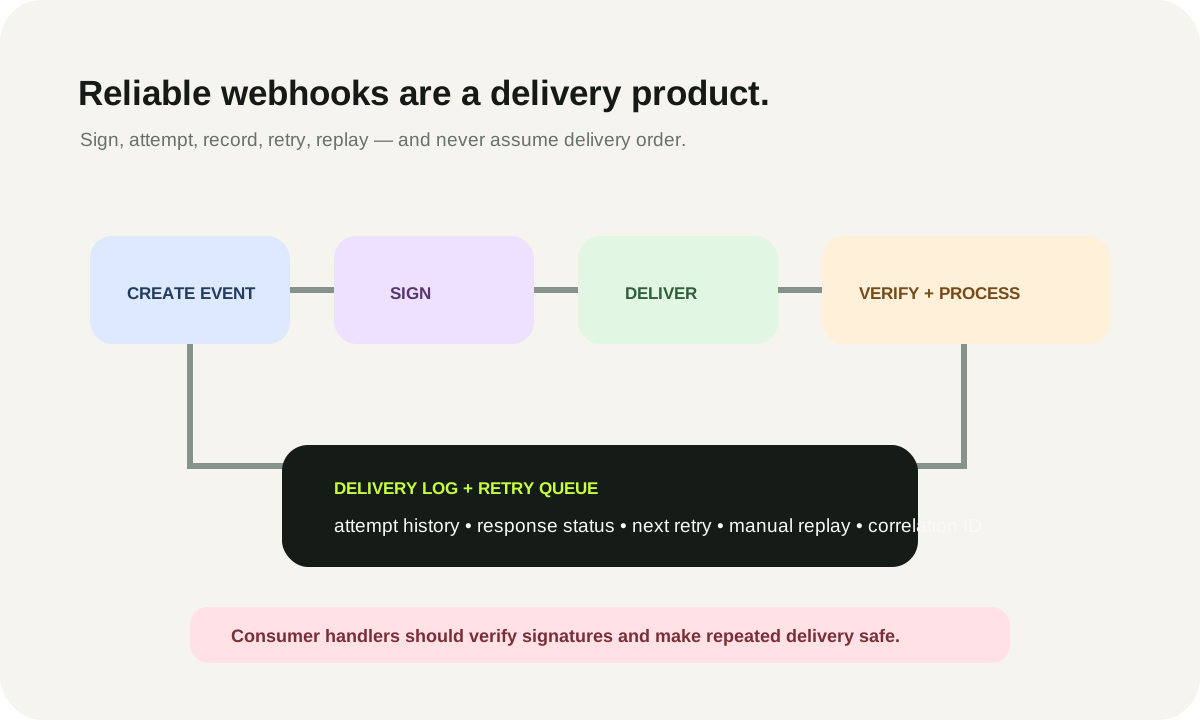
A webhook system should generate a stable event identifier, serialize a documented event shape, sign the payload and record each delivery attempt.
Signing protects authenticity, not business idempotency
Consumers should verify signatures before trusting a webhook payload. Stripe's current webhook guidance, for example, requires signature verification using the raw body and signing secret.
But a valid signature does not mean the event is new. Consumers also need replay protection or event-id deduplication so a retried delivery does not repeat a destructive operation.
Design retry and replay deliberately
A useful delivery record includes event ID/type, endpoint, attempt number, request time, response status, response duration, next retry, terminal status and request/correlation ID.
Provide manual replay tooling for operators and, when appropriate, customers. Replay should create a new delivery attempt for the same event rather than silently manufacturing a new business event.
Never require event ordering unless guaranteed
Distributed delivery can arrive late or out of order. Event handlers should use event identity and authoritative resource state rather than assuming the last webhook received is the newest state.
8. Error taxonomy and observability
A consistent error envelope reduces support burden.
Separate categories such as validation, authentication, authorization, not found, conflict, idempotency conflict, rate limited, dependency unavailable and internal error.
Return a stable machine-readable code plus a human-readable message and request ID. Do not leak secrets, SQL errors or stack traces.
Request IDs connect customer reports to operations
A customer saying the API failed yesterday is hard to investigate. A request ID lets support locate the exact trace, logs and dependent calls.
Capture latency, status class, route template, consumer identity, tenant context and selected error code. Avoid logging secrets or full sensitive payloads.
Define degraded-mode behavior
If a non-critical downstream service is unavailable, some reads may continue from known state while writes fail clearly. If authorization or integrity dependencies are unavailable, failing closed may be required.
Document degraded behavior per capability rather than applying one generic fallback to every endpoint.
9. SDK, documentation and testing strategy
Documentation is part of the contract. Generate reference documentation from an OpenAPI description when practical, but add task-oriented examples that show complete workflows.
A schema alone does not explain how to paginate through all results, retry writes, verify a webhook, rotate credentials, recover from 429 or migrate versions.
Build SDKs only when you can maintain them
A public SDK improves adoption when it handles authentication, pagination, retries and typed resources consistently. But every language SDK becomes a release and compatibility obligation.
For smaller partner APIs, strong HTTP documentation plus generated client options may be more sustainable than hand-maintaining many official SDKs.
Contract tests should run before deployment
Test OpenAPI/schema compatibility, authorization allow/deny cases, idempotent retries, cursor traversal, rate-limit headers, documented errors, webhook signatures/retry behavior and old-client fixtures against new server code.
For public APIs, consider consumer-driven contract tests or recorded compatibility fixtures for your most important integrations.
10. Backward-compatibility checklist
Resource contract
- Existing required request fields remain valid.
- Existing response fields keep their type and meaning.
- New fields are optional for old clients.
- Enum consumers are told to tolerate unknown values where expansion is expected.
- Stable identifiers do not change format without migration.
Authentication and authorization
- Scope semantics do not silently broaden.
- New endpoints require explicit scopes.
- Tenant boundary checks are covered by denied tests.
- Credential rotation and revocation are testable.
Reliability
- Retryable writes define idempotency behavior.
- Duplicate requests are safe where promised.
- Pagination produces stable traversal.
- Rate-limit responses communicate retry behavior.
- Dependency failures return documented error classes.
Webhooks
- Payloads are signed.
- Consumers can deduplicate events.
- Retry policy is documented.
- Delivery history is observable.
- Manual replay is auditable.
- Event additions do not break consumers that ignore unknown types.
Versioning
- Breaking changes trigger the documented version/deprecation process.
- Migration guides show field/behavior differences.
- Old-version test fixtures remain in CI during the support window.
- Sunset/deprecation signals are visible before removal.
- Changelog entries are tied to release/version dates.
Enterprise pressure test
Enterprise customers often require separate installations, OAuth scopes, audit logs, stricter tenant boundaries, fixed egress allowlists or higher-volume quotas.
Pressure-test whether the same API can support one integration installed across many tenants without cross-tenant token confusion; tenant admins granting only approved scopes; support identifying which application made a request; security teams revoking one credential without breaking unrelated clients; customer-specific quotas without embedding plan logic into every endpoint; and webhook endpoints with separate secrets and delivery histories.
Migration path without a rewrite
A practical sequence is:
Phase 1: internal resource API with server-side auth, stable errors and request IDs.
Phase 2: cursor pagination, idempotent writes and structured operational metrics.
Phase 3: partner credentials, scopes, sandbox documentation and signed webhooks.
Phase 4: explicit quota communication, delivery replay tooling and compatibility CI.
Phase 5: public developer portal, stronger version lifecycle and selected SDKs.
This migration works when the resource model, tenant authorization and error semantics are stable before the API becomes public.
Compatibility release gate and rollback
Before shipping an API change, review it from the consumer's point of view rather than only from server tests. Compare the generated schema with the previous published contract, run representative old-client fixtures and inspect whether authorization, errors, pagination or rate-limit semantics changed even when the JSON shape did not.
For risky releases, canary the new server behavior for selected internal or partner clients and watch error codes, latency, throttling and webhook delivery before broad rollout. A rollback plan should state whether reverting server code is sufficient or whether data migrations, event schemas or newly issued credentials make rollback more complex.
Treat documentation and changelog publication as part of the release. If a change needs consumer action, publish the migration path before enforcing it and keep support/admin tooling able to identify which client version, credential or webhook endpoint is affected.
Boundary decisions by system layer
Keep business-resource semantics and authorization in application code. Use gateway/edge infrastructure for coarse traffic protection, but do not make it the only tenant permission layer. Store idempotency records, webhook attempts and request correlation data durably enough to investigate failures. Use operational/admin tooling for key management, delivery replay, quota inspection and deprecation tracking.
Use the interactive API contract planner above to expose the modules and unresolved decisions triggered by your consumer, auth, webhook, quota and versioning requirements.
If you need help turning product capabilities into a stable API contract, see custom SaaS development. Continue with SaaS authentication architecture, SaaS billing architecture, and SaaS admin dashboard design.
Last reviewed: October 3, 2026. API provider behavior and version policies change. Verify current official documentation before implementing provider-specific assumptions.
Frequently asked questions
Should every SaaS API be versioned in the URL?
No. A disciplined additive compatibility policy can avoid frequent major versions. If explicit versions are required, path, header or media-type approaches can work; the important part is deterministic behavior, support windows and migration guidance.
Which HTTP methods are idempotent?
RFC 9110 defines PUT, DELETE and safe methods such as GET and HEAD as idempotent in their intended server effect. POST is not automatically idempotent, so retry-safe POST workflows usually need application-level semantics such as an idempotency key.
What should a rate-limited API return?
Use an appropriate HTTP error such as 429 when throttling applies and communicate retry/quota state with documented response headers such as Retry-After or your published limit/reset headers.
Are signed webhooks enough to prevent duplicate processing?
No. Signature verification authenticates the delivery. Consumers should also deduplicate stable event IDs or otherwise make repeated delivery safe.
Should product entitlements be encoded in API rate limits?
Keep commercial quota and protective rate limiting separate. A customer may purchase a monthly usage allowance while the platform still enforces short-window burst limits for reliability.
Do internal APIs need the same discipline as public APIs?
They can use lighter onboarding/version processes, but stable errors, tenant authorization, idempotency and observability still reduce production failures. Designing those foundations early makes later partner/public exposure easier.
Sources and assumption boundaries
Fast-changing platform, pricing and search claims were reviewed on October 3, 2026. Interactive scores and scenarios are clearly labeled planning models, not sourced market benchmarks.
- RFC 9110 — HTTP Semantics IETF/RFC Editor definition of HTTP method semantics, including idempotent methods and retry considerations.
- Stripe API — Idempotent requests Production example of application-level idempotency keys for retry-safe API writes.
- Stripe Webhooks Current first-party guidance for webhook event delivery, signature verification and endpoint handling.
- GitHub REST API rate limits Current first-party example of quota communication through response headers and multiple limit classes.
- GitHub REST API versions Current first-party example of explicit date-based API versions, breaking-change policy and deprecation lifecycle.