Quick answer
Enterprise-ready SaaS authentication separates authentication from authorization, keeps tenant context explicit, adds MFA/recovery policy, supports SSO through standards such as OIDC/SAML, models permissions server-side, revokes sessions when identity state changes and records privileged security events.
Last reviewed: October 2, 2026Identity / RBAC decision builder
Select the constraints your SaaS must support. The planner turns them into an identity-module map and unresolved architecture questions. Scores are transparent WebDesignK planning points—not benchmark hours, risk ratings or compliance scores. Inputs stay in this browser.
- Identity core + account lifecycle — Authentication; phase: Foundation.
- Session lifecycle + revocation — Authentication; phase: Foundation.
- RBAC policy helpers — Authorization; phase: Foundation.
- Tenant membership + boundary enforcement — Authorization; phase: Foundation.
- MFA enrollment, challenge + recovery — Authentication; phase: Foundation.
- Enterprise SSO connection layer — Federation; phase: Enterprise.
- Domain / IdP discovery and connection routing — Federation; phase: Enterprise.
- Tenant delegated admin controls — Authorization; phase: Enterprise.
- Security/audit event trail — Operations; phase: Operations.
- Choose supported federation protocols and connection ownership model (for example OIDC and/or SAML).
- Define IdP-initiated versus service-provider-initiated flows and account-linking behavior.
- Define recovery factors, lost-device process and which authenticators are acceptable for privileged users.
- Define how tenant context is selected, verified and propagated to every authorization decision.
- Define which roles tenant admins may grant without privilege escalation.
- Define security event schema, retention, export access and privileged-action correlation fields.
1. Architecture component planning scores
Complexity and operational-burden points are summed from the modules generated by your inputs.
Takeaway: SSO, tenant boundaries, recovery and auditability add operational work that should be visible in the architecture plan.
2. Migration / implementation phase weight
Relative points group selected modules into foundation, enterprise and operations phases.
Text fallback: Foundation 16 points, Enterprise 12 points, Operations 3 points.
3. Control surface by domain
Counts show how many generated modules sit in each identity/security domain.
Takeaway: authentication and authorization are separate surfaces; enterprise federation and audit operations should not be collapsed into the login form.
Source/assumption note: planner points are editorial planning weights disclosed in code. They are not NIST assurance levels, security scores, delivery estimates or compliance evidence. Validate requirements against your threat model, enterprise contracts and current identity standards.
Tables built for the buying decision
Primary decision table
| Capability | B2C baseline | B2B baseline | Enterprise requirement | Implementation option |
|---|---|---|---|---|
| Primary sign-in | Password or passwordless | Password/social/passwordless mix | Enterprise-managed identity may be required | Managed IdP or application auth with proven libraries |
| MFA | Optional or risk-based | Required for privileged roles | Policy, recovery and stronger authenticators for high-risk access | Managed MFA + application policy |
| SSO | Usually not required | May be requested by larger customers | OIDC/SAML connections, routing, claim mapping, diagnostics | Managed federation layer or standards-based integration |
| Authorization | Simple user/admin split | Tenant-aware RBAC | Delegated admin, scoped roles, separation of duties | Application-owned policy service/helpers |
| Sessions | Standard browser sessions | Revocation after role/member changes | Admin sign-out, SSO lifecycle, security response | Central session store/revocation index or provider APIs |
| Audit | Login/security basics | Role/member changes | Privileged actions, impersonation, export/search | Structured application security event pipeline |
Permission matrix example
| Role | Member read | Invite member | Assign role | Billing | Security audit | Impersonate |
|---|---|---|---|---|---|---|
| Viewer | Allow | Deny | Deny | Deny | Deny | Deny |
| Member admin | Allow | Allow | Scoped | Deny | Deny | Deny |
| Billing admin | Allow | Deny | Deny | Allow | Deny | Deny |
| Security admin | Allow | Scoped | Allow | Deny | Allow | Deny |
| Support operator | Allow | Deny | Deny | Read only | Scoped | Scoped / approved |
| Platform admin | Allow | Allow | Allow | Allow | Allow | Approved only |
Turn this planning result into a scoped review.
Send the assumptions, constraints and result summary. WebDesignK can review the architecture/content/implementation boundary, identify missing discovery inputs and return a prioritized next-step scope.
- Bring: current site/product, constraints, integrations and your tool result.
- You get: a scoped recommendation, open questions and implementation priorities.
Decision snapshot for SaaS authentication
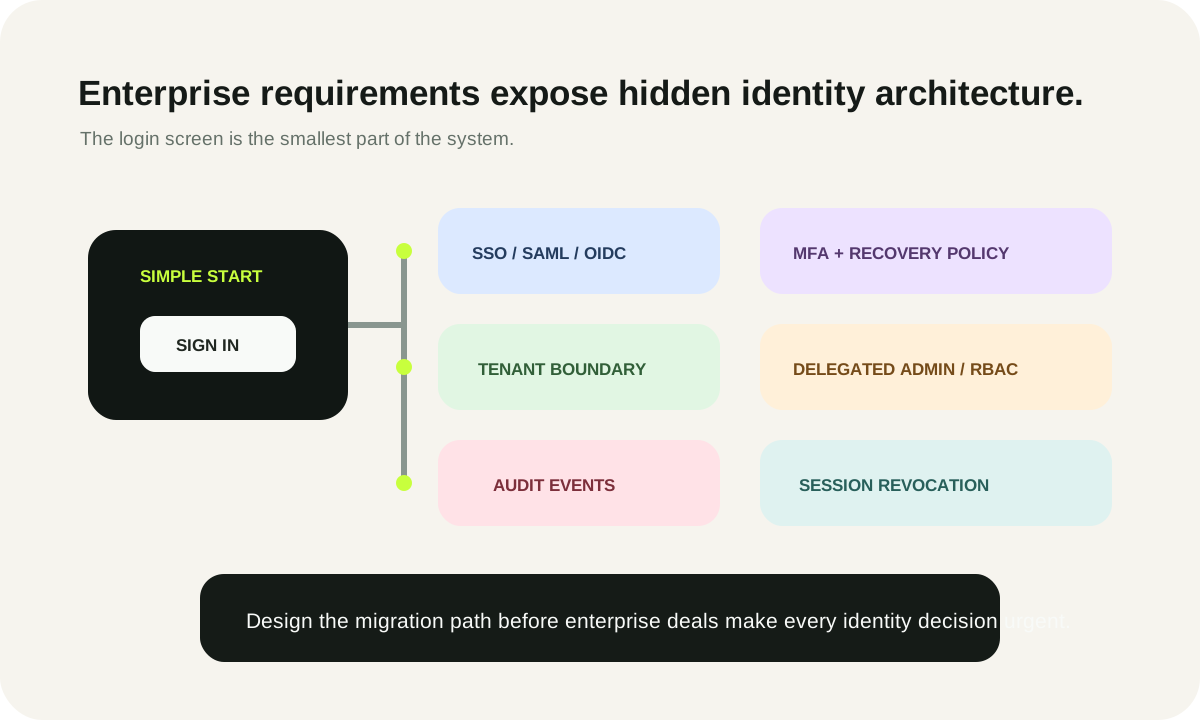
SaaS authentication becomes an architecture problem as soon as the product must support multiple organizations, enterprise SSO, meaningful role separation, MFA policy, delegated administration, revocation and auditable privileged actions. The login form is only the entry point. A production identity system must connect identity proof, session state, tenant context and authorization without letting one layer silently substitute for another.
What you’ll learn / decide
- where authentication ends and authorization begins;
- when passwords, passwordless and social login belong in the same product;
- how MFA policy changes recovery requirements;
- how OIDC and SAML fit enterprise SSO;
- when RBAC is enough and when attributes or scoped conditions become necessary;
- how tenant boundaries affect every permission check;
- what support impersonation should and should not allow;
- how session revocation and device trust alter the operational model;
- what audit events enterprise buyers expect to reconstruct;
- when a managed identity provider reduces risk and when application-specific identity logic still remains yours.
The critical tradeoff is speed of adoption versus control of policy. Managed identity can remove difficult protocol and credential work, but your application still owns tenant membership, effective permissions, authorization checks, privileged workflows and business-specific recovery decisions.
1. Authentication vs authorization: separate the decisions
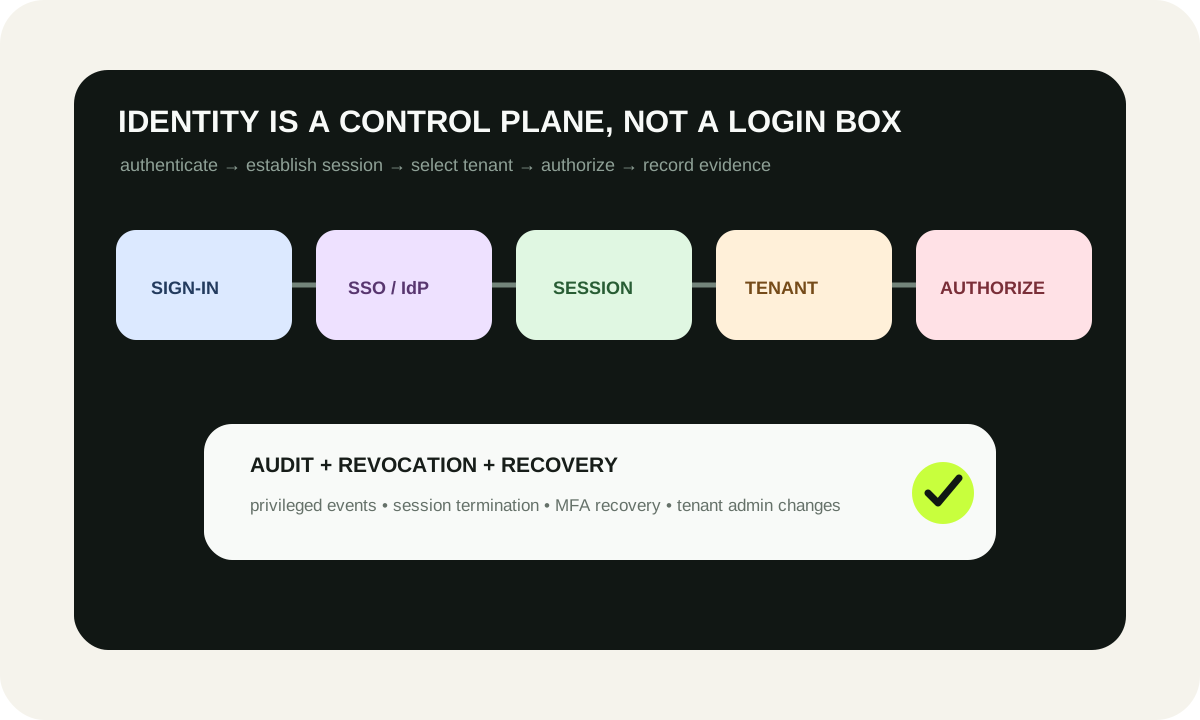
Authentication answers who is this actor? Authorization answers may this actor perform this action on this resource in this tenant/context? They are related but not interchangeable.
OWASP’s authorization guidance emphasizes this distinction because authenticated users should not automatically gain access to every resource. In a SaaS product, the same person may be a billing admin in one organization, a read-only guest in another and a platform operator nowhere.
A clean request path therefore looks like:
- verify identity using the chosen authentication method;
- establish or refresh the session;
- resolve current tenant/workspace membership;
- load effective role/permissions and contextual constraints;
- authorize the requested action server-side;
- record security-relevant outcomes when appropriate.
Keep authorization close to business resources
Do not make a front-end “isAdmin” flag the real policy engine. The API or server-side command handling the resource should enforce the permission. UI hiding is useful for clarity but not for protection.
Resource-oriented permission names help. “invoice.refund,” “member.invite,” “role.assign,” “project.delete” and “audit.export” are easier to reason about than one generic “admin” boolean.
2. Passwordless, passwords and social login
There is no universal sign-in method that fits every SaaS audience. The right baseline depends on whether the product serves consumers, small teams, enterprise workforce users or a mix.
Passwords still require safe storage, reset and breach-resistance workflows. Social login can reduce account-creation friction, but linking identities needs explicit rules. Passwordless flows can remove password handling but shift operational dependency to email, device or authenticator control.
Design account linking before adding more login methods
A user who signs in with Google today and SSO tomorrow should not accidentally create duplicate accounts or inherit the wrong tenant membership.
Define a canonical internal user identity and explicit linking rules. Never merge identities only because two providers return the same display name. Email matching may also require verification and organization-specific constraints.
Treat recovery as part of authentication
Every stronger authentication control creates a recovery path that can become the weakest link. If a user loses a device, leaves a company or cannot access an inbox, the recovery process must be deliberate, observable and resistant to social engineering.
3. MFA policies and recovery flows
MFA adds a second factor to the authentication decision. OWASP recommends MFA broadly and specifically calls out administrative or highly privileged users as important candidates.
NIST SP 800-63B distinguishes phishing-resistant authentication from OTP-style flows where users manually enter codes. For systems with higher-risk administrative access, that distinction matters when selecting authenticators.
Policy is more than “MFA on”
Define:
- who must enroll;
- which authenticators are allowed;
- when step-up authentication is required;
- how backup/recovery methods work;
- whether remembered devices are supported;
- what happens after factor reset;
- how administrators recover locked accounts;
- how the reset itself is audited.
A policy that requires MFA but lets support disable it without strong evidence can undermine the intended control.
Recovery deserves separate permissions
Treat MFA reset, recovery-code regeneration and factor removal as privileged actions. If help-desk staff perform them, require a documented procedure and capture the actor, target and result.
4. SSO, SAML and OIDC for enterprise customers
Enterprise SSO usually introduces a customer-managed identity provider. Your application becomes a relying party/service provider and must route users to the correct connection, validate protocol responses and link the resulting identity to the correct tenant and membership.
OpenID Connect is an identity layer on top of OAuth 2.0 that lets a client verify the end user based on authentication performed by an authorization server. SAML 2.0 is an established federation standard widely used for enterprise browser SSO.
Protocol choice is only one decision
You also need to decide:
- who configures the connection;
- how domains map to organizations;
- whether one organization can have multiple connections;
- whether service-provider-initiated and IdP-initiated flows are supported;
- how claims/groups map to roles;
- what happens if a claim changes;
- whether local login remains available;
- how account linking works;
- how connection failures are diagnosed.
Enterprise SSO must fail visibly
If an IdP is unavailable or sends an invalid response, show a diagnosable error without leaking sensitive protocol data. Record correlation IDs and connection identifiers that support teams can use.
Do not silently fall back to a weaker local login unless product policy explicitly permits it.
5. RBAC, ABAC and permission modeling
NIST’s RBAC model assigns permissions to roles and users to roles. This works well when job functions map cleanly to repeatable permission sets.
A practical SaaS baseline might include owner, admin, member, billing admin and viewer. Avoid creating dozens of roles only to encode conditions that are really about scope, ownership or resource attributes.
Know when roles stop being enough
You may need attributes or scoped policy when rules depend on:
- tenant;
- project/team membership;
- resource ownership;
- data region;
- environment;
- subscription/entitlement;
- object classification;
- request context.
The goal is not to “use ABAC.” The goal is to make the permission decision explicit, testable and explainable.
Permission matrix
Model permissions as resource/action pairs and test representative roles. Include denied cases, not only happy paths. A role matrix should make privilege escalation paths visible—especially who can assign roles or create new administrators.
6. Tenant boundaries and admin impersonation risk
Multi-tenant SaaS adds one requirement to almost every authorization decision: which tenant owns this resource?
A secure system should derive tenant context from authenticated membership and server-side resource relationships, not from an unchecked client parameter.
Cross-tenant bugs are authorization bugs
Test users who belong to multiple tenants, users removed from a tenant, stale sessions, guessed resource IDs and APIs that accept tenant IDs directly.
The same resource identifier should never become accessible simply because the requester changes a path or query parameter.
Impersonation is a privileged session
Support impersonation can be useful, but it should be governed:
- require permission and a reason;
- display a persistent impersonation indicator;
- define actions blocked while impersonating;
- log start and end events;
- identify both operator and target user in downstream audit context;
- provide an immediate exit path;
- consider view-only support modes before full write access.
7. Session management, device trust and revocation
Authentication creates a session; security depends on how that session evolves.
OWASP’s session-management guidance covers session identifiers, lifecycle and access-control integration. A SaaS product should define inactivity timeout, absolute lifetime, refresh behavior, revocation and what happens after security-sensitive changes.
Revoke when identity state changes
Examples that may justify revocation include:
- password reset;
- MFA reset;
- user suspension;
- role downgrade;
- organization removal;
- suspected compromise;
- SSO connection disablement;
- administrator-triggered “sign out everywhere.”
The exact policy should be explicit. Do not assume a deleted membership instantly invalidates every cached authorization result.
Device trust is not a substitute for authorization
Trusted-device state can reduce friction or influence step-up decisions, but it should not grant business permissions. Keep authentication assurance and resource authorization as separate inputs.
8. Audit logs and security events
Enterprise identity requirements are difficult to operate without an audit trail. Security teams need to reconstruct identity changes and privileged access.
Capture events such as:
- login success/failure;
- MFA enrollment/reset/removal;
- password reset;
- session creation/revocation;
- SSO connection changes;
- role assignment/removal;
- delegated-admin changes;
- impersonation start/end;
- tenant membership changes;
- security policy changes;
- audit exports.
Each event should carry enough context to investigate: actor, target, tenant, action, outcome, timestamp and correlation/request identifiers. Avoid putting secrets, tokens or unnecessary personal payloads into logs.
Audit access needs authorization too
Reading or exporting security logs can expose sensitive operational information. Treat audit search/export as privileged capabilities and log exports themselves.
9. Build vs managed identity provider
Managed identity platforms can take on difficult protocol, authenticator, directory and federation work. That can reduce implementation risk and accelerate enterprise features.
But buying identity does not outsource your product’s authorization model.
Your application still needs to own:
- tenant/member relationships;
- resource ownership;
- product roles and permissions;
- entitlement-aware authorization;
- delegated-admin boundaries;
- support impersonation policy;
- privileged-action audit context;
- account-linking rules;
- recovery decisions that depend on business context.
Questions for a managed provider
Evaluate:
- supported protocols and connection lifecycle;
- MFA authenticators and recovery controls;
- session/revocation APIs;
- tenant/organization model;
- custom claims and role/group mapping;
- audit/security event access;
- hooks/webhooks for lifecycle events;
- migration/import strategy;
- availability and degraded-mode behavior;
- export/portability if you change providers later.
Avoid comparing providers only by login-widget quality.
10. Enterprise-readiness checklist
Identity foundation
- Internal user identity is separate from provider-specific identities.
- Account linking rules are explicit.
- Authentication and authorization are separate code paths.
- Password/reset flows have rate limiting and observable failures.
- MFA enrollment and recovery have documented privileged behavior.
Federation
- SSO connection ownership and tenant mapping are defined.
- OIDC/SAML responses are validated by trusted libraries/services.
- Fallback behavior is intentional.
- Connection failures are diagnosable without exposing secrets.
- Role/group claim mapping cannot silently grant excessive privilege.
Authorization
- Permission checks occur server-side.
- Tenant membership is verified for tenant-scoped resources.
- Role assignment permissions are narrower than ordinary admin actions.
- Delegated admins cannot grant privileges above their allowed scope.
- Representative denied cases are automated tests.
Sessions and audit
- Session lifetimes and revocation triggers are documented.
- Security-sensitive changes can invalidate sessions.
- Audit events identify actor, tenant, target, action and outcome.
- Audit exports are permissioned.
- Impersonation retains operator identity.
Failure behavior and migration path
A simpler first release can start with local identity, strong sessions, a small role model and explicit tenant membership. Add MFA policy before privileged operations grow. Add federation as enterprise demand appears. Add delegated administration only after role-grant boundaries are clear. Expand audit/event pipelines as support and security teams need reconstruction.
This migration works only if identity, tenant membership and authorization are separate data concepts from day one. If a single “user.role” field tries to encode everything, enterprise SSO and delegated admin often force a painful rewrite.
Pressure-test before launch
Run these scenarios:
- a user is removed from a tenant while a session is active;
- an SSO connection is disabled during an active session;
- a tenant admin attempts to grant a role they do not possess;
- an MFA reset is requested by support;
- an impersonating operator tries a restricted action;
- a role is downgraded while API tokens or sessions exist;
- an audit export is requested by a user without security privileges.
The system should fail predictably and leave enough evidence to investigate.
Use the interactive identity/RBAC planner above to expose the modules and unresolved decisions triggered by your tenant, SSO, MFA, role and audit requirements.
If you need help turning enterprise identity requirements into an implementation plan, see custom SaaS development. Continue with SaaS admin dashboard design, multi-tenant SaaS architecture, and how long it takes to build a SaaS product.
Design degraded-mode behavior before production
Identity failures are often system failures, not user mistakes. Define what happens when the managed identity provider, email provider, SSO metadata endpoint, MFA service or session store is unavailable.
For each dependency, document whether existing sessions continue to work, whether new sign-ins are blocked or retried, whether privileged actions require fresh authentication, which error is shown, which retry is automatic versus operator-triggered, which metrics distinguish provider outage from bad credentials, and whether support has a safe break-glass procedure.
A degraded mode should never silently weaken authentication. If enterprise SSO is mandatory for a tenant, an IdP outage should not automatically expose a password fallback that the tenant intentionally disabled. If an MFA challenge cannot be delivered, the application should follow the documented recovery path instead of bypassing the factor.
Make identity operations observable
Track identity flows as operational journeys rather than only HTTP status codes. Useful signals include authentication success/failure by method, SSO connection errors, MFA enrollment failures, recovery attempts, session revocations, authorization denials and role-assignment failures.
Do not turn these into opaque security scores. Operators need counts, reasons, tenant/connection context and correlation IDs that lead to a diagnosable event. For federation, separate configuration failures from runtime authentication failures. A certificate or redirect mismatch is a different incident from an IdP outage. For authorization, distinguish expected denials from policy-evaluation errors.
Migration path from a simpler identity model
A product can start simpler without blocking enterprise evolution if the data model preserves the right boundaries.
Phase 1 — application identity: one canonical user record, verified login identities, secure session lifecycle and a small explicit role set.
Phase 2 — organization membership: move roles onto tenant memberships rather than a global user role. Add server-side tenant checks and role-assignment audit events.
Phase 3 — stronger authentication: add MFA policy, recovery controls, session revocation and privileged step-up where appropriate.
Phase 4 — enterprise federation: add organization-owned SSO connections, domain/connection routing and claim-to-membership mapping without replacing the internal user ID.
Phase 5 — delegated administration: let tenant administrators invite members and grant only the roles they are authorized to grant. Add audit/search/export workflows for enterprise operations.
This sequence avoids the common rewrite where SSO identities become the primary database key or where one global role must later be split across many organizations.
Enterprise rollout checklist for one customer
Before enabling SSO for a production tenant, rehearse the exact rollout: configure the connection against a test organization; verify redirect, issuer/audience and signature validation; test an existing account and a brand-new user; test a disabled or unassigned user; verify role/group mapping cannot over-grant access; confirm tenant selection; confirm logout/session revocation; verify support can diagnose connection errors without seeing secrets; and document rollback if the customer IdP configuration breaks.
For migrations from local login to mandatory SSO, communicate how existing sessions and recovery channels behave. Avoid a flag-day migration if you cannot safely identify affected accounts.
Boundary decisions by system layer
Keep protocol-heavy work—credential verification, OIDC/SAML validation, authenticator ceremonies and secure token handling—in mature libraries or managed identity services where practical. Keep product-specific policy in your application: tenant membership, resource permissions, role grants, entitlements and support/admin boundaries.
The data layer should store durable identity relationships and policy state, not raw protocol artifacts that can be re-derived. Operational tooling should expose configuration status, audit evidence and revocation controls without becoming an undocumented bypass around the application’s authorization rules.
That boundary makes future provider changes survivable: authentication plumbing can move while the product’s internal user, tenant and permission semantics remain stable.
Last reviewed: October 2, 2026. Identity standards and provider capabilities evolve; verify current official specifications and product documentation before implementation.
Frequently asked questions
Is authentication the same as authorization?
No. Authentication establishes identity; authorization decides whether that identity may perform a specific action on a resource in context. SaaS systems should keep the two decisions separate.
Do enterprise SaaS products need SAML?
Not universally. Many enterprise customers still use SAML, while OIDC is also common. Your requirement should come from customer identity environments and supported provider strategy rather than assuming one protocol fits every account.
Should MFA be required for every user?
That depends on threat model and product policy. At minimum, privileged/admin access deserves stronger consideration. Recovery, lost-device and reset workflows must be designed with the MFA policy.
When is RBAC not enough?
RBAC becomes awkward when decisions depend heavily on tenant, ownership, environment, resource attributes or dynamic conditions. Roles can remain part of the model while scoped attributes/conditions handle those contexts.
Can a managed identity provider handle authorization too?
It can help with identity, groups and some policy data, but application-specific authorization still needs to understand tenants, resources, ownership, entitlements and business actions.
What should happen to sessions after a role or tenant membership change?
Define an explicit policy. High-risk changes often require invalidating or re-evaluating active sessions and authorization caches so removed privileges do not persist unexpectedly.
Sources and assumption boundaries
Fast-changing platform, pricing and search claims were reviewed on October 2, 2026. Interactive scores and scenarios are clearly labeled planning models, not sourced market benchmarks.
- NIST SP 800-63B Digital Identity Guidelines Current NIST authenticator guidance, including phishing-resistant authentication characteristics.
- OpenID Connect Core 1.0 OpenID Foundation specification defining OIDC authentication and ID Token/claims behavior.
- OASIS SAML 2.0 Technical Overview OASIS technical overview of SAML 2.0 federation concepts and profiles.
- OWASP Multifactor Authentication Cheat Sheet MFA implementation and recovery guidance for web applications.
- OWASP Authorization Cheat Sheet Least privilege, deny-by-default and server-side authorization guidance.
- OWASP Session Management Cheat Sheet Session lifecycle and security guidance.
- NIST Role-Based Access Control NIST background and references for RBAC models and role engineering.