Quick answer
SaaS billing should model subscription state explicitly, ingest usage idempotently, preview plan changes, project commercial state into product entitlements, treat tax/payment failures as separate operational concerns, and repair asynchronous drift through durable webhook processing plus scheduled reconciliation.
Last reviewed: October 3, 2026Billing / entitlement modeler
Select the commercial constraints your SaaS must support. The modeler converts them into billing modules, unresolved architecture decisions and planning-score bars. Scores are transparent editorial weights, not benchmark hours, prices or compliance ratings. Inputs stay in this browser.
- Product / price catalog mapping — Catalog; phase: Foundation.
- Subscription lifecycle state machine — Billing; phase: Foundation.
- Webhook ingestion + reconciliation — Operations; phase: Foundation.
- Usage event ingestion + aggregation — Billing; phase: Monetization.
- Trial state + conversion handling — Billing; phase: Monetization.
- Plan-change preview, proration + credits — Billing; phase: Monetization.
- Product entitlement projection + checks — Entitlements; phase: Foundation.
- Tax calculation / registration data boundary — Operations; phase: Operations.
- Sales-assisted contract / override layer — Catalog; phase: Operations.
- Define the billable usage event, idempotency key, aggregation window and late-event policy.
- Define plan-change preview, credit balance, proration and cancellation timing rules.
- Choose the product entitlement source of truth and behavior during billing-provider delays.
- Define tax provider responsibility, customer location inputs, product tax classification and finance review flow.
- Model negotiated prices, commits, credits or overrides without mutating the public plan catalog.
- Define reconciliation jobs for missed, duplicated or out-of-order asynchronous billing events.
1. Component planning scores
Complexity and operational burden are summed only from modules triggered by your inputs.
Takeaway: usage metering, proration, tax and sales-assisted contracts create operational work beyond collecting card payments.
2. Implementation phase weight
Relative planning points group the generated modules into foundation, monetization and operations work.
Text fallback: Foundation 14 points, Monetization 11 points, Operations 8 points.
3. Module count by domain
Counts expose which part of the billing control plane expands under the selected constraints.
Takeaway: pricing catalog, billing lifecycle, entitlements and operations should remain separate concepts even when one provider supports all four.
Source/assumption note: planner points are WebDesignK editorial planning weights disclosed in code. They are not delivery estimates, financial advice, tax advice or vendor benchmark data. Tax and accounting treatment should be validated with qualified professionals and current provider documentation.
Tables built for the buying decision
Primary decision table
| Plan | Billing basis | Usage metric | Entitlement | Overage | Proration |
|---|---|---|---|---|---|
| Starter | Recurring flat fee | None | Core workspace features | Not applicable | Next-cycle changes |
| Pro | Recurring + optional quantity | Seats or included units | Advanced features + higher limits | Configured by metric/quantity policy | Preview before mid-cycle changes |
| Usage | Base + metered consumption | Explicit billable event | Feature access + consumption allowance | Metered/tiered according to commercial model | Plan change and usage handled separately |
| Enterprise | Contract / negotiated recurring + usage | Contract-specific metric(s) | Custom bundle, limits and overrides | Contract terms / credits / commits | Contract approval + provider preview where supported |
Lifecycle and reconciliation matrix
| Event | Billing action | Product entitlement | Webhook / reconciliation |
|---|---|---|---|
| Subscription activated | Confirm provider subscription/items | Grant mapped active entitlements | Process event idempotently; reconcile provider object |
| Trial expires | Invoice/convert or end trial | Move to active, grace or restricted policy | Verify trial/subscription state on reconciliation |
| Plan upgraded | Preview/apply provider change | Grant new capabilities at defined effective time | Persist transition and compare resulting items |
| Payment fails | Provider retry/dunning | Apply grace/restriction policy, not blind deletion | Track invoice/payment events and scheduled repair |
| Cancellation scheduled | Set period-end cancellation | Keep or restrict access according to paid-through date | Reconcile cancellation/status before final revocation |
| Usage corrected | Adjust meter/credit according to provider path | Usually no feature change unless credit limits apply | Keep original + correction evidence |
| Manual entitlement override | No automatic invoice change unless intended | Apply explicit scoped override with expiry | Audit actor/reason and protect from accidental reconciliation overwrite |
Turn this planning result into a scoped review.
Send the assumptions, constraints and result summary. WebDesignK can review the architecture/content/implementation boundary, identify missing discovery inputs and return a prioritized next-step scope.
- Bring: current site/product, constraints, integrations and your tool result.
- You get: a scoped recommendation, open questions and implementation priorities.
Decision snapshot for SaaS billing architecture
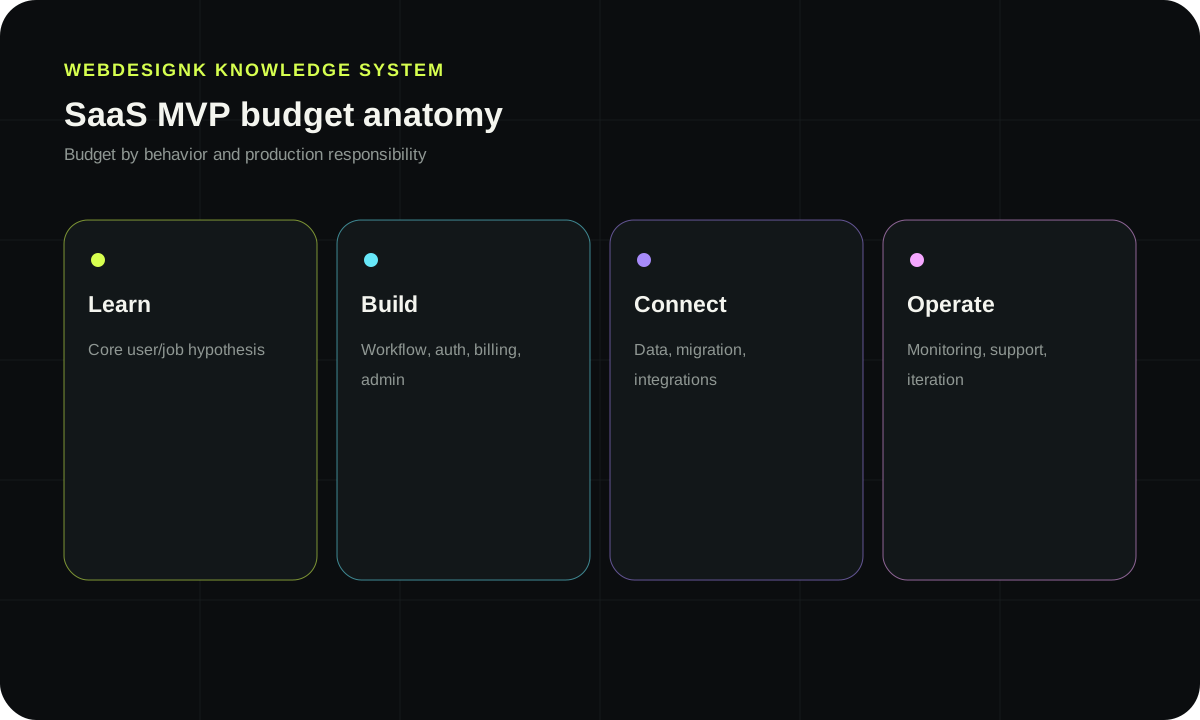
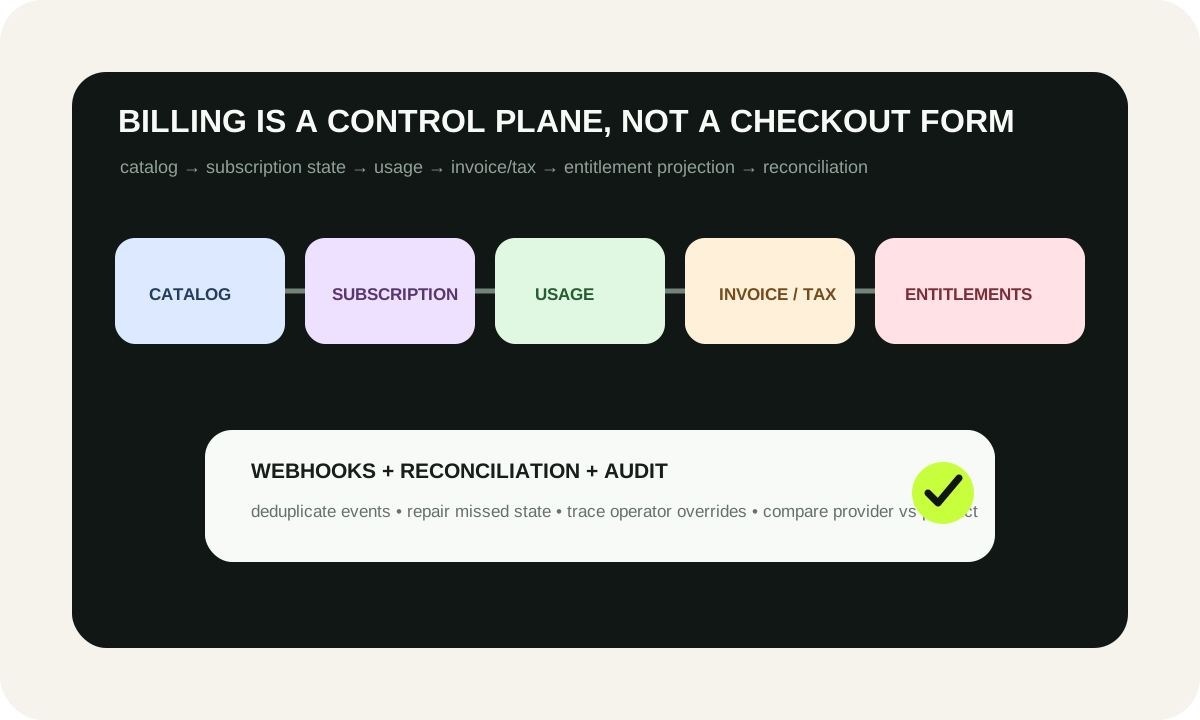
A reliable SaaS billing architecture separates four things that are often mixed together: the commercial catalog, the provider's billing lifecycle, product entitlements, and the internal operational record used for reconciliation and support. Checkout is only the front door. The difficult work is handling asynchronous state changes, usage, plan transitions, taxes, failed payments, negotiated contracts and product access without allowing billing drift to silently become customer-facing access errors.
What you'll learn / decide
- how pricing, billing and entitlements should be separated;
- how to model the subscription lifecycle as explicit state;
- where usage events are captured, aggregated and corrected;
- how plan changes, proration and credits affect product state;
- how entitlements should be checked inside product code;
- where tax, invoices and payment failures belong;
- how trials, coupons and sales-assisted contracts change the data model;
- why webhooks are signals rather than the only source of truth;
- what finance/admin tooling must expose;
- how to test billing as a distributed system rather than a checkout flow.
The key tradeoff is provider convenience versus internal control of product state. A managed billing platform can calculate invoices, collect payments, meter usage and help with taxes, but your application still needs a durable model for what the customer bought, what the customer can use, and how to repair drift when asynchronous events arrive late, twice or not at all.
1. Separate pricing, billing and entitlements
Pricing answers what you offer commercially: plans, add-ons, included quantities, overage rules and negotiated terms. Billing answers what should be invoiced and collected. Entitlements answer which product capabilities and limits are available to a customer right now.
Those are related decisions, but one should not be used as a shortcut for the others.
A plan called Pro might bill monthly, include a base quantity, allow usage overages and grant five product features. If product code asks only whether the plan name is Pro, it becomes difficult to support grandfathered plans, feature add-ons, negotiated enterprise bundles or temporary overrides.
Use stable internal concepts
Map provider products, prices and subscription items to stable internal identifiers. Product code should understand capabilities such as advanced_export, api_access or max_projects=50 rather than provider-specific price IDs.
That boundary allows you to change price versions, introduce annual billing or migrate providers without rewriting authorization and feature-gating code.
Avoid making checkout the source of truth
Checkout creates or modifies commercial state; it should not be the only mechanism that grants product access. The application needs a deterministic projection from confirmed billing state to entitlements, with explicit rules for pending, trialing, past-due, canceled and manually overridden states.
2. Subscription lifecycle state machine
Treat the subscription lifecycle as a state machine, even if the billing provider already exposes status fields.
The application needs to decide what each commercial state means operationally. For example, past due may not immediately remove access. A cancel-at-period-end instruction may still leave entitlements active until the paid term ends. A trial expiration may move the account into a grace, restricted or read-only state rather than immediate deletion.
Separate provider state from product policy
Store the provider subscription/customer identifiers and the last observed provider state, but calculate product access through your own policy layer.
Useful internal states may include trialing, active, grace, restricted, canceling, canceled, suspended, pending_activation and reconciliation_required.
Do not invent states the business cannot explain. Every state should have a trigger, allowed transitions and an entitlement consequence.
Make transitions idempotent
A billing event may be retried. Replaying the same transition must not double-apply credits, duplicate usage or grant access twice. Persist event identity or another idempotency mechanism before changing durable state.
3. Usage metering and aggregation
Usage billing begins with a simple question: what event is billable?
Examples include API calls, processed records, active seats, gigabytes stored, minutes streamed or tokens consumed. The definition must be precise enough that engineering, finance and customers interpret it the same way.
Design the usage event contract
A billable event should usually identify tenant/customer, metric, quantity, event time, unique idempotency key, source, optional pricing dimensions and ingestion status.
Do not send every raw product event directly to invoicing without a durable internal path. Usage may need validation, deduplication, correction or delayed ingestion.
Current Stripe documentation, for example, distinguishes its newer Metronome usage-based billing platform from the lower-level Billing Meters path and recommends the newer path for many new usage-based integrations. That is a reminder that provider capabilities evolve; keep your internal usage contract stable even if the downstream billing implementation changes.
Late and corrected usage must have a policy
Define what happens when usage arrives after the invoicing window, when a producer retries an event, or when a customer dispute reveals a measurement error.
The answer might be correction before invoice finalization, a credit on a later invoice or a manual finance adjustment. Whatever the policy is, support and finance need to see the original usage, adjustment and final billed result.
4. Plan changes, proration and credits
Plan changes create some of the most confusing billing edge cases because commercial intent, invoice math and product access can change at different times.
Decide whether upgrades are immediate, next-cycle or configurable. Decide whether downgrades reduce access immediately or only after the current paid period. Define behavior for included usage, credits and prepaid balances.
Preview before applying
For any mid-cycle plan change, expose a preview containing the current plan/effective date, target plan, new entitlement set, provider-calculated invoice/proration preview when available, internal credits or negotiated adjustments, and effective time for access changes.
The user or operator should see the commercial effect before committing.
Do not recreate complex provider math casually
When a billing provider has a supported proration/invoice preview, use it rather than rebuilding invoice arithmetic in application code. Your application should store the business intent and resulting provider objects, not maintain a second independent accounting engine unless that is deliberately part of the product.
5. Entitlement checks in product code
Entitlements translate commercial state into product capability.
Stripe's Entitlements documentation describes the concept directly as determining when to grant or revoke product feature access. Even when you use another provider or an internal entitlement service, the architectural value is the same: product features should depend on capabilities, not loosely interpreted payment objects.
Keep the fast path local
Hot-path product requests should not require a live billing-provider API call. Maintain an internal entitlement projection or cache that is updated by billing changes and periodic reconciliation.
A typical authorization path becomes:
- authenticate the actor;
- resolve tenant;
- authorize the actor's role;
- load tenant entitlement/limit state;
- check capability and remaining limit;
- record usage if the action is metered.
This keeps user authorization and commercial authorization distinct but composable.
Decide failure behavior
If the billing provider is unavailable, existing customers should not randomly lose product access because a live API call timed out. Use last-known confirmed entitlement state with a defined freshness/reconciliation policy.
For high-risk consumption such as expensive infrastructure usage, you may choose more conservative behavior when usage or credit state is stale. That is a product/business decision, not a generic billing rule.
6. Taxes, invoices and payment failures
Tax is not a UI toggle. It depends on jurisdictions, customer/business location, product classification and registration obligations.
Stripe Tax currently documents support for sales tax, VAT and GST calculations and related registration/filing workflows. Other providers expose different capabilities. Treat provider automation as infrastructure, not legal advice.
Keep tax responsibilities explicit
Document who determines where the company is registered, which product tax codes/classifications are used, what customer location evidence is required, how tax-exempt customers are handled, how invoice corrections or credit notes flow, and who reviews exceptions.
Qualified tax/accounting professionals should validate legal and filing obligations.
Payment failure does not equal immediate deletion
Define dunning and access behavior separately. A failed payment may trigger provider retries, customer notifications, grace state or support intervention.
Record both provider payment/invoice status and internal access policy so support can explain why an account is still active or restricted.
7. Trials, coupons and sales-assisted contracts
Trials, discounts and negotiated contracts introduce exceptions that must remain explainable.
A trial should have explicit start/end state and conversion behavior. Coupons or discounts should be visible in billing context without changing the underlying product entitlement definition unless the commercial agreement says they should.
Sales-assisted contracts need a contract layer
Enterprise deals may include custom prices, commits, prepaid credits, ramps, minimums, negotiated overages or manual invoicing.
Do not clone a public plan and then silently mutate fields until every enterprise customer has a unique pseudo-plan. Preserve the base catalog reference, contract-specific commercial terms, effective dates, entitlement overrides, usage commitments/credits and approval/audit context.
The internal model should let finance answer why a customer's invoice differs from the public plan.
8. Webhooks and reconciliation
Webhooks are essential because billing is asynchronous, but a webhook handler should not be the only mechanism keeping state correct.
Stripe's webhook documentation describes asynchronous events sent to your endpoint. In distributed systems, event delivery can be retried or delayed. Your integration must verify, deduplicate and process events idempotently.
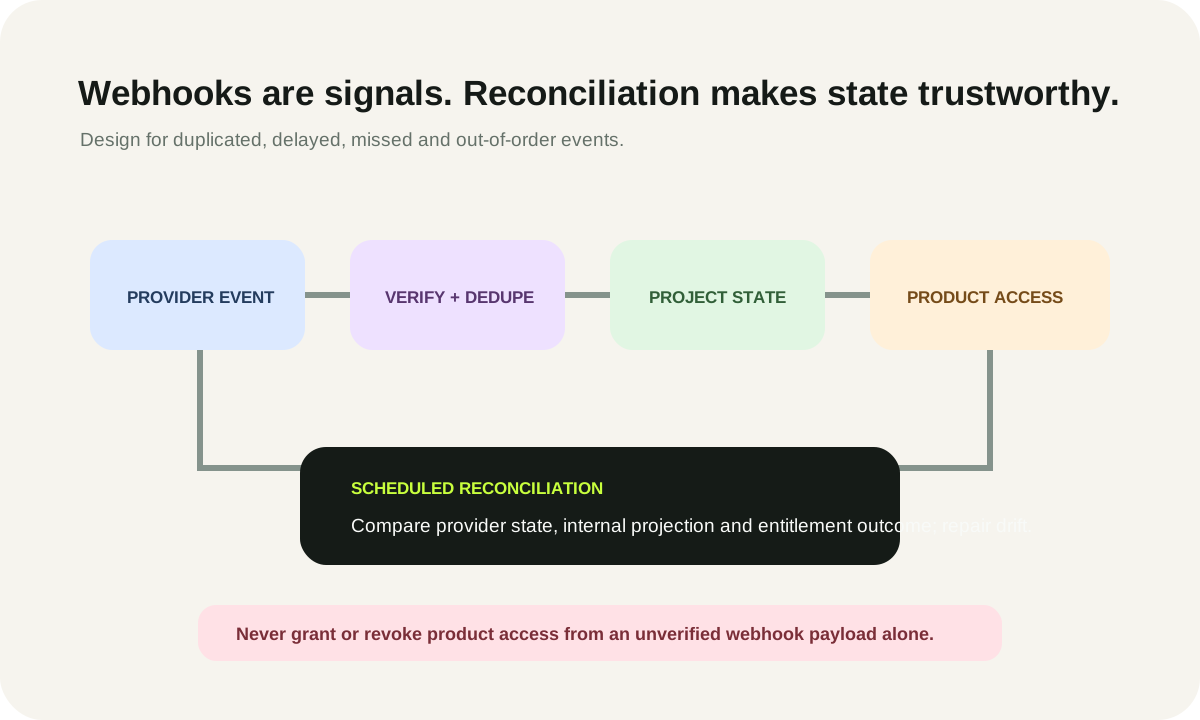
Webhook processing pipeline
A robust path is:
- receive the provider event;
- verify signature/authenticity;
- persist event identity and raw metadata needed for traceability;
- deduplicate;
- enqueue or process the event;
- fetch authoritative provider objects when required;
- update the internal billing projection;
- recalculate entitlements;
- record processing result;
- retry transient failures safely.
Return success only according to your provider's delivery semantics and after the event is durably accepted.
Reconciliation closes the reliability gap
Run scheduled jobs that compare provider state with your internal projection.
Reconcile customers/subscriptions, active prices/items, invoice/payment state, entitlement projection, usage totals where provider APIs support comparison, contract overrides, and canceled or missing resources.
If a webhook was missed, reconciliation should repair the state rather than requiring manual database edits.
9. Finance/admin tooling and auditability
Billing architecture is incomplete if finance and support cannot understand or repair it without engineering.
An internal billing/admin screen should show tenant/customer identity, provider customer and subscription IDs, plan/price version, billing period, invoice/payment state, usage summary/freshness, active entitlements/limits, trial or grace state, tax context, contract overrides, last webhook/reconciliation result and operator actions.
High-impact admin actions need safeguards
Changing a plan, granting credits, overriding entitlements, forcing reconciliation or disabling access can affect revenue and customer operations.
Require explicit permission and capture actor, tenant, target, before/after state, reason or ticket, provider request/result, timestamp and correlation ID.
Prefer preview before commit and reversible/compensating actions where possible.
10. Billing architecture test matrix
Billing should be tested as a stateful integration, not just a successful checkout.
Lifecycle tests
- new paid subscription activates expected entitlements;
- trial starts, converts and expires correctly;
- immediate upgrade previews and applies correctly;
- scheduled downgrade changes access at the intended time;
- cancellation at period end preserves access until the configured boundary;
- failed payment enters the intended grace/restriction behavior;
- resumed or recovered payment restores state safely.
Usage tests
- duplicate usage event does not double bill;
- late event follows policy;
- corrected event produces expected adjustment;
- high-volume ingestion preserves idempotency;
- usage visibility identifies freshness and aggregation window.
Webhook and reconciliation tests
- duplicate webhook is idempotent;
- out-of-order events do not regress newer state;
- webhook processing failure retries safely;
- a missed event is repaired by reconciliation;
- provider and internal state divergence is surfaced;
- reconciliation does not overwrite an approved internal contract override incorrectly.
Entitlement tests
- paid feature appears after confirmed commercial state;
- downgrade removes only intended features/limits;
- billing-provider outage does not arbitrarily revoke last-known valid access;
- manual override has owner, reason and expiry;
- role permission and commercial entitlement are both required where appropriate.
Tax and invoice tests
- supported customer location produces expected tax integration path;
- tax-exempt state is explicit;
- invoice correction/credit flow is traceable;
- finance can locate provider invoice and internal commercial context.
Failure behavior and observability
Track billing events as operational journeys: usage ingestion failures, webhook lag, reconciliation drift, invoice failures, entitlement projection errors and contract-override changes.
Do not compress the system into a single billing health score. Operators need actionable counts, stale-state age, last successful reconciliation and exact tenant/provider references.
If your billing provider is unavailable, keep existing confirmed product state according to an explicit freshness policy. Queue provider-dependent mutations rather than pretending they succeeded. For usage-heavy products, define whether new expensive consumption is allowed when credit/usage state becomes stale.
Enterprise pressure test and degraded billing mode
Enterprise customers expose billing assumptions quickly. Test whether one tenant can have negotiated prices, multiple legal entities, purchase-order or manual-invoice workflows, credits, usage commitments, custom entitlement bundles and restricted finance-admin roles without cloning the whole billing model.
Also define degraded behavior when the billing provider, tax service or usage pipeline is temporarily unavailable. Existing confirmed entitlements should follow an explicit freshness policy rather than disappearing because a provider API timed out. Provider-dependent mutations should be queued or rejected clearly instead of being shown as successful. If usage state is stale, decide whether expensive new consumption is allowed, rate-limited or paused.
Operationally, expose the last successful webhook, last reconciliation time, stale-state age and unresolved drift. Finance should be able to distinguish a provider outage, a payment failure, a tax configuration problem and an internal projection error without asking engineering to inspect raw database rows.
Before an enterprise launch, rehearse plan changes, usage corrections, credit application, invoice failure, contract renewal, entitlement override expiry and reconciliation after a deliberately skipped webhook.
Migration path without a rewrite
A practical sequence is:
Phase 1: simple recurring plans, provider checkout, internal subscription projection and reconciliation.
Phase 2: explicit entitlements/limits separated from provider prices.
Phase 3: trials, plan-change previews, proration and finance/admin tools.
Phase 4: metered usage with durable event contracts and correction paths.
Phase 5: sales-assisted contracts, credits/commits, richer tax operations and finance audit workflows.
The migration stays manageable when product access depends on internal entitlements instead of hard-coded provider price IDs.
Boundary decisions by system layer
Use the billing provider for invoice/payment primitives, supported proration and tax/metering capabilities. Use application code for commercial intent, entitlement policy, tenant access and product limits. Use the data layer for durable mappings, projections, usage events and reconciliation evidence. Use admin tooling for controlled overrides, previews and audit—not as an undocumented bypass.
Use the interactive billing/entitlement modeler above to expose the modules and unresolved decisions triggered by your pricing, usage, tax and enterprise-contract requirements.
If you need help converting a pricing model into a reliable billing control plane, see custom SaaS development. Continue with SaaS admin dashboard design, SaaS authentication architecture, and multi-tenant SaaS architecture.
Last reviewed: October 3, 2026. Billing provider capabilities, tax support and pricing APIs change. Verify current official provider documentation and obtain qualified tax/accounting advice for legal obligations.
Frequently asked questions
Should product access depend directly on Stripe subscription status?
Usually not directly. Map confirmed commercial state into internal entitlements/limits so product code does not depend on provider-specific price IDs or live API calls.
Are webhooks enough to keep billing state correct?
No. Process webhooks durably and idempotently, then run reconciliation that compares provider state with your internal projection so missed or delayed events can be repaired.
How should usage-based billing events be modeled?
Define one precise billable event contract with customer/tenant, metric, quantity, timestamp and idempotency identity. Store enough internal evidence to deduplicate, correct and explain usage before it becomes invoice state.
Should a failed payment immediately remove SaaS access?
That is a product/business policy decision. Many systems distinguish provider payment state from internal grace or restriction policy so dunning and recovery do not become accidental data loss.
What is the difference between a plan and an entitlement?
A plan is a commercial offer. An entitlement is a product capability or limit granted to a customer. Keeping them separate supports add-ons, grandfathering, negotiated contracts and provider migrations.
Who should decide SaaS tax obligations?
Use provider tooling for supported calculation/registration workflows, but qualified tax/accounting professionals should validate registrations, product classification, filing and legal obligations for your markets.
Sources and assumption boundaries
Fast-changing platform, pricing and search claims were reviewed on October 3, 2026. Interactive scores and scenarios are clearly labeled planning models, not sourced market benchmarks.
- Stripe usage-based billing Current first-party Stripe guidance for usage-based billing architecture and platform options.
- Stripe Entitlements First-party documentation for granting and revoking product feature access from commercial state.
- Stripe Tax First-party documentation for sales tax, VAT and GST calculation and related tax workflows.
- Stripe Webhooks First-party event delivery documentation used for asynchronous billing integration guidance.