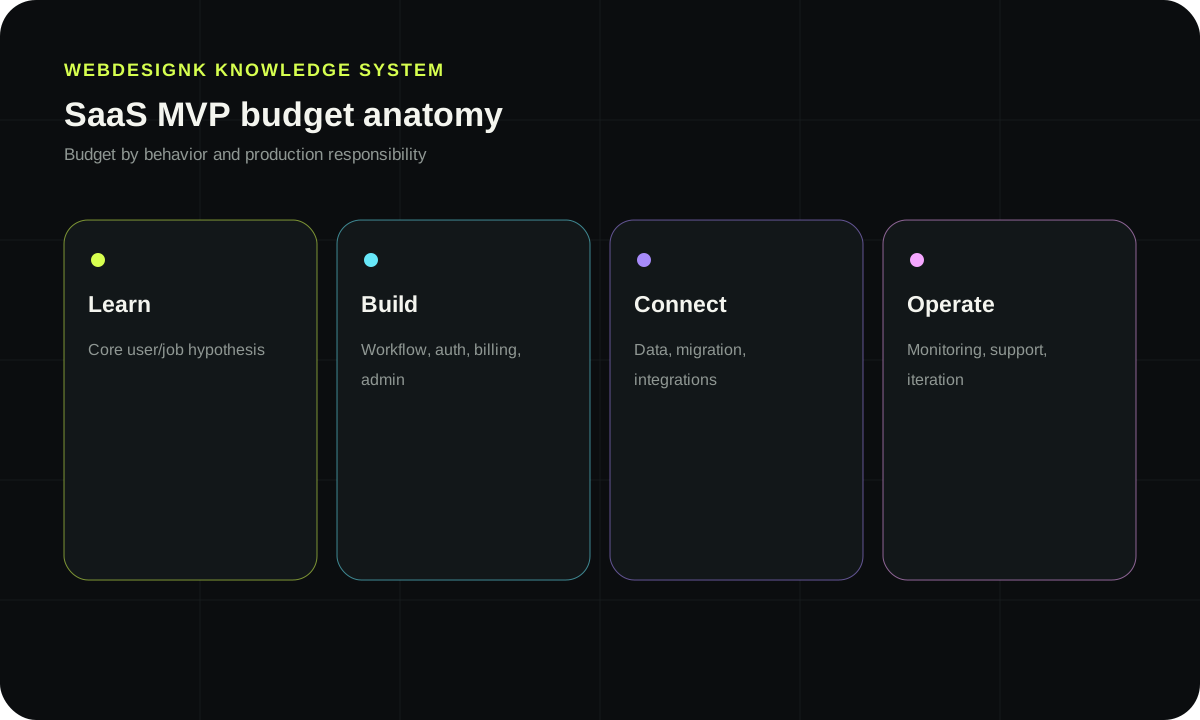
A SaaS architecture should be decided before development starts because the hardest failures are rarely visual: they are tenant-isolation gaps, unclear identity and authorization boundaries, data-model lock-in, entitlement drift, weak observability, unsafe deployments, and operational processes that cannot scale with more tenants. The goal is not to predict every future feature. It is to make the few decisions that are expensive, risky, or difficult to reverse explicit before implementation accelerates.
What you'll learn / decide
- which architecture decisions should be explicit before the first production tenant;
- what evidence proves each decision is implemented rather than merely discussed;
- where tenant identity must travel through APIs, jobs, data access and telemetry;
- how to separate authentication, authorization and tenant isolation;
- which choices belong on the critical path and which can evolve later;
- how to turn architecture into an executable launch and 30-day operating checklist.
Last reviewed: October 7, 2026.
Decision snapshot for SaaS Architecture Checklist
The single most important architecture tradeoff is how much infrastructure and data you share across tenants versus how much isolation you require. That choice affects identity, storage, caching, background work, observability, deployment, cost allocation and incident response.
There is no universal “best SaaS architecture.” AWS's SaaS Lens explicitly notes that SaaS is not one-size-fits-all and describes pool, silo and bridge approaches that can be combined according to isolation, scale and business requirements. The practical goal is therefore not to pick the most fashionable stack. It is to define tenant context, isolation boundaries and operating evidence before those rules are spread across dozens of services.
Use the interactive checklist below as a pre-development architecture gate. Mark a check complete only when the evidence named in that row exists.
How to use the checklist and define done
Architecture checklists fail when “done” means “we talked about it.”
For every major decision, define an artifact that another engineer, reviewer, security lead or operator can inspect. Good evidence includes:
- an architecture decision record (ADR);
- a request trace that shows tenant context through service boundaries;
- a role/permission matrix tied to API enforcement;
- negative tests proving a user from tenant A cannot read or mutate tenant B;
- a schema or query plan showing tenant partition keys;
- an entitlement/event contract;
- a restore drill;
- an alert routed to an owner;
- an accessibility walkthrough of the core application task;
- a deployment runbook with a real rollback decision.
If the artifact does not exist, the decision is still open.
Use ADRs for the decisions that are expensive to reverse
A useful ADR does not need to be long. Capture:
| Decision | What to record | Evidence |
|---|---|---|
| Tenant model | Pool, bridge or silo by workload; why | Diagram + threat/isolation assumptions |
| Identity | Trusted tenant source and user/organization model | Request trace + auth tests |
| Data | Partition key, indexes, RLS choice, deletion/export | Schema + negative tests |
| Entitlements | Plan/add-on → server capability mapping | Contract + API tests |
| Billing events | Idempotency and reconciliation | Event sequence + replay test |
| Observability | Correlation fields and sensitive-data rules | Trace/log/metric example |
| Deployment | Compatibility, migrations, rollback | Release runbook + restore path |
The point is not paperwork. The ADR lets a later feature team know which rule is intentional and which rule is accidental.
Critical-path filter
Treat a check as launch-blocking when missing it can create one of these outcomes:
- cross-tenant data access;
- incorrect permissions or entitlements;
- irreversible data-model coupling;
- lost or duplicated billing state;
- no reliable rollback or restore path;
- no way to observe a tenant-specific failure;
- public/private route leakage;
- inability to delete or export tenant data as required by your operating model.
Lower-risk UI polish can evolve. Isolation and data-boundary mistakes become exponentially harder to unwind after real tenants and integrations exist.
The checklist gives you a concrete discovery package. If you want help turning it into an implementation backlog, WebDesignK's custom SaaS development service can scope tenancy, identity, data, billing, APIs and production operations before development starts.
Critical preflight checks
1. Decide what “tenant” means
A tenant might be:
- one company;
- one workspace;
- one account with multiple organizations;
- a reseller plus downstream customers;
- a regional or regulated deployment boundary.
Do not let this remain implicit. The tenant identifier becomes part of access control, data ownership, logs, jobs, billing, analytics and support.
AWS's SaaS guidance recommends making tenant context a first-class element of identity. In practical terms, derive tenant identity from a trusted authenticated relationship rather than accepting an arbitrary tenant ID from a client request and hoping later code checks it.
2. Decide isolation independently from authentication
OWASP's multi-tenant guidance highlights cross-tenant leakage and tenant impersonation as core risks. A successful login only proves who the actor is. It does not prove that a requested invoice, project, file or API object belongs to the actor's tenant.
Model three separate questions:
- Authentication: who is the actor?
- Authorization: what is this actor allowed to do?
- Tenant isolation: does the target resource belong to the correct tenant boundary?
OWASP's authorization guidance recommends deny-by-default behavior and validating permissions on every request. Those principles become especially important when routes accept object IDs that could be guessed, copied or replayed across tenant contexts.
3. Define data ownership before adding domain tables
For every tenant-owned table or collection, decide:
- the tenant partition field;
- required composite indexes;
- whether child records inherit tenant ownership;
- whether queries require tenant predicates;
- how background jobs reconstruct tenant context;
- how exports and deletion locate all tenant-owned data;
- whether database-level RLS is used as defense in depth.
PostgreSQL row-level security can restrict which rows a user can read or mutate. Its documentation also notes important owner/bypass behavior and default-deny behavior when RLS is enabled without an applicable policy. RLS is therefore a design decision, not a checkbox: test it with the actual database roles your application uses.
Strategy and content checks
SaaS architecture is product strategy expressed as constraints.
Before choosing services, write down the promises the product must keep:
- Are customers organizations with multiple members?
- Can a user belong to multiple organizations?
- Are there parent/child organizations?
- Is data residency a sales requirement?
- Do enterprise customers require SSO or SCIM?
- Are custom roles required, or can you support a small fixed role set?
- Is usage metered?
- Can a plan downgrade remove capabilities immediately?
- Is audit history a customer-facing requirement?
- Are exports or tenant deletion contractual requirements?
- Will integrations execute on behalf of users, organizations, or the platform?
These decisions shape architecture more than whether the application uses one or ten services.
Avoid tenant-specific product forks
AWS's SaaS Lens recommends keeping a single product experience rather than creating separate bespoke versions per tenant. Enterprise variation should usually be expressed through configuration, entitlements, policy and integration boundaries—not copied codebases.
That does not mean every tenant must share infrastructure. A silo deployment can still be SaaS when onboarding, management, operations and product lifecycle remain unified.
UX and conversion checks
Architecture becomes visible to users through identity and state.
Membership is a state machine
Define the lifecycle:
invited → active → suspended/removed → restored or deleted.
Then add ownership transfer, expired invitations, a user belonging to several tenants, leaving the last admin role, and support-assisted recovery.
A good UI should not offer an action that the API will reject, but the API must still enforce the rule even when the UI hides the control.
Entitlements should be server-enforced
Do not use front-end feature flags as the source of truth for paid capabilities.
A robust flow is:
subscription/add-on state → entitlement state → server authorization → UI presentation.
The UI can read entitlements to show a coherent experience. It should not be able to grant itself an enterprise export merely by toggling a client-side flag.
Design permission errors
Permission states need deliberate UX:
- “not found” when revealing object existence would leak information;
- “access denied” when the resource can safely be identified;
- “ask an admin” when role escalation is expected;
- “upgrade required” when the capability is commercial rather than security-based.
Those are product states, not generic error messages.
Technical/performance checks
Keep tenant context through async boundaries
The most common isolation bugs happen after the request handler.
A queue message, scheduled task or webhook retry may run minutes later without the original HTTP identity. Include a trusted tenant reference in the job envelope and validate it before touching tenant-owned resources.
Do the same for:
- cache keys;
- object-storage paths;
- distributed locks;
- search indexes;
- vector stores;
- webhooks;
- batch exports;
- generated files;
- notification jobs.
Design for noisy neighbors
Shared infrastructure creates efficiency, but one tenant's behavior can consume capacity used by others.
Decide where you need:
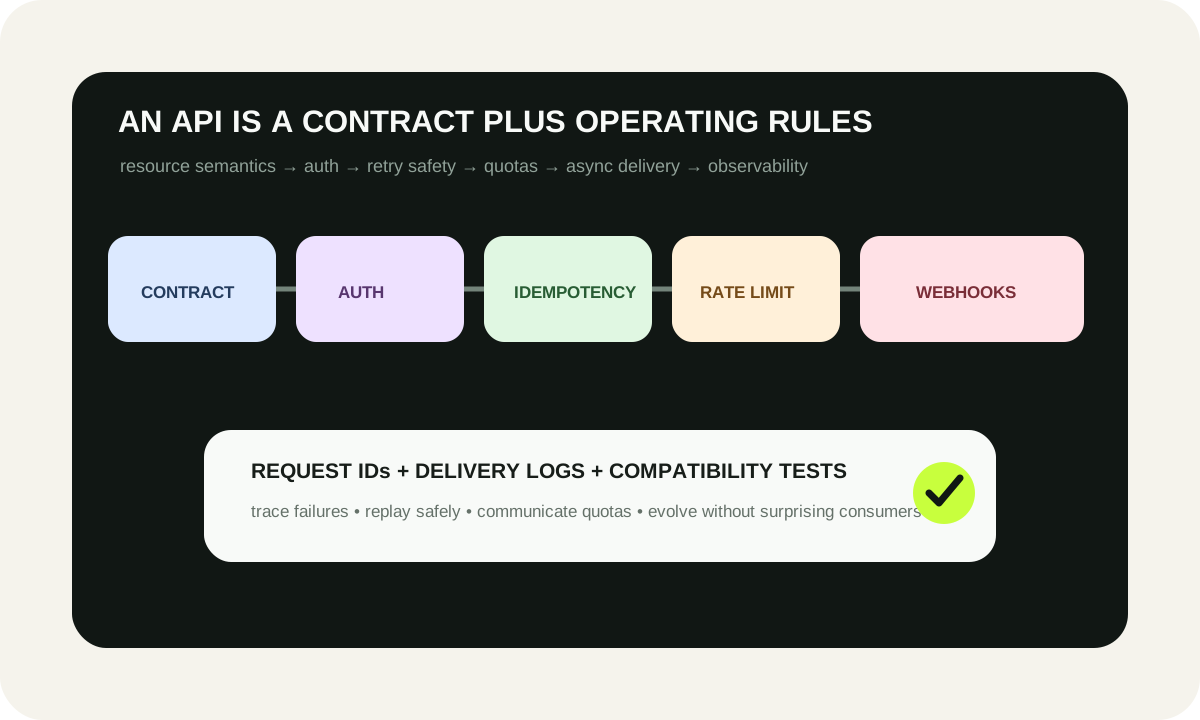
- request rate limits;
- job concurrency limits;
- queue partitioning;
- database workload controls;
- per-tenant quotas;
- timeouts and circuit breakers;
- expensive-query detection;
- bulk-operation limits.
The correct thresholds depend on your product and workload. Do not copy “industry standard” numbers without measurement.
Make deployments backward-compatible
A production SaaS release can have multiple application versions and background workers executing at once.
Prefer migrations that tolerate mixed versions:
- expand the schema or contract;
- deploy readers/writers that support both shapes;
- backfill or migrate data;
- verify;
- contract only after old code is gone.
A rollback is not real if the database migration made the previous application unable to run.
SEO and indexation checks
Most authenticated SaaS application pages should not be search landing pages. Public marketing, docs, templates, comparison pages or directories may be.
Separate the two systems deliberately.
Public routes
For public/indexable surfaces define:
- canonical URLs;
- sitemap membership;
- title/description ownership;
- structured data where visible content supports it;
- pagination/facet behavior where relevant;
- localization/hreflang if you publish multiple languages.
Authenticated app routes
For private tenant routes ensure:
- no private content is emitted into public metadata or server caches;
- application URLs are not accidentally included in XML sitemaps;
- previews and tenant subdomains have intentional indexation behavior;
- public share links have their own explicit access and indexation policy.
A SaaS platform can have excellent application architecture and still create search risk if “public” and “private” are not separate route contracts.
Analytics/measurement checks
Architecture telemetry must help answer two different questions:
- What happened to the user?
- What happened inside the system?
Product analytics can describe activation, adoption and conversion. Operational telemetry describes requests, service dependencies, latency, failures and saturation.
OpenTelemetry provides vendor-neutral APIs and conventions for traces, metrics and logs. Distributed traces are particularly useful for SaaS because a request can cross several services, queues or databases before a tenant sees the result.
Tenant-aware does not mean tenant-data-heavy
Add enough context to diagnose tenant-specific failures without dumping sensitive business content into telemetry.
Typical safe correlation fields include:
| Field | Why it matters |
|---|---|
| request/correlation ID | joins one operation across services |
| tenant ID or pseudonymous tenant key | identifies affected tenant boundary |
| actor/user ID where appropriate | explains permission path |
| route/operation | groups failures by capability |
| service/job name | identifies failing boundary |
| entitlement/plan code when safe | explains feature path |
| deployment version | correlates regressions with releases |
Do not log passwords, secrets, tokens, payment details or arbitrary customer payloads just because they are useful during debugging.
Make billing measurable separately
Billing requires its own reconciliation evidence.
For subscription, usage or credit systems, define:
- event source;
- idempotency key;
- ordering assumption;
- retry behavior;
- durable state;
- reconciliation job;
- entitlement update;
- customer-visible status.
A dashboard showing “webhook received” is not proof that billing state and product access agree.
Security/accessibility/compliance checks
Zero trust is useful as a design lens
NIST's Zero Trust Architecture guidance shifts trust away from network location and toward explicit access to resources. For SaaS, that is a useful reminder that “inside the private network” should not be your only authorization boundary.
Service-to-service calls still need an identity, policy and resource boundary appropriate to the risk.
Support access is part of the threat model
Customer support often needs to inspect tenant state. Avoid silent, unlimited impersonation.
Prefer a controlled support-access model with:
- named operator;
- reason;
- tenant scope;
- expiration;
- audit record;
- visible “acting as” state;
- stronger controls for destructive actions.
Accessibility belongs in architecture too
Authentication, onboarding, organization switching, permission errors and billing states are shared platform surfaces. Fixing them once can improve every product workflow; getting them wrong affects every tenant.
Test keyboard navigation, focus management, form errors, status messages and reflow in the shared shell before product teams copy the pattern.
Launch/handoff validation
Before the first production tenant, run an end-to-end architecture smoke test.
Tenant-isolation smoke test
Create at least two representative tenants and prove:
- tenant A cannot read tenant B's resource by changing an ID;
- tenant A cannot update/delete tenant B's resource;
- a background job for A cannot process B's object;
- tenant-scoped cache keys do not collide;
- file/download URLs cannot cross the boundary;
- support/admin actions are audited;
- telemetry identifies the correct tenant without leaking secrets.
Identity and permission smoke test
Exercise:
- unauthenticated request;
- valid member;
- wrong role;
- removed member;
- expired invite;
- user in two organizations;
- last-admin/ownership transfer;
- enterprise SSO path if sold.
Billing/entitlement smoke test
Use the provider's supported test environment to cover:
- new subscription;
- failed/abandoned payment where applicable;
- duplicate/replayed event;
- upgrade/downgrade;
- cancellation;
- usage or credit update if used;
- entitlement reconciliation.
Release handoff packet
The implementation team should leave production with:
- current architecture diagram;
- ADR index;
- tenant/isolation test evidence;
- role/permission matrix;
- data model and retention notes;
- event/entitlement contracts;
- observability dashboard links;
- backup/restore procedure;
- release/rollback runbook;
- named owners for security, data and operations risks.
If you need this converted into a delivery plan, talk to WebDesignK with the copied checklist summary and your expected tenant model, identity requirements, integrations and launch constraints.
Related deep dives: multi-tenant SaaS architecture patterns, SaaS authentication, SSO, MFA and RBAC, SaaS API design, and how long it takes to build a SaaS product.
30-day post-launch monitoring
Architecture decisions should be rechecked against production behavior rather than left in a discovery document.
Day 1
Watch for hard failures:
- authentication and organization switching;
- permission denials and suspicious cross-tenant attempts;
- core workflow errors;
- job failures;
- billing/entitlement mismatches;
- deployment errors;
- public/private routing mistakes.
Days 2–7
Look for patterns:
- noisy tenant workloads;
- slow tenant-scoped queries;
- queue imbalance;
- cache behavior;
- integration retries;
- unexpected privilege escalations;
- missing traces or correlation fields;
- onboarding/support friction.
Days 8–14
Review operational evidence against the architecture assumptions.
If a pooled database is working but one tenant's queries dominate capacity, the answer may be indexing, quotas or workload isolation—not an immediate rewrite into separate databases.
If support constantly requires unrestricted impersonation, the product may need a formal support-access capability.
Days 15–30
Close the architecture stabilization review:
- update ADRs where reality changed the assumption;
- convert repeated incidents into guardrails/tests;
- validate backup/restore evidence;
- review permissions and privileged access;
- reconcile billing/entitlement edge cases;
- move capacity hypotheses into measured performance work.
Architecture is not frozen after day 30. The point is to move from undocumented change to explicit, evidence-backed evolution.
Frequently asked questions
Do I need microservices for a SaaS product?
No. A modular monolith can support strong tenant isolation, clean domain boundaries and reliable operations. Split services when independent scaling, ownership, failure isolation or deployment needs justify the operational cost—not because the product is called SaaS.
Is authentication enough for tenant isolation?
No. Authentication proves actor identity. Authorization and tenant isolation must still verify that the actor can perform the requested action on a resource belonging to the correct tenant.
Does every tenant need a separate database?
No. Pool, bridge and silo models are all valid patterns. Some products share tables with strong tenant scoping; others dedicate databases or entire stacks for selected workloads or customers. Choose from isolation, compliance, scale and operating requirements.
Should I use PostgreSQL row-level security?
It can be a valuable defense-in-depth layer when its policy and database-role behavior are understood and tested. It does not remove the need for application authorization, and table owners/bypass roles require careful design.
What should be built first?
Build the architecture-enforcing primitives early: trusted tenant context, authorization, data ownership, entitlements, audit/telemetry correlation and safe deployment rules. Feature breadth is easier to add after those boundaries are reliable.
How often should architecture decisions be reviewed?
Review on meaningful triggers: a new enterprise requirement, identity/billing change, new data store, new integration boundary, scaling incident, security finding or deployment-model change. Operational controls such as access reviews and restore drills also deserve a regular cadence.
Sources reviewed
- AWS Well-Architected SaaS Lens — Tenant Isolation
- AWS Well-Architected SaaS Lens — Identity and Access Management
- AWS Well-Architected SaaS Lens — General Design Principles
- OWASP Multi-Tenant Security Cheat Sheet
- OWASP Authorization Cheat Sheet
- OpenTelemetry Documentation
- NIST SP 800-207 — Zero Trust Architecture
- PostgreSQL 18 — Row Security Policies
Security, privacy, data-residency and regulatory obligations vary by product, customer, market and architecture. This guide is an engineering planning framework, not legal or compliance advice. Use qualified security and legal specialists for obligations that apply to your product.