Quick answer
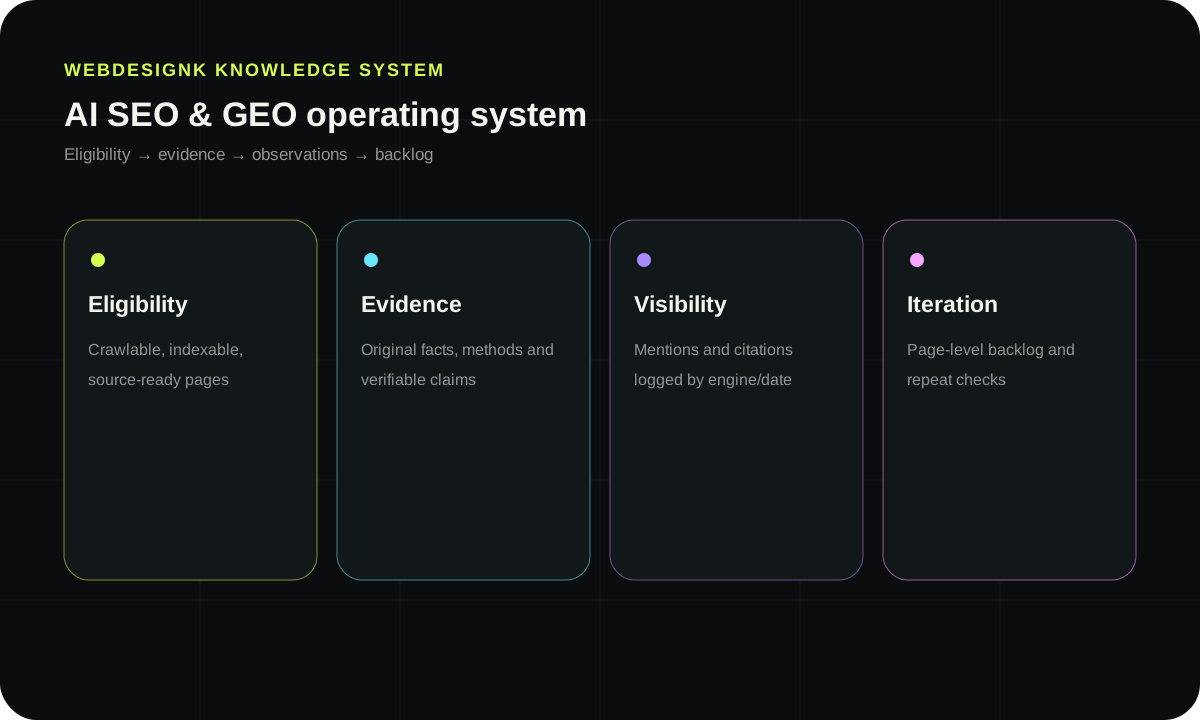
The core tradeoff is coverage versus evidence: more AI-targeted pages do not help if they repeat commodity information. Build fewer, stronger source pages and measure actual engine/date observations.
Last reviewed: September 16, 2026AI visibility tracker
Add observations you checked yourself. Nothing below is prefilled with synthetic visibility data. Records stay in this browser via localStorage.
1. Visibility status by engine
Counts come only from the observations you added.
2. Presence trend by audit date
Presence = any non-missing status in your log; it is not an engine ranking.
3. Engine × status heatmap
Darker cells mean more records in that engine/status combination.
Observation log
| Prompt | Engine | Brand mentioned? | Status | Citation URL | Competitor / source cited | Page to improve | Checked date | |
|---|---|---|---|---|---|---|---|---|
| No observations yet. Add your first checked prompt above. | ||||||||
Source note: all chart values are user-entered observations stored locally. No benchmark, market share or engine behavior is manufactured.
Tables built for the buying decision
Primary decision table
| Entity / fact | Canonical first-party source | Consistency check | Evidence to strengthen | Owner / next action |
|---|---|---|---|---|
| Brand and legal identity | About / imprint / organization profile | Same naming across owned profiles | Independent company references where appropriate | Resolve contradictions before outreach |
| Product/category definition | Primary product or service page | Stable category language and scope | Documentation, case evidence, expert references | Clarify what the product does and does not do |
| Capabilities and limits | Documentation / specification | Marketing claims match docs | Screenshots, changelog, methodology or test evidence | Date fast-changing capabilities |
| Research / benchmark claims | Methodology + results page | Units, sample and date remain attached | Raw definitions or downloadable methodology | Retire claims whose source can no longer be verified |
| Key people / expertise | Author and company profiles | Role and expertise match current reality | Named authorship, talks, research or independent coverage | Use real authors; avoid synthetic credentials |
AI-search observation fields
| Field | Why it matters | Do not infer |
|---|---|---|
| Prompt + intent family | Keeps monitoring tied to a real buyer question | That one phrasing represents every possible query |
| Engine + checked date | Makes fast-changing observations reproducible | That engines behave identically |
| Brand mentioned? | Measures entity presence in the response | That a mention means your site was a source |
| Citation URL | Shows the exposed supporting source | That the citation proves every sentence in the answer |
| Competitor/source cited | Reveals pages worth studying | That copying the cited page will reproduce the result |
| Page to improve | Turns monitoring into an owned backlog | That every miss deserves a new page |
Sources and assumption boundaries
Fast-changing platform, pricing and AI-search claims were reviewed on September 16, 2026. Interactive scores and scenarios are clearly labeled planning models, not sourced market benchmarks.
- Google Search Central — AI features and your website Official eligibility and AI-feature guidance; reviewed September 16, 2026.
- Google Search Central — Optimizing for generative AI features Official guidance on foundational SEO, query fan-out, original content and myths; reviewed September 16, 2026.
- OpenAI — Publishers and Developers FAQ Official ChatGPT search publisher/crawler guidance including OAI-SearchBot; reviewed September 16, 2026.
- Perplexity — Perplexity Crawlers Official crawler and robots guidance; reviewed September 16, 2026.
Turn this planning result into a scoped review.
Send the assumptions, constraints and result summary. WebDesignK can review the architecture/content/implementation boundary, identify missing discovery inputs and return a prioritized next-step scope.
- Bring: current site/product, constraints, integrations and your tool result.
- You get: a scoped recommendation, open questions and implementation priorities.
Decision snapshot for AI SEO & GEO
AI SEO and GEO are best treated as an extension of strong search strategy, not as a separate set of tricks. The practical job is to make your pages crawlable, specific, evidence-rich, internally coherent and easy to verify, then monitor how different answer engines actually mention or cite you. The key tradeoff is coverage versus evidence: publishing more pages is not useful if those pages repeat commodity information or make claims that cannot be checked.
What this means: build a prompt set around real buyer questions, record the exact page and source cited for every observation, and turn gaps into a page-level backlog. A brand mention is not the same thing as a citation, and a citation in one engine on one date is not proof of durable visibility.
Classic search vs answer-engine discovery
Classic search and answer-engine discovery overlap, but the user experience is different. A traditional result page exposes a ranked set of links. An answer experience may retrieve information from several pages, synthesize an answer and expose a smaller or differently presented set of sources. That changes what a marketer should measure. Rank position is still useful in ordinary search, but it does not tell you whether your brand was mentioned, whether your page was used as a source, or whether another source was cited while describing your category.
Google's current guidance is deliberately conservative: its AI features are built on the same core search systems and there is no special schema, file or “AI-only” markup required to appear. Google says pages need to be indexed and eligible to appear with a snippet, and recommends the same people-first, technically sound SEO foundations used elsewhere in Search. That is important because it pushes the strategy away from speculative hacks and back toward crawlability, useful information and evidence.
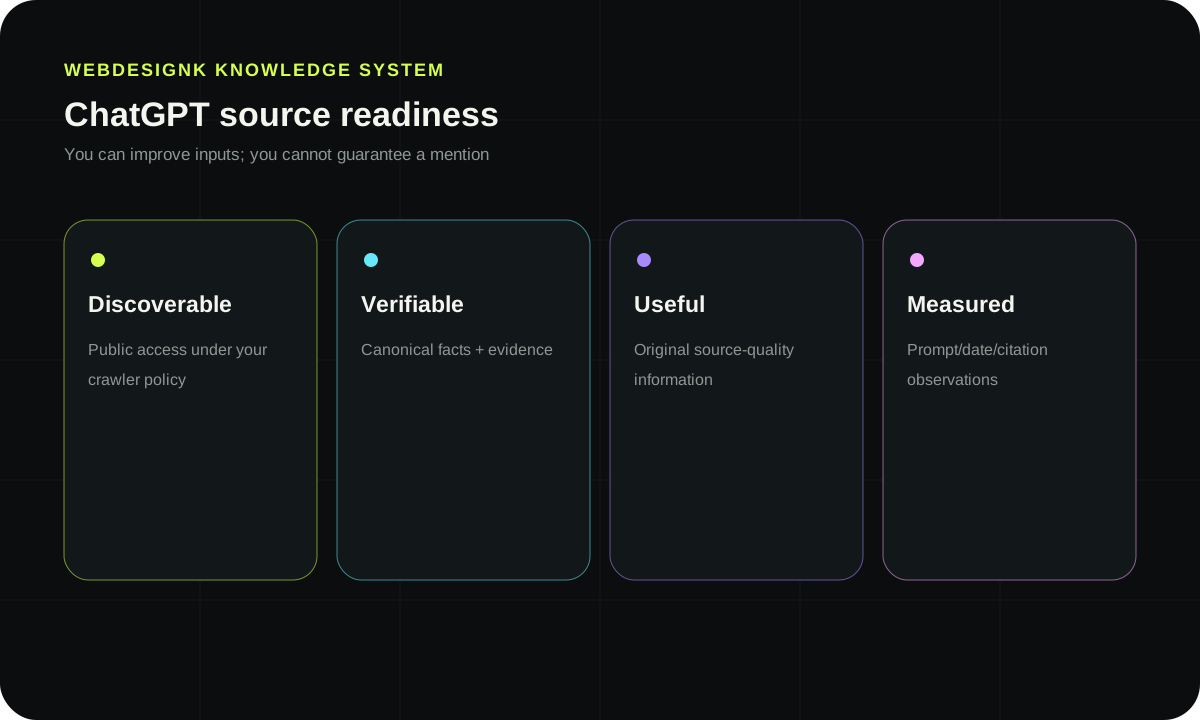
OpenAI publishes separate crawler guidance for ChatGPT search. Its publisher FAQ says public sites can appear in ChatGPT search and specifically advises publishers who want content discoverable in summaries and snippets not to block OAI-SearchBot. Perplexity also documents its crawlers and robots controls. These are concrete technical controls; they should not be confused with guarantees of citation or ranking.
How to decide what belongs in an AI-search program
Start with questions that matter commercially, not hundreds of synthetic prompt variations. A useful first set usually includes five families:
- Navigational: questions where a user is trying to find your brand, product, documentation or a known page.
- Category: “best”, “leading”, “alternatives”, “platforms for” and category-definition questions.
- Problem: questions describing a job, constraint or failure without naming a solution.
- Comparison: questions comparing approaches, vendors, architectures or product types.
- Recommendation: questions asking what to choose under a particular context.
Each family exposes a different kind of gap. Navigational misses can indicate entity ambiguity or crawlability problems. Category misses can show weak category association. Problem-query misses can reveal that your site talks about product features but not the buyer's actual job. Comparison misses may reveal a lack of explicit decision criteria or evidence.
How retrieval, synthesis and citation differ
Do not model an answer engine as “Google rankings with a chatbot on top.” Retrieval is the process of finding candidate information. Synthesis is the process of composing a response from available context. Citation or source presentation is the product layer that tells the user where supporting information came from. The exact implementation varies by engine and can change over time, so your monitoring system should record observations rather than assume one universal mechanism.
Google explains that AI Overviews and AI Mode may use query fan-out, issuing multiple related searches to develop a response. That means a page can become relevant through a supporting subtopic even when it does not mirror the original prompt word-for-word. Google's newer generative-AI optimization guidance also emphasizes unique, non-commodity information and warns against creating many pages simply to capture query variations.
For your own measurement, keep four states separate:
- Mentioned: the brand appears in the answer, whether or not your site is linked.
- Cited: a page from your site is exposed as a source or supporting link.
- Competitor/source cited: another source is used where your page might plausibly provide stronger evidence.
- Missing: neither your brand nor your site appears in the observation.
Those states create different actions. A brand mention with no owned citation may call for stronger primary evidence. A competitor citation may indicate a content gap. A total miss may mean the topic is not strongly associated with your entity, the page is not eligible/crawlable, or the engine simply made a different retrieval choice. One observation cannot diagnose the cause by itself.
Entity clarity and source consistency
An entity is easier to understand when basic facts are consistent across first-party pages and reputable third-party references. This does not mean repeating the same keyword everywhere. It means avoiding contradictory names, product descriptions, locations, ownership claims, pricing language or category definitions.
Build an entity consistency sheet
For each high-value fact, record the canonical first-party URL, the wording you intend to maintain and the external references that independently corroborate it. Useful rows include legal/brand name, core product category, leadership, primary product names, supported markets, official social profiles, documentation and key research assets. If a fact changes, update the first-party source and the places under your control before launching another content campaign.
Common mistake: treating Organization schema as an entity-reputation shortcut. Structured data can clarify machine-readable facts and support eligible search features, but it does not manufacture third-party credibility. Google explicitly says there is no special structured data required for its generative AI features.
Extractable content structures
Answer engines need useful information, but “write for extraction” should not become robotic prose. The goal is to make important claims understandable without forcing a reader to reconstruct the answer from five disconnected paragraphs.
Use short definitions where a term genuinely needs one. Put comparison criteria into semantic tables. State constraints next to recommendations. Use descriptive headings that answer sub-questions. Keep units, dates and geography next to numbers. Attribute claims close to the claim. Where a process is genuinely sequential, use ordered steps; where it is not, do not force a HowTo format merely for schema.
What this means for a commercial page
A service page can include a concise “best fit / poor fit” section, an implementation diagram, concrete inputs and outputs, a decision table and evidence. A product page can expose supported integrations, limitations, data ownership and deployment requirements. A research article can publish methodology and raw definitions. These structures help humans decide and make the page easier for systems to interpret without resorting to AI-specific markup.
Best fit: original information that cannot be reconstructed by summarizing ten competitors. Examples include proprietary methodology, first-party data with methodology, implementation lessons, detailed product documentation, original comparisons with disclosed criteria and expert commentary tied to evidence.
Evidence, citations and original information
The safest way to improve citation potential is to become a better source. That means publishing information another page would reasonably want to reference. “We are the best” is a marketing claim. A benchmark with methodology, a public specification, a reproducible experiment, a transparent calculator, a detailed implementation guide or a dataset is source material.
Separate three layers in every data-heavy page:
- Sourced facts: claims supported by named external or primary sources.
- First-party observations: your own measured data, with methodology, sample and date.
- Planning scenarios: values used to explore a decision, clearly labeled as assumptions rather than market facts.
That separation matters in AI-search content because unsupported numbers are especially easy to copy, summarize and amplify. A polished chart does not turn an assumption into a benchmark.
Source provenance is part of the content model
Store the source URL, publisher, review date and which claim it supports. If a source changes frequently, add “last reviewed.” If a statistic is no longer available from the primary source, either replace it or explain the historical context. For first-party data, preserve methodology long enough that a reviewer can understand how the number was produced.
Technical crawlability and structured data
Technical SEO remains a prerequisite. Google says supporting pages for AI features must be indexed and eligible to appear in Search with a snippet. OpenAI advises publishers who want discovery in ChatGPT search not to block OAI-SearchBot. Perplexity publishes robots controls for its own crawlers. These are engine-specific technical facts, so review their official documentation when you audit access.
A practical crawlability pass should verify:
- the canonical URL returns a successful response and is not accidentally noindexed;
- robots controls match your intended access policy;
- important content is present in crawlable HTML and not hidden behind an interaction that never renders server-side;
- canonicals, redirects and duplicate variants point consistently to the preferred URL;
- internal links expose the page from relevant hubs and sibling guides;
- structured data describes visible content and does not conflict with on-page facts;
- images have descriptive alternatives, stable URLs and useful surrounding context.

Schema: clarify what exists, do not invent what does not
For an editorial guide, Article or BlogPosting, WebPage, BreadcrumbList, ImageObject, Organization/publisher and an appropriate author are usually enough. Add FAQPage only if the same FAQ is visibly rendered. Add HowTo only for a real step-by-step task. Do not create hidden “FAQ content” solely inside JSON-LD.
Build a monitoring prompt set
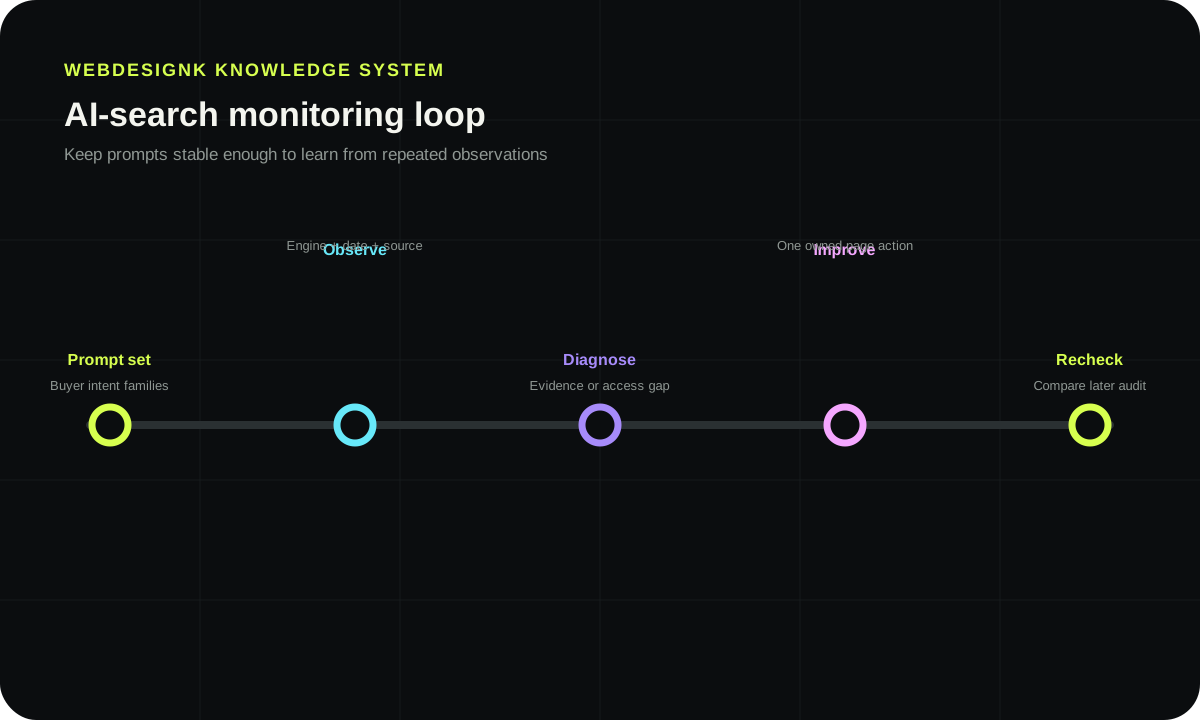
A monitoring set is a measurement instrument. It should be small enough to audit repeatedly and broad enough to cover the buying journey. Start with 15–30 high-value prompts grouped by intent. Keep the wording stable for trend comparisons, then maintain a secondary exploratory set for new questions.
For each prompt, record engine, date, account/region context when relevant, brand mention, owned citation URL, other cited domains and the page you would improve if the result exposes a gap. The interactive tracker above follows exactly that model. It intentionally starts from your observations; it does not ship with fabricated “visibility” data.
Example prompt families
For a B2B analytics product, a category prompt might ask for analytics platforms for multi-location retailers. A problem prompt might ask how to reconcile store and ecommerce attribution. A comparison prompt might compare warehouse-native and packaged analytics. A recommendation prompt might add constraints such as a small data team or strict data residency. A navigational prompt might ask for the vendor's documentation on a known capability.
The point is not to stuff prompts with your brand. The point is to observe where real buyer language intersects with the evidence you have published.
Measure mentions, citations and assisted demand
AI visibility is multi-dimensional. Track at least prompt coverage, brand mentions, owned citations, cited third-party sources and the pages most often associated with successful observations. Where your analytics can identify referrals or campaign context, connect AI-origin visits to meaningful behavior such as qualified form starts, product exploration or returning branded search.
Do not collapse all of this into one “AI rank.” A single score hides whether the problem is crawlability, weak evidence, missing topic coverage or poor source consistency. The charts in this guide therefore visualize only the records you enter and state their source explicitly.
How to decide what to improve first
Prioritize gaps where three conditions overlap: the prompt matters commercially, another source is consistently cited, and you have a credible page that can become materially more useful. That is a better backlog than chasing every missing mention.
A page-level action might be: add a missing comparison criterion, publish the methodology behind a claim, consolidate contradictory entity facts, expose a hidden technical specification, strengthen internal links from the relevant hub, or create an original asset that answers a recurring sub-question.
Avoid spam, fake authority and synthetic facts
AI-search demand has created a new vocabulary, but the old shortcuts remain risky. Do not publish dozens of near-duplicate “answer pages” for prompt variants. Do not invent awards, customer counts, benchmark percentages or fake quotations. Do not buy low-quality mentions merely to create apparent entity signals. Do not add schema for content users cannot see.
Google's guidance explicitly warns against scaled content created primarily to manipulate search and says there is no need to rewrite content solely for generative AI systems. The durable strategy is therefore less glamorous: publish useful primary material, keep facts consistent, make the site technically accessible and measure actual observations.
Common mistake: interpreting an AI-generated answer as an authoritative fact about the engine itself. Models can summarize incorrectly. If you are documenting how a platform works, cite the platform's current documentation and date the review.

A practical 90-day AI-search plan
Days 1–30: establish evidence and access
Audit crawl/index controls for Google and the AI-search crawlers relevant to your policy. Map the core entity facts and resolve contradictions. Build the first prompt set by buyer intent. Identify ten commercial pages that should function as primary sources and mark where claims lack evidence or dates.
Days 31–60: improve source quality
Upgrade the highest-value pages with original information, decision tables, named sources, definitions, diagrams and clearer internal links. Add only the structured data that matches visible content. Publish at least one asset with genuine citation value: a methodology, benchmark, calculator, technical guide, dataset or transparent comparison.
Days 61–90: monitor, diagnose, iterate
Repeat the stable prompt set by engine and date. Separate mention from citation. Compare cited domains. Convert recurring gaps into page-level work. Watch assisted demand rather than visibility alone. Retire prompts that do not map to real buying behavior and add emerging prompts to the exploratory set rather than rewriting the baseline every week.
\n## Implementation worksheet: turn observations into page work\n\nDo not let the monitoring sheet become a reporting ritual. For every repeated high-value miss, write one hypothesis and one page action. A useful hypothesis is falsifiable: “our implementation guide is not being surfaced because it never states the decision criteria buyers use” is actionable; “the engine does not like us” is not. Add the evidence you observed, the owned page responsible for the topic, the smallest meaningful improvement, an owner and the next audit date.\n\nScore backlog items by commercial relevance, evidence gap and repeat frequency, not by how embarrassing the screenshot looks. A low-value vanity prompt can remain missing. A category or recommendation prompt that appears in sales conversations and repeatedly cites a competitor's technical guide deserves attention. When you improve the page, preserve the old observation and mark the change date. That creates a real before/after record without pretending the content change caused the next engine result.\n\nFor executive reporting, separate three layers: technical eligibility (crawl/index/access), source quality (evidence/original information) and observed visibility (mentions/citations). This prevents a good visibility week from hiding a broken technical foundation, and it prevents a clean technical audit from being sold as proof of AI-search presence.\n
Next-step decision summary
AI SEO/GEO deserves investment when your customers use answer engines during research and your site has enough real expertise to become a source. The sequence is: technical eligibility → entity clarity → useful primary evidence → extractable page structure → repeatable monitoring → page-level iteration. Skip any vendor that promises guaranteed citations, secret AI ranking factors or a one-file shortcut. The only measurements in the interactive lab are yours, and the official platform sources below are the reference point for fast-changing crawler and search behavior.
Frequently asked questions
Is GEO different from SEO?
The label is different, but Google explicitly says its generative AI search features rely on core Search systems and do not require special AI-only optimization. A practical GEO program adds engine-specific monitoring and source/citation analysis to strong SEO foundations.
Do I need special AI schema or an llms.txt file for Google AI Overviews?
Google says there is no special structured data or AI text file required for its generative AI features, and its current guidance says Google Search does not use llms.txt for visibility.
Can I guarantee a citation in ChatGPT or Perplexity?
No. You can make content discoverable and improve source quality, but retrieval and citation decisions vary by engine, query, date and product behavior. Monitor observations rather than selling guarantees.
What should I measure besides mentions?
Track owned citation URLs, other cited sources, prompt intent, engine/date, the page you would improve, qualified referral behavior and assisted branded demand where your analytics can support it.