Quick answer
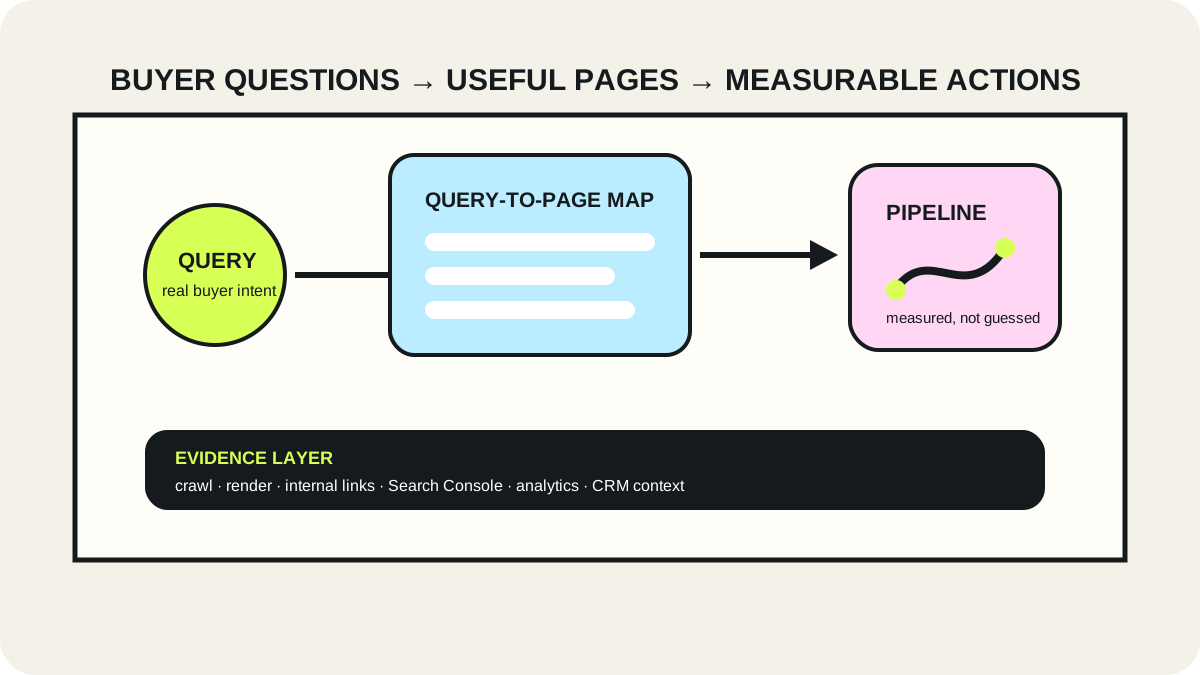
Treat B2B SEO as a query-to-page and evidence-to-backlog system, not a publishing quota. Map buyer intent to distinct page jobs, verify crawl/index/render/internal-link delivery, add useful proof and entity coverage, then prioritize findings with explicit impact, confidence, effort and validation. Search Console explains visibility and query/page behavior; analytics and CRM data explain later actions under your chosen attribution model. The strongest plan improves the page portfolio and the measurement loop together.
Last reviewed: September 19, 2026B2B SEO prioritization board
Add only findings you can support with evidence. Planning score = impact × confidence × 4 ÷ effort, with each input on a 1–5 scale. The score ranks your own backlog; it does not estimate traffic, revenue or pipeline lift. Entries stay in this browser via localStorage.
| Opportunity | Category | Evidence | Pages | Impact | Confidence | Effort | Score | Owner | Fix | Validation | Action |
|---|---|---|---|---|---|---|---|---|---|---|---|
| No backlog items yet. Add evidence-backed opportunities above. | |||||||||||
1. Priority bars from your backlog
Higher bars reflect only the disclosed impact/confidence/effort formula.
Text fallback: no opportunities entered yet.
Add an opportunity to create priority bars.
2. Coverage by workstream
Counts show where your entered backlog is concentrated; this is not a site-quality score.
Text fallback: Technical 0 items; Content 0 items; Internal Links 0 items; Schema 0 items.
3. Average backlog input profile
Average impact, confidence and effort make skew in your own scoring assumptions visible.
Text fallback: impact 0/5; confidence 0/5; effort 0/5.
Assumption note: the board does not contain benchmark traffic, ranking, conversion or pipeline data. Every score and chart is calculated from the opportunities and 1–5 inputs you enter.
Tables built for the buying decision
Primary decision table
| Issue / opportunity | Evidence | Affected template / pages | Impact | Confidence | Effort | Priority | Owner | Fix | Validation |
|---|---|---|---|---|---|---|---|---|---|
| Important pages lack crawlable internal links | Crawl/render sample shows target pages absent from contextual hub links | Solution, comparison or integration pages | Set 1–5 from business criticality | Set 1–5 from reproducibility | Set 1–5 from implementation scope | Calculate in board | SEO + web owner | Add contextual <a href> links from relevant hubs/templates | Re-crawl and verify rendered links plus target status/indexability |
| Canonical signals conflict | HTML, redirects, sitemap or internal links point at different preferred URLs | Affected template family | Set from affected intent/page value | Raise only when canonical evidence is clear | Include CMS/routing QA effort | Calculate in board | Engineering | Align canonical, redirects, sitemap and internal links | Inspect representative URLs after release and monitor selected canonical |
| Client-rendered essential content is unreliable | Rendered inspection differs from expected main content/links | JS-heavy commercial templates | Set from affected buyer journey | Based on reproducible render evidence | Include rendering/refactor cost | Calculate in board | Engineering | Move critical content/links to reliable render path | Test HTML/rendered output and crawl sample |
| High-intent query has no appropriate page job | Query/page data plus SERP review shows intent mismatch | New or existing comparison/solution page | Set from commercial relevance | Based on query/site evidence | Include research/content/design | Calculate in board | SEO + Content | Create or repurpose one page for the distinct intent | Verify indexability, internal links, useful proof and later query/page data |
| Useful supporting content is isolated from commercial paths | Guide ranks/earns impressions but lacks relevant next-step links | Guides and service/solution hubs | Set from buyer-stage importance | Based on page/link evidence | Usually template/content effort | Calculate in board | Content / SEO | Add decision-relevant links in both directions | Re-crawl links and review assisted journeys over time |
| Supported structured data is missing or inaccurate | Eligible page content lacks valid corresponding markup or markup mismatches visible content | Eligible page templates | Set from feature/page importance | Based on supported type and validation | Include template + QA effort | Calculate in board | Engineering / SEO | Implement accurate supported markup | Validate representative URLs and inspect rendered payload |
| Measurement cannot connect landing pages to qualified outcomes | Search/analytics data exists but lead/opportunity context is not joined | Analytics + CRM workflow | Set from decision value | Based on data-quality audit | Often cross-system effort | Calculate in board | Analytics / RevOps | Preserve landing/source context and define attribution fields | Trace test lead through analytics and CRM; document attribution model |
Query-to-page map for B2B search intent
| Buyer intent | Typical query pattern | Best page job | Evidence to include | Useful next action |
|---|---|---|---|---|
| Problem discovery | how to solve / why does / strategy for | Educational guide or diagnostic resource | Clear explanation, examples, symptoms and decision criteria | Related implementation or evaluation guide |
| Approach evaluation | X vs Y / alternatives / build vs buy | Comparison or decision guide | Tradeoffs, constraints, scenarios and source-backed claims | Relevant service/solution page |
| Solution discovery | service / software / platform for [job] | Service, solution or category page | Capabilities, fit, process, proof and limitations | Scoped consultation, demo or product path |
| Technical validation | architecture / integration / security / migration | Technical guide, integration page or implementation resource | Requirements, diagrams, edge cases, operational detail | Technical discovery or implementation plan |
| Vendor validation | brand reviews / case studies / examples / security | Proof, case study, trust or security page | Specific evidence, outcomes, process and limitations | Contact or evaluation step |
| Commercial validation | cost / pricing / ROI / timeline | Pricing, cost guide or commercial FAQ | Assumptions, ranges where sourced, inclusions and exclusions | Scope or quote request |
| Implementation | checklist / template / how to deploy | Hands-on guide, checklist or tool | Steps, validation criteria and operational ownership | Audit or implementation support |
Sources and assumption boundaries
Fast-changing platform, pricing and search claims were reviewed on September 19, 2026. Interactive scores and scenarios are clearly labeled planning models, not sourced market benchmarks.
- Google Search Essentials Current Google fundamentals covering technical requirements, spam policies and core search best practices including people-first content and descriptive language.
- Google Search Central — Creating helpful, reliable, people-first content Primary guidance for evaluating whether content adds useful, substantial and trustworthy value for people rather than being produced mainly for search rankings.
- Google Search Central — Link best practices Documents crawlable HTML links and how links help Google discover pages and understand relationships.
- Google Search Central — JavaScript SEO basics Primary documentation on how Google processes JavaScript and recommendations for discoverable links and rendered content.
- Google Search Central — Canonical URLs Documents canonicalization methods, signal strength and alignment across redirects, rel=canonical, sitemaps and internal links.
- Google Search Central — Build and submit a sitemap Explains sitemap construction and states that sitemap submission is a hint rather than a guarantee of crawling or indexing.
- Google Search Central — Structured data introduction Defines structured data as standardized page information that can help Google understand content and enable eligible rich-result experiences.
- Google Search Console — Performance report Official documentation for Search Console search-result performance metrics, queries, pages, filters and date ranges.
- Google Analytics — Attribution Official overview of attribution and available models for assigning credit across touchpoints leading to important actions.
Turn this planning result into a scoped review.
Send the assumptions, constraints and result summary. WebDesignK can review the architecture/content/implementation boundary, identify missing discovery inputs and return a prioritized next-step scope.
- Bring: current site/product, constraints, integrations and your tool result.
- You get: a scoped recommendation, open questions and implementation priorities.
Decision snapshot for B2B SEO Strategy
A B2B SEO strategy creates pipeline when it connects real buyer questions to pages with a clear business job, makes those pages reliably crawlable and understandable, and measures what happens after search visibility becomes a visit. The central tradeoff is reach versus commercial relevance: publishing more pages can increase surface area, but the useful strategy prioritizes queries, page types and technical fixes that help qualified buyers learn, compare, validate and take the next step.
What you’ll learn / decide
- which search intents deserve a page and which page type should own them;
- how to diagnose crawl, index, render and internal-link evidence before creating more content;
- how to connect topic/entity coverage to buyer questions instead of keyword volume alone;
- how to turn findings into an owned backlog with impact, confidence, effort and validation;
- how to measure search visibility, on-site progress and downstream pipeline without pretending attribution is perfect.
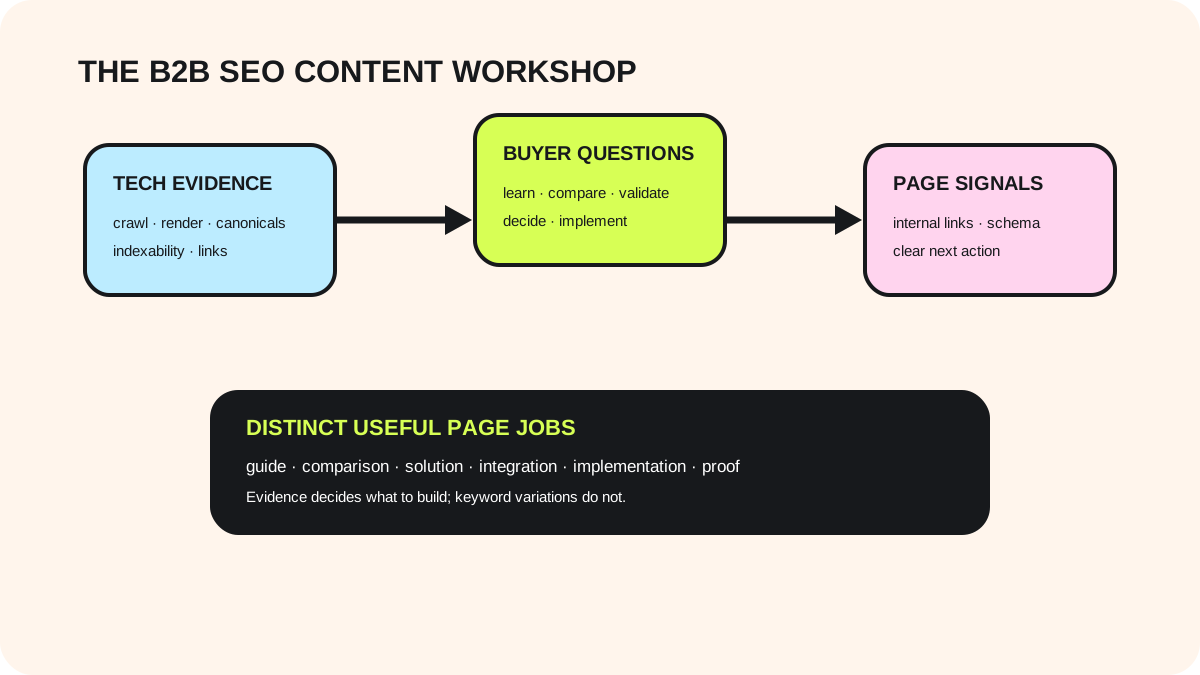
The practical output is not a list of “SEO ideas.” It is a query-to-page map, evidence-backed technical/content backlog and measurement loop. A buyer-intent page should have one job, one canonical URL, crawlable paths into it, enough evidence to answer the question, and a useful next action. If those foundations are weak, scaling content usually scales ambiguity too.
Search intent and business outcome
B2B search behavior rarely ends with one query. A buyer may first name a problem, then compare approaches, investigate requirements, evaluate vendors, validate risk and return later through another channel. SEO therefore works best as a demand-capture and demand-education system, not a blog traffic contest.
Start by defining the business outcome for each intent class. Informational queries can introduce a problem and teach the evaluation criteria. Commercial investigation queries can compare approaches, costs, architectures or vendors. Solution queries can explain how a service or product handles a concrete job. Branded proof queries can reduce risk with implementation details, case evidence, security answers or migration guidance. The SEO goal is to make the right page available when that question exists, then preserve a clear path to the next useful action.
Build a query-to-page map before a content calendar
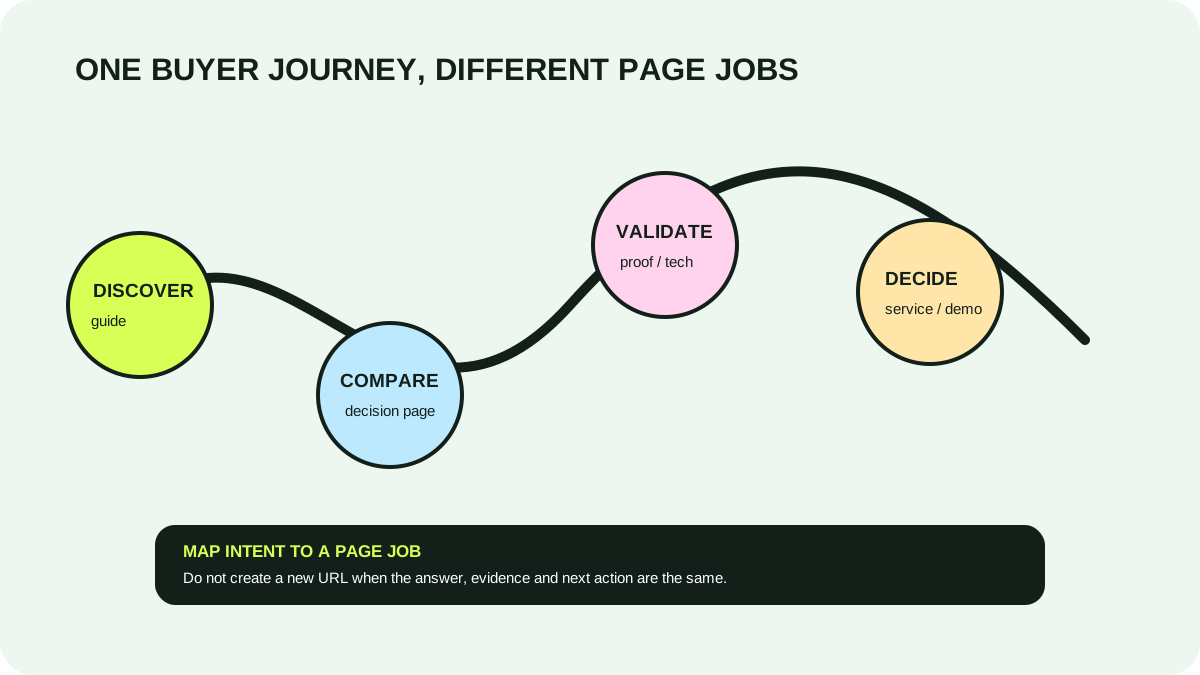
A query-to-page map prevents two common problems: several pages competing for the same job, and high-intent questions being answered only in generic blog posts. Map each meaningful intent to a page family such as service, solution, comparison, integration, use case, product capability, implementation guide, evidence page or educational guide. Then record the next action that page should support.
Do not force every query into a new URL. If two query variants require essentially the same answer and proof, one stronger page may serve them better. If the intent changes materially—such as “what is multi-tenant SaaS” versus “multi-tenant SaaS development company”—the page job changes even if the words overlap.
Define pipeline relevance without inventing attribution
For each page family, specify a business hypothesis in plain language: “This comparison page should help evaluation-stage buyers understand tradeoffs and reach the relevant service page,” or “This implementation guide should help technical evaluators validate feasibility before contacting sales.” That hypothesis is testable. “This page will generate 30% more pipeline” is not evidence unless your own data supports it.
Current-state diagnosis
Before adding more content, establish what the current site can already discover, render, index and measure. The useful diagnosis joins technical evidence, search evidence and business evidence.
For technical evidence, sample priority templates and verify status codes, robots directives, canonical signals, rendered main content, crawlable links, sitemap inclusion and internal inlinks. For search evidence, use Search Console query/page data to see which URLs receive impressions and clicks, where queries map to surprising pages, and whether a page family is absent or merely underperforming. For business evidence, inspect landing-page journeys, important actions, CRM source data and sales feedback where those systems are available.
Google's Search Console Performance report exposes clicks, impressions, queries and pages, but those numbers are search-result behavior—not pipeline by themselves. Likewise, analytics attribution assigns credit using a model. Treat both as measurement lenses, then preserve raw page/query and lead/opportunity context when possible instead of collapsing everything into one “SEO revenue” number.
Diagnose page families, not isolated URLs
A single URL can look healthy while its template family is broken. Compare samples across service pages, solution pages, blog guides, comparison pages and any scaled templates. Ask whether the same canonical mistakes, missing internal links, client-only content, thin sections or tracking gaps repeat. Template-level fixes often create more leverage than editing individual titles one by one.
Record evidence in backlog-ready language
Write findings so another person can implement and validate them: “18 comparison URLs canonicalize to the category page; confirmed in HTML source and URL Inspection” is actionable. “Canonicalization needs improvement” is not. Include the affected template, a reproducible check, owner, proposed fix and validation step from the beginning.
Technical foundations
Technical SEO is the delivery layer for the demand strategy. A page that cannot be reliably discovered, rendered or selected as the intended canonical cannot do its business job consistently.
Crawl and discovery
Google documents that crawlable links are generally standard <a> elements with href attributes. For B2B sites, this matters because valuable pages are often hidden behind filters, JavaScript-only navigation, resource hubs or cards that look clickable without exposing a normal link. Critical solution, comparison, integration and evidence pages should be reachable through intentional internal paths, not only through a sitemap or search box.
Sitemaps are useful discovery and monitoring inputs, but Google describes sitemap submission as a hint, not a guarantee of crawling or indexing. Use a sitemap to declare important canonical URLs; use internal links and clean page signals to show how the site actually fits together.
Canonicalization and duplication
If multiple URLs contain duplicate or very similar content, canonical signals should align. Google documents redirects and rel="canonical" as strong canonicalization signals and sitemap inclusion as weaker. In practice, align redirects, self-canonicals, internal links and sitemap URLs around the URL you actually want buyers and search engines to use.
B2B sites frequently create duplicate paths through campaign parameters, faceted navigation, old CMS routes, translated variants or multiple solution taxonomies. Do not “fix” duplication by hiding strategically important pages without understanding the cause. Verify which URL is selected, why alternatives exist, and whether the pages should consolidate or become genuinely distinct.
Rendering and essential content
Google can process JavaScript, but its documentation still highlights differences and limitations in how crawlers access and render JavaScript applications. Important copy, links, metadata and structured data should survive a rendered-page inspection. If the commercial page depends on a client-side request that fails for crawlers or slow users, that is not merely an SEO concern; it is a delivery reliability concern.
Information architecture/internal linking
Information architecture decides which pages are easy to find and how context flows between them. Internal links should connect buyer intent, topic relationships and business progression.
A useful B2B architecture often has hubs for major problems or solution areas, then supporting pages for use cases, comparisons, implementation questions, integrations and proof. Educational content should not become an isolated blog universe. Where relevant, guides should link naturally to the next evaluation resource; commercial pages should link to supporting evidence that answers objections.
Build links around decisions, not exact-match repetition
Anchor text should tell the reader what the linked page offers. A paragraph about migration risk can link to a migration guide; a section about technical SEO evidence can link to a technical audit checklist. The goal is not to repeat one keyword everywhere. It is to make the relationship between the current question and the next resource explicit.
Measure internal-link evidence
For priority page families, track whether they are orphaned, how many meaningful inlinks they receive, which hubs link to them, and whether navigational changes are actually present in rendered HTML. After an internal-link release, re-crawl the affected scope and verify the links before waiting for search outcomes. Technical validation should happen immediately; search-performance interpretation comes later.
Content and entity coverage
Content coverage is not a checklist of keyword variations. It is evidence that the site can answer the questions a qualified buyer needs answered about a problem, approach, product, service and implementation context.
Google's current guidance emphasizes helpful, reliable, people-first content and asks whether a page adds original information, substantial coverage and first-hand expertise. For B2B teams, this creates a useful editorial standard: include the implementation details, constraints, examples, decision criteria, screenshots, process knowledge, source links or practitioner insight that a generic summary cannot provide.
Cover entities by relationships
Think in relationships such as product → capability → use case → integration → industry constraint → implementation method → proof. A SaaS development firm, for example, can explain multi-tenancy, authentication, billing, observability and migration because those concepts are genuinely connected to the work. The point is not to mention entities mechanically; it is to make the knowledge graph useful to the buyer.
Separate page purpose from topic overlap
Two pages can mention the same concepts but serve different jobs. A “B2B SEO strategy” guide teaches the system. A “technical SEO audit” guide teaches diagnosis. An “SEO agency vs in-house” page supports a sourcing decision. A programmatic SEO guide supports a scaling decision. Internal links should preserve those distinctions rather than merging everything into one giant page.
SERP/competitor gap analysis
Competitor research is useful when it reveals missing buyer evidence, not when it becomes a word-count race. Search the priority query set and record what kinds of pages appear, what intent they seem to satisfy, what proof they provide, and where your current page differs.
Separate three gap types. A page-type gap exists when searchers appear to expect a comparison, category, tool or implementation guide and your site has no equivalent job. An evidence gap exists when your page claims expertise but lacks concrete proof, examples or technical depth. A coverage gap exists when a buyer must leave your site to answer an important adjacent question before they can evaluate your offer.
Do not infer that every competitor section is a ranking requirement. Search results vary by query, market and time, and competitors can rank despite weaknesses. Use the SERP as observation, then test your own page against buyer usefulness, technical quality and business purpose.
Record the gap as a hypothesis
A useful backlog item says: “Evaluation-stage query set consistently returns comparison-style pages; our generic service page has impressions but low engagement and no explicit tradeoff section. Test a dedicated comparison resource linked from the service hub.” That captures the evidence and the proposed change without pretending the SERP proves causality.
Measurement and attribution
Measurement should answer three separate questions: Can search engines discover and understand the page? Are searchers finding and choosing it? Are the resulting visits progressing through useful business actions? Mixing all three into one metric makes diagnosis harder.
For technical release validation, use crawl output, response/render checks, canonical/indexability tests, structured-data validation and internal-link verification. These can often be checked immediately after deployment. For search behavior, use Search Console dimensions such as query and page over a period long enough to collect meaningful impressions. For on-site behavior and key actions, use analytics and CRM data with a documented attribution model.
Google Analytics describes attribution as assigning credit across touchpoints and provides multiple attribution models. That is a reminder that “SEO sourced pipeline” depends on your measurement definition. A qualified buyer may first discover the brand through organic search, return directly, click a sales email and convert later. Preserve assisted context where your systems allow it instead of forcing every opportunity into a single-touch story.
Use observation windows appropriate to the signal
Do not wait weeks to verify a broken canonical fix; inspect the release immediately. Do not expect stable search-performance conclusions minutes after publishing. Google notes that recrawling can take from days to weeks and is not guaranteed instantly. For B2B sites with lower query volume, use a window long enough to collect comparable query/page data and account for sales-cycle latency. The exact minimum is site-specific; document it rather than inventing a universal number.
Pair leading and lagging signals
Leading signals include successful crawl/render validation, index eligibility, internal-link presence and initial query impressions. Lagging signals include qualified visits, key events, opportunity creation and revenue outcomes. A strategy can improve leading signals before pipeline appears; conversely, a few pipeline wins do not prove every SEO tactic worked. Keep the measurement chain visible.
Prioritize by impact/confidence/effort
A backlog becomes useful when the team can explain why this task should happen before another task. Impact, confidence and effort are simple planning dimensions, not objective facts.
Use impact to represent the business/technical importance if the hypothesis is true: a blocked high-intent template may deserve more weight than a cosmetic improvement. Use confidence to represent evidence quality: reproducible crawl and URL Inspection evidence may justify more confidence than a vague competitor observation. Use effort to reflect implementation and coordination cost, including engineering, content, design, QA and release risk.
The interactive board on this page uses a transparent planning formula:
planning score = impact × confidence × 4 ÷ effort
All three inputs are on a 1–5 scale. The multiplier simply maps the maximum combination to 100. It does not estimate traffic, rankings, leads or revenue. Change the inputs when the evidence changes.
Prioritize blockers before optimization polish
A formula is not a substitute for judgment. If a release accidentally noindexes a revenue-critical page family, fix the blocker even if a small metadata task receives a convenient numeric score. Use the board to order comparable opportunities, while keeping genuine incidents and policy constraints outside normal optimization queues.
Keep validation in the same task
Every backlog item should include how completion will be proven. “Implement schema” is incomplete; “add valid supported markup to eligible pages, test representative URLs, and confirm the rendered payload” is testable. “Improve internal linking” becomes “add crawlable links from the solution hub to the four comparison pages and verify them in rendered HTML plus the next crawl.” Validation protects the backlog from becoming a list of shipped-but-unverified changes.
Implementation workflow
A dependable workflow moves from evidence to hypothesis to implementation to validation to re-measurement.
- Collect evidence. Crawl the target scope, inspect representative rendered pages, review Search Console query/page data, and gather analytics/CRM context where available.
- Map intent to page jobs. Decide which page should own each important buyer question and whether a new URL is actually necessary.
- Create owned backlog items. Record evidence, affected templates, owner, proposed fix, impact, confidence, effort and validation.
- Batch by shared implementation. Fix a template or component once where possible instead of opening dozens of URL-level tasks.
- QA the release technically. Re-crawl, inspect HTML/rendering, test canonicals, links, status codes and structured data immediately after deployment.
- Re-measure search behavior. Compare query/page performance only after enough data has accumulated for the site and topic.
- Connect to business outcomes. Review important actions, qualified leads and opportunity context using the attribution definition your team has chosen.
- Update the backlog. Raise or lower confidence as evidence changes; close items only when validation is complete.
Owner design matters
SEO work crosses marketing, content, design, analytics and engineering. Give each task one accountable owner even when several teams contribute. “Engineering + SEO + Content” as a shared owner often means nobody owns release validation. The owner can coordinate specialists, but the validation step should still have a named accountable person.
Release smaller evidence loops
Where risk allows, prefer smaller batches that let you confirm technical behavior before a site-wide rollout. A navigation change can be tested on one hub. Structured data can be validated on representative templates. A new content pattern can launch on a few high-value pages before the team scales it. Smaller loops make it easier to learn which assumption was wrong.
Review cadence and FAQ
A B2B SEO review should separate operational monitoring, release validation, search-performance review and strategic planning. They run on different clocks.
Operational checks should surface acute crawl/indexation or site failures quickly. Release validation happens whenever relevant SEO-affecting changes ship. Search-performance reviews should use a consistent comparison window appropriate to query volume and seasonality. Strategy reviews can be less frequent and should revisit the query-to-page map, page portfolio, evidence gaps and commercial priorities.
A monthly meeting is not a strategy by itself. The useful cadence is defined by decisions: what changed, what was validated, what signal moved, what remains uncertain, and which backlog item now deserves priority.
What should a B2B SEO dashboard include?
Keep the dashboard close to decisions. Useful views often include priority page-family indexability, Search Console query/page trends, branded versus non-branded segmentation where meaningful, key landing-page actions, content/backlog status, and qualified lead or opportunity context from the CRM. Avoid vanity totals that cannot explain what to do next.
How long should we wait after an SEO change?
Technical validation should happen as soon as the release is live: status codes, rendered links, metadata, canonicals and structured data can be checked immediately. Search reprocessing is slower; Google states that recrawling can take days to weeks. Performance interpretation should use a site-specific window with enough comparable impressions and should account for B2B sales-cycle lag.
Should every target keyword have its own page?
No. Create a distinct page when the buyer intent, required evidence or next action is materially different. If several query variants need the same answer, a stronger shared page is often clearer than near-duplicate URLs.
Is structured data a ranking shortcut?
No. Google describes structured data as a standardized way to provide explicit clues about page meaning and enable eligible rich-result experiences. Implement supported markup when it accurately represents visible content, validate it, and treat it as one delivery layer—not a substitute for useful pages.
How should we connect SEO to pipeline?
Define the measurement model first. Preserve organic landing/query context where available, track meaningful on-site actions, connect qualified leads and opportunities in the CRM, and document how attribution credit is assigned. Use assisted-path evidence where available rather than claiming one organic visit caused the entire deal.
What should the first 30 days focus on?
Start with diagnosis and the backlog, not a publishing quota. Map the highest-value buyer intents, inspect the technical delivery of the existing page families, connect Search Console and analytics evidence, identify the most consequential content/internal-link gaps, assign owners, and ship a small number of measurable fixes. The goal is to build a repeatable evidence loop that can scale.
Frequently asked questions
What is the most important part of a B2B SEO strategy?
A query-to-page map tied to business purpose. It prevents content volume from replacing intent coverage and gives technical, content and internal-link work a shared destination.
How should B2B SEO be measured?
Separate technical validation, Search Console query/page behavior, on-site key actions and CRM outcomes. Then document the attribution model used to connect touchpoints rather than treating one metric as the whole funnel.
How do you prioritize SEO tasks?
Use evidence first, then compare impact, confidence and effort. The interactive board on this page ranks user-entered tasks with a transparent formula; genuine incidents or policy blockers should still override normal optimization scoring.
How long should we wait before evaluating an SEO change?
Validate technical release behavior immediately. Search reprocessing can take days to weeks, and performance interpretation needs a site-specific observation window with enough comparable impressions and appropriate sales-cycle context.
Should every keyword have a separate page?
No. Create a separate URL when intent, evidence or next action is materially different. Closely related query variants often belong on one stronger page.
Can structured data or internal links guarantee higher rankings?
No. Structured data can clarify page meaning and enable eligible search features, while crawlable internal links help discovery and context. Neither is a guaranteed ranking lift, so validate implementation and measure your own outcomes.