Quick answer
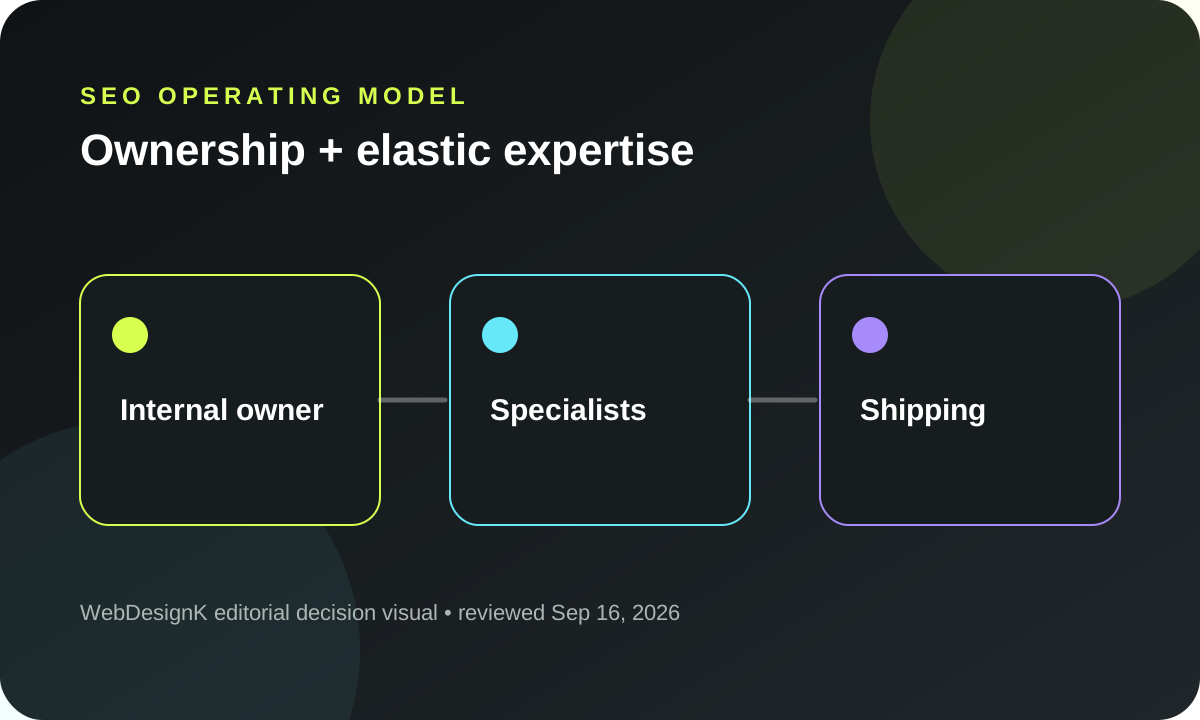
Choose the operating model by separating durable internal ownership from elastic specialist capacity. The wrong comparison is agency fee versus one salary; the useful comparison is equivalent scope, implementation ability and 12-month operating responsibility.
Last reviewed: September 16, 2026SEO operating-model scope estimator
The inputs mirror the issue brief because template/CMS/language/integration complexity changes how much technical, content, analytics and governance work an SEO operating model must absorb. Output is an editorial scope model—not a staffing or price quote.
1. Lean / Growth / Complex workstream shares
Takeaway: complexity shifts more effort toward technical SEO, integrations and governance.
2. Your current workstream mix
Takeaway: the donut shows how your inputs redistribute planning effort; it is not a market benchmark.
- Strategy 19%
- Content 21%
- Technical SEO 15%
- Reporting 15%
- Integrations 18%
- QA/governance 13%
3. 12-month operating emphasis line
Takeaway: launch/migration complexity is front-loaded; recurring technical/content governance remains after the first quarter.
Assumption note: tier thresholds, scenario shares and the 12-month emphasis curve are WebDesignK editorial planning assumptions. They are intentionally separated from source-backed SEO guidance in the article.
Tables built for the buying decision
Primary decision table
| Scope tier | Deliverables | Team shape | Planning timeline | Major cost drivers | Best fit |
|---|---|---|---|---|---|
| Lean | Priority technical backlog, content plan, core reporting | Internal owner + focused specialist | Quarterly roadmap | Template/CMS limits, content capacity | Smaller site with clear priorities |
| Growth | Technical + content + measurement cadence, implementation QA | Internal owner + multi-discipline agency/hybrid | Monthly operating cadence | More templates, integrations, publishing velocity | Growing B2B/SaaS/ecommerce team |
| Complex / enterprise | Multi-site/locales, migrations, governance, specialist audits | Internal program lead + specialists + engineering/data | Continuous program | Migration risk, locales, data, approvals, release process | Large or regulated organization |
Recurring SEO operating costs to separate from projects
| Item | Why it exists | Cadence | Control lever |
|---|---|---|---|
| Technical monitoring | Find crawl/index/template regressions | Continuous + monthly review | Automation + clear ownership |
| Content planning/QA | Keep demand coverage and quality coherent | Monthly/quarterly | Editorial system + prioritization |
| Reporting/analysis | Turn data into decisions | Monthly/quarterly | Metric definitions + narrative |
| Tools/data | Crawling, rank/search/analytics workflows | Monthly/annual | Tool consolidation + access design |
| Specialist escalation | Migrations, rendering, international, schema | As needed | Retainer boundaries / project scopes |
Sources and assumption boundaries
Fast-changing platform, pricing and AI-search claims were reviewed on September 16, 2026. Interactive scores and scenarios are clearly labeled planning models, not sourced market benchmarks.
- Google Search Central — SEO Starter Guide Official foundational SEO guidance; reviewed September 16, 2026.
- U.S. Bureau of Labor Statistics — Advertising, Promotions, and Marketing Managers U.S. occupational role/pay context; not a loaded employer cost or agency price. Reviewed September 16, 2026.
- Google Search Central — Redirects and Google Search Official migration/redirect guidance; reviewed September 16, 2026.
Turn this planning result into a scoped review.
Send the assumptions, constraints and result summary. WebDesignK can review the architecture/content/implementation boundary, identify missing discovery inputs and return a prioritized next-step scope.
- Bring: current site/product, constraints, integrations and your tool result.
- You get: a scoped recommendation, open questions and implementation priorities.
Decision snapshot: agency versus in-house is an operating-model decision
Choosing between an SEO agency and an in-house team is less about finding a universal winner and more about matching ownership, breadth, speed and continuity to the work your business actually needs. In-house teams can hold deep company context and stay close to product, engineering and brand decisions. An agency can add specialist breadth, parallel execution and outside pattern recognition without requiring every capability to be hired permanently. The decisive question is where you need durable internal ownership versus elastic specialist capacity.
What you will decide: the scope tier your site creates, the workstreams that consume effort, what a comparable proposal must include, and which responsibilities should remain inside the company even if delivery is external.
Direct answer and planning-range framework
Start with work, not headcount. Build a 12-month SEO backlog across strategy, technical SEO, content, analytics, digital PR/authority where relevant, engineering dependencies and governance. Then mark each item as continuous ownership, project work or specialist escalation. Continuous ownership usually benefits from a named internal decision-maker because prioritization touches product, brand and revenue. Project work can often be delivered by an agency or specialist team. Escalations—large migrations, international expansion, JavaScript rendering problems or complex ecommerce faceting—need expertise that may not justify a permanent hire.
The scope estimator above uses the issue brief's website variables because templates, CMS complexity, languages, integrations, ecommerce, migrations, motion, accessibility and content volume change the amount of SEO coordination required. It outputs a planning tier and workstream mix, not a price quote or a claim about what agencies charge.
Scope tiers: lean, growth and complex/enterprise
A lean program usually has a small template set, one language, limited integrations and no major migration. The challenge is focus: identify a small number of commercially meaningful technical/content priorities and make sure someone can ship them. Adding an agency only helps if there is internal ownership to approve changes and provide business context.
A growth program has more page types, publishing velocity, integrations, reporting audiences and cross-functional dependencies. The operating model needs a reliable cadence: backlog triage, technical tickets, content briefs, QA, measurement and stakeholder review. At this stage, the agency-versus-in-house decision is often hybrid rather than binary.
Complex or enterprise SEO adds multiple locales, large inventories, migrations, governed releases, security constraints, many stakeholders and potentially several web properties. The cost driver is coordination and change safety as much as raw page count.
What drives cost more than page count alone
Page count is a weak proxy when ten templates generate hundreds of thousands of URLs or when a small site depends on a difficult rendering stack. Cost and effort rise with template diversity, indexation complexity, data dependencies, approval layers, migration risk, content production requirements and the number of teams needed to ship a recommendation.
For an agency, complexity shows up in discovery, auditing, technical specifications, meetings, QA and specialist time. For an in-house team, the same complexity appears as salaries, recruiting, management, tools, training and opportunity cost. Compare equivalent work, not a monthly retainer against one employee's salary.
Separate capacity from capability
A team can have expertise but no shipping capacity, or capacity without the specialist knowledge to diagnose a migration or rendering problem. The model should identify both gaps. This is why a hybrid team—internal owner plus external specialists—often appears in practical SEO organizations.
Team roles and delivery model
At minimum, define a business/SEO owner, technical counterpart and content owner. Larger programs may add analytics, engineering, UX, editorial, localization and PR/authority roles. The agency should not become the only place where the strategy exists. Keep business priorities, access, documentation, analytics definitions and decision history under company control.
Agencies can be useful when you need several disciplines at once without hiring each one: technical SEO, content strategy, analytics, migration support and cross-site QA. In-house teams are strongest when daily product context and organizational influence dominate the work. The hybrid pattern uses internal ownership and external elasticity deliberately rather than by accident.
Integrations, migration and data complexity
SEO rarely operates only inside a CMS. Product data, faceted navigation, localization, analytics, CRM attribution, experimentation and frontend frameworks can all change what is crawlable and measurable. A migration adds URL mapping, redirect testing, baseline exports, launch QA and post-launch monitoring. If the SEO team cannot get engineering changes prioritized, adding more recommendations does not solve the constraint.
Use the estimator's integration and migration inputs to reveal this coordination load. Then decide who owns implementation specifications, who can approve release risk and who validates production. Agencies should be measured partly on whether their recommendations are implementation-ready; in-house teams should be measured partly on whether they can turn findings into shipped changes.
Timeline and how urgency changes staffing
Urgency changes the shape of the team. A normal quarterly roadmap may be handled by one internal lead plus scheduled specialist support. A six-week migration can require parallel crawling, content inventory, redirect mapping, analytics validation and engineering QA. Buying temporary parallelism can be more rational than hiring permanent roles for a peak.
Avoid “rush” plans that simply reduce discovery. Compressing elapsed time safely usually means more coordination and parallel work, not skipping baseline exports or QA. Decide which tasks can run concurrently, which are release dependencies and which can wait until after launch.
One-time versus recurring operating costs
One-time work includes migrations, technical audits, new information architecture, analytics cleanup and initial content-system design. Recurring work includes monitoring, content planning, technical backlog management, reporting, experimentation and periodic strategy reviews. Keep these categories separate so a buyer can see what disappears after a project and what becomes an operating habit.
For in-house planning, include recruiting time, management overhead, benefits, tools and the fact that one hire rarely covers every specialist discipline. BLS occupational data can provide labor-market context, but it should not be treated as a loaded company cost or as an agency price. For agency planning, ask which roles and deliverables are included, what triggers additional scope and how specialist escalation is handled.
Hidden costs and scope-change traps
Common traps include unlimited “SEO support” with no definition of output, content volume without editorial QA, technical recommendations without engineering acceptance criteria, dashboards without decision ownership, and migration support that ends on launch day. Another hidden cost is access: if the team spends weeks waiting for analytics, CMS or engineering access, the calendar moves without useful delivery.
Define scope-change triggers before signing. New countries, CMS replacement, ecommerce launch, large acquisition, rebrand, domain change or a major product taxonomy shift are examples that materially change the work. A good statement of work says what happens when those conditions appear.
How to compare proposals on equivalent scope
Normalize proposals into workstreams: strategy, technical SEO, content, analytics/reporting, implementation support, QA and governance. Compare frequency, named roles, included deliverables, expected client inputs, response times, meeting load, tools/data access and change control. A cheaper proposal that excludes implementation QA may not be comparable to one that includes migration support.
Ask for example artifacts: audit ticket format, content brief, migration checklist, reporting narrative and escalation process. You are evaluating an operating system, not a slide deck. The strongest proposal makes ownership boundaries obvious.
Budget FAQ and next-step brief
Before asking for a quote or approving a hire, write a one-page brief: business goals, priority products/markets, current site/CMS, major technical constraints, planned migrations, content capacity, analytics stack, engineering availability and what success will be measured against. This allows an agency to scope honestly and helps an internal hiring manager define the actual role.
The next decision is not “agency or employee?” in isolation. It is: what must we own internally, what specialist capacity is missing, what can we implement, and what operating cadence will keep the program from becoming a queue of unshipped recommendations?
How to test whether the operating model can actually ship
Before choosing a partner or opening a role, take three real backlog items and walk them through the proposed operating model. One should be technical, one content-led and one cross-functional. Ask who diagnoses the issue, who writes the implementation-ready acceptance criteria, who gets engineering priority, who validates production and who communicates the result. If the answer repeatedly depends on “someone on your side,” make sure that person is explicitly staffed and has authority. If the in-house model assumes every specialist skill will come from one hire, list the gaps that still require contractors, agencies or training.
This exercise exposes a common procurement mistake: buying recommendations instead of shipping capacity. A technically excellent audit has low commercial value when no one owns implementation. Likewise, an internal SEO manager can be highly capable yet constrained by release queues, data access or insufficient content production. The operating model needs both expertise and a path from diagnosis to deployment.
Due diligence for an SEO agency
Ask for representative deliverables rather than only case-study outcomes. Review a technical ticket, content brief, migration plan, monthly analysis and example of how a recommendation changed after engineering feedback. The objective is to understand the team's working quality: specificity, evidence, prioritization, handoff discipline and willingness to say when data is insufficient. Ask who will actually work on the account, which specialists are shared across clients, what work is subcontracted and how continuity is handled when people change.
Clarify access and ownership before work starts. Your company should retain control of Search Console, analytics, tag management, CMS, domains and other first-party accounts. Agency-created documentation should live somewhere the company can retain after the engagement. These details reduce switching cost and make hybrid models easier to evolve.
Due diligence for an in-house hire
Define the role from the backlog rather than from a generic “SEO manager” title. A content-led organization may need editorial strategy and stakeholder influence; a marketplace or ecommerce platform may need technical indexing and data skills; a migration-heavy roadmap may require deep web architecture experience. No candidate will be equally strong in every specialty, so define the primary strengths and the specialist support budget around them.
Also test the organizational conditions. Who is the engineering counterpart? Can the SEO owner create or influence tickets? Is there content capacity? Can the person access data without weeks of approval? A great hire placed into a system with no implementation route will appear underperforming even when diagnosis is correct.
A practical 12-month governance cadence
A durable cadence can be simple: monthly technical/content backlog review, quarterly strategy reset, release-based QA for major template changes and a migration playbook for structural changes. Keep a decision log for major canonical, navigation, taxonomy and content-policy choices. Measure leading indicators such as shipped fixes and content coverage alongside commercial outcomes. Traffic alone cannot tell you whether the operating system is healthy.
For agencies, use the cadence to distinguish retained operating work from project spikes. For in-house teams, use it to identify when temporary specialist capacity is needed. The model should flex without forcing the company to re-litigate agency versus employee every quarter.
Frequently asked questions
Is an SEO agency cheaper than an in-house team?
Not universally. Compare equivalent roles, deliverables, tools, management and implementation responsibilities over the same period. A retainer and one salary rarely represent the same scope.
What should stay in-house even with an agency?
Business priorities, access ownership, decision history, analytics definitions, product context and final prioritization should remain under company control.
When does a hybrid SEO model make sense?
When the company needs a persistent internal owner but also needs specialist breadth or temporary parallel capacity that would be inefficient to hire permanently.
How should SEO proposals be compared?
Normalize them into workstreams, cadence, named roles, deliverables, client inputs, implementation support, QA, reporting and change-control triggers.