Quick answer
Treat programmatic SEO as a publishing system, not a URL generator. Define one repeatable intent, prove that your data and modules create page-specific value, publish a reviewed sample, expose it through crawlable internal links, and expand only when indexation and user evidence remain healthy. Google's spam policies explicitly call out doorway abuse and scaled content created primarily to manipulate rankings. Your quality gate should therefore decide which URLs launch, stay noindexed, consolidate or get pruned before scale makes weak assumptions expensive.
Last reviewed: 2026-09-19Programmatic-page publish gate
Score one proposed page family before you scale it. The gate is a disclosed WebDesignK planning model—not a Google ranking factor, traffic forecast, or guarantee of indexation. Inputs stay in this browser.
Keep the family out of the index while improving weak dimensions → Add page-specific data or modules → Strengthen contextual internal links → Re-run the quality sample before launch
1. Impact / confidence / effort priority
Priority uses the transparent formula impact × confidence ÷ effort.
Takeaway: entered priority score is 3; it compares your own backlog items only.
2. Implementation coverage
Track the share of the page-family plan you have actually reviewed.
Takeaway: average entered coverage is 55%.
3. Quality-gate ring
The ring compares your weighted quality score with the threshold you selected.
Takeaway: the score is below your selected threshold; hard blockers still override the score.
4. Quality-dimension heatmap
Use this to spot the weakest reason a generated URL deserves to exist.
Text fallback: Intent uniqueness 3.0/5, Data uniqueness 3.0/5, Template variation 3.0/5, Index threshold 3.8/5, Internal links 2.0/5.
Assumption note: quality weights and the launch/hold/block labels are WebDesignK planning rules. Priority and coverage use only values you enter. Google does not publish these scores or thresholds.
Tables built for the buying decision
Primary decision table
| Issue / opportunity | Evidence | Affected template / pages | Impact | Confidence | Effort | Priority | Owner | Fix | Validation |
|---|---|---|---|---|---|---|---|---|---|
| Intent overlap between generated pages | Query-to-page map shows multiple URLs answering the same task | Location + service template | 5/5 | 4/5 | 3/5 | High | SEO + Product | Consolidate the intent or add a page-specific job and evidence | Re-crawl sample; verify distinct titles, main content, canonicals and internal links |
| Generic source data | Rows differ only by name/location while attributes are identical | Integration directory | 5/5 | 5/5 | 4/5 | High | Data + Content | Add authoritative attributes, compatibility states, setup requirements and maintained ownership | Sample records against source-of-truth; reject incomplete records from indexable output |
| Weak discovery | Generated URLs appear in sitemap but receive almost no contextual internal links | Marketplace category family | 4/5 | 4/5 | 2/5 | High | SEO + Engineering | Add browse paths, parent/child links and related entities where useful | Crawl from navigation/hubs and confirm pages are discoverable without sitemap-only dependency |
| Uncontrolled parameter space | Filters/sorts create many crawlable combinations not intended as landing pages | Faceted category pages | 5/5 | 4/5 | 4/5 | High | Engineering + SEO | Define allowlisted landing-page states and block or neutralize non-search states | Crawl parameter patterns; compare indexable set with approved inventory |
| Schema copied across pages without matching visible data | Structured data fields repeat or contradict page content | Comparison pages | 3/5 | 5/5 | 2/5 | Medium | Engineering + Content | Generate schema only from verified visible fields | Validate representative URLs and compare JSON-LD with rendered content |
| Stale or orphaned generated pages | Underlying entity is inactive or source record has no current owner | City / provider directory | 4/5 | 4/5 | 3/5 | High | Data Operations | Add freshness status, owner, retirement rule and redirect/noindex decision | Scheduled stale-record report plus sampled URL checks after retirement |
| Strong reusable page family | Distinct intent, unique data, useful modules, links and maintainable source ownership | Comparison database | 5/5 | 4/5 | 4/5 | High | SEO + Product + Engineering | Launch a controlled sample and expand only after QA | Compare submitted/discovered/indexed samples and user outcomes before increasing inventory |
Page-family quality design
| Page family | Source data | Unique modules | Internal links | Indexation rule | Quality gate |
|---|---|---|---|---|---|
| City + service pages | Real service availability, local proof, hours/coverage, location-specific constraints | Local availability, proof, nearby alternatives, location FAQ when truly different | Region hub → city; nearby cities; relevant service pages | Index only cities with actual differentiated service and evidence | Block if the page is a city-name swap that funnels to the same generic destination |
| Integration directory | Maintained compatibility, auth method, data direction, setup steps, limitations | Setup path, field map, supported actions, troubleshooting, alternatives | Product → integrations hub → integration; related integrations | Index supported/maintained integrations with enough useful detail | Block records with no verified support state or page-specific implementation value |
| Marketplace categories | Inventory, attributes, availability, taxonomy and entity state | Filters with intentional URLs, comparisons, inventory summaries, buyer guidance | Parent taxonomy, siblings, entity pages, curated subcategories | Index stable category states with demand and useful inventory | Block empty/thin combinations and uncontrolled filter permutations |
| Comparison database | Comparable attributes with definitions, source and update timestamp | Difference highlights, methodology, filters, evidence links | Category hub, entity pages, related comparisons | Index comparisons with valid entities and meaningful differentiators | Block synthetic pair pages that repeat one generic paragraph |
| Use-case / industry pages | Verified capability mapping, workflows, constraints and proof | Workflow diagram, requirements, implementation notes, relevant case evidence | Solution hub, related capabilities, relevant proof | Index only when the use case changes the decision or implementation | Block adjective swaps that do not change the buyer answer |
Sources and assumption boundaries
Fast-changing platform, pricing and search claims were reviewed on 2026-09-19. Interactive scores and scenarios are clearly labeled planning models, not sourced market benchmarks.
- Google Search Central — Spam policies for Google web search Primary source for doorway abuse and scaled content abuse; reviewed September 19, 2026.
- Google Search Central — URL canonicalization Primary source for duplicate clustering and canonical signals; reviewed September 19, 2026.
- Google Search Central — Build and submit a sitemap Primary source for canonical sitemap URLs, sitemap discovery and sitemap limits; reviewed September 19, 2026.
- Google Crawling Infrastructure — Optimize your crawl budget Primary Google guidance for very large or frequently changing URL inventories; reviewed September 19, 2026.
- Google Search Central — URL structure best practices Primary source for crawlable URL structure and avoiding uncontrolled URL spaces; reviewed September 19, 2026.
Turn this planning result into a scoped review.
Send the assumptions, constraints and result summary. WebDesignK can review the architecture/content/implementation boundary, identify missing discovery inputs and return a prioritized next-step scope.
- Bring: current site/product, constraints, integrations and your tool result.
- You get: a scoped recommendation, open questions and implementation priorities.
What programmatic SEO actually is
Programmatic SEO is a publishing approach in which structured data and reusable templates create many useful search landing pages for repeatable intents. The method is justified when the intent repeats but the answer genuinely changes by entity, location, integration, category, comparison or other data dimension. The central tradeoff is coverage versus editorial control: automation can make relevant pages economically possible, but every additional indexable URL increases the cost of bad data, duplicate intent, weak internal linking and unreviewed template logic.
Google's current spam policies do not define programmatic publishing itself as spam. They do, however, describe doorway abuse as pages created for similar queries that funnel users toward another destination, and scaled content abuse as large amounts of unoriginal content created primarily to manipulate rankings rather than help users. That distinction is the operating boundary for a responsible program.
What you'll decide: whether the page family has a legitimate repeatable intent; which source data makes each URL useful; what modules must vary; how URLs are discovered; which pages qualify for indexation; how QA changes at 10, 100 and 10,000 URLs; and what evidence triggers expansion, consolidation or pruning.
The operating principle: generate candidates, not automatic indexable pages
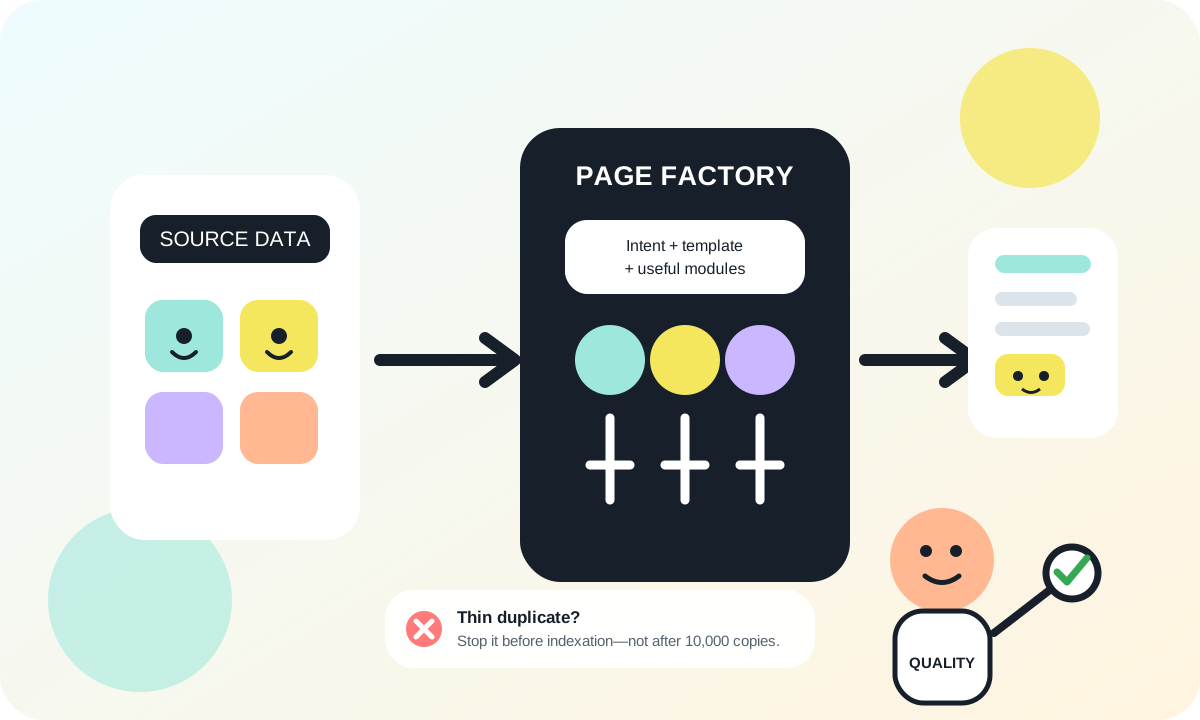
The safest mental model is to let automation generate candidate pages. A separate publication policy decides whether each candidate becomes indexable. That policy can be deterministic where the data allows it: required source fields, entity status, minimum unique modules, valid canonical, parent link, freshness date and no unresolved QA blocker. Human review then samples the system at the template and edge-case level instead of pretending every URL can receive bespoke editorial production.
This separates scale from indexation. Your database can contain 100,000 entities while only the subset that meets the page-family contract is exposed to search engines. The interactive gate above uses transparent editorial thresholds to make that conversation concrete; its score is a planning tool, not a Google metric.
When programmatic pages are justified
Programmatic pages create value when a user benefits from landing directly on a specific answer that would be awkward or expensive to maintain manually. Examples include an integration page that documents a specific authentication method and supported data flow, a marketplace category that exposes real inventory and attributes, a location page that reflects actual local availability, or a comparison page whose source data changes the decision.
The strongest opportunities usually have four characteristics. First, the user intent repeats predictably. Second, the underlying data is authoritative and maintainable. Third, the page can expose useful variation beyond a token substitution. Fourth, the site has a browse or internal-link structure that makes the pages part of a coherent product rather than isolated search entrances.
Good scale is a product capability, not a content quota
A travel marketplace might have a legitimate page for each destination because inventory, seasonality, neighborhoods, transport and nearby options differ. A software company might have integration pages because setup steps, permissions and supported objects differ. In both cases, the programmatic page is useful even if the user never arrived from Google. That is a practical test: if the page has no reason to exist inside the product or site architecture, search demand alone is a weak justification.
A warning sign is a brief that starts with “we found 30,000 keywords” but cannot name the source-of-truth system, page-specific decision, content owner or browse path. Keyword volume can help prioritize a valid page family; it should not invent the product value of the family.
URL and taxonomy design
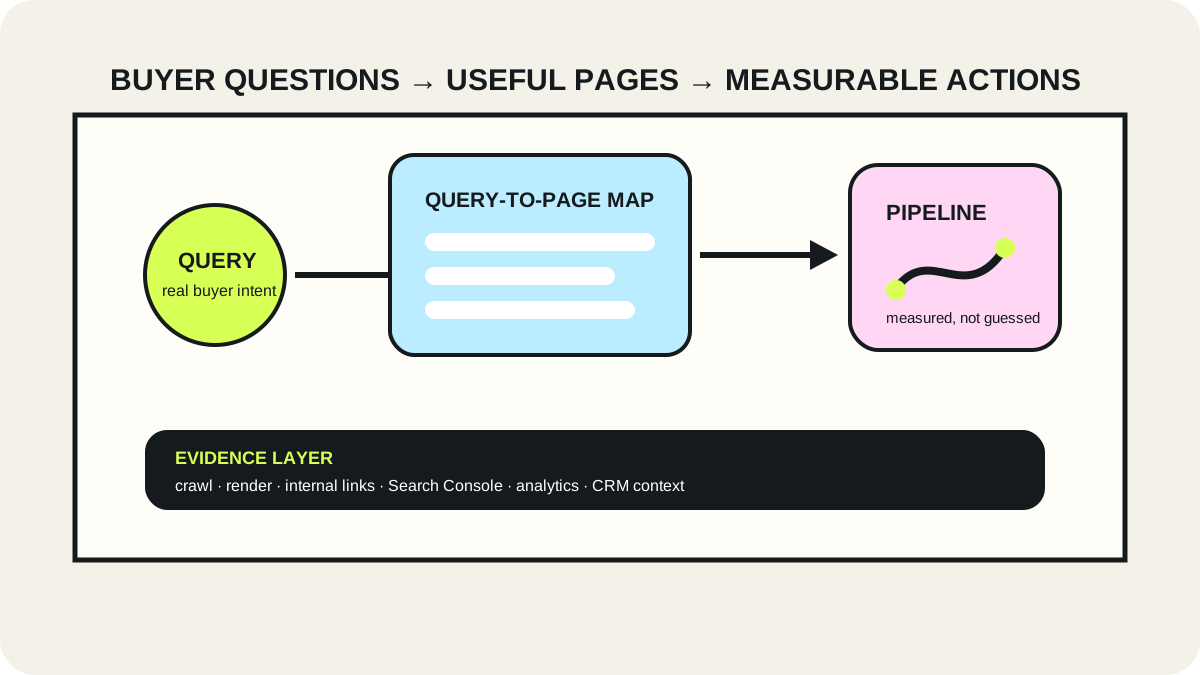
Build a query-to-page map before building templates. Write the search task in plain language and define the entity or dimension that changes the answer. Then specify which page family owns it. A useful map prevents several generated families from competing for the same intent and exposes situations where a single strong hub is more appropriate than thousands of leaves.
For example, “Does Product A integrate with Product B?” can map to one integration-detail template. “Best accounting integrations” belongs to an integrations category or editorial comparison—not every individual integration page. “Web designer in Austin” might justify a location page only when the business actually serves Austin and can show local availability or evidence. If every city page says the same thing and sends the visitor to the same generic contact page, the architecture starts to resemble the doorway pattern Google warns about.
Map intent before URL syntax
Do not begin by deciding that the URL will be /city/service/ or /integrations/vendor/. First decide whether the visitor's job is navigational, comparative, transactional, local, compatibility-driven or informational. Then choose a hierarchy that represents that information model and can be browsed normally. URL structure should follow the taxonomy instead of becoming the taxonomy.
Create one ownership rule for collisions: if two candidates answer substantially the same task, decide whether to merge data into one page, make one page a parent and the other a narrower child, or keep one non-indexable. This rule prevents cannibalization from becoming a cleanup project after thousands of pages exist.
Data model and source quality
Programmatic SEO quality is bounded by source-data quality. A template cannot create meaningful differentiation from a dataset that contains only a name, slug and generic description. Define the fields that make the page useful, where each field comes from, who owns it, how often it changes and what happens when it is missing.
For an integration directory, useful fields might include support status, authentication method, objects/actions, sync direction, setup prerequisites, limitations, documentation links and last verification date. For a location/service family, they might include actual service coverage, appointment or delivery constraints, local team or proof, relevant regulations where appropriate, and nearby alternatives. The exact fields differ by business; the discipline is to make them explicit.
Separate authoritative data from editorial enrichment
Store the factual layer separately from generated prose. If a product integration stops being supported, the status should change in one source of truth and propagate to the page, sitemap and internal-link behavior. Editorial modules can explain the implications, but they should not be the only place where a critical fact lives.
Add validation at ingestion. Reject malformed identifiers, impossible combinations, missing required ownership and stale records before they reach the rendering layer. For externally sourced data, retain provenance and a retrieval/update timestamp. If a field cannot be verified, omit it or label uncertainty rather than filling the gap with synthetic confidence.
Edge case: user-generated or partner-supplied records
Directories often receive records from customers, partners or sellers. Treat those inputs as untrusted until validated. Require minimum structured fields, normalize taxonomy, detect duplicates and define a moderation path. Indexability should depend on the same quality contract regardless of who created the record. Otherwise the weakest ingestion path can create the largest thin-content surface.
Template design and unique value
A scalable template needs more than variable nouns. List every module and classify it as invariant, data-variable, conditionally rendered or editorial. Then ask which modules create decision value. A title and breadcrumb may be invariant structure. Compatibility details, inventory, local proof, comparison attributes, setup steps, pricing where legitimately available, FAQs and related entities can vary from the data.
Aim for compositional variation, not random wording. If an integration supports OAuth and webhooks, show the relevant setup and event modules. If it supports neither, do not generate paraphrased filler to make the page look longer. A shorter page with precise information is better than a large page padded with interchangeable prose.
Conditional modules should fail closed
A module should not render merely because a field exists. Define eligibility. A “customer proof” block needs an approved case reference, not any company name in the database. A “nearby locations” block should use real serviceable locations, not arbitrary geographic neighbors. A comparison table should require comparable source fields and clear definitions.
Template QA should include the empty state, the richest state and contradictory data. The richest record often hides layout problems; the sparse record reveals whether the template still deserves indexation.
Indexation controls
Indexation should be an explicit state machine. A candidate can be draft, blocked, published-noindex, published-indexable, retired or redirected. Each transition needs criteria. This is more reliable than assuming every generated route belongs in the sitemap and adding cleanup rules later.
A practical indexable contract might require: active entity; distinct intent; required source fields present; at least one or more page-specific value modules; valid self-canonical; stable 200 response; contextual internal link from an approved parent; useful title/H1 generated from verified attributes; no critical QA failure; and a current owner/freshness signal. Those are example controls, not universal Google thresholds.
Google's sitemap documentation recommends including the canonical URLs you want to appear in Search rather than every reachable variant. Sitemap submission is also a hint, not a guarantee of crawling or indexing. Align sitemap membership with your publication state so the sitemap becomes a clean expression of intended inventory.
Canonicals consolidate duplicates; they do not justify bad inventory
Google explains that duplicate or very similar pages can be clustered and one representative canonical selected. Use consistent canonical signals when multiple valid URLs represent the same content, but do not generate a large weak inventory and expect rel=canonical to transform it into a useful program. If a URL has no distinct job, the better fix is usually to avoid creating or indexing it.
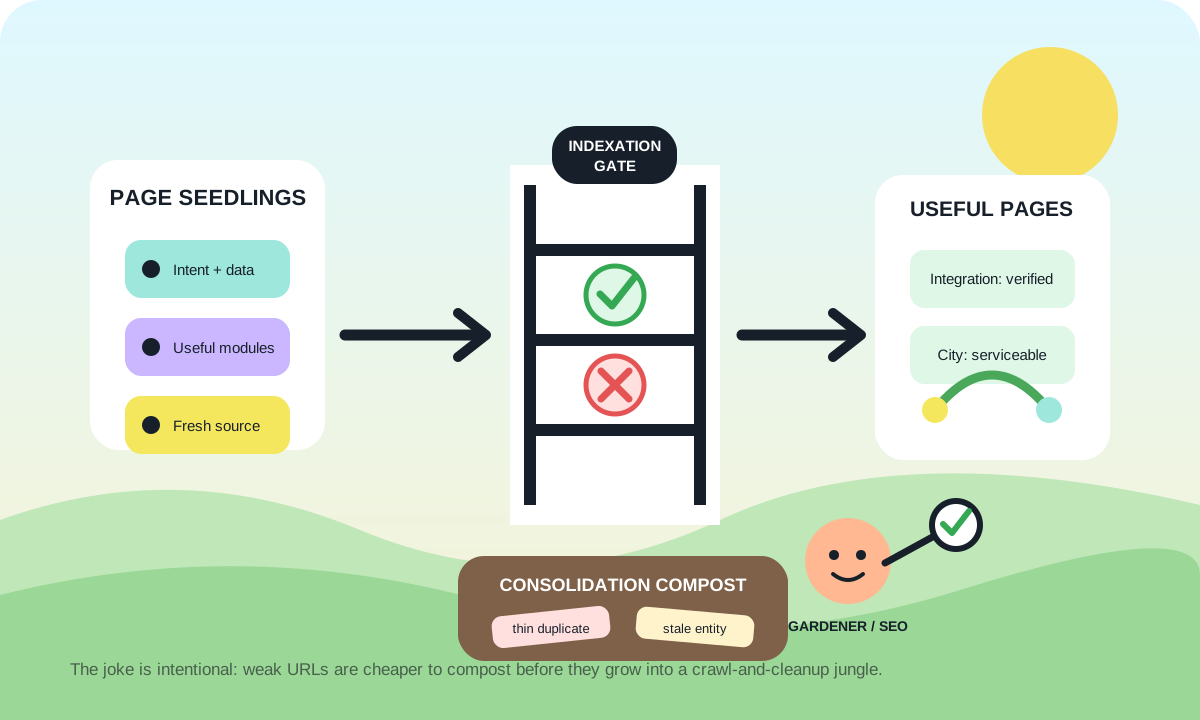
Internal-link architecture
Programmatic pages should belong to the site's information architecture. Build parent hubs, category pages, entity relations, breadcrumbs and contextual sibling links so users can discover the same page families without search engines. A page that exists only because it appears in an XML sitemap is technically discoverable but often reveals a weak product architecture.
Link rules should be deterministic enough to test. A location page can link to its region parent, nearby serviceable locations and relevant service details. An integration page can link to the integrations hub, supported product workflow and related integrations. A marketplace category can link to parent and child categories plus valid entities. Avoid indiscriminate “related pages” grids that connect thousands of URLs without semantic value.
Measure discovery as a graph problem
Track orphaned candidates, click depth for priority pages, parent coverage, broken/redirected internal links and the number of indexable pages with no contextual inbound links. At large scale, these metrics are often more actionable than manually browsing a handful of URLs. They also help distinguish an indexation problem from a discovery problem.
Crawl-budget and duplicate-content risks
For very large or frequently changing sites, Google's crawl-budget guidance recommends controlling duplicate and low-value URL spaces, keeping sitemaps focused on canonical URLs, and avoiding server or soft-error patterns that waste crawling. Most small sites do not need a special crawl-budget project, but a programmatic system can create large URL inventories quickly; that is why URL-state controls, parameter rules, stable response behavior and clean canonical sitemap membership should be designed before expansion.
Google's doorway-abuse examples include pages targeted at similar queries that funnel users to a final destination and substantially similar pages positioned closer to search results than a clear browseable hierarchy. The programmatic design question is therefore simple: does this URL complete a meaningful user task, or merely capture a query before sending the user somewhere else?
Scaled content abuse likewise focuses on large volumes of unoriginal content created primarily to manipulate rankings. The creation method can be automation, AI or something else; the issue is lack of user value. Do not use generated prose as a uniqueness layer over identical facts. Search engines and users can both see through pages whose only material difference is a substituted place or product name.
Doorway test for local pages
Before creating hundreds of city pages, ask whether the service, availability, proof, process or decision genuinely differs. If the answer is no, a regional hub or service page may be more useful. If the answer is yes, encode those local differences as required data fields and block pages that cannot satisfy them.
Duplicate-intent test for comparisons
Pairwise comparison systems can explode combinatorially. Do not publish every possible pair merely because the database can. Require two valid entities, meaningful comparable attributes, a real audience question and enough differentiated evidence to support the comparison. Otherwise keep the pair out of the indexable inventory.
QA and monitoring at scale
The QA method must evolve as inventory grows. At roughly ten pages, review every page manually across mobile/desktop, structured data, links, rendering and source accuracy. At one hundred pages, still manually sample representative and edge-case records, but add automated assertions across the full family. At ten thousand pages, the system needs continuous controls: source validation, template tests, crawl sampling, sitemap reconciliation, indexation monitoring, stale-record detection and alerting.
These numbers are operational examples for how to change QA technique, not Google thresholds. The key principle is that manual review shifts from every URL to every rule plus representative records while automated coverage expands.
Build a synthetic QA matrix
Create fixtures for the sparsest valid record, richest valid record, missing optional fields, missing required fields, special characters, long names, empty related entities, unsupported combinations, retired entities and localization if applicable. Run them through rendering and assert the expected publication state. This catches template regressions before production data finds them.
Add production checks for status code, canonical, robots/indexability, H1/title presence, internal-link count, structured-data validity where used, image failures and accidental placeholder text. A failed check should identify the template/data rule, not create ten thousand separate tickets.
Quality thresholds for publishing
Measure the system in layers. Eligibility asks whether URLs are technically indexable and discoverable. Coverage asks which intended URLs are crawled and indexed. Usefulness asks whether users arriving on the family engage with the page-specific value and complete the next task. Operations asks how many records are stale, broken or require manual correction.
Do not set pruning rules around a single traffic cutoff. A low-volume page can still be useful for a rare high-value task; a high-impression page can still be poor if it answers the wrong intent. Combine evidence: stale source record, persistent duplicate/canonical clustering, no distinct content, no browse path, no valid entity, repeated soft-404 behavior, or consistently poor outcomes relative to the intended job.
Re-measure after changes without overclaiming causality
After changing template logic or indexation rules, verify deployment immediately, then allow enough time for crawling and reprocessing before drawing search conclusions. Google notes that crawling and re-evaluation can take time and does not guarantee when a URL will be indexed. Use Search Console, server logs and crawl samples to observe state changes. For business outcomes, choose an observation window consistent with your normal traffic volume and sales cycle rather than declaring a universal number of days.
Keep a change log with deployment date, affected page family, expected technical effect and validation query. This turns a future indexation change into a diagnosable event instead of a vague “programmatic SEO stopped working” incident.
Examples of good page families
Strong page-family examples include city/service pages backed by real local availability and proof, maintained integration directories with setup-specific compatibility fields, marketplace categories built from live inventory and intentional taxonomy, and comparison databases whose verified attributes and methodology materially change by entity. The page-family decision table above makes the source-data, module, linking, indexation and quality contract explicit for each pattern.
Before launch, confirm the query-to-page map, source owners, required fields, publication-state rules, URL/canonical policy, sitemap inclusion, internal-link graph, template fixtures, analytics events, accessibility, structured data where appropriate, monitoring and retirement behavior. Then launch a controlled sample and validate it in the real rendering environment.
Governance matters because programmatic systems keep publishing after the launch meeting. Name owners for taxonomy, data quality, template code, editorial rules, SEO policy and incident response. Any team changing a source schema should know which page families depend on it. Any team changing a template should have a regression suite. Any team adding a new page dimension should document how it affects URL count and intent ownership.
Implementation backlog: convert findings into shippable tasks
Use the action table above as the issue format: issue/opportunity → evidence → affected pages → impact → confidence → effort → priority → owner → fix → validation. Keep impact, confidence and effort as your own planning inputs rather than pretending they are universal SEO scores. The mini tool visualizes that same principle.
A good ticket is root-cause oriented. “Fix 4,200 thin pages” is not actionable. “Integration template renders an empty setup module when auth_method is null; block indexation until required support fields exist; validate with sparse fixture plus production crawl sample” is actionable and can close thousands of symptoms with one fix.
A safe rollout sequence
- Prove the intent and source data with a manually reviewed sample.
- Build template/data assertions and the indexation state machine.
- Expose the sample through real internal links and the canonical sitemap inventory.
- Verify rendering, analytics, canonical/indexation signals and user usefulness.
- Expand in cohorts so regressions have a bounded blast radius.
- Review coverage, stale data and duplicate patterns before each expansion.
- Keep a reversible noindex/consolidation path for weak records.
Programmatic SEO works when the scale is earned by repeatable value. If the data and product value justify the scale, the template can become a durable acquisition surface. If they do not, generating more URLs only multiplies a quality problem. WebDesignK can help design the data contract, templates, internal-link system, indexation gates and measurement loop so the pages deserve to be indexed before the inventory becomes expensive to unwind.
Tooling and automation workflow
Treat the workflow as a controlled publishing pipeline: validate source records, create page candidates, render templates in a preview environment, run automated technical checks, sample edge cases editorially, then apply the index/noindex decision. Automation should make the policy repeatable; it should not bypass the policy. Keep data validation, rendering checks, link discovery, canonical/schema validation and indexation eligibility as separate observable steps so failures are diagnosable.
A practical implementation can queue changed entities, render only affected candidates, compare required fields and content modules against the page-family contract, crawl the preview output, and publish only records with no blocking errors. Store the decision and reason for each URL so teams can audit why a page was indexed, held, consolidated or retired.
Common failure modes and how to fix them
The most common failure is scaling the URL count before proving that the page family produces distinct value. Fix that by shrinking the pilot, strengthening the source data and making template modules conditional on real page-specific evidence. A second failure is orphaned inventory: generated pages exist but no useful browse path links to them. Fix that with parent hubs and contextual relationships instead of relying on XML sitemaps alone.
Other recurring problems include stale source records, conflicting canonicals, accidental indexation of empty states, near-duplicate location pages and QA rules that check only HTTP status. Address these with explicit freshness ownership, deterministic canonical rules, fail-closed indexation controls, intent-level consolidation and rendered-content checks.
Editorial QA and refresh cadence
Set review frequency from how quickly the underlying data and user decision can change. High-churn inventory or availability may need automated freshness checks every publishing cycle; stable reference attributes can use a longer cadence. Separately schedule template-level editorial sampling so a technically valid page family does not slowly become repetitive, misleading or visually broken.
Refresh triggers should include source-field changes, template releases, search-intent drift, material drops in valid indexation, broken internal-link coverage and repeated quality-gate failures. Record the trigger and the remediation rather than changing pages simply to make them look recently updated.
When to keep pages manual or high-touch
Keep a page manual when the decision depends on expert judgment, original research, sensitive claims, complex comparison logic or a narrative that cannot be represented faithfully by structured data. High-value category hubs, strategic comparisons and pages that shape brand trust often deserve bespoke editorial ownership even when supporting detail pages are generated.
A hybrid model is usually stronger than an all-or-nothing choice: automate repeatable entity facts and QA, while editors own the page families where interpretation, positioning and evidence quality matter most.
Next step: turn the page-family contract into a production system
If you need help designing the data contract, template rules, internal-link architecture, indexation gates and measurement plan, see WebDesignK SEO performance and content services. Bring the quality-gate result from this article into the discovery conversation so the first discussion starts with your actual constraints.
FAQ
Is programmatic SEO against Google guidelines?
No. Programmatic publishing is a production method. Google's policies focus on abusive outcomes such as doorway pages and scaled unoriginal content made primarily to manipulate rankings. The page family still needs useful, differentiated value.
How many pages should we launch first?
There is no universal number. Launch a sample that covers normal records and edge cases while still being manually reviewable. Expand only when your automated rules and observed production behavior support expansion.
Should every generated URL be indexable?
No. Treat indexation as a state decided by data completeness, intent, usefulness, technical validity, discovery and governance. Draft, stale, duplicate or weak candidates can remain noindexed, consolidated or unpublished.
Does adding more unique text solve thin pages?
Not by itself. Unique wording is not the same as unique value. The page should change the answer through verified data, useful modules, workflow context, inventory, comparison evidence, local proof or another meaningful dimension.
How often should quality gates run?
Run deterministic data/template checks whenever source records or templates change, and schedule recurring audits for freshness, orphaning, indexation drift and page-family outcomes. The cadence should reflect how quickly your data changes and the operational risk of stale pages.
What is the first thing to fix if thousands of pages are already live?
Start with inventory and intent ownership. Group URLs by template and publication state, identify source-data gaps and duplicate patterns, then fix root causes in the data contract or template rules. Avoid treating every weak URL as a separate content rewrite project.
Frequently asked questions
Is programmatic SEO against Google guidelines?
No. Programmatic publishing is a production method, not a policy violation by itself. The risk is what the pages do. Google's spam policies prohibit doorway abuse and scaled content created primarily to manipulate rankings without helping users. A legitimate programmatic system still needs useful, differentiated pages and normal technical SEO.
How many programmatic pages should we launch first?
There is no universal safe number. Start with a sample large enough to exercise every template and data edge case while still being manually reviewable. Expand only after you can verify rendering, source quality, internal-link discovery, canonical behavior, indexation patterns and useful user outcomes.
Should every generated page be in the XML sitemap?
No. Include canonical URLs you actually want search engines to discover and consider for Search. Keep draft, blocked, duplicate, retired and intentionally non-indexable variants out of the indexable sitemap inventory.
Can canonical tags solve thin or duplicate programmatic pages?
Canonical signals can help consolidate duplicate or very similar URLs, but they do not turn weak pages into useful pages. If many URLs have no distinct user value, fix the page-family design or reduce the indexable inventory instead of using canonicals as a substitute for differentiation.
What should we measure after launching a programmatic page family?
Measure technical eligibility first: status codes, rendering, canonicals, sitemap membership, crawl discovery and indexation samples. Then measure page-family usefulness through qualified organic landings, engagement with page-specific modules, conversions appropriate to the intent, stale-record rate and the volume of URLs that need consolidation or pruning.
When should a programmatic page be pruned?
Consider consolidation, noindex or removal when the underlying entity is invalid, the page cannot sustain a distinct intent, source data is stale, the template produces near-duplicate value, or the URL remains operationally unmaintainable. Choose the response based on whether a useful replacement exists and whether the old URL has value that should be redirected.