Quick answer
The core tradeoff is launch speed versus discovery quality. A fast visual refresh is not a win if it preserves the wrong message or breaks search, CRM and measurement paths.
Last reviewed: September 16, 2026B2B redesign next-step planner
Rate each constraint 1–5. Outputs are planning guidance from your inputs, not benchmarked conversion predictions.
1. Implementation roadmap
Takeaway: Growth plans concentrate effort where your inputs show the most operating pressure.
2. Constraint pressure profile
3. Phase share donut
Text fallback: Discovery 22%, Message & IA 23%, UX/build 23%, Measurement 17%, Launch 15%.
Assumption note: phase weights are transparent WebDesignK planning coefficients driven only by your inputs.
Tables built for the buying decision
Primary decision table
| Decision | Option | Benefit | Tradeoff | Effort | Best fit |
|---|---|---|---|---|---|
| Information architecture | Intent-led journeys | Maps pages to buyer questions | Requires discovery and content decisions | Medium | Growth/complex offers |
| CMS model | Structured content | Faster governed publishing | More modeling up front | Medium | Teams publishing often |
| Migration | Preserve URLs where useful | Reduces avoidable search disruption | Limits cosmetic URL cleanup | Low/Medium | Sites with organic demand |
| Conversion path | Progressive CTAs | Matches commitment to intent | Needs CRM/event design | Medium | Long B2B buying cycles |
| Proof | Evidence near claims | Reduces buyer uncertainty | Requires source/approval discipline | Medium | High-consideration services |
Implementation evidence checklist
| Owner | Evidence | Status |
|---|---|---|
| Strategy | Buyer jobs + offer hierarchy approved | Required |
| SEO | URL inventory + redirect/canonical plan | Required |
| Engineering | Performance/accessibility release checks | Required |
| Data | Event map + CRM routing test | Required |
| Marketing | Page-level proof and CTA ownership | Required |
Sources and assumption boundaries
Fast-changing platform, pricing and AI-search claims were reviewed on September 16, 2026. Interactive scores and scenarios are clearly labeled planning models, not sourced market benchmarks.
- Google Search Central — Site moves and migrations Official guidance on URL mapping and redirects; reviewed September 16, 2026.
- web.dev — Core Web Vitals Official performance measurement guidance; reviewed September 16, 2026.
- W3C — WCAG 2.2 Accessibility standard reference; reviewed September 16, 2026.
Turn this planning result into a scoped review.
Send the assumptions, constraints and result summary. WebDesignK can review the architecture/content/implementation boundary, identify missing discovery inputs and return a prioritized next-step scope.
- Bring: current site/product, constraints, integrations and your tool result.
- You get: a scoped recommendation, open questions and implementation priorities.
Decision snapshot for B2B website redesign
A B2B redesign should be prioritized when the current site is actively making good-fit buyers work too hard to understand the offer, trust the company, find proof, or take the next commercial step. The project is not primarily a visual refresh. It is a redesign of the buyer journey, information architecture, proof system, measurement model and publishing workflow. The central tradeoff is launch speed versus discovery quality: shipping faster is useful only if the team has protected the pages, messages, integrations and measurement paths that already create demand.
What you will decide: whether the problem is positioning, content debt, UX, technical execution, measurement, or a combination; what discovery inputs are required; which phase should lead the program; and what evidence proves the new site is producing more qualified opportunities rather than simply looking newer.
Executive quick answer
The strongest B2B redesigns begin with commercial evidence. Interview sales and customer-facing teams, review qualified and disqualified opportunities, inspect search and landing-page behavior, inventory the current content and map the questions buyers ask before they are willing to speak with sales. Design comes after that evidence is converted into a page system.

A useful redesign brief should state the target account profile, primary buyer jobs, offer hierarchy, proof available for each claim, critical organic landing pages, CRM/form routing, analytics events and operational ownership after launch. Without these inputs, teams tend to optimize surface polish while leaving the actual buying friction untouched.
The decision trigger
Prioritize the redesign when at least one of these conditions is expensive enough to affect pipeline: sales repeatedly explains what the homepage should have explained; traffic reaches important pages but qualified visitors struggle to find the next step; new offers do not fit the old information architecture; the CMS makes publishing slow or risky; important pages are technically fragile; or the marketing team cannot trust conversion attribution.
When the problem becomes expensive
A weak B2B website creates cost in several places at once. Paid campaigns send expensive traffic to pages that do not resolve buyer uncertainty. Sales spends more time re-educating prospects. Content teams create isolated assets that are difficult to discover. SEO authority is distributed across competing or outdated URLs. Product changes require developer intervention for routine publishing. Measurement gaps make it impossible to separate a messaging problem from a traffic-quality problem.
The expensive failure is not necessarily low traffic. A site can attract substantial traffic and still be commercially weak if it attracts the wrong intent, hides proof, uses generic messaging, or routes every visitor into the same high-commitment contact form.
Three failure modes to detect early
Visual-first redesign. The team approves a visual system before agreeing on buyer questions, claims, proof and page jobs. Detect it when design reviews discuss components but nobody can say which objections a page must remove.
Migration without a URL/content inventory. Existing pages are deleted or renamed without mapping inbound links, organic demand or user journeys. Detect it when the new sitemap exists but no old-to-new decision log exists.
Measurement added after launch. Forms work but event definitions, attribution fields and CRM routing were not tested in production. Detect it when the launch checklist contains “install analytics” rather than verified events with expected payloads.
Decision criteria and constraints
Evaluate each major redesign decision against six constraints: buyer clarity, proof density, publishing ownership, technical performance, search continuity and measurement. A choice that is attractive in one dimension can create operating debt in another. For example, a highly custom animated module may strengthen storytelling but create publishing friction; a very flexible CMS can accelerate publishing but require governance to avoid inconsistent page structures.
Before implementation, gather the current sitemap/crawl, analytics and Search Console access, CRM funnel definitions, form routing logic, top landing pages, sales call themes, product/service positioning, existing case studies, brand assets, legal/privacy requirements and a list of third-party integrations. Treat missing inputs as discovery tasks rather than assumptions.
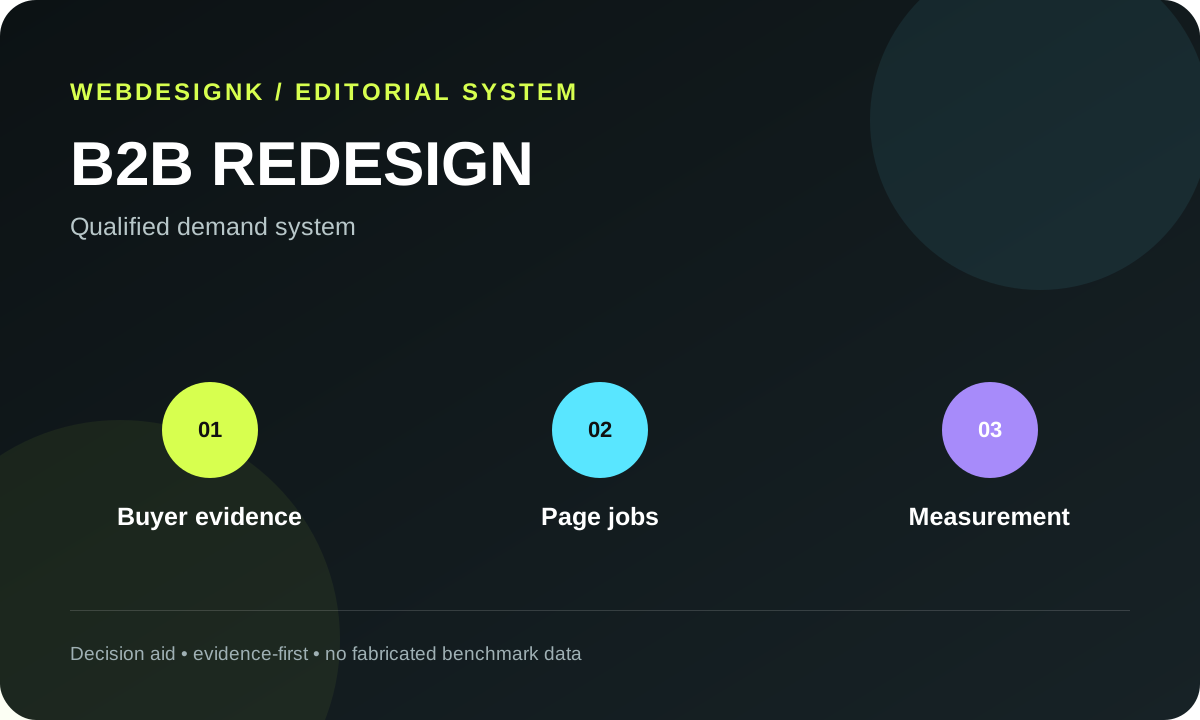
Define page jobs before page layouts
Every important page should have a job: explain a category, qualify a need, prove a capability, answer an implementation concern, compare approaches, or move a buyer into the next step. The page job determines the evidence hierarchy and CTA—not the other way around.
What a useful discovery sprint should produce
A discovery sprint should end with decisions, not a stack of interview notes. Produce a buyer-problem map, offer hierarchy, current-to-future sitemap, page-job matrix, content/proof gap list, integration inventory, URL migration risks and a measurement contract. Each artifact should name its owner and unresolved questions. This reduces uncertainty before expensive design and engineering choices become difficult to reverse.
When stakeholder opinions conflict, return to observable evidence. Sales may believe one objection dominates while search behavior or customer interviews show another. Do not force false consensus; record the disagreement and design a way to validate it through page behavior, campaign tests or future sales feedback.
Edge case: multiple products or business units
A multi-product B2B company often needs a shared trust layer plus distinct intent paths. Resist duplicating the entire site for every business unit if buyers share proof, resources or company context. Conversely, do not flatten genuinely different buying motions into one generic solutions page. Model the common layer and specialized journeys separately, then decide where navigation and cross-links should bridge them.
Content governance after launch
Define which teams can create page types, edit reusable proof, change navigation, alter forms or publish SEO landing pages. Give editors flexibility inside guardrails instead of unrestricted layout control. A component that can express every possible arrangement often produces inconsistency; a smaller system with clear page patterns can be faster for authors and visitors.
Document the release path for routine content versus structural changes. If every headline edit needs a deploy, marketing will route around the system. If every editor can change technical metadata and templates without review, quality drifts. The operating model matters as much as the framework.
How to interpret the first 30 days
Do not overreact to daily organic or conversion volatility immediately after launch. Confirm instrumentation first, then compare landing-page groups and high-value journeys against an appropriate historical baseline. Investigate large changes by URL and intent before attributing them to visual design. A form conversion drop can be broken routing, consent behavior or traffic mix; an organic decline can be concentrated in migrated URLs rather than the whole redesign.
Create a weekly launch review with engineering, SEO, marketing and sales. Close technical defects quickly, but treat major copy or architecture changes as hypotheses unless evidence is clear. This prevents the team from rewriting the site during the noisy stabilization window.
Recommended approach step by step
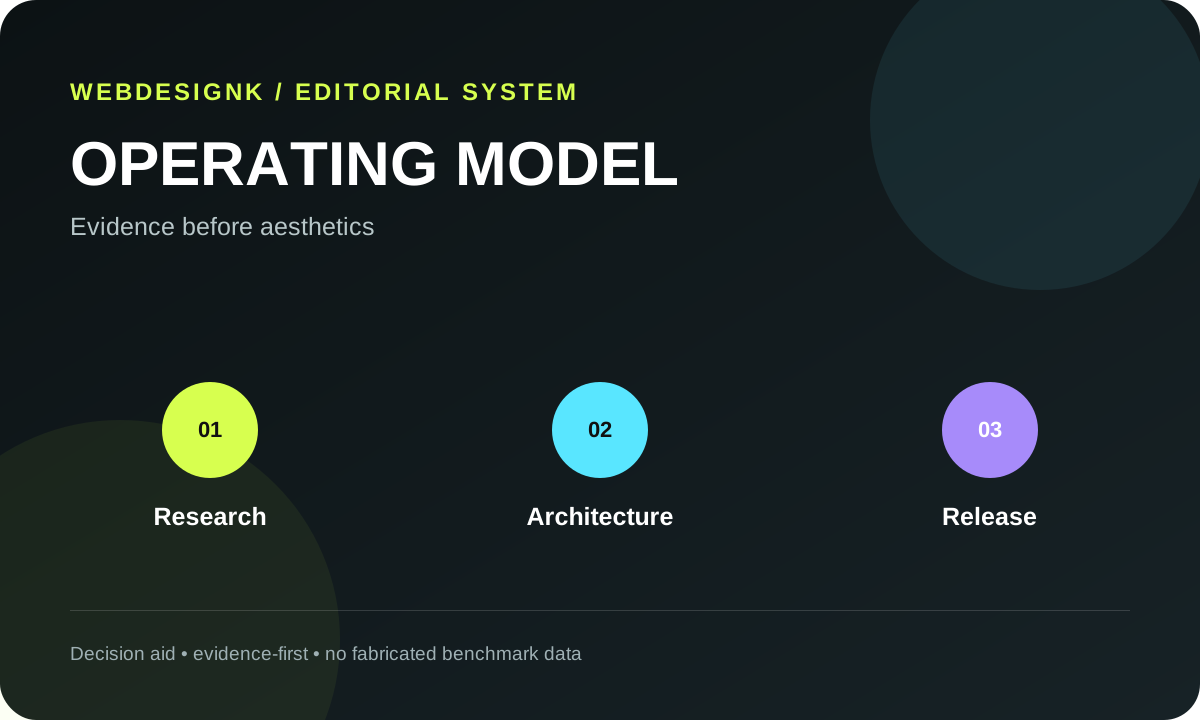
Start with evidence and inventory. Preserve what is already earning qualified attention. Next, rewrite the offer hierarchy and information architecture around buyer intent. Prototype key page narratives before designing the entire component system. Build a reusable content model and a small set of robust components. Instrument the critical journeys. Test the migration and launch on production-like infrastructure. After release, review demand quality and behavior weekly before making large structural changes.
A practical release gate should include content approval, redirects, canonical tags, form routing, analytics events, CRM field mapping, consent behavior, accessibility smoke tests, performance checks, structured data where appropriate and a rollback plan.
Scenarios by company stage
Lean B2B team. Concentrate on one offer hierarchy, a small set of high-intent pages, proof and a simple conversion path. Avoid building a complex design system that the team cannot maintain.
Growth company. Add segment or use-case paths, stronger case evidence, comparison content, CRM qualification, content governance and a repeatable landing-page system.
Complex enterprise. Account for multiple business units, markets, languages, permissioned publishing, legal review, integration ownership, design-system governance and analytics consistency. The architecture needs explicit owners because a technically flexible site can still become operationally chaotic.
Technical and operational considerations
The site should make publishing fast without allowing accidental technical damage. Define which fields editors may control, which metadata is generated, how canonical URLs are formed, what redirects are created when slugs change, who owns schema and how components are versioned. For B2B sites with important organic demand, preserve URL intent unless there is a strong reason to change it.
Use performance budgets rather than vague “fast site” goals. Identify the likely LCP element, keep third-party scripts accountable, optimize image delivery and test real interactions that can influence INP. Accessibility belongs in component acceptance criteria so fixes do not become a separate end-of-project phase.
Common mistakes and warning signs
Warning signs include a redesign KPI that is only “launch on time,” a sitemap based on internal departments rather than buyer intent, no source-of-truth redirect map, every CTA leading to the same contact form, case studies with no specific context or evidence, a CMS that requires engineering for routine edits, analytics events named after button labels instead of business actions, and a backlog dominated by cosmetic feedback while unresolved journey risks remain.
How to evaluate implementation options
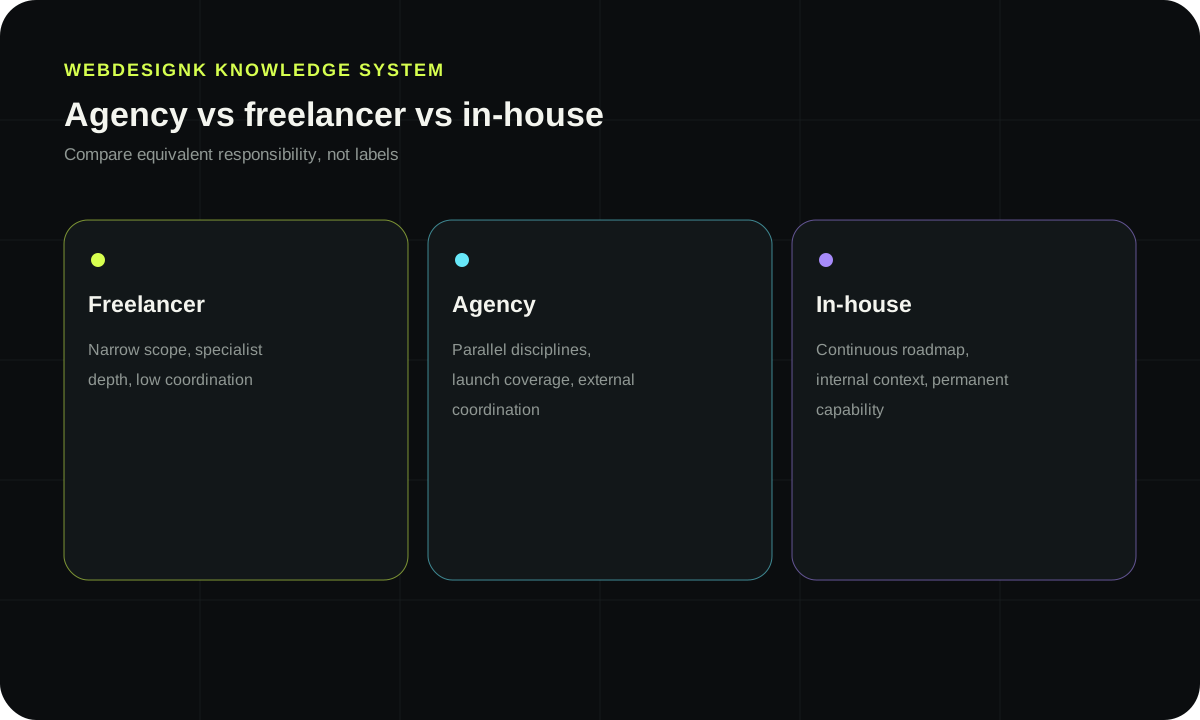
Compare implementation proposals on equivalent scope. Ask who owns discovery, content modeling, UX, engineering, migration, analytics, QA and launch. Clarify which integrations are included, what browser/device coverage exists, how change requests are priced or scheduled, and what post-launch support means. A cheaper proposal can be more expensive if the buyer must separately coordinate content, migration and measurement.
The decision table above is deliberately not a universal vendor ranking. Use it to make tradeoffs visible and then require evidence from each implementation option.
Timeline and measurement plan
Separate leading indicators from outcomes. Leading indicators include completion of page jobs, proof coverage, successful form routing, crawl/indexation health, event coverage, page performance and content-production speed. Outcomes include qualified conversion rate, opportunity creation, contribution of organic and campaign landing pages, progression into sales-accepted stages, and the quality of conversations initiated from the website.

Review technical and measurement health daily during the first launch window, then weekly while traffic and sales patterns stabilize. Review content/search opportunities monthly and larger architecture assumptions quarterly. Do not judge a redesign from one aggregate conversion percentage; segment by intent, landing page, CTA type and qualification stage.
FAQ and next-step checklist
A sensible next step is to build a short evidence pack before commissioning layouts: current URLs and top entry pages; target account and buyer definitions; offer hierarchy; ten recurring sales questions; five proof assets; CRM/form routing; analytics events; platform constraints; known SEO risks; and a named decision owner. Feed those inputs into the planner above, copy the result and use it as the first discovery artifact rather than beginning with a mood board.
Frequently asked questions
How do I know whether a B2B site needs a redesign?
Prioritize it when buyer clarity, publishing limitations, technical fragility or measurement gaps are materially affecting pipeline or execution—not simply because the visual style feels old.
Should every URL change in a redesign?
No. Preserve useful URLs when possible. When URLs must change, create explicit old-to-new mappings and validate permanent redirects and canonical signals.
What should be measured after launch?
Track technical health and event integrity first, then qualified conversion, opportunity creation, landing-page contribution, CTA progression and publishing speed by segment.
Should design start before content strategy?
Visual exploration can happen early, but key page jobs, claims, proof and information architecture should be defined before the team commits to final page layouts.