Quick answer
The core tradeoff is editorial convenience and ecosystem familiarity versus custom application control and engineering ownership. SEO quality depends primarily on implementation, content and technical discipline rather than the platform label.
Last reviewed: September 16, 2026Next.js vs WordPress scope estimator
Planning tier from your scope inputs; not a price quote.
1. Lean / Growth / Complex effort mix
2. Current workstream composition
3. Complexity contribution line
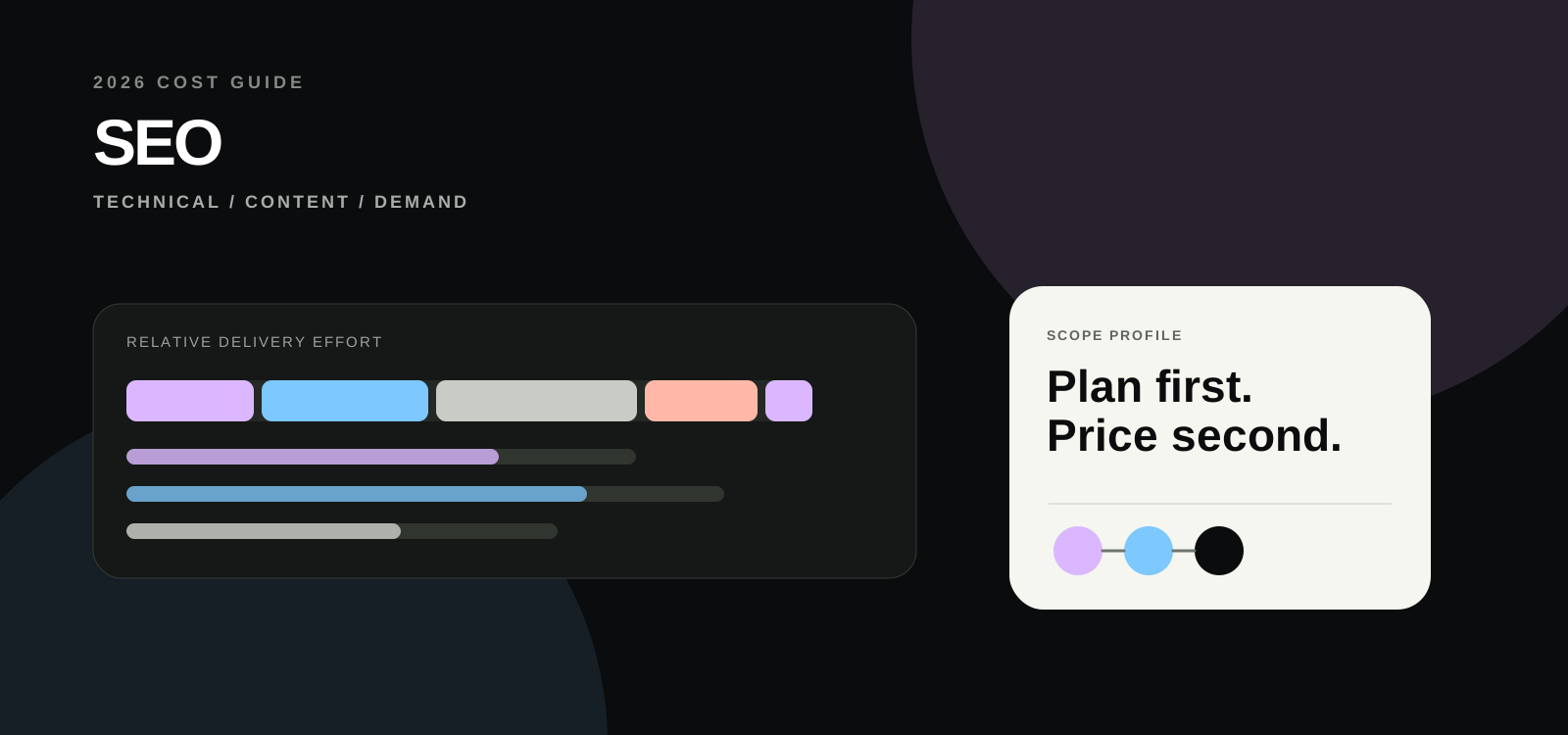
Workstream shares are explicitly illustrative WebDesignK planning coefficients derived from your scope inputs, not market-cost benchmarks.
Tables built for the buying decision
Primary decision table
| Scope tier | Deliverables | Team | Timeline | Major cost drivers | Best fit |
|---|---|---|---|---|---|
| Lean | Core templates, CMS, forms, analytics | Strategy/design/dev/content | Shorter | Template/content readiness | Focused marketing site |
| Growth | Design system, structured CMS, CRM, migration | Cross-functional team | Medium | Integrations + migration | Demand-generation site |
| Complex | Markets, apps, advanced integration/governance | Larger specialist team | Longer | Data, permissions, QA, migration | Enterprise/application-like site |
Recurring-cost and ownership controls
| Item | Why it exists | Cadence | Control lever |
|---|---|---|---|
| Hosting/CDN | Serve production site | Monthly/usage | Architecture + traffic |
| Updates/dependencies | Security/compatibility | Continuous/release | Governance + automation |
| CMS/plugins/services | Publishing/features | Monthly/annual | Vendor choices |
| Monitoring/backups | Recovery and incidents | Continuous | SLO + retention |
| Content/SEO optimization | Demand improvement | Ongoing | Editorial roadmap |
Sources and assumption boundaries
Fast-changing platform, pricing and AI-search claims were reviewed on September 16, 2026. Interactive scores and scenarios are clearly labeled planning models, not sourced market benchmarks.
- Next.js — Documentation Official framework documentation; reviewed September 16, 2026.
- WordPress — REST API Handbook Official content/API architecture documentation; reviewed September 16, 2026.
- WordPress — Performance optimization Official performance guidance; reviewed September 16, 2026.
- Google Search Central — Canonicalization Platform-neutral SEO reference; reviewed September 16, 2026.
Turn this planning result into a scoped review.
Send the assumptions, constraints and result summary. WebDesignK can review the architecture/content/implementation boundary, identify missing discovery inputs and return a prioritized next-step scope.
- Bring: current site/product, constraints, integrations and your tool result.
- You get: a scoped recommendation, open questions and implementation priorities.
Decision snapshot for Next.js vs WordPress business websites
Next.js and WordPress solve different layers of the website problem. WordPress gives a mature content-management and plugin ecosystem with a PHP-rendered application model; Next.js is a React framework for building custom full-stack web applications and can work with many content sources. The practical choice is not “which is better for SEO?” Both can produce crawlable, high-performing business sites when implemented well. The important tradeoff is editorial convenience and ecosystem familiarity versus custom application control and engineering ownership.
What you will decide: the scope tier, content operating model, integration and migration complexity, which costs recur after launch, and what implementation team each option requires.
Direct answer and planning range framework
Choose WordPress when the business primarily needs a content-managed marketing site, values its editorial ecosystem and has a team or partner comfortable owning WordPress hosting, updates and plugin governance. Choose Next.js when the site behaves more like a custom application, needs deeply tailored frontend behavior or integration, or when your engineering organization already operates modern JavaScript applications and wants that control.

A third option is architectural combination: WordPress can expose content over its REST API while a separate frontend consumes it. That increases ownership and should be justified by a real need rather than by the label “headless.”
This guide does not publish a universal project-price range. Use the scope estimator to expose the workstreams first; then compare proposals on the same deliverables, ownership and recurring responsibilities.
Scope tiers: lean, growth and complex/enterprise
A lean business site has a small template system, straightforward content types, limited integrations, one language and modest migration. A growth site adds a stronger design system, structured content, CRM/marketing integrations, multiple landing-page patterns, richer measurement and a more meaningful content migration. A complex site may involve multiple markets, advanced permissions, custom applications, ecommerce, large-scale migration, high governance requirements or extensive system integration.
The platform does not remove this complexity. A WordPress build with many custom plugins and data flows can be complex; a Next.js site with a simple content model can be lean.
What drives cost more than page count alone
Template variety, content modeling, migration quality, integration behavior, workflow, localization, accessibility, performance and QA usually matter more than raw page count. A hundred pages that map cleanly into ten structured templates can be easier than twenty pages that each require unique interactions and bespoke data.
For WordPress, plugin selection and custom-theme/plugin boundaries shape maintenance. For Next.js, component architecture, data fetching, deployment and CMS integration shape engineering effort. In both cases, ambiguous content ownership creates expensive rework.
Team roles and delivery model
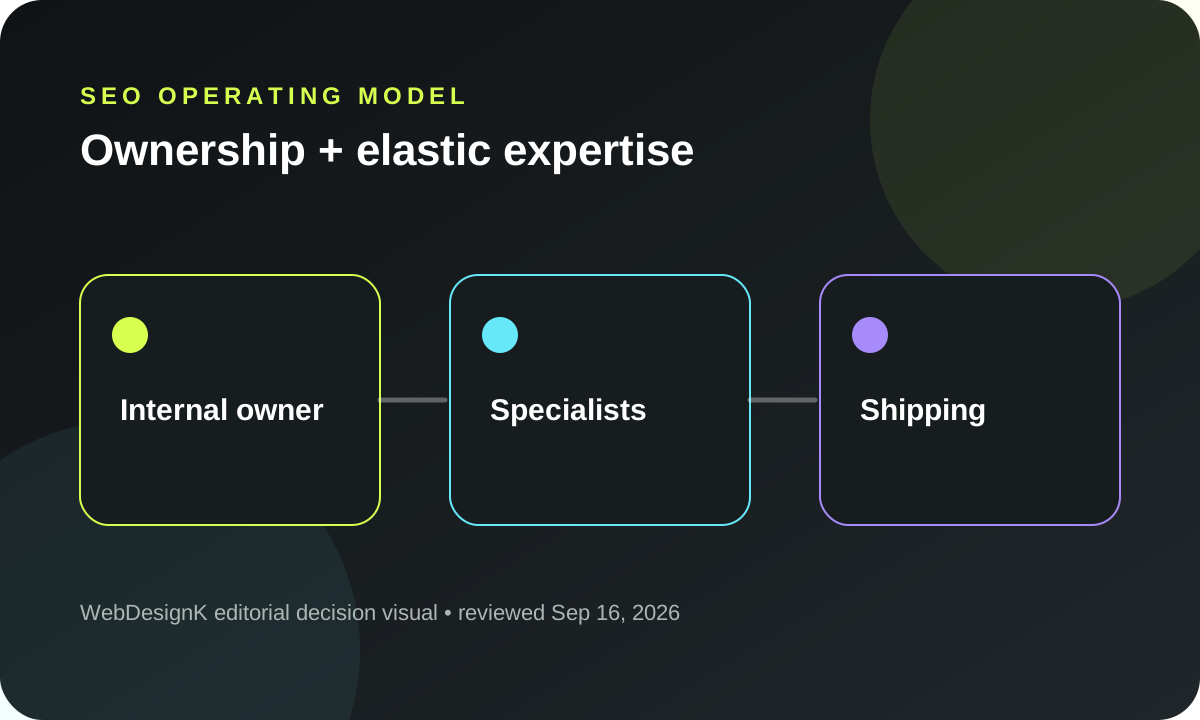
A serious project still needs strategy/product ownership, design, frontend implementation, content, SEO, analytics and QA. WordPress specialists may combine theme, plugin and CMS responsibilities. A Next.js team typically needs React/Next.js engineering plus ownership of the chosen CMS or content API.
Internal marketing should retain ownership of offer accuracy, content approval, campaign requirements and measurement meaning regardless of platform. External partners should not become the only people who understand how a lead becomes a CRM record or how a page change becomes a release.
Integrations, migration and data complexity
List integrations before choosing architecture: CRM, forms, marketing automation, search, authentication, product data, directories, calculators, customer portals and analytics. Classify each as read-only, write, real-time or asynchronous. The complexity is in the behavior and failure modes, not the logo count.
WordPress provides a REST API for posts, pages, taxonomies, media and other resources, which enables custom frontends or integrations. Next.js can consume WordPress or other CMS APIs, but doing so means the team now owns the frontend delivery and API boundary separately.
Migration requires a content and URL decision. Preserve useful URLs when possible. Map redirects where paths change. Move metadata, images, structured fields, authorship and internal links deliberately rather than treating migration as copy-and-paste.
Timeline and how urgency changes staffing
Urgency does not make the same scope smaller; it changes parallelism and risk. A compressed schedule needs faster decisions, stable requirements, more parallel QA and clearer content ownership. If the buyer cannot provide approvals or content quickly, adding developers will not necessarily shorten the critical path.
Use the scope estimator to identify which workstream dominates your current brief. A migration-heavy WordPress rebuild may need content/SEO capacity; a highly interactive Next.js build may need more engineering and QA.
One-time vs recurring operating costs
Separate build work from the 12-month operating model. WordPress commonly includes hosting, backups, security/maintenance, core/theme/plugin updates, premium plugin or service subscriptions and ongoing content/SEO work. Next.js can include hosting/CDN, CMS/service subscriptions, dependency/framework maintenance, monitoring, engineering releases and the same ongoing content/SEO work.
Do not compare a fully managed WordPress retainer with a Next.js hosting bill, or a custom Next.js engineering team with bare WordPress hosting. Normalize the ownership: who patches, monitors, publishes, restores, updates integrations and responds when something fails?
Hidden costs and scope-change traps
Watch for plugin or dependency sprawl, undocumented custom code, content migration excluded from the build, analytics implemented as an afterthought, vague accessibility commitments, no redirect plan, no post-launch owner and “unlimited flexibility” promises without governance.
For WordPress, a large plugin surface can increase compatibility and maintenance work. For Next.js, custom components and integrations can create engineering dependency if the publishing model is not designed for marketers. Neither is inherently cheap or expensive without scope.
Example: the same page count can hide very different scope
Two 40-page sites can require radically different effort. Site A may use six reusable templates, one language, a simple CRM form and a clean migration. Site B may need individualized calculators, authenticated content, three languages, legacy redirects, custom search and several data sources. Page count alone hides the work that creates risk and ongoing ownership.
Edge case: WordPress as CMS and Next.js as frontend
A hybrid setup can preserve WordPress editorial workflows while moving rendering into Next.js. That can be useful when the frontend needs application-like behavior or a shared React platform, but it adds API, preview, caching, deployment and failure boundaries. Treat it as a third architecture with its own operating cost, not a free combination of both products’ advantages.
Who owns updates and incidents?
For WordPress, name the owner for core, plugin and theme updates, backups, security patches, hosting and compatibility testing. For Next.js, name the owner for framework and dependency updates, runtime/deployment, CMS/API changes, monitoring and rollback. A proposal that says “maintenance included” should still define response scope, environments and exclusions.
Editor experience should be tested, not assumed
Give real editors representative tasks before choosing the content model: create a landing page, update a case study, swap proof, schedule a campaign, change metadata and preview a page. Count where developer help is required. A familiar CMS can still become difficult after heavy customization; a structured headless CMS can be simple if the content model matches the job.
Treat forms and CRM as a distributed system
A contact form is not complete when the browser shows success. Verify spam controls, consent state, server processing, CRM field mapping, duplicate handling, notifications, attribution and failure recovery. The website platform changes where this code lives but not the need for end-to-end tests.
SEO migration is platform-neutral
Whether moving WordPress to WordPress, WordPress to Next.js or another stack entirely, preserve search intent and URL value deliberately. Create old-to-new mappings, keep redirects direct, test canonical tags and update internal links. Do not combine a platform migration with unnecessary taxonomy changes unless the information architecture genuinely needs them.
Normalize the 12-month comparison
Build a responsibility matrix before comparing costs. Include infrastructure, backups, security, software/service licenses, dependency or plugin maintenance, monitoring, incident response, content operations, SEO work and feature development. Mark each item as internal team, agency/partner or vendor responsibility. Only then can two proposals be compared fairly.
The cheapest launch can create the most expensive year-two operating model if routine changes require specialist intervention or technical debt makes updates risky. Conversely, paying for a custom stack is wasteful when a standard CMS already covers the operating requirements cleanly.
Performance claims need template-level evidence
Do not compare a hand-tuned Next.js demo with an overloaded WordPress production site, or vice versa. Measure representative templates under realistic media, analytics and third-party conditions. Identify the LCP element, long interactions that can affect INP and layout-shift sources. Both stacks can be fast or slow depending on architecture, hosting, themes/components, plugins/dependencies and operational discipline.

Security and governance are operating models
WordPress teams need disciplined updates, minimal trusted plugins, appropriate hosting and access controls. Next.js teams need dependency/runtime updates, secret management, deployment security and API authorization. Neither label creates security by itself. Compare who performs these tasks, how quickly critical updates are tested and how the site can be restored after a failed release.
How to compare proposals on equivalent scope
Ask each proposal to identify: discovery deliverables, template/component count, content model, migration responsibilities, integrations, SEO migration, accessibility criteria, performance checks, analytics events, environments, QA coverage, deployment, documentation, training and post-launch support. Then compare the boundaries and change-control process.
Platform choice should also match organizational capability. If your company has strong JavaScript engineering and application-like website needs, custom frontend ownership may be rational. If the marketing team needs a familiar CMS ecosystem and the site requirements fit it well, WordPress can be the lower-complexity operating choice.
Budget FAQ and next-step brief
A useful brief should include existing URL/content inventory, intended page/template system, CMS roles, languages, integrations, migration volume, forms/CRM behavior, ecommerce or application needs, accessibility target, motion/interaction requirements, analytics events and launch constraints. Enter those into the estimator, copy the result and require vendors to explain how their scope addresses the same workstreams.
Frequently asked questions
Is Next.js automatically better for SEO than WordPress?
No. Both can implement crawlable HTML, metadata, canonicals, structured data, sitemaps and fast pages. Execution matters more than the label.
Is WordPress always cheaper?
No. Cost depends on scope, customization, plugin/service choices, migration and who owns ongoing maintenance.
Can WordPress be used as a headless CMS with Next.js?
Yes. WordPress exposes content through its REST API, but a separate frontend adds architectural and operating responsibility.
Which is better for a marketing team?
Choose the model that gives marketers the publishing controls they need without creating unsafe technical flexibility or constant engineering dependency.