Quick answer
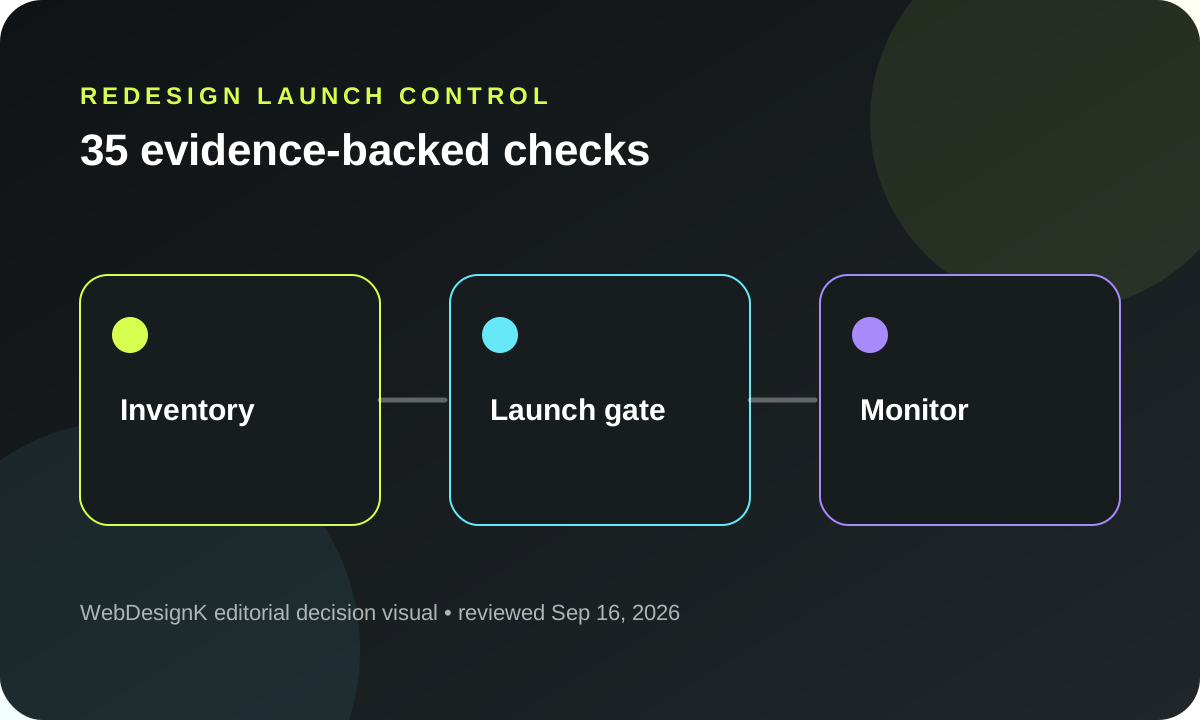
The highest-risk mistakes are usually structural: incomplete URL inventory, weak redirect mapping, accidental noindex/robots rules, canonicals pointing to the wrong version, broken internal links, changed content intent, missing analytics, or launching without live verification. Preserve evidence before migration so post-launch comparisons are possible.
Last reviewed: 2026-09-19T00:00:00.000Z35-point redesign launch checklist
Progress is stored only in this browser. “Complete” means you have the evidence named in the row—not that someone remembers checking it.
1. Overall completion donut
Takeaway: launch confidence depends on evidence-backed completion, especially blockers.
2. Category progress bars
Takeaway: uneven category progress exposes handoff gaps before launch.
3. Severity × completion heatmap
Takeaway: unresolved blockers deserve attention before medium-priority polish.
| Status | Check | Category | Severity | Owner | Evidence of done | Recheck cadence |
|---|---|---|---|---|---|---|
| Map every changed URL to an intentional destination | SEO | Blocker | SEO + Engineering | Exported redirect map + sampled 301 tests | Launch + after URL changes | |
| Validate self-canonicals and intentional cross-canonicals | SEO | Blocker | SEO + Engineering | Crawler export showing canonical target/status | Launch + monthly | |
| Remove staging/noindex/robots blocks from production scope | Critical | Blocker | Engineering + SEO | Production robots.txt + meta/X-Robots audit | Launch | |
| Regenerate sitemap with only canonical indexable URLs | SEO | High | SEO + Engineering | Sitemap fetch + URL sample | Launch + automated | |
| Verify analytics loads on production and excludes internal/test traffic where configured | Analytics | Blocker | Data + Marketing | Realtime/debug event screenshot | Launch + monthly | |
| Test primary lead/purchase conversion events end to end | Analytics | Blocker | Data + Marketing | Test conversion IDs and destination records | Launch + monthly | |
| Confirm consent mode / cookie controls match the deployed trackers | Security | High | Legal/Privacy + Engineering | Consent-state network test | Launch + tracker changes | |
| Submit every business-critical form and verify routing/validation | UX | Blocker | QA + Marketing | Successful test submissions in destination | Launch + release | |
| Complete checkout or equivalent money path on production/safe test mode | Critical | Blocker | QA + Engineering | Recorded test transaction/order | Launch + release | |
| Test sign-in, password reset and protected-route behavior where applicable | Security | High | Engineering + QA | Test account flow recording | Launch + auth changes | |
| Verify custom 404, removed URL behavior and no soft-404 regressions | SEO | High | SEO + Engineering | Known-missing URL response + rendered page | Launch | |
| Check important pages return intended HTTP status codes | Technical | Blocker | Engineering + SEO | Crawler status-code export | Launch + monthly | |
| Test navigation, menus and sticky UI on small mobile viewport | UX | High | Design + QA | 390px browser screenshots | Launch + navigation changes | |
| Check layouts at common mobile/tablet/desktop breakpoints | UX | High | Design + QA | Breakpoint QA matrix | Launch + component changes | |
| Complete critical paths with keyboard only | UX | High | QA + Design | Keyboard walkthrough notes | Launch + interaction changes | |
| Confirm visible focus states and logical focus order | UX | High | Design + Engineering | Focus-state screenshots | Launch | |
| Verify form labels, errors and accessible names | UX | High | QA + Engineering | Accessibility audit + manual sample | Launch | |
| Review meaningful image alt text and decorative-image handling | Content | Medium | Content + QA | CMS/export spot check | Launch + content publishing | |
| Validate page H1/H2 hierarchy and avoid heading-as-decoration | Content | Medium | Content + SEO | Heading outline sample | Launch | |
| Confirm unique titles and descriptions for priority pages | SEO | High | SEO + Content | Crawler metadata export | Launch + quarterly | |
| Validate structured data matches visible page content | SEO | High | SEO + Engineering | JSON-LD parse + rich result/schema validator | Launch + template changes | |
| Test social share title, description and image | Content | Medium | Marketing | Share-debug preview | Launch | |
| Check LCP on representative high-traffic templates | Technical | High | Engineering | Field/lab report with tested URL | Launch + monthly | |
| Check interaction responsiveness and heavy client work | Technical | High | Engineering | Performance trace / field report | Launch + monthly | |
| Check layout stability for images, embeds, banners and fonts | Technical | High | Engineering | Performance trace with shift sources | Launch + monthly | |
| Verify responsive image sizing, modern formats and dimensions | Technical | Medium | Engineering + Design | Network/image audit | Launch + template changes | |
| Check font loading, fallback behavior and unused weights | Technical | Medium | Engineering + Design | Network waterfall | Launch | |
| Review security headers appropriate to the stack | Security | High | Engineering + Security | Header capture/scanner result | Launch + infrastructure changes | |
| Confirm HTTPS, mixed-content absence and certificate validity | Security | Blocker | Engineering | TLS/browser network test | Launch + certificate automation | |
| Reconcile final approved content against production | Content | High | Content + Marketing | Signed-off page inventory | Launch | |
| Check priority internal links and navigation targets | SEO | High | SEO + Content | Broken-link crawl + priority path sample | Launch + monthly | |
| Test onsite search/filtering if present | UX | Medium | QA + Product | Query test set | Launch + search changes | |
| Configure uptime/error monitoring and alert ownership | Technical | High | Engineering | Monitor dashboard + test alert | Launch + quarterly drill | |
| Document CMS publishing, rollback and incident owners | Critical | High | Product + Engineering | Handoff/runbook link | Launch + ownership changes | |
| Schedule 7/14/30-day traffic, errors, rankings and conversion review | Analytics | High | Marketing + SEO + Data | Calendar/report owner + baseline snapshot | Post-launch |
Source/assumption note: the checklist is a WebDesignK operational launch framework. Google redirect and Core Web Vitals guidance cited below support specific SEO/performance checks; your stack and regulatory context may require additional controls.
Tables built for the buying decision
Primary decision table
| Check | Category | Severity | Owner | Evidence | Status |
|---|---|---|---|---|---|
| Freeze a crawlable URL inventory | SEO | Critical | SEO | Current crawl/export stored | Open |
| Export search landing-page/query evidence | SEO | Critical | SEO | Search Console exports stored | Open |
| Map every changing indexable URL to one destination | SEO | Critical | SEO | Reviewed redirect map | Open |
| Identify URLs that intentionally disappear | SEO/Product | Critical | SEO/Product | Documented 404/410 or consolidation decision | Open |
| Preserve or intentionally change canonical targets | SEO/Engineering | Critical | SEO/Engineering | Rendered canonical QA | Open |
| Keep robots directives explicit by environment | Engineering/SEO | Critical | Engineering/SEO | Production robots/indexability check | Open |
| Prevent staging/preview from being indexed | Engineering | Critical | Engineering | Auth/noindex environment check | Open |
| Validate internal links against new routes | Content/Engineering | High | Content/Engineering | Broken-link scan | Open |
| Preserve important page intent/content during redesign | Content/SEO | High | Content/SEO | Old/new content comparison | Open |
| Recheck title/meta changes for priority pages | SEO/Content | High | SEO/Content | Metadata inventory | Open |
| Keep structured data valid and applicable | SEO/Engineering | Medium | SEO/Engineering | Rendered JSON-LD validation | Open |
| Generate sitemap from canonical indexable URLs | Engineering/SEO | High | Engineering/SEO | Sitemap QA | Open |
| Test redirect chains and loops | Engineering/SEO | Critical | Engineering/SEO | Redirect audit | Open |
| Avoid redirecting unrelated removed pages to home | SEO | High | SEO | Mapping review | Open |
| Verify status codes on representative routes | Engineering | Critical | Engineering | Automated route matrix | Open |
| Validate mobile rendering and navigation | UX/QA | High | UX/QA | 390px headed QA | Open |
| Verify forms and critical CTAs end to end | QA/Growth | Critical | QA/Growth | Submission/recovery evidence | Open |
| Check real content in templates, not placeholders | Content/QA | High | Content/QA | Representative template review | Open |
| Measure Core Web Vitals/performance risk | Engineering | Medium | Engineering | Lab + field plan | Open |
| Verify analytics page-view/event continuity | Analytics | Critical | Analytics | Debug/realtime evidence | Open |
| Preserve campaign/UTM handling intentionally | Analytics | Medium | Analytics | Acquisition QA | Open |
| Annotate migration date and release | Analytics/SEO | Medium | Analytics/SEO | Change log | Open |
| Test consent/tracking behavior after route changes | Analytics/Privacy | High | Analytics/Privacy | Consent-state QA | Open |
| Validate security headers/auth boundaries | Security/Engineering | High | Security/Engineering | Security test evidence | Open |
| Run accessibility preflight on templates | Accessibility/QA | High | Accessibility/QA | Automated + manual checks | Open |
| Rehearse deployment and rollback | Engineering/Ops | Critical | Engineering/Ops | Runbook rehearsal | Open |
| Prepare DNS/CDN/cache change plan if applicable | Ops | High | Ops | Change/rollback plan | Open |
| Launch with crawl/error/redirect monitoring | SEO/Ops | Critical | SEO/Ops | Dashboards/alerts active | Open |
| Inspect priority URLs after launch | SEO/QA | Critical | SEO/QA | Live rendered checks | Open |
| Monitor 404s and unexpected old-URL hits | SEO/Ops | High | SEO/Ops | 404 report + redirect backlog | Open |
| Compare indexation/search behavior over time | SEO | High | SEO | Dated Search Console review | Open |
| Keep old redirects long enough for users/search | SEO/Ops | High | SEO/Ops | Redirect retention ownership | Open |
| Review analytics and conversion guardrails | Growth | High | Growth | Pre/post segmented review | Open |
| Document unresolved defects with owners | PM/QA | Critical | PM/QA | Launch exception log | Open |
| Run 30-day migration review | Cross-functional | High | Cross-functional | Decision log + backlog | Open |
Launch-day monitoring matrix
| Signal | Why it matters | Owner | First response |
|---|---|---|---|
| Priority URL status/canonical | Detect wrong routes or canonical targets | SEO/Engineering | Compare against route/canonical manifest |
| Redirect misses/loops | Catch old URLs that fail or chain | Engineering/SEO | Patch mapping; avoid unrelated fallback |
| 404 volume/source | Expose missed internal/external old links | SEO/Ops | Classify and map where appropriate |
| Analytics events/page views | Prevent blind migration period | Analytics | Debug routing/consent/event duplication |
| Forms/conversions | Protect business-critical journeys | Growth/QA | Reproduce by source/device and fix |
| Search Console crawl/index signals | Observe search processing over time | SEO | Investigate patterns; avoid daily overreaction |
Sources and assumption boundaries
Fast-changing platform, pricing and search claims were reviewed on 2026-09-19T00:00:00.000Z. Interactive scores and scenarios are clearly labeled planning models, not sourced market benchmarks.
- Google Search Central — Site moves with URL changes Official site-move guidance; reviewed September 19, 2026.
- Google Search Central — Redirects and Google Search Official redirect guidance; reviewed September 19, 2026.
- Google Search Central — Canonical URLs Official canonicalization guidance; reviewed September 19, 2026.
- Google Search Central — Build and submit a sitemap Official sitemap guidance; reviewed September 19, 2026.
- Google Search Central — Latest documentation updates Used to confirm current migration/search documentation status in September 2026.
Turn this planning result into a scoped review.
Send the assumptions, constraints and result summary. WebDesignK can review the architecture/content/implementation boundary, identify missing discovery inputs and return a prioritized next-step scope.
- Bring: current site/product, constraints, integrations and your tool result.
- You get: a scoped recommendation, open questions and implementation priorities.
A safe SEO migration is a controlled change-management process, not a launch-day redirect task. Inventory current URLs and search evidence, decide which content and intent must survive, map changed URLs one-to-one where appropriate, validate canonicals/internal links/sitemaps/robots, preserve analytics, rehearse launch and monitor live behavior afterward. No checklist can guarantee unchanged rankings, but it can prevent avoidable migration failures and make unexpected changes diagnosable.
What you'll learn / decide
- How to define “done” before a migration starts
- Which preflight items are critical blockers
- How to coordinate SEO, content, UX, analytics and engineering
- What to monitor during the first 30 days after launch
Decision snapshot for SEO Migration Checklist
The key tradeoff is change versus continuity. Redesigns and replatforms can improve architecture and experience, but changing URLs, content, internal links, rendering and metadata simultaneously makes attribution and recovery harder. Preserve what works unless there is a documented reason to change it.
Make the decision with explicit inputs rather than inherited assumptions. Record what is known, what still needs discovery, who owns the next decision, and what evidence will prove that a phase is complete. This matters because the same label can hide very different systems: “SaaS,” “ecommerce,” or “migration” may range from a narrow workflow to a multi-market, integration-heavy operating platform.
Separate one-time implementation from continuing operations. Architecture, content/data ownership, releases, monitoring, security, vendor/platform changes and incident response continue after launch. A good plan therefore evaluates day-two responsibilities at the same time as launch scope, and it keeps irreversible choices behind stronger evidence than reversible ones.
Use scenarios and calculators as planning aids only. They can expose dependencies, relative effort and the arithmetic consequence of user-entered assumptions, but they cannot guarantee a launch date, ranking, conversion lift or revenue outcome. Validate the actual result with production evidence and revise the backlog when observations disagree with the plan.
How to use the checklist and define done
Turn the checklist into owned evidence, not a ceremonial tick-box exercise. Define which items are blockers, who can accept exceptions, where artifacts live, and how the team proves production behavior after launch.
Make the decision with explicit inputs rather than inherited assumptions. Record what is known, what still needs discovery, who owns the next decision, and what evidence will prove that a phase is complete. This matters because the same label can hide very different systems: “SaaS,” “ecommerce,” or “migration” may range from a narrow workflow to a multi-market, integration-heavy operating platform.
Separate one-time implementation from continuing operations. Architecture, content/data ownership, releases, monitoring, security, vendor/platform changes and incident response continue after launch. A good plan therefore evaluates day-two responsibilities at the same time as launch scope, and it keeps irreversible choices behind stronger evidence than reversible ones.
Use scenarios and calculators as planning aids only. They can expose dependencies, relative effort and the arithmetic consequence of user-entered assumptions, but they cannot guarantee a launch date, ranking, conversion lift or revenue outcome. Validate the actual result with production evidence and revise the backlog when observations disagree with the plan.
Critical preflight checks
Before build freeze, preserve crawl inventories, search landing/query evidence, backlinks where available, analytics definitions, key conversions, redirects and content decisions. Identify environment/indexation risks and confirm the route manifest can be tested automatically.
Make the decision with explicit inputs rather than inherited assumptions. Record what is known, what still needs discovery, who owns the next decision, and what evidence will prove that a phase is complete. This matters because the same label can hide very different systems: “SaaS,” “ecommerce,” or “migration” may range from a narrow workflow to a multi-market, integration-heavy operating platform.
Separate one-time implementation from continuing operations. Architecture, content/data ownership, releases, monitoring, security, vendor/platform changes and incident response continue after launch. A good plan therefore evaluates day-two responsibilities at the same time as launch scope, and it keeps irreversible choices behind stronger evidence than reversible ones.
Use scenarios and calculators as planning aids only. They can expose dependencies, relative effort and the arithmetic consequence of user-entered assumptions, but they cannot guarantee a launch date, ranking, conversion lift or revenue outcome. Validate the actual result with production evidence and revise the backlog when observations disagree with the plan.
Strategy and content checks
For each important old URL, decide whether its user/search intent remains, consolidates or disappears. Preserve useful content and internal-link context when intent is unchanged. If content is intentionally rewritten, record the reason so post-launch movement is interpretable.
Make the decision with explicit inputs rather than inherited assumptions. Record what is known, what still needs discovery, who owns the next decision, and what evidence will prove that a phase is complete. This matters because the same label can hide very different systems: “SaaS,” “ecommerce,” or “migration” may range from a narrow workflow to a multi-market, integration-heavy operating platform.
Separate one-time implementation from continuing operations. Architecture, content/data ownership, releases, monitoring, security, vendor/platform changes and incident response continue after launch. A good plan therefore evaluates day-two responsibilities at the same time as launch scope, and it keeps irreversible choices behind stronger evidence than reversible ones.
Use scenarios and calculators as planning aids only. They can expose dependencies, relative effort and the arithmetic consequence of user-entered assumptions, but they cannot guarantee a launch date, ranking, conversion lift or revenue outcome. Validate the actual result with production evidence and revise the backlog when observations disagree with the plan.
UX and conversion checks
A migration can preserve URLs while breaking revenue journeys. Test navigation, search, filters, forms, checkout/contact actions, mobile layouts, error recovery and accessibility with realistic content. Keep conversion guardrails separate from search visibility.
Make the decision with explicit inputs rather than inherited assumptions. Record what is known, what still needs discovery, who owns the next decision, and what evidence will prove that a phase is complete. This matters because the same label can hide very different systems: “SaaS,” “ecommerce,” or “migration” may range from a narrow workflow to a multi-market, integration-heavy operating platform.
Separate one-time implementation from continuing operations. Architecture, content/data ownership, releases, monitoring, security, vendor/platform changes and incident response continue after launch. A good plan therefore evaluates day-two responsibilities at the same time as launch scope, and it keeps irreversible choices behind stronger evidence than reversible ones.
Use scenarios and calculators as planning aids only. They can expose dependencies, relative effort and the arithmetic consequence of user-entered assumptions, but they cannot guarantee a launch date, ranking, conversion lift or revenue outcome. Validate the actual result with production evidence and revise the backlog when observations disagree with the plan.
Technical/performance checks
Validate HTTP status, rendering, canonical tags, robots, sitemaps, internal links, structured data, caching, CDN behavior, JavaScript rendering and representative performance. Test both happy paths and old/invalid URLs.
Make the decision with explicit inputs rather than inherited assumptions. Record what is known, what still needs discovery, who owns the next decision, and what evidence will prove that a phase is complete. This matters because the same label can hide very different systems: “SaaS,” “ecommerce,” or “migration” may range from a narrow workflow to a multi-market, integration-heavy operating platform.
Separate one-time implementation from continuing operations. Architecture, content/data ownership, releases, monitoring, security, vendor/platform changes and incident response continue after launch. A good plan therefore evaluates day-two responsibilities at the same time as launch scope, and it keeps irreversible choices behind stronger evidence than reversible ones.
Use scenarios and calculators as planning aids only. They can expose dependencies, relative effort and the arithmetic consequence of user-entered assumptions, but they cannot guarantee a launch date, ranking, conversion lift or revenue outcome. Validate the actual result with production evidence and revise the backlog when observations disagree with the plan.
SEO and indexation checks
Use self-consistent signals: internal links, canonical, redirects and sitemap should agree on the preferred destination. Exclude drafts/noindex pages from promotion. Keep redirect maps specific and test for chains, loops and accidental broad rules.
Make the decision with explicit inputs rather than inherited assumptions. Record what is known, what still needs discovery, who owns the next decision, and what evidence will prove that a phase is complete. This matters because the same label can hide very different systems: “SaaS,” “ecommerce,” or “migration” may range from a narrow workflow to a multi-market, integration-heavy operating platform.
Separate one-time implementation from continuing operations. Architecture, content/data ownership, releases, monitoring, security, vendor/platform changes and incident response continue after launch. A good plan therefore evaluates day-two responsibilities at the same time as launch scope, and it keeps irreversible choices behind stronger evidence than reversible ones.
Use scenarios and calculators as planning aids only. They can expose dependencies, relative effort and the arithmetic consequence of user-entered assumptions, but they cannot guarantee a launch date, ranking, conversion lift or revenue outcome. Validate the actual result with production evidence and revise the backlog when observations disagree with the plan.
Analytics/measurement checks
Verify route changes do not duplicate or drop page views and conversion events. Preserve source/UTM behavior, consent states and cross-domain/payment flows where relevant. Annotate the release date and store a pre-launch baseline.
Make the decision with explicit inputs rather than inherited assumptions. Record what is known, what still needs discovery, who owns the next decision, and what evidence will prove that a phase is complete. This matters because the same label can hide very different systems: “SaaS,” “ecommerce,” or “migration” may range from a narrow workflow to a multi-market, integration-heavy operating platform.
Separate one-time implementation from continuing operations. Architecture, content/data ownership, releases, monitoring, security, vendor/platform changes and incident response continue after launch. A good plan therefore evaluates day-two responsibilities at the same time as launch scope, and it keeps irreversible choices behind stronger evidence than reversible ones.
Use scenarios and calculators as planning aids only. They can expose dependencies, relative effort and the arithmetic consequence of user-entered assumptions, but they cannot guarantee a launch date, ranking, conversion lift or revenue outcome. Validate the actual result with production evidence and revise the backlog when observations disagree with the plan.
Security/accessibility/compliance checks
Migration QA should include authentication/authorization boundaries, security headers and data flows plus automated and manual accessibility checks. Regulatory/legal requirements depend on context; involve qualified specialists where necessary.
Make the decision with explicit inputs rather than inherited assumptions. Record what is known, what still needs discovery, who owns the next decision, and what evidence will prove that a phase is complete. This matters because the same label can hide very different systems: “SaaS,” “ecommerce,” or “migration” may range from a narrow workflow to a multi-market, integration-heavy operating platform.
Separate one-time implementation from continuing operations. Architecture, content/data ownership, releases, monitoring, security, vendor/platform changes and incident response continue after launch. A good plan therefore evaluates day-two responsibilities at the same time as launch scope, and it keeps irreversible choices behind stronger evidence than reversible ones.
Use scenarios and calculators as planning aids only. They can expose dependencies, relative effort and the arithmetic consequence of user-entered assumptions, but they cannot guarantee a launch date, ranking, conversion lift or revenue outcome. Validate the actual result with production evidence and revise the backlog when observations disagree with the plan.
Launch/handoff validation
Launch with a written runbook, owners, rollback conditions and a priority URL test set. Immediately verify production status codes, canonicals, redirects, forms, analytics, sitemaps, robots, errors and monitoring rather than assuming staging evidence transfers perfectly.
Make the decision with explicit inputs rather than inherited assumptions. Record what is known, what still needs discovery, who owns the next decision, and what evidence will prove that a phase is complete. This matters because the same label can hide very different systems: “SaaS,” “ecommerce,” or “migration” may range from a narrow workflow to a multi-market, integration-heavy operating platform.
Separate one-time implementation from continuing operations. Architecture, content/data ownership, releases, monitoring, security, vendor/platform changes and incident response continue after launch. A good plan therefore evaluates day-two responsibilities at the same time as launch scope, and it keeps irreversible choices behind stronger evidence than reversible ones.
Use scenarios and calculators as planning aids only. They can expose dependencies, relative effort and the arithmetic consequence of user-entered assumptions, but they cannot guarantee a launch date, ranking, conversion lift or revenue outcome. Validate the actual result with production evidence and revise the backlog when observations disagree with the plan.
30-day post-launch monitoring
Track issues over time instead of reacting to a single day. Review priority landing/query patterns, crawl/index signals, 404s, redirect misses, analytics, conversions and performance. Turn every unexpected pattern into a dated investigation with an owner and evidence.
Make the decision with explicit inputs rather than inherited assumptions. Record what is known, what still needs discovery, who owns the next decision, and what evidence will prove that a phase is complete. This matters because the same label can hide very different systems: “SaaS,” “ecommerce,” or “migration” may range from a narrow workflow to a multi-market, integration-heavy operating platform.
Separate one-time implementation from continuing operations. Architecture, content/data ownership, releases, monitoring, security, vendor/platform changes and incident response continue after launch. A good plan therefore evaluates day-two responsibilities at the same time as launch scope, and it keeps irreversible choices behind stronger evidence than reversible ones.
Use scenarios and calculators as planning aids only. They can expose dependencies, relative effort and the arithmetic consequence of user-entered assumptions, but they cannot guarantee a launch date, ranking, conversion lift or revenue outcome. Validate the actual result with production evidence and revise the backlog when observations disagree with the plan. Close the loop with a named owner and review date so the plan remains operational after launch.
Sources and assumptions
Official documentation in the source list was reviewed on September 19, 2026. Vendor plan limits and pricing can change. Any planning scenario not explicitly sourced is an editorial framework, not a quote, benchmark or guarantee.
Frequently asked questions
Can an SEO migration guarantee no ranking loss?
No. Search systems can reprocess changed URLs/content and external factors also move. The goal is to preserve signals and remove avoidable technical/content mistakes.
Should every old URL redirect to the homepage?
No. Map to the closest relevant destination when one exists; unrelated blanket redirects are poor user and diagnostic behavior.
When should redirect mapping begin?
During information-architecture and content decisions, well before launch.
How long should redirects stay?
Keep important redirects as a durable part of the routing strategy rather than removing them immediately after launch; re-check official guidance and operational needs.
Should the sitemap contain redirected URLs?
Use canonical indexable destination URLs in the sitemap, not old redirected URLs.
What should be compared after launch?
Route/status/canonical behavior, crawl/index signals, priority landing pages, queries, analytics/conversions, performance and error/404 patterns—using the pre-migration baseline.