Quick answer
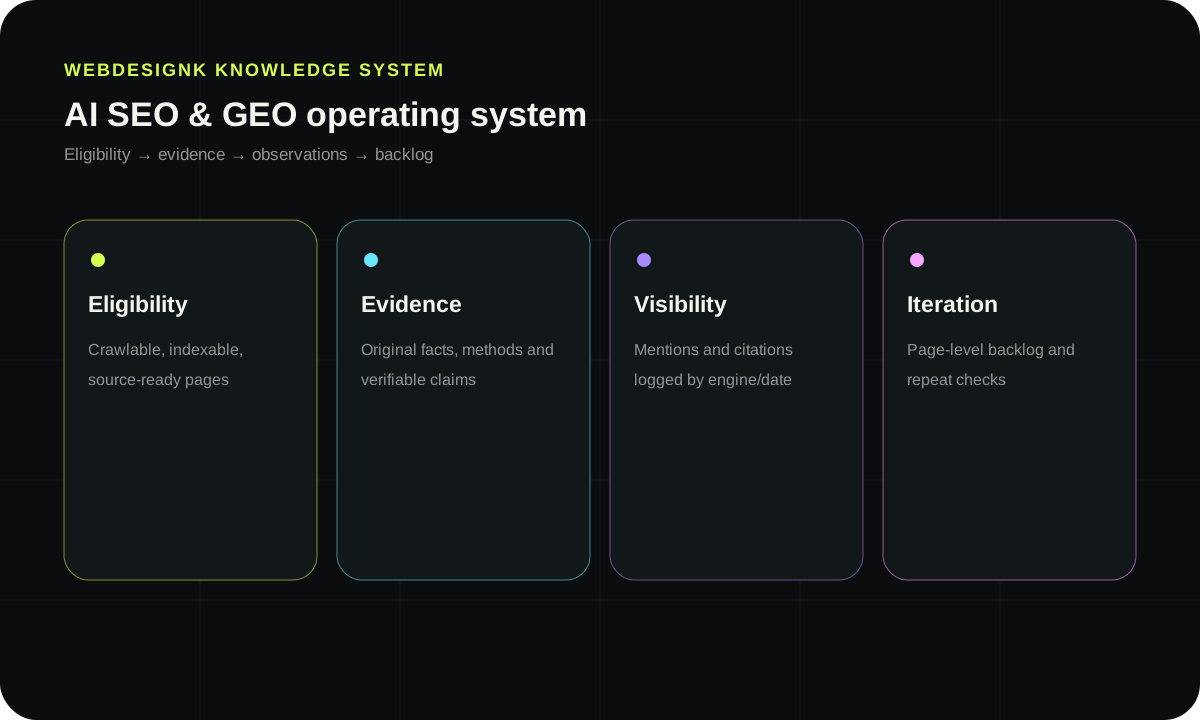
Treat GEO as an extension of SEO, not a replacement acronym. Start SEO-first when technical/content foundations are weak; add GEO when AI answer discovery is part of the buyer journey; integrate both when search and answer engines are material acquisition surfaces. The tradeoff is operational depth: more monitoring and evidence governance can create better learning, but only if each observation maps to a real page or system action.
Last reviewed: 2026-09-19T10:55:00.000ZWeighted decision scorer
Set importance from 0 (not relevant) to 5 (critical). SEO/GEO fit values are transparent WebDesignK editorial planning assumptions. GEO is modeled as an additional operating layer, not a replacement ranking system; your weights drive the result and no score is a search-engine benchmark.
1. Grouped criterion contribution bars
Each group shows how much the current importance weight lets each option contribute on that criterion. The overall fit summary sits above the grouped bars.
2. Weighted criteria radar
Shape shows which criteria each option satisfies under your current importance settings.
- Cost predictability: weight 3
- Speed: weight 3
- Ownership / control: weight 3
- SEO / performance: weight 3
- Integrations: weight 3
- Scale / parallelism: weight 3
- Governance: weight 3
- Editor experience: weight 3
3. Criteria contribution heatmap
Cells combine each option's disclosed fit (1–5) with your importance weight (0–5).
Assumption note: option fit values are transparent WebDesignK editorial planning assumptions, not measured market performance. The result changes only from your criterion weights and the disclosed matrix.
Tables built for the buying decision
Primary decision table
| Criterion | SEO-first | GEO-focused layer | Integrated SEO + GEO | Tradeoff / who should care |
|---|---|---|---|---|
| TCO | Existing SEO/content stack; fewer monitoring layers | Adds prompt/citation monitoring and evidence QA | Largest recurring scope because both measurement systems are maintained | Lean teams should count operating time, not software labels |
| Launch speed | Fastest when SEO processes already exist | Needs prompt taxonomy, observation method and provenance fields | Slower setup because shared governance and reporting must be designed | Deadline-sensitive teams should add GEO incrementally |
| SEO / performance | Strong focus on crawl, indexation, links and page quality | Can underperform if treated as a replacement for technical SEO | Keeps SEO fundamentals while adding answer-engine QA | Any team dependent on organic discovery should preserve SEO foundations |
| Ownership | Clear page/technical owners | Adds AI-search monitoring owner | Shared ownership across SEO, editorial, engineering and subject experts | Organizations need named day-2 owners before scaling |
| Integrations | Search Console/analytics/CMS workflows | Adds monitoring exports and citation/source data | Connects search + answer observations into one backlog | Teams should prefer exportable raw observations over opaque scores |
| Scale | Scales with established content/technical governance | Prompt expansion can become noisy quickly | Scales best when prompt families map to topic/page ownership | Large sites need strict sampling and action thresholds |
| Security / governance | Normal crawler, publishing and review controls | Adds answer-engine bot access and evidence governance | Formalizes crawler access, source truth and review across both surfaces | Regulated/enterprise teams should involve security and legal where appropriate |
| Editorial workflow | Intent-led pages and refresh cadence | Adds extractability/provenance checks | One brief covers user value, search intent, evidence and answer-readiness | Editors should avoid duplicate 'AI optimized' versions of pages |
What changes from SEO measurement to answer-engine measurement
| Observation | SEO view | GEO / answer-engine view | Action boundary |
|---|---|---|---|
| Discovery | Impression / query / indexed page | Prompt family + engine + checked date | Keep raw observations separate; do not force one composite score |
| Visibility | Ranking/result appearance | Brand mentioned, cited, competitor/source cited, or missing | Distinguish a mention from a source citation |
| Source provenance | Landing URL and referring search result | Exact citation/source URL used in the answer when visible | Map source gaps to the page that can provide better evidence |
| Content quality | Intent satisfaction, usefulness, links, engagement | Extractable passages, evidence, entity consistency and current facts | Improve user value first; do not write for a parser at users' expense |
| Technical access | Googlebot/rendering/indexability | Search/answer crawler access plus normal site controls | Review robots/WAF/CDN rules with security owners |
| Outcome | Organic visits, conversions, revenue-assisted signals | Mentions/citations plus referral/branded/assisted-demand signals | Avoid claiming causality from visibility movement alone |
Sources and assumption boundaries
Fast-changing platform, pricing and search claims were reviewed on 2026-09-19T10:55:00.000Z. Interactive scores and scenarios are clearly labeled planning models, not sourced market benchmarks.
- Google Search Central — Optimize for generative AI features in Search Official Google guidance that SEO best practices remain relevant for generative AI Search features and that core Search quality systems continue to matter; reviewed September 19, 2026.
- Google Search Central — Spam policies for Google web search Official policy boundary for Search, including generative AI responses; reviewed September 19, 2026.
- Google Search Central — Search appearance and structured data Official overview of structured data and Search appearance features; reviewed September 19, 2026.
- OpenAI — Publishers and Developers FAQ Official OpenAI guidance on website discovery in ChatGPT search, OAI-SearchBot access and citation/link visibility; reviewed September 19, 2026.
- Perplexity — Architecting and Evaluating an AI-First Search API Official Perplexity engineering discussion of search crawling, robots.txt rate limits and document understanding; reviewed September 19, 2026.
Turn this planning result into a scoped review.
Send the assumptions, constraints and result summary. WebDesignK can review the architecture/content/implementation boundary, identify missing discovery inputs and return a prioritized next-step scope.
- Bring: current site/product, constraints, integrations and your tool result.
- You get: a scoped recommendation, open questions and implementation priorities.
Decision snapshot for SEO vs GEO
SEO and GEO are not mutually exclusive channels. SEO is the foundation that makes pages crawlable, understandable, useful and discoverable in conventional search. GEO adds an answer-engine layer: make claims easy to extract, support them with first-party evidence, maintain clear entities and sources, and measure whether AI systems mention or cite the brand. The practical decision is how much additional GEO workflow your team needs beyond strong SEO—not which acronym replaces the other.
What you’ll learn / decide: whether your current search program needs an SEO foundation, a focused GEO layer, or an integrated operating model; how ownership changes after launch; what to measure; and which switching costs appear when a team changes approach.
Quick decision summary: best-fit scenarios
For most organizations, the safest operating model is SEO first, then add GEO practices where AI discovery materially affects the buyer journey. Google’s current guidance says its generative AI features still rely on core Search ranking and quality systems, so normal SEO best practices remain relevant. GEO becomes useful when your buyers ask comparison, recommendation, category and problem-solving questions in answer engines and your team needs citation-aware monitoring, source consistency and extractable evidence.
SEO-first fits when the foundation is still weak
Choose an SEO-first backlog when crawlability, indexation, information architecture, page quality, internal links, structured data, performance or basic conversion paths are incomplete. Adding an AI-search dashboard cannot compensate for pages that are hard to crawl, ambiguous, duplicated or unsupported. SEO-first also fits lean teams that need one disciplined publishing and measurement process before creating a second reporting layer.
Add a GEO layer when AI discovery is already part of buying research
A focused GEO layer makes sense when customers routinely ask ChatGPT, Google’s AI features, Perplexity or similar systems for shortlists, comparisons or explanations in your category. The layer should not be a collection of “LLM hacks.” It should add prompt monitoring, source-provenance logging, entity consistency checks, answer-ready summaries, evidence blocks and a process for turning visibility gaps into page improvements.
Use an integrated model when search and answer engines are both material acquisition surfaces
Growth teams and complex organizations usually benefit from one backlog with two views: traditional search demand and answer-engine discovery. The same page can serve both if it is technically accessible, satisfies intent, communicates entities clearly, contains original evidence and offers sections that can be understood without reading the entire document. The integrated model costs more operationally because monitoring, governance and refresh work expand, but it reduces the risk of two disconnected content programs.
Side-by-side comparison on buyer criteria
The comparison table below treats SEO and GEO as operating emphases, not mutually exclusive technologies. “Integrated SEO + GEO” means one publishing and measurement system that preserves SEO fundamentals while adding answer-engine monitoring and citation-oriented content QA. It does not mean publishing duplicate “AI versions” of every page.
Use the interactive scorer after this section to change criterion importance. Its option-fit values are disclosed WebDesignK planning assumptions; the numbers are not search-engine benchmarks or guarantees.
What actually changes when the search interface becomes an answer interface?
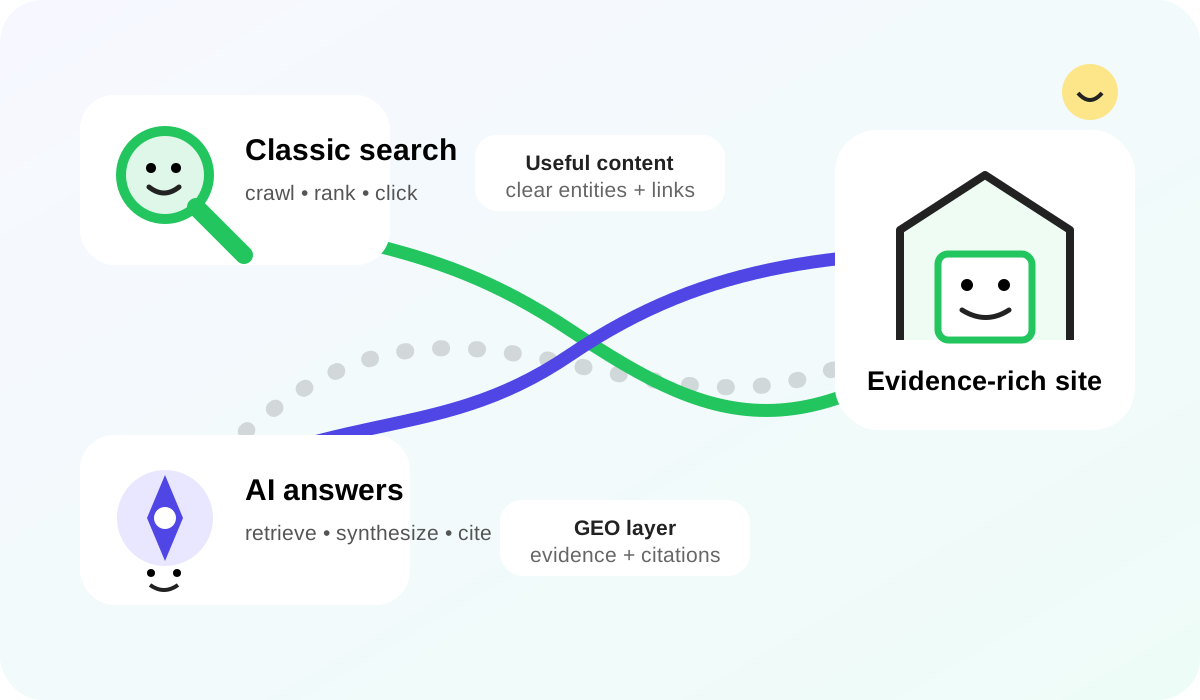
Classic search commonly exposes a ranked set of results that invites the user to choose a page. Answer engines can retrieve multiple sources, synthesize a response, mention brands inside the answer and attach citations or links selectively. That changes the observable outcome: ranking position alone is not enough to describe visibility. Teams may also need to record whether a brand was mentioned, whether its URL was cited, which competing sources were used and which page should become more useful before the next check.
The underlying quality requirement remains familiar. A page still needs accessible HTML, coherent internal linking, useful information, clear authorship or organizational identity when relevant, and content that deserves to be retrieved. GEO adds stronger pressure for extractability and provenance because an answer system may use a small passage rather than presenting the whole page as the primary destination.
Total cost of ownership
There is no universal “GEO price” that can be responsibly compared with an “SEO price.” The real TCO question is which operational layers your team must own.
An SEO-first program normally includes research, technical QA, content production, internal linking, structured data where appropriate, Search Console or analytics measurement, refresh work and conversion optimization. A GEO layer adds recurring prompt-set maintenance, per-engine observation logging, source/citation review, entity consistency checks, passage-level content improvements and potentially more frequent review of fast-changing product or platform documentation.
A useful 12-month TCO model therefore counts people and systems across these buckets:
- Research and editorial: query/prompt research, expert input, drafting, evidence review and updates.
- Technical: crawlability, rendering, performance, schema, robots controls, feeds or APIs where relevant.
- Measurement: search analytics plus answer-engine observation, citation provenance and assisted-demand signals.
- Governance: source approval, factual review, legal/privacy review where needed, and change ownership.
- Operations: incident response when crawlers are blocked, templates break, migrations occur or important source facts change.
The decision boundary is simple: if your team cannot sustain the additional monitoring and evidence workflow, keep the first backlog focused on SEO quality. A half-maintained GEO dashboard creates more noise than value.
Do not turn visibility into a vanity-reporting tax
A prompt tracker is useful only when each observation can become an action. Record the prompt, engine, date, mention/citation state, source URL, competitor/source cited and page to improve. Then classify the gap: crawl access, entity ambiguity, weak evidence, missing comparison detail, stale content, poor passage structure or simply no reason to expect the brand to be relevant. If there is no plausible page-level action, the metric may not deserve recurring reporting time.
Speed to launch and day-2 operations
SEO-first usually launches faster because most organizations already have analytics, publishing and technical-search processes. GEO adds setup work: define prompt families, choose representative engines, document a repeatable observation method and establish source-provenance fields. More importantly, GEO creates day-2 work after the dashboard exists.
Day-2 ownership should be explicit:
- Publishing owner: keeps pages accurate, useful and extractable without writing robotic “answer snippets.”
- SEO/technical owner: protects crawlability, canonical behavior, internal links, rendering and structured data quality.
- AI-search owner: maintains prompt sets, checks engines on dated intervals and distinguishes mention from citation.
- Subject-matter owner: validates factual claims and original evidence.
- Analytics owner: connects search/AI visibility observations with qualified visits, branded demand, conversions or sales conversations without claiming unsupported causality.
Incident response becomes a search-visibility responsibility
If a WAF, CDN rule, bot challenge or robots configuration blocks a crawler, answer-engine discoverability can change independently of editorial quality. OpenAI documents OAI-SearchBot access for ChatGPT search discovery, while Google continues to rely on its established crawling/indexing systems for Search features. Teams should therefore include crawler access in normal release and security reviews instead of treating it as a one-time GEO task.
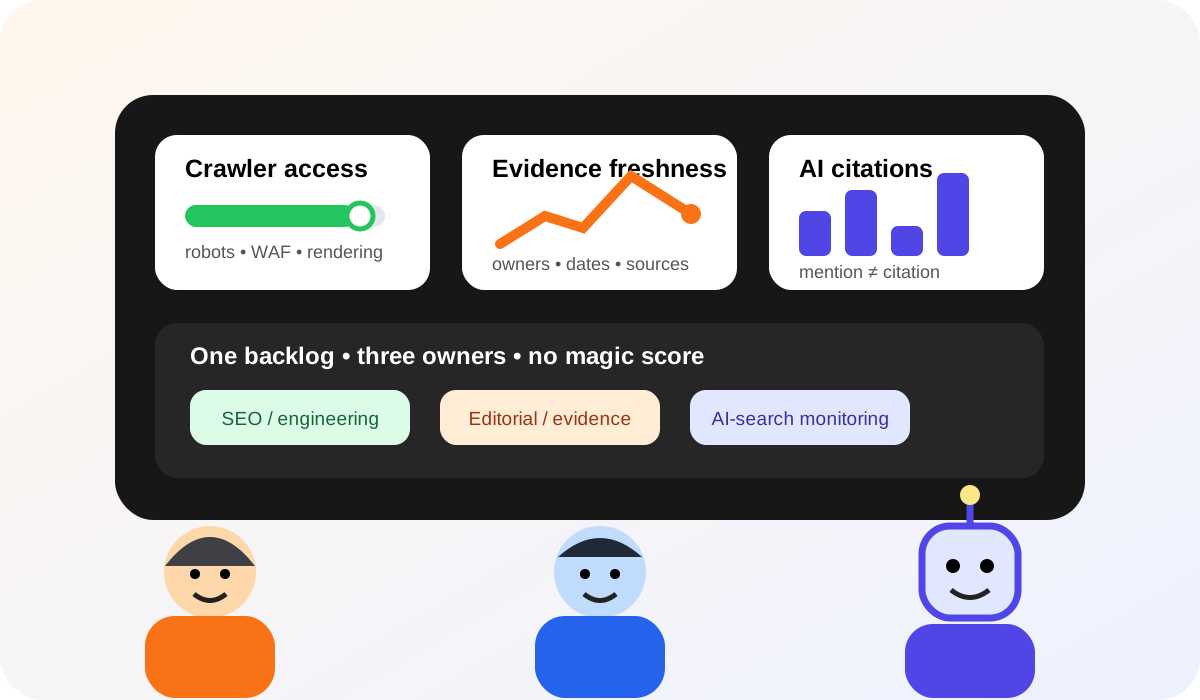
SEO, performance and technical flexibility
SEO remains the technical foundation. Google’s 2026 generative-AI guidance explicitly says SEO best practices remain relevant for its AI features because those features use core Search ranking and quality systems. That means crawlability, indexability, helpful content, internal linking, page experience and appropriate structured data are not “legacy” work that can be skipped in favor of GEO.
GEO changes the emphasis of some content and measurement tasks:
- Write sections that answer a sub-question completely enough to stand on their own.
- Put important qualifiers next to the claim they qualify.
- Use tables, definitions and lists when they genuinely simplify comparison or extraction.
- Keep dates and source provenance visible for fast-changing facts.
- Publish original information—research, product facts, methods, examples or expert explanation—instead of merely restating commodity summaries.
- Monitor answer surfaces separately because different engines can retrieve, synthesize and cite differently.
Structured data helps machines understand pages, but it is not a citation switch
Use structured data when it accurately represents visible page content and a supported schema type fits the page. Do not add unsupported markup, hidden facts or invented entities in the hope that an answer engine will cite the site. Treat schema as one layer of machine-readable clarity, not a substitute for useful information or a guaranteed AI-visibility lever.
Performance also remains important operationally. Slow, unstable or JavaScript-dependent experiences can harm users and can complicate rendering or extraction. A GEO initiative should not justify heavier pages, duplicated widgets or client-only content that removes the useful answer from server-rendered HTML.
Integrations, data ownership and lock-in
The strongest GEO programs own their observation data and their source-of-truth relationships. Do not make a proprietary “AI visibility score” the only record. Keep raw observations that can be exported: prompt, engine, locale or market when relevant, date, brand mention, citation URL, other sources, and the internal page/action mapped to the result.
That makes switching tools possible. If a monitoring vendor changes methodology, pricing or engine coverage, the team retains the evidence log and can recalculate its own metrics. The same principle applies to content production: evidence, entity definitions, product facts and expert approvals should live in systems your organization controls rather than only inside one optimization platform.
Integrate actions, not just dashboards
Useful integrations push findings into the systems where work happens: CMS tickets, engineering issues, editorial briefs, CRM notes or analytics annotations. A citation gap that never reaches a page owner is not an optimization loop. Conversely, avoid automating content changes directly from an answer-engine observation. Retrieval behavior can fluctuate, and one missed citation is not proof that a page is defective.
Security, governance and enterprise requirements
AI-search work touches security and governance because crawler access, public information and monitoring datasets cross team boundaries. The public website should expose only information approved for publication. Robots rules and bot access should be reviewed with security teams rather than bypassed casually. Monitoring exports can contain prompts, internal page plans or competitor notes, so normal access controls and retention policies still apply.
For regulated or high-risk topics, a GEO workflow should strengthen—not weaken—review. Legal, medical, financial or safety claims need qualified review appropriate to the organization and jurisdiction. Search visibility is never a reason to publish uncertain guidance as fact.
Governance questions that can flip the operating model
An integrated SEO+GEO model is easier to justify when the organization can answer “yes” to most of these questions:
- Do we have named owners for product/entity facts and refresh dates?
- Can we export raw monitoring observations instead of relying only on vendor scores?
- Can engineering verify crawler access without weakening security controls broadly?
- Can editors distinguish sourced facts, first-party claims, hypotheses and planning assumptions?
- Can analytics avoid presenting correlation as proven incremental revenue?
- Can we retire prompts, pages and reports that no longer map to buyer decisions?
If the answer is repeatedly “no,” simplify the program before adding more automation.
Scenario recommendations by company stage
Scenario A: lean team with weak technical SEO
A six-person SaaS company has inconsistent metadata, orphaned feature pages, slow templates and no reliable content refresh owner. Buyers may use AI tools, but the company cannot yet explain which pages are canonical or which product claims are current. Start SEO-first. Fix crawl/indexation, navigation, page quality and ownership. Add a small manual AI prompt sample only as discovery research, not as a second KPI system.
The condition that flips the choice: the SEO foundation is stable enough that missed answer-engine visibility can be translated into specific page improvements rather than generic “make us more AI visible” requests.
Scenario B: growth team with established organic demand
A B2B platform already ranks for category and problem queries, publishes expert-led material and has engineering support. Sales prospects increasingly arrive with AI-generated shortlists and comparison questions. Add a focused GEO layer or integrated model. Monitor a controlled set of navigational, category, problem, comparison and recommendation prompts; log citations; improve weak evidence and comparison passages; and measure assisted demand alongside search performance.
The condition that flips the choice back toward a simpler SEO-first program: monitoring consumes substantial time but produces few actionable page changes or no meaningful buyer signal.
Scenario C: complex enterprise with many entities, regions and approvals
A multi-brand enterprise has localized sites, multiple product data sources, legal review and strict security controls. Use an integrated model with governance. Define entity/source ownership, locale-specific prompt sets, crawler/security validation, evidence approval, exportable observation data and a shared backlog. Do not let regional teams create disconnected “GEO content” that contradicts canonical product facts.
The condition that blocks expansion: the organization cannot reconcile source-of-truth conflicts or cannot reliably state which public claims are approved.
Migration and switching considerations
Switching from SEO-only operations to an integrated SEO+GEO model should be an additive migration, not a rewrite. Keep the existing keyword/query map, canonical URLs, internal links, historical analytics and content governance. Add prompt families and citation observations on top. Reuse the same subject-matter expertise and page ownership.
SEO-first to integrated SEO + GEO
What you keep: technical SEO, page inventory, content workflows, analytics, authority-building and conversion measurement.
What you add: prompt taxonomy, per-engine/date observations, citation provenance, answer-ready QA, entity consistency checks and a repeatable gap-to-page action process.
Primary risk: creating a parallel editorial queue that duplicates the SEO backlog instead of enriching it.
GEO-heavy back to a simpler SEO operating model
What you keep: useful evidence blocks, entity definitions, original research, source logs and any content improvements that help users.
What you can retire: excessive prompt variants, opaque vendor scores, duplicated “AI optimized” pages and monitoring that does not lead to action.
Primary risk: losing raw observation history if it only exists in a vendor dashboard. Export before switching.
Changing monitoring vendors or engines
Preserve a normalized record format and the exact checked date. Engine behavior changes, product names evolve and feature availability differs by locale. Do not merge observations from different engines and dates into one timeless “AI visibility” number without showing the methodology.
Decision checklist and FAQ
Before increasing GEO spend, confirm:
- Important pages are crawlable, indexable where intended and internally linked.
- The organization has a source of truth for product/entity facts.
- Content includes original or first-party value beyond commodity summaries.
- Fast-changing claims have visible review dates and source links where useful.
- Prompt monitoring covers buyer tasks, not thousands of arbitrary permutations.
- Observations distinguish mentioned from cited.
- Raw data records engine and checked date.
- Every recurring metric can map to a page, technical or governance action.
- Crawler access is reviewed with security controls rather than bypassing them broadly.
- SEO and GEO work share one backlog and ownership model where possible.
Is GEO replacing SEO?
No. GEO describes additional practices for being understood, retrieved, mentioned or cited in generative answer experiences. Google explicitly states that SEO best practices remain relevant for its generative AI Search features. For most sites, GEO is an extension of a sound SEO and content system rather than a replacement.
Do I need separate pages for AI search?
Usually no. Create a separate page only when there is a distinct user intent that deserves its own answer. Duplicating an existing page and lightly rewriting it for “AI” creates maintenance and canonicalization problems without creating new user value.
Does schema guarantee AI citations?
No. Structured data can improve machine-readable clarity when it matches visible content and supported types, but it does not guarantee retrieval, mentions or citations. Useful, accessible and trustworthy source material still matters.
Should we track rankings and citations in one score?
Keep the raw measures separate first. A rank, an AI mention, a citation and an assisted conversion are different observations. You can build a planning dashboard later, but preserve the underlying events and methodology so a composite score does not hide what actually changed.
How many prompts should a team monitor?
There is no universal number. Start with a manually reviewable set that covers real buyer tasks: navigational, category, problem, comparison and recommendation prompts. Expand only when additional prompts produce distinct decisions or actions.
What is the safest first GEO experiment?
Pick one commercially meaningful topic cluster with solid SEO foundations. Define a small prompt set, record observations across selected engines on the same date, identify recurring source/evidence gaps, improve the relevant pages, and repeat the check on a documented cadence. Treat changes as observations, not proof of causality.
Next-step decision summary
If technical SEO and content ownership are weak, fix them first. If those foundations are healthy and buyers increasingly use answer engines, add a measured GEO layer that emphasizes evidence, extractability, crawler access and citation-aware monitoring. If both surfaces materially affect acquisition, integrate them under one backlog, one source-of-truth model and one governance system rather than running competing SEO and GEO teams.
Frequently asked questions
Is GEO replacing SEO?
No. GEO adds practices for generative answer discovery, while SEO remains the crawl, quality, intent and technical foundation. Google explicitly states that SEO best practices remain relevant to its generative AI Search features.
Do I need separate AI-search pages?
Usually not. Create a page only for a distinct user intent. Duplicate AI-targeted versions increase maintenance and do not automatically create new value.
Does structured data guarantee citations?
No. Accurate structured data can improve machine-readable clarity but does not guarantee retrieval, mentions or citations.
Should AI mentions and rankings be one KPI?
Preserve them as separate raw observations first. Rankings, mentions, citations and conversions represent different stages and should not be hidden inside one unexplained score.
How many prompts should we monitor?
Start with a manually reviewable set of real buyer tasks—navigational, category, problem, comparison and recommendation prompts—and expand only when new prompts change decisions or actions.
What is the safest first GEO experiment?
Choose one strong topic cluster, document a small prompt set and observation method, record multiple engines on the same date, improve recurring evidence or clarity gaps, then repeat without treating correlation as proof of causality.