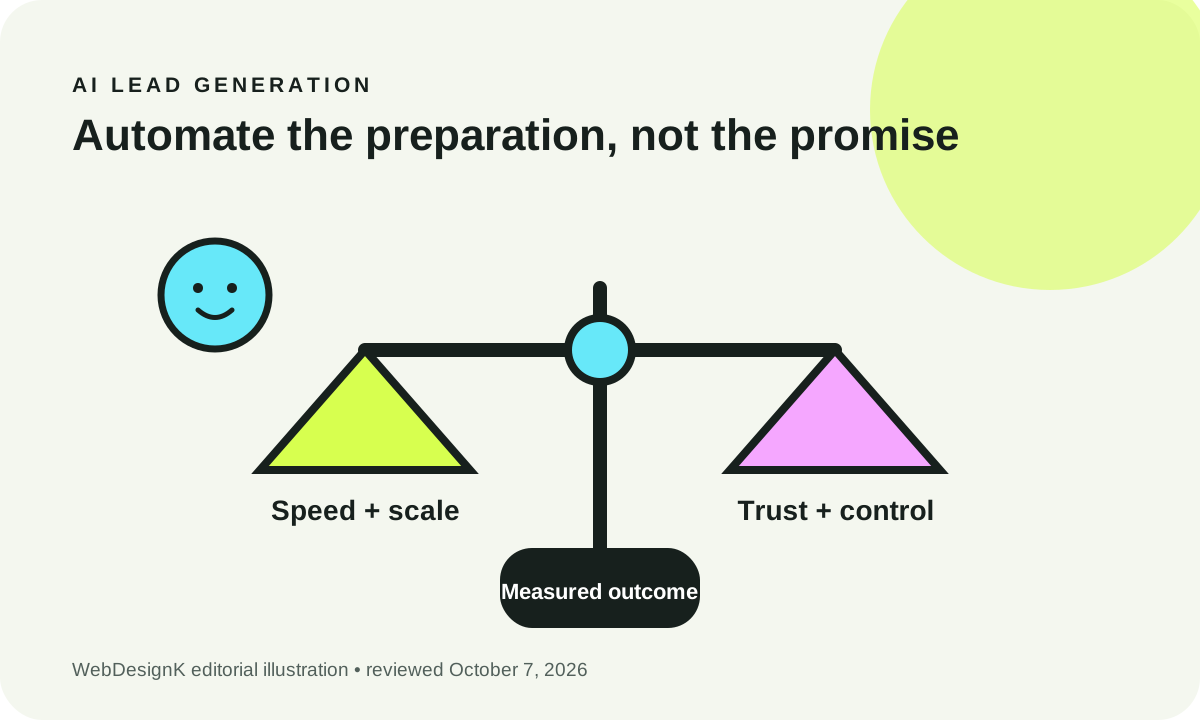
AI CRM automation is most useful when it removes repetitive enrichment, routing, follow-up preparation and scoring work without allowing uncertain model output to become an unreviewed business decision. Start with a documented lead lifecycle, clean source and permission records, and explicit ownership rules. Use AI to summarize or classify ambiguous information; use deterministic checks for contact eligibility, assignment and deadlines. Measure the correction and review cost alongside time saved.
What you will decide: which lead tasks to automate first, what evidence permits routing, where human approval belongs, which CRM fields are authoritative, and how to run a reversible pilot without fabricating revenue impact.
Last editorial review: October 20, 2026. Written for U.S. B2B operators; vendor capabilities and messaging requirements must be checked against official current documentation. Examples, images and model scores below are illustrative policies, not client performance evidence.
0. Decision snapshot: faster handoff without silent lead mistakes
Imagine a B2B team receiving leads from its contact form, webinars, referral partners and paid campaigns. Sales complains about slow assignment, marketing sees duplicate records, and operations wants an AI system that “finds the best leads.” The tempting solution is one opaque score and an automatic sequence. The safer answer is a small, observable workflow whose decisions can be explained and reversed.
The decisive tradeoff is throughput versus accountable correctness. Faster routing creates value only if the record belongs to the right organization, the messaging status is usable, the owner is valid and an ambiguous result is intercepted. A high numerical score must not override a suppression record or a missing contact permission check. Similarly, enriching a title from an uncertain source cannot silently change an account's legal identity or segment.
Use a rules-first pilot if the team can name the sources, define a lead owner map and audit real outcomes. Delay automated external messages when consent/suppression is fragmented, attribution is absent or humans regularly disagree about qualified leads. Do not confuse predictive scoring with a source of truth: a model can suggest a category, while the application remains responsible for approved data, authorization and delivery.
1. Start with a business outcome, not a model demonstration
“Add AI to Salesforce” is an implementation slogan rather than an outcome. A defensible objective is narrower: “Reduce the time from a validated inbound hand-raise to an assigned owner, without increasing wrong-owner assignments or unsanctioned outreach.” Define a baseline, process boundary and evaluation window before choosing a provider or prompting model.
Map the existing work with real people: who receives the web form, who checks duplicates, which CRM view supplies the account record, who chooses territory, how exclusions are handled, and when the sales representative follows up. Separate active work from queue waiting. Often a simple assignment-rule change or repaired webhook removes more delay than AI classification.
For each automation candidate, log a unit of work (one lead or one approved follow-up draft), median manual handling time, touches, rework causes, handoff events, and whether the business knows the eventual outcome. A pile of created tasks is not evidence of saved capacity; the same mistake can multiply quickly when sent to hundreds of records.
An illustrative operator journey
A fictional service business, MeridianOps, receives a request about a compliance-oriented software deployment. The form includes a work email domain, a region selected by the prospect and a question in ordinary language. A human previously looks for duplicates, reads the question, searches the company directory, decides whether a specialized sales owner is available, and drafts a reply.
A safe pilot might let AI summarize the inquiry and suggest its service category, while deterministic code de-duplicates accounts, checks contact policy, selects the regional queue and prepares a draft for review. The organization, conversion rates and savings in this example are fictional. The takeaway is about division of responsibility: an inference can help a person decide what the question is about, but it cannot invent permission to contact the person.
2. Map trigger → AI step → deterministic step → human review
Before a vendor evaluation, draw an event chain. The CRM event should have a defined source, timestamp and idempotency key. Enrichment should state its provider and confidence. Routing should have ordered, documented conditions and a default queue. Outreach should need a separate delivery eligibility check. Human review should be explicit for unresolved identity, contradictory data and high-stakes account changes.
| Workflow | Trigger | AI step | Deterministic step | Human approval | Data needed | KPI | Main risk | Impact / effort |
|---|---|---|---|---|---|---|---|---|
| Lead normalization | New first-party form | Suggest topic and industry | Schema validation, dedupe key | Uncertain category | Form version, known account | Accepted clean records | Wrong entity merge | High / Low |
| Enrichment review | Company domain supplied | Suggest firmographic category | Provider provenance + TTL check | Low confidence | Authorized sources, timestamp | Verified enrichment yield | Incorrect company data | Medium / Medium |
| Owner routing | Record becomes eligible | Suggest team specialization | Territory, capacity, exclusions | Tie, missing region | Territory rules, owner roster | Correct first-owner rate | Misassignment | High / Medium |
| Follow-up drafting | Valid assigned lead | Summarize request, propose response | Suppression and approved template gate | External message approval | Source, contact policy, brand guide | Approved drafts | Unwanted messaging | Medium / Medium |
| Lead scoring | Reviewed enrichment update | Summarize buying signals | Fixed scored evidence and version | Rule override request | Signal taxonomy, model version | Score calibration | Unjustified priority | Medium / High |
| Stale-lead cleanup | Scheduled review | Flag inconsistent notes | Age threshold and audit trail | Delete or merge | CRM history and owner | Review completion | Data loss | Medium / Low |
An AI step is deliberately missing from some sub-actions. A deterministic de-duplication key, opt-out check and territory match should behave the same on repeated inputs. If a vendor presents one large AI “agent” that cannot reveal intermediate decisions, test whether the team can reconstruct precisely why a lead was assigned.

Decision-tree illustration, not observed CRM routing data. The outbound eligibility gate precedes scoring and any follow-up.
What should never be probabilistic?
Contact suppression, do-not-email markers, account access, immutable opportunity identifiers, record-merge authority, owner deactivation, financial changes and deletion rights need predictable application policies. AI can produce a proposed value; a typed validation and approval layer decides what is persisted. Every write should carry a source and actor.
Salesforce's assignment rule guidance documents deterministic criteria for leads and queues. Your own CRM may expose different configuration, but the architectural principle is transferable: keep routing logic inspectable and a default owner for unmatched records.
3. Data and systems prerequisites: provenance before enrichment
A useful lead record is not just name, email and company. It needs a defensible source, capture timestamp, contact policy state, canonical account identity, assignment history and versioned field provenance. Missing values should be genuinely missing—not plausible strings invented because a parser wanted to complete a table.
Create a minimal data contract. For each field, record whether it was supplied by a person, verified against an approved system, inferred with a confidence label, or copied from an unverified vendor response. Keep a last-checked timestamp and owner. The same company name can refer to different legal entities, subsidiaries or franchise locations; matching a fuzzy string is not permission to merge their contacts.
A first-party website form may provide stronger task intent than a downloaded event list, but it is not necessarily more reliable for an exact employee count. A third-party enrichment provider can return different answers for a quickly growing company. Resolve conflicts through a documented source hierarchy rather than silently choosing the highest-looking number.
Contact eligibility is a separate question from data quality. U.S. commercial email requirements do not reduce to a universal opt-in checkbox. The FTC's CAN-SPAM compliance guide describes commercial-message identification, truthful headers and subject lines, a postal address, opt-out handling and other obligations, including for B2B commercial email. Other markets and channels may have different consent rules. The simulator below treats an internal “approved for this outreach workflow” flag as a company policy gate, not as a legal determination.
Keep two audit trails
The record audit should show identity, approved source, changed fields, provider, human reviewer and version. The decision audit should show workflow version, consent/suppression evaluation, score inputs, territory match, assigned owner, exception reason and action attempt. Together they let operations answer “why did this lead go here?” without reading private model prompts.
Do not save raw user-submitted contact details to ordinary product analytics. Where possible, track event counts using privacy-respecting aggregate dimensions such as source class and routing outcome.
4. Where AI adds leverage versus simple rules
AI may add value when incoming information is messy: a paragraph describing several business problems, an unusual job title, a poorly structured RFP excerpt or a note requiring summarization. Even there, return an evidence-backed suggestion rather than a final truth. For example, categorize “need implementation and ongoing SOC2 documentation support” as a possible security-compliance inquiry, and surface the exact sentence used.
Rules are better when the answer can be specified in a decision table. “New York form submissions go to the East territory queue,” “suppressed records must not enter outbound sequences,” and “an unrecognized region goes to review” are not problems that require a language model. Making these probabilistic adds cost and makes explanations weaker.
For lead scoring, define meaningful signals before creating weights. A requested sales demo may be a verified high-intent event; a scraped employee count may be weak evidence. A numerical result should expose contribution per signal, freshness and missingness. An opaque high score cannot justify outreach in a suppressed channel.

Editorial decision matrix. No observed model confidence, conversion prediction or customer data is depicted.
When not to use an LLM at all
Avoid AI for routine static lookups, simple validation, exact comparison against approved territory tables and retry orchestration. A rules engine can be tested with fixtures and often exposes failures more clearly. Reserve model calls for tasks with a genuine linguistic interpretation burden, and require a safe “unknown” output. Unsupported guesses should not increase a score.
5. Human-in-the-loop, contact controls and brand safety
Human review should happen at specific points, not as a vague promise. Define whether the person is verifying source identity, checking an extracted fact, accepting a proposed score adjustment or approving an external message. Show the original evidence and a clear reason for the machine's suggestion. Do not force a reviewer to read a full conversation just to understand a routing exception.
A follow-up draft must reflect the actual inquiry and approved offer. Prohibit fabricated client names, case-study numbers, meeting slots and pricing. Use an approved style guide and limit personalization to attributes that are relevant, authorized and reasonably expected. Provide an easy “reject draft” option so a reviewer cannot accidentally advance a contact into a sequence.
The messaging gate should combine your organization's approved eligibility status with channel-specific legal and operational rules, suppression lists, delivery preferences and a valid sender identity. The FTC's commercial-email rules are one layer, not a complete international compliance framework. Consult qualified counsel for contested situations, particularly where consent and cross-border data transfer matter.
A reversible approval workflow
A practical decision screen shows: source and timestamp; firmographic value with evidence; proposed score and rule version; territory owner; contact eligibility; and action plan. Reviewers should approve or reject each sensitive step independently. A rejected enrichment can remain a non-persistent suggestion; it should not quietly overwrite the CRM record after the dialog closes.
If an assistant cannot explain a claim with an approved source and timestamp, the system must support “needs verification.” That is an operationally useful answer, not a failure to be hidden.
6. CRM, analytics, content and messaging integrations
Integration boundaries make or break the workflow. Incoming lead creation needs idempotency: a double-submit or webhook retry must not create duplicate accounts or deliver two identical emails. The CRM should own canonical record identity; external enrichment is an input, not a replacement for the CRM. The messaging provider should receive only contacts that passed the channel eligibility gate.
Model an explicit state machine: received → validated → eligible → enriched/reviewed → assigned → draft prepared → approved → contacted → outcome recorded. A record can enter a review or hold state at multiple steps. Protect every transition with a typed contract, permissions and a valid previous state. This prevents an asynchronous reply from updating a lead that was already merged, suppressed or closed.
For attribution, preserve original campaign/source data separately from AI-assigned categories. A model's classification of buying intent must not rewrite the UTM or referring-source evidence. If a prospect moves from advertising to a direct revisit, store those touch events with their own timestamps and follow the company's documented attribution policy.
Failure cases worth implementing early
Suppose the enrichment provider times out after a successful CRM insert. The record should remain created but marked “enrichment pending,” not deleted or falsely categorized. If the owner roster is empty, the lead must land in a named review queue. If the messaging provider acknowledges a timeout ambiguously, check authoritative delivery state before retrying; otherwise the customer may receive duplicate outreach.
If an integration is compromised, operators should be able to pause external sends independently of basic lead ingestion. Fast rollback depends on that separation.
7. Quality, attribution and failure monitoring
An automation dashboard can look healthy while producing the wrong work. Count both throughput and verified outcomes. Recommended measures include incoming leads with source evidence, duplicate rejection rate, eligible-to-assigned latency, first-owner correctness, enrichment correction rate, queued exceptions, reviewer handling time and verified follow-up completion. Define denominators by channel and source.
The claim “conversion increased” requires a credible baseline and comparable cohorts. A system that routes only obvious leads could appear more successful while leaving complex opportunities in a neglected queue. Review the distribution of exceptions, not just the average of completed records. Split changes from seasonality or campaign-mix shifts wherever possible.
| Monitored event | Authoritative evidence | Failure symptom | Response owner |
|---|---|---|---|
| Capture | Webhook ID, valid form version | Duplicate or missing lead | Marketing operations |
| Policy check | Current suppression and channel status | Ineligible contact queued for sending | Compliance / messaging owner |
| Enrichment | Provider, evidence, confidence and TTL | Stale title or wrong organization | Data operations |
| Assignment | Territory rule version and roster | Unowned or bounced lead | Sales operations |
| Follow-up | Human approval and provider event ID | Duplicate send or unsent approved draft | Sales / lifecycle team |
| Outcome | Sales accepted stage and real pipeline link | “Converted” without qualified evidence | Revenue operations |
A genuine funnel illustration would plot event counts from a dated production dataset. None is supplied here, so the visual below deliberately has an empty state instead of fictional percentages.

No performance bars or numbers appear because no verified, consented first-party dataset was provided. Record actual event counts and segment filters before plotting a trend.
8. Throughput, cost and ROI: include the cost of being wrong
Model work in minutes and money only when the input assumptions are explicit. A reasonable planning equation is:
Monthly net operating benefit = verified manual minutes avoided × loaded hourly cost / 60 − AI/provider expense − human review expense − correction and incident expense − ongoing maintenance.
If you estimate an employee's hourly loaded cost, label it as your own internal U.S. dollar assumption rather than a published market average. If the person spends ten minutes correcting an AI-generated follow-up that would have taken five minutes to write, the net benefit may be negative. Include a cost for duplicate contact, mistaken routing, manual exceptions and downstream reputation risk when credible business data exists; do not invent a dollar amount for those harms.
Report both throughput and useful outcomes. The number of records scored per hour matters less than timely, accurate assignment to people who can act on them. Track model-token costs, enrichment provider charges, CRM API budgets, retries, storage, human approvals and evaluation maintenance. Pricing is vendor-specific and can change, so inspect current official commercial terms when building the actual forecast.
An ROI pilot should compare the same categories of lead under a stable business policy. Include a quality floor and explicit rollback triggers: unexpected suppression violations, wrong-territory assignment spikes, duplicated outreach, increased correction time or missing audit logs. No apparent savings justify continuing when those controls fail.
Which workflow deserves the first sprint?
Prioritize tasks that have high frequency, measurable manual repetition, clear deterministic gates and low downstream reversibility cost. A classification-assisted routing queue can be safer than fully autonomous prospecting. Build an effort/impact matrix from actual team minutes and observed error reviews, not subjective “AI opportunity scores.” The simulator below is a policy example, not an ROI predictor.
9. Pilot and rollout: try one lead-to-owner route
Start with one inbound source and one territory policy. Run it in shadow mode, where the suggested classification and owner are recorded but not used to send messages or update the production owner. A reviewer compares each result with the existing business process and labels correct, uncertain, wrong or policy-violating. Only after defined evidence passes review should routing writes be enabled in a limited, reversible cohort.
For example, choose inbound demo requests with a declared U.S. region, a verified approved-contact workflow and an active East/West owner roster. Give the simulator an illustrative score threshold, then test both sides of the boundary. A high score with missing permission must still be held. An international territory with no roster mapping needs a queue, not a fictional global sales representative.
Try the CRM enrichment and routing simulator
This browser-only mini-tool uses made-up policy inputs, not a real lead. It will not fetch enrichment, connect to a CRM or initiate outreach. Change the source, eligibility, confidence, scoring threshold, territory or fallback to see the resulting example owner route and policy evidence. The synchronized bars show gates passed—not conversion probability or model accuracy.
Reading the simulator correctly
The simulator adds only a fixed, transparent source bonus to a user-selected base score when the enrichment is marked verified. It does not call an enrichment provider or estimate closing probability. It blocks automatic owner routing when source evidence, contact policy or owner roster is missing. Lower score leads go to an internal nurture review queue, not an autonomous external campaign.
Try raising the base points to 100 while marking the contact status suppressed: the record must remain held. Switch to stale enrichment: the same territory becomes a review case. Set the region to international and choose a hold fallback: the example shows an unassigned hold rather than inventing a sales rep. Reset restores the default case, and Copy exports only simulated decision values.
10. Governance and a practical 90-day roadmap
A governance owner should maintain rule versions, source priority, permissible data uses, enrichment TTL, territory exceptions, messaging approvals, incident response and rollback plans. The point is not more paperwork; it is preserving a comprehensible workflow after the original engineer or operations analyst leaves the project.
Days 1–30: observe and agree on policy. Audit the current lead path, identify sources and suppressions, normalize records, collect a baseline, define target outcomes, and document the fixed routing policy with cases at every boundary. Test unknown territory, nonconsenting or suppressed contacts, duplicates, expired firmographics and empty owner rosters.
Days 31–60: shadow mode, then restricted writes. Run the classification and routing logic without sending external communications. Compare the proposed owner with a reviewed decision, capture corrections and time to completion, verify idempotency, and establish an explicit promotion threshold. If quality is stable, activate owner assignment for a small known source/territory pair. Keep outbound drafts behind approval.
Days 61–90: evidence-based expansion. Consider an additional source, model-assisted classification and limited draft generation only if the original cohort met quality gates. Audit stage progression, wrong assignments, suppressed records, reviewer time, actual sales outcomes and costs. Expand only on repeatable evidence; roll back immediately on high-severity policy or data boundary failures.
Release checklist
- A named operations owner signs off the lead state machine and scope.
- Every lead has an actual source event and de-duplication path.
- Source confidence and freshness are visible; missing data stays missing.
- Suppression, messaging eligibility and account permissions are enforced server-side.
- Territory and owner assignment are deterministic, documented and testable.
- Every unmatched or conflicting case goes to a real review or hold state.
- All external follow-ups have approved content, sender, channel and human gate.
- Shadow-mode fixtures cover adverse cases and repeated/replayed events.
- Actual funnel and correction numbers are captured with timestamped denominators.
- A pause and rollback mechanism can stop sends without losing incoming records.
Questions operators ask most often
Is AI lead scoring the first thing to deploy? Usually not. Clean contact policy and assignment states first. A useful score cannot recover the wrong account ID or justify a suppressed email.
Will enrichment make routing reliable? Only if the source is appropriate, the record is fresh and the chosen field is verified. A plausible employee count or industry label is insufficient evidence for an irreversible merge or message.
Can the system follow up automatically? Only after the required internal and external messaging gates have been proven. Automation of a reviewed draft is very different from unapproved autonomous outreach.
Does a higher lead score mean a higher chance of conversion? Not in this simulator. It is a documented priority rule, not a calibrated probability. Real predictive claims require observed cohorts and a validated outcome model.
How does this integrate with an existing CRM? Start with its official APIs, assignment rules, idempotent webhooks and field permissions. Avoid direct database writes that bypass its audit and workflow semantics.
For a scoped implementation, WebDesignK's AI marketing service can help map data contracts, outreach gates, CRM integration and an observable pilot. Share the current lead stages, a redacted workflow diagram, permission constraints and owner roster assumptions; the useful deliverable is a bounded operating design and measurable rollout plan. Contact the team when those inputs are ready.
Further reading and evidence reviewed October 20, 2026: Salesforce assignment rules, FTC CAN-SPAM guidance, and NIST Generative AI Risk Management Profile. These sources offer complementary practice and governance guidance; this article does not imply a particular vendor architecture or provide jurisdiction-specific legal advice.