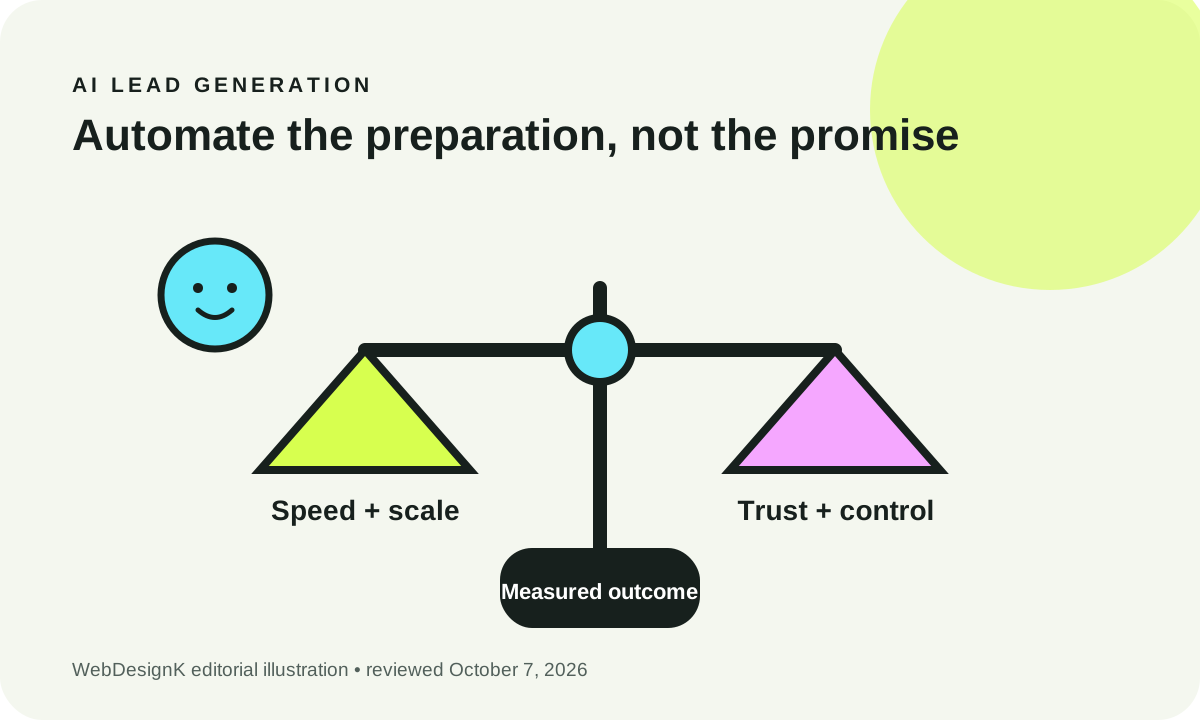
AI website personalization changes what an eligible visitor sees based on a documented context, such as a voluntarily chosen interest or a known stage in a buying journey. It can make product discovery and next steps clearer, but it can also misuse data, hide important information and distort measurement. Begin with a reliable default experience, an explicit eligibility rule, a control holdout and a measurable business outcome—not a promise that a model will lift conversion.
You will decide: which visitor decision to improve, what information may be used, how to build a safe fallback, how much traffic remains unchanged, and what evidence would justify a rollout.
Editorial review: October 19, 2026. U.S.-focused planning context; local privacy obligations and provider capabilities require separate review. All scenarios and model outputs below are hypothetical.
0. Decision snapshot: useful relevance versus inappropriate inference
Website personalization is not inherently a chatbot, an identity graph or predictive AI. It is a conditional experience: eligible visitors see relevant messaging, products, guidance or next steps based on a defined signal, while everyone else can still complete the core task. A fixed rule that respects a visitor's declared interest may outperform an elaborate machine-learning model when data is limited, sparse or sensitive.
The central trade-off is increased relevance versus consent, fairness and interpretability. A seemingly higher conversion rate could reflect an audience with stronger intent rather than better messaging. A personalized discount could cause unfair treatment, change profit margin or undermine trust if customers discover inconsistent pricing. An opaque segment classifier can also misroute visitors without a usable explanation.
Start small: one observed friction point, one permitted signal, one transparent message or recommendation change, one default, and one control cohort. Hold implementation until the data and next-step ownership are understood.
1. Define the visitor decision and a real business outcome
Before selecting an AI model or personalization vendor, write down the visitor's decision: Which integration guide should I read? Which plan fits a small team? Which industry use case is relevant? Which product is compatible with an existing purchase? Avoid vague objectives such as “deliver a tailored digital journey”; specify the job and where the decision stalls.
Consider a fictional B2B software company with a website explaining scheduling software for field teams and office teams. First-party, voluntarily selected interests may be enough to show a relevant use-case guide. If visitors do not choose a preference, the default page continues to offer both choices. The experience should never assume a sensitive attribute or restrict essential information.
Distinguish operational personalization (remembering a language choice or preserving a user's selected view) from behavioral targeting (inferring preferences from browsing) and commercial personalization (reordering product or offer presentation). These have different user expectations, data needs and risk profiles.
What counts as success?
Define a specific completed behavior, such as a qualified demo request accepted by the sales team, a verified help article resolution or an actual order. A click on a dynamically selected CTA is not automatically a lead or a sale. If someone sees a personalized product card and later abandons checkout, the business result remains uncertain.
Choose one primary outcome in advance and separate early diagnostic steps—guide views, form starts and CTA clicks—from the outcome itself. Name the denominator: assigned visitor, eligible visitor, session, unique buyer or completed lead. Keep allocation sticky within a real experiment so a visitor does not switch variants between steps.
2. Capture the baseline before changing anything
You cannot interpret a conversion change without understanding the starting funnel and the eligible population. Collect counts for arrival, meaningful engagement, relevant CTA selection, submitted and accepted lead, or actual purchase. Split by traffic source, intent and device where appropriate. Record failures from analytics consent, blocked scripts and external form integrations.
If the site reports 5,000 landing sessions and 80 accepted inquiries over a stated period, the ratio of accepted inquiries to sessions is 1.6% for that exact dataset. This is an illustrative arithmetic example, not a WebDesignK client result or industry benchmark. It also may not be the appropriate denominator for a user-level randomized trial. Choose the experiment's allocation unit before computing its success rate.
Distinguish observed from modeled data
Google's GA4 consent type reference distinguishes analytics, functionality and personalization-related storage types. Its consent-mode developer guide explains controlling supported measurement behavior based on consent. These product-specific signals are not an automatic legal basis to process any data; legal review depends on purpose, jurisdiction and implementation.
Some analytics reports include modeled observations when consent prevents direct measurement. Google's behavioral modeling explanation distinguishes modeled estimates from directly observed events. Never silently mix those estimates with a controlled experiment's raw randomized counts.
Use the same data window for control and treatment, reconcile assignment and exposure logs, and verify the number of eligible people actually allocated. For an opt-out case, the public default page should still work even when analytics cannot measure a session.
3. Find the highest-friction moments
Inspect moments where a visitor cannot find the relevant information or is asked to make a commitment before understanding the offer. Review real support questions, anonymized form-error patterns, repeated navigation back to the same category, unnecessary product-filter resets and lost cart state. A qualitative interview is valuable when sample sizes are too small for reliable quantitative inference.
Personalization should respond to a defined content discovery problem. It cannot fix a broken form, irrelevant product, unavailable appointment, misleading claim or poor mobile navigation. If the default site is unusable, repair it before adding a variant layer that introduces more complexity.
Prioritize visible, reversible use cases
| Visitor friction | Low-risk personalized change | Signal needed | Default for ineligible visitors | Important risk |
|---|---|---|---|---|
| Cannot find relevant industry guide | Visitor-selected industry content order | Explicit declared industry | General industry selector and guide list | Unapproved industry inference |
| Too many product choices | Reorder relevant category recommendations | Voluntary preferences or permitted contextual signal | Complete searchable catalog | Hidden alternatives or skewed product access |
| Repeated documentation detours | Recommend next useful support article | Current help topic or permitted session context | Full help index and human route | False claim of issue resolution |
| Unclear B2B consultation CTA | Show one use-case-specific next step | Stated buying purpose | General consultation and service details | Misqualification, misleading availability |
| Unexplained prices or offers | Clarify plan comparison content | User-selected requirements | Same accessible price and terms | Differential pricing or deceptive framing |
The table deliberately favors clear user controls over inferred personal attributes. Do not infer health status, credit risk, race, disability, income or vulnerability to decide which opportunities someone can see.
4. Message, proof, CTA and checkout or form design
A personalized headline must still be accurate for the underlying product. If one segment sees “Integration review for field service teams,” the page needs real documentation that supports that service. A dynamic case study must not imply an industry result the business cannot verify.
Keep critical information accessible to all visitors: product terms, pricing where public, safety details, opt-out controls and a human support route should not disappear behind opaque targeting. Let personalization adjust emphasis, not rewrite contractual reality.
Match the change to the visitor's decision
A voluntary “What are you looking for?” chooser can reorder educational cards. A returning authenticated customer may prefer a support link. A qualified inquiry can see a use-case-specific CTA after reading the scope. Each change has a named content owner and a set of claims checked against current documentation.
Do not use personalized countdown timers, hidden opt-out links or preselected private-data sharing. The U.S. FTC's report on dark patterns documents deceptive choices and obscured material terms as consumer protection concerns. The business should be able to explain every change in understandable language.
A personalized form may preselect a non-sensitive, confirmed option, but it should never assume that the visitor consented to a marketing follow-up. Submitted values need server-side validation, a reliable CRM delivery path and an accurate completion notice. Measure accepted outcomes, not just clicks.
5. Mobile-specific friction and accessible alternatives
Mobile visitors have less screen space, intermittent networks and more risk of overlay conflicts. Personalized components that shift after initial render may hide the primary CTA, disrupt focus or alter reading order. Keep a stable initial layout and avoid sudden changes after a form has started.
A legitimate “no preference” branch should remain visible. Screen-reader users need descriptive controls, results announced in context and a predictable focus path. Keyboard interaction must work for content selectors and opt-out choices. A model-driven carousel should not be the only way to discover every important product or guide.
Responsive release checks
Use a narrow viewport, slow network and reduced-motion setting. Test the default path, permission denied, permission unknown, explicitly opted-in and missing preference state. Confirm that the page preserves a shopper's inputs across changes and that checkout or form confirmation matches the actual server result. A polished screenshot alone does not verify any of these scenarios.
For technical performance, compare equivalent page types using Core Web Vitals and accessible interaction tests. A change that lifts CTA clicks while hurting layout stability or form completion is not automatically a success.
6. Segment by traffic source, visitor intent and device
A single site-wide conversion rate can hide differences in visitor readiness and the devices they use. Someone arriving on an integration page may have specific buying intent; someone reading a broad educational guide may not. A returning mobile visitor may face a navigation problem rather than a lack of recommendations. Define the eligible audience and segments in advance, using permitted, observable criteria rather than inferred personal traits.
If your design requires a particular permission, the group declining or withholding that permission must not be silently included in the treatment population. Randomize unchanged control and treatment within a consistently defined eligible population. The conversion rate for consenting visitors does not establish what would happen to the whole site's audience.
Why audience mix can mislead
Imagine high-intent visitors complete a task more often than exploratory visitors. If a new variant receives disproportionate high-intent traffic, its aggregate conversion rate may look better even when the variant has no beneficial effect. Establish assignment and source-mix diagnostics before the test. Break down observed outcomes by intended segment, device and traffic source where sample size and privacy policy permit.
Never use a visitor's presumed health, financial vulnerability or protected status as a hidden marketing segment. A voluntary industry selection or current page context often answers the business question more transparently.
7. Prioritized experiment backlog
A personalization idea belongs in a test backlog only when the team can name the visitor problem, proposed change, intended result, potential harm and the person responsible for reviewing it.
| Friction hypothesis | Page / step | Experiment change | Primary metric | Guardrail | Effort | Pre-test confidence |
|---|---|---|---|---|---|---|
| Industry guide is buried | B2B entry page | Reorder use cases after voluntary industry selection | Accepted qualified inquiries per eligible visitor | Content access and opt-out choice | Low–medium | Medium, pending interviews |
| Too many products | Ecommerce category | Reorder available cards using permitted declared preferences | Completed orders per assigned eligible visitor | Returns, margin, alternative visibility | Medium | Low |
| Help navigation loops | Knowledge base | Suggest an article after the user chooses topic | Verified self-service resolution | Human escalation availability | Medium | Medium, if support logs substantiate |
| Generic CTA confuses buyers | Product comparison | Show scope-specific next step | Completed, accepted consultation | False claims and misrouted leads | Low–medium | Medium |
| Visitors distrust differing offers | Plan selection | Replace opaque recommendation with a transparent option comparison | Completed valid decision | Equal access to material terms | Medium | Low |
These are planning hypotheses, not experiments already performed. The confidence labels are editorial—not objectively measured effectiveness scores.
Define the stopping and learning rule
Before allocation, document the randomization unit, period, eligible population, variant assignment, exact conversion denominator, guardrails, minimum review window and an owner who can stop an unsafe experiment. A material security, privacy or fulfillment failure can justify immediate shutdown. Ordinary random variation should not trigger a declaration of success after a few favorable events. A credible analysis plan needs actual observed counts and an appropriate uncertainty assessment.
8. Model possible revenue impact without promising uplift
Scenario modeling is useful for prioritization as long as the difference between prediction and observation stays explicit. For illustration, suppose a website has 8,000 eligible visits per month and chooses a 30% control holdout. The allocation is 2,400 control and 5,600 treatment visits if all 8,000 are actually eligible. These values are arithmetic examples, not a sampled experiment or industry baseline.
To compare scenarios fairly, use the same traffic volume and segment mix under the unchanged-control and proposed-treatment rates. Calculate expected actions for each segment as traffic multiplied by segment share multiplied by conversion-rate assumption. Subtract control from variant to show a hypothetical monthly difference. Multiply by the appropriate realized outcome value only when the KPI actually represents monetary outcomes. Do not multiply a raw form submission by a full enterprise contract price and report it as revenue.
When permission is denied or unknown, a conservative experiment plan should send the visitor to the usable public default, with zero personalized treatment assignments. This is a planning constraint, not an automatic conclusion about every applicable jurisdiction or use case. A qualified reviewer must assess the actual processing basis.
What the scenario model cannot predict
The model does not establish causal lift, statistical significance, true consent distribution, attribution, repeat-visitor identity, long-term retention or margin differences. Its correct use is to ask how different assumptions change resource and guardrail priorities. A projected line or number must never be labeled as historical conversion performance.
9. Measurement, privacy and fairness guardrails
Define an exposure event distinct from merely rendering the page and connect it to a completed outcome under appropriate permissions. If an analytics integration is blocked by a browser or consent setting, record a measurement limitation instead of manufacturing data. Never send a person's form contents, inferred sensitive status or private profile into an experiment log.
Guardrails should include opt-out behavior, default-content access, checkout or form reliability, complaints, refunds, margin, false qualification, harmful segment disparities and mobile layout stability. If a content variant with higher CTA clicks creates more invalid leads, the result is not necessarily a business improvement.
The NIST AI Risk Management Framework provides a voluntary way to organize validity, explainability, privacy and harmful-bias reviews. The FTC's dark-patterns report identifies designs that obstruct or manipulate visitor choices. Neither source automatically certifies a site's personalization system.
Consent-to-variant decision path
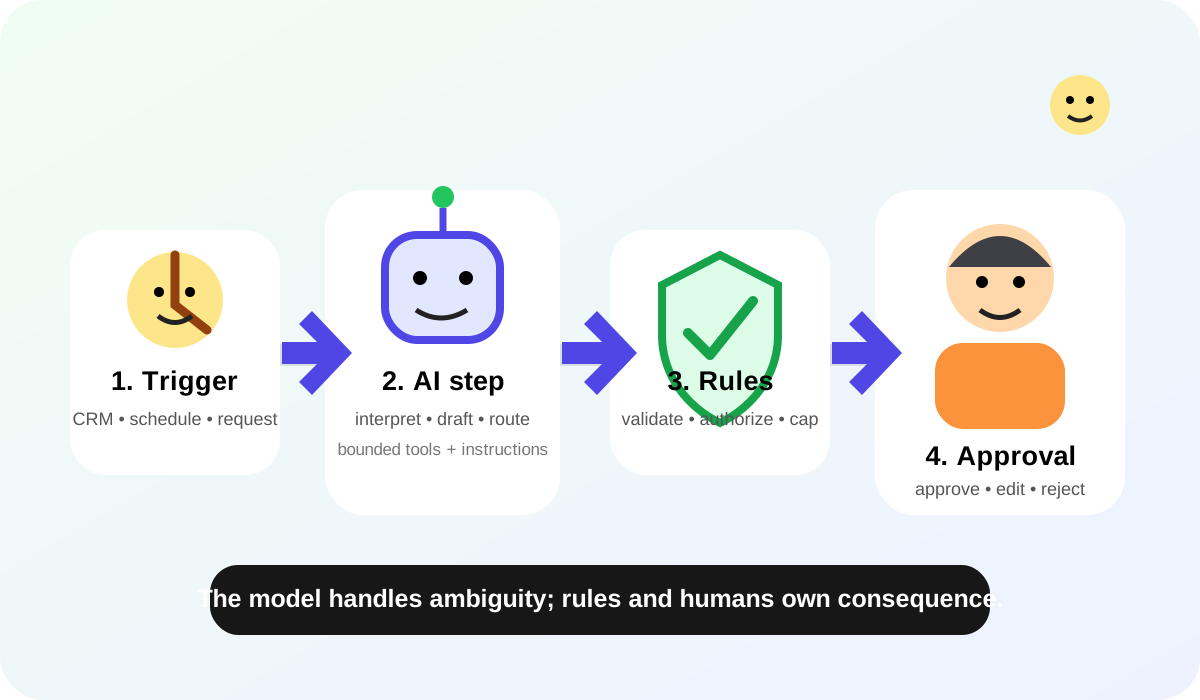
First confirm the intended data use has been reviewed and is permitted for this context. Unknown or denied permission should follow the public default in this example. Next check whether the visitor supplied a suitable nonsensitive interest; if none is available, use the default. For eligible cases, confirm the experiment and control assignment are functional, then assign the visitor consistently to unchanged control or one named treatment variant. Stop or roll back when consent, fairness, product-truth or transaction guardrails fail.

Interactive personalization guardrail and scenario lab
This topic-specific planner compares high-intent and exploratory segments under a proposed holdout. It calculates an eligible allocation bar, two input-driven scenario lines and a conservative permission decision. It also produces a copyable experiment and fairness checklist. Every scenario comes from user inputs; this page does not collect personal information, contact external models or inspect real conversion logs.
AI personalization consent and holdout experiment lab


10. A 90-day roadmap from responsible design to evidence
Days 1–15: baseline and permission. Agree on the visitor decision, primary completed outcome, eligibility rule, acceptable data use and public default. Audit existing measurement gaps and the devices and sources driving the journey. Obtain domain and privacy-owner sign-off before building a behavioral variant.
Days 16–30: write a reversible hypothesis. Use an unchanged control, one clearly scoped treatment and a stable allocation plan. The new message must be truthful, with claims checked against documentation. Keep essential content visible in both experiences.
Days 31–45: test every fallback. Simulate denied permission, unknown state, missing context, script failure, reduced motion, mobile viewport, keyboard and screen-reader use, and consent state changes. Verify that the default content and transaction path continue working. Do not ship a new segment until controls are observable and removable.
Days 46–60: limited eligible rollout. Check that actual assignment matches the specified split, treatment content renders as intended, exposure is measured only when permitted and guardrail metrics are available. Do not reclassify opted-out visitors to inflate the sample.
Days 61–75: assess evidence, not hopes. Compare assigned control and treatment in the same segment population, with known denominators. Inspect source mix and device differences, unintended harms and uncertainty. If instrumentation is unreliable, improve it before asserting a business effect.
Days 76–90: promote, revise or stop. Document the decision, owner, rollback, evidence and review date. An inconclusive result may justify a cleaner experiment. A negative result should remain a learning record rather than becoming a marketing success claim.
Implementation support and next step
For a defined technical review, WebDesignK's AI marketing service can assess eligibility rules, editorial content variants, CMS capabilities, measurement and safe fallback. Bring a description of your visitor journey, existing event definitions, a permitted signal inventory and the tool's copied scenario summary. The useful next deliverable is an accountable experiment specification, not promised conversion growth. You may also contact WebDesignK.
Related reading: AI chatbots and qualified handoff, B2B landing page messaging and forms, AI-assisted editorial workflow and chatbot versus live chat.
Primary sources reviewed October 19, 2026: Google Analytics consent types, Google consent-mode documentation, NIST AI Risk Management Framework, FTC dark patterns report and GA4 experiment integration.
All examples and graphics are original illustrative planning models, not observed visitor outcomes. This guide does not provide legal or statistical certification.