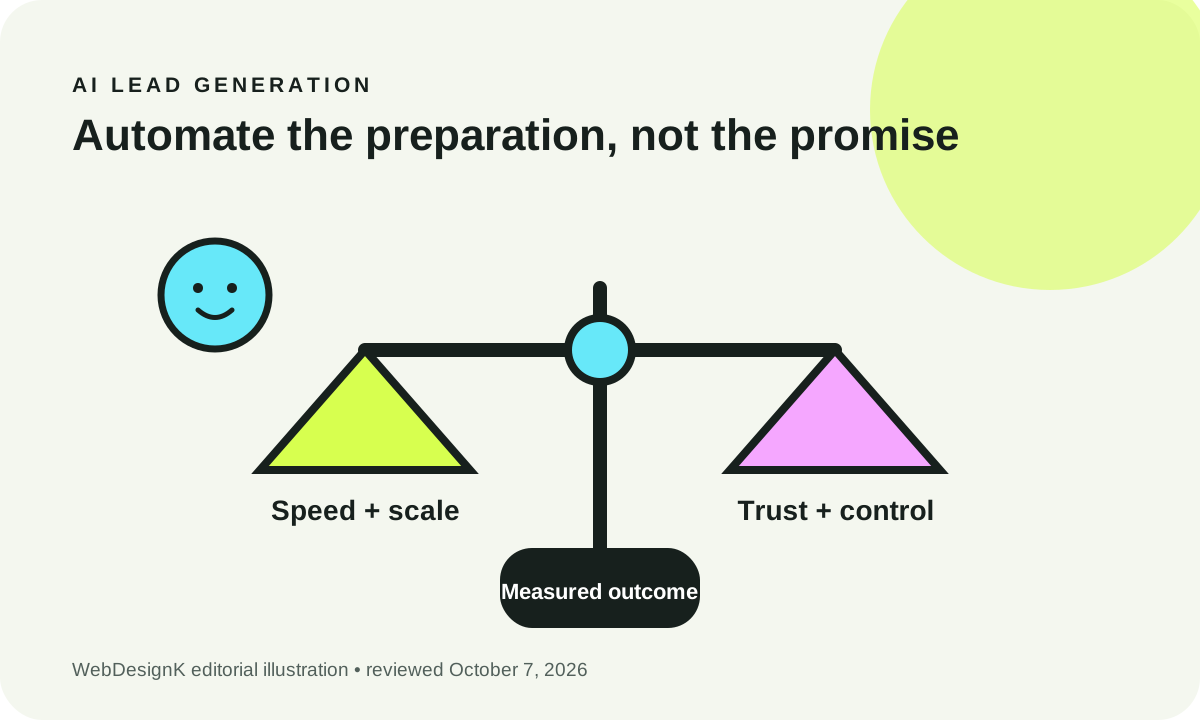
An AI content workflow turns research, drafting, fact-checking, publishing and distribution into a controlled sequence—not a button that writes and posts on its own. Start with a measurable audience problem, require traceable evidence for material claims, and give a named human the authority to approve each release. Use AI for summarizing, structuring and adapting approved material; keep factual sign-off, permissions and final publication deterministic.
What you'll decide: which editorial steps to automate, which claims need verification, who approves publication, how to reuse an article safely, and whether the time saved outweighs review and rework.
0. Decision snapshot
Decision snapshot: Automate repetitive preparation before automating external publication. The difficult choice is not which model produces the most words; it is how much human verification you can remove without increasing unsupported claims, duplicated work, privacy risk or reputational exposure. If you cannot point to a source and owner for an important sentence, delay that sentence rather than compensating with polished prose.
Editorial review: October 19, 2026. The workflows and examples below are operational guidance, not claims about a specific vendor or measured campaign.
1. Start with the business outcome, not the AI model
A content team can publish twice as much and still fail its purpose. Define the reader's decision first: Can a buyer compare implementation options? Can an existing customer complete onboarding? Can a sales engineer answer a recurring technical question without contradicting the product? Those outcomes determine the evidence, formats and review requirements.
Write a one-sentence assignment before selecting tools: "Help [specific audience] decide [specific question] using [acceptable evidence], and measure [observable reader action]." For a B2B software company, a practical assignment might be: "Help security leads decide whether a proposed SaaS integration can meet their data-handling requirements, using current engineering documentation and an expert-approved checklist, then measure qualified consultation requests." This is an illustrative assignment—not an observed client campaign.
Choose one primary business measure and several guardrails. Qualified leads or meaningful product activation may be the result you care about; time to publish, verified-claim coverage, corrections, and content age are operational guardrails. Record their definitions before you deploy an automation so an apparent increase in output cannot conceal extra editing work.
Define the evidence standard by claim type
A product feature should point to a current product specification, release note or demonstrable workflow. A customer quote requires documented consent and a verifiable attribution. A regulatory statement deserves primary guidance and appropriate professional review. A number about conversion needs actual denominators, timeframe and measurement method. An expert opinion should be identified as judgment rather than presented as a measured fact.
The U.S. FTC's advertising guidance explains why advertising claims need a reasonable evidentiary basis. Google Search's generative AI guidance warns against mass-generating low-value pages. Neither document says that adding human review automatically makes a page compliant or valuable: the work must actually support its claims and serve readers.
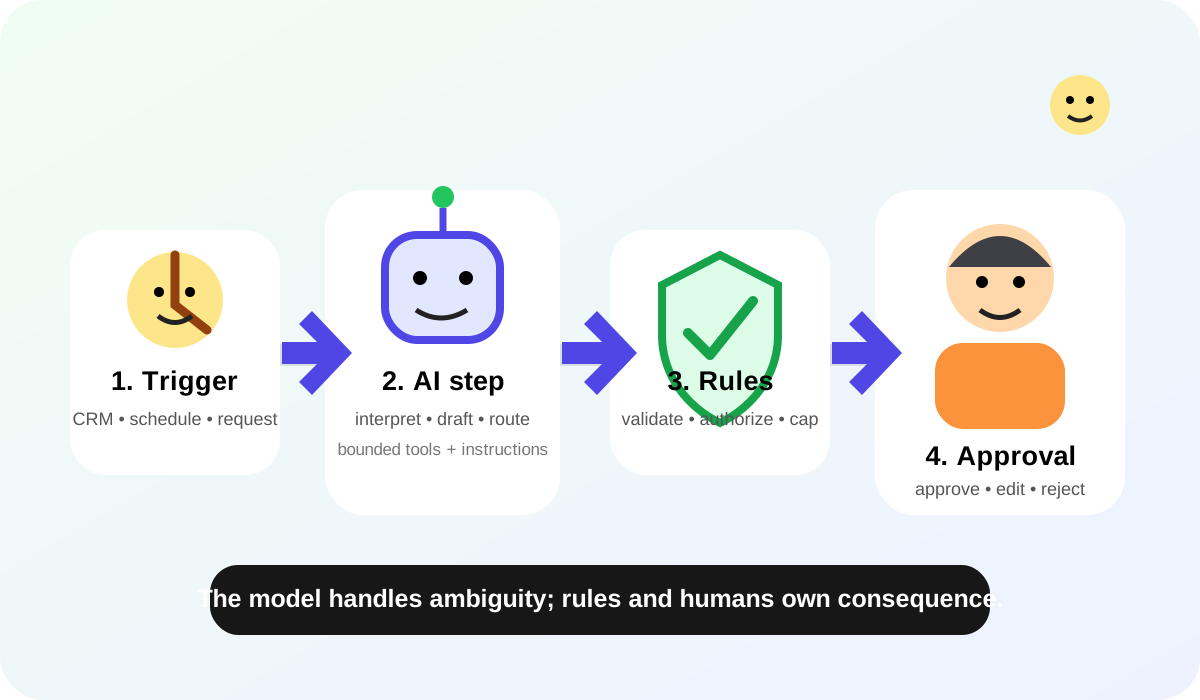
2. Map trigger → AI step → deterministic step → human review
Draw the existing editorial path on paper before introducing software. Note where research arrives, which people revise it, where approval is recorded and who controls publishing credentials. Otherwise you merely accelerate an undocumented process.

The strongest architecture separates activities that tolerate probabilistic output from those that require repeatable rules.
| Workflow | Trigger | AI step | Deterministic step | Human approval | Data | KPI | Primary risk | Impact / effort |
|---|---|---|---|---|---|---|---|---|
| Research brief | Approved topic request | Cluster questions and summarize supplied material | Record source URLs, author and retrieval date | Editor checks research scope | Source pack, brief | Brief acceptance rate | Unsupported summary | High / medium |
| Draft outline | Source pack approved | Propose a structure and alternative angles | Enforce required sections and word-limit guardrails | Editor selects argument | Audience goal, evidence list | Structural revision count | Generic or repetitive angle | Medium / low |
| Claim verification | Draft version created | Extract testable statements | Require source mapping, mark unmatched claims | Subject expert verifies each material claim | Draft, source registry | Verified-claim coverage | Confident misinformation | High / high |
| Publication QA | Content signed off | Suggest metadata and readability fixes | Validate links, canonical, accessibility, permissions | Publisher signs release | Approved revision, CMS | Avoidable post-publish defects | Accidental publication | High / medium |
| Distribution | Canonical article published | Adapt approved facts into channel formats | Use allowlisted channels, approved links and scheduled jobs | Channel owner approves variants | Approved revision, campaign brief | Useful referral actions | Context loss or overstated claims | Medium / medium |
Impact/effort values are editorial hypotheses for prioritizing a pilot, not industry performance data. Recalculate them against your process.
A safe state machine might be requested → researched → drafted → awaiting verification → approved → scheduled → published → monitored. A failed source check returns the work to research. Publication can occur only from an approved immutable revision; editing the draft after approval must invalidate or renew approval. If an external publishing API fails, retry the same idempotent job rather than creating duplicate posts.
A worked example: one sourced technical guide
Imagine a SaaS team preparing a guide on permission scopes. A product manager submits a question and an engineer supplies current internal documentation. An AI tool proposes likely user questions and a first outline, but the editor removes any topic not supported by the sources. The system extracts every product-capability claim into a review queue. Engineering checks those claims against the actual release, legal checks any privacy claims that warrant it, and marketing approves language and links.
Only that reviewed revision becomes the canonical article. A newsletter receives a short, source-preserving excerpt; a sales team receives a checklist based on the same approved facts. If a feature changes next month, the source owner updates the canonical revision and identifies which channel variants need withdrawal or correction. No numerical business benefit is assumed in this example.
3. Build the data and system prerequisites
Keep one canonical place for each article's title, audience, owners, claims, linked sources, status, approval history and publication destinations. A CMS may store the editorial content while another service stores audit events, but the relationship must be visible and stable. Avoid treating a model's conversation history as the content system of record.
Minimum operational fields should include: stable article identifier; source title, URL, author and retrieval date; claim identifier and supporting source; source owner and expected refresh window; revision number; reviewer role; approval decision and date; locale; canonical URL; permitted distribution channels; and rollback target. Not every field belongs in public HTML, but somebody must be able to reconstruct why a claim was published.
Where the research can fail
A retrieved page may be obsolete, promotional, translated incorrectly, or merely repeating someone else's unverified statement. A document labeled "internal approved" may refer to last year's product. A broken link may hide an otherwise valid claim. Ask what would disprove the assertion and prefer a primary source where practical.
For research involving nonpublic customer information, send the smallest necessary excerpt to a provider only when permissions and contractual controls allow it. Keep access controls in the retrieval layer. Redact secrets and personal data before prompts, logs, analytics and exports. A human reviewer is not a substitute for preventing access to information the model should never see.
The voluntary NIST AI Risk Management Framework and its generative-AI profile describe risk management throughout the AI lifecycle; they are useful operating references, not a certification that a particular workflow is safe.
4. Choose AI where judgment scales—not where a rule is better
AI can help discover recurring questions from an approved corpus, propose outlines, normalize terminology, extract candidate claims, prepare channel-specific versions and suggest readability revisions. It is most helpful when several plausible phrasings must be compared against human judgment.
Deterministic software should count versions, validate URLs, check media size, validate structured fields, enforce allowed destinations, inspect missing evidence, control review permissions, and record an audit trail. An AI model should never decide that it has permission to publish by asserting that a document "looks approved."
| Task | Use generative AI? | Prefer deterministic rule? | Must a human decide? | Why |
|---|---|---|---|---|
| Extract likely questions from approved interviews | Yes, with review | Validate input authorization | Yes for the final brief | Questions are interpretive |
| Rewrite approved paragraphs for a different channel | Yes | Preserve source IDs and limits | Yes before external release | Context may change meaning |
| Calculate verified claims / total claims | No | Yes | Human checks source quality | Arithmetic must be reproducible |
| Assign publication roles and access | No | Yes | Authorized owner approves access | Permissions are not a writing task |
| Decide whether a claim is substantiated | Assist only | Track review state | Qualified reviewer signs off | Evidence requires expert judgment |
| Schedule an approved post | No | Yes, with idempotency | Channel owner sets schedule | Predictability and rollback matter |
The distinction makes the automation easier to debug. If a claim appears in the wrong channel, you should know whether the error came from source selection, AI adaptation, approval or the scheduling job.
5. Build the human-in-the-loop approval and brand controls
"Human in the loop" is meaningless if someone only sees a green approval button. The reviewer needs the actual claim, a directly accessible source, the proposed public wording, previous revisions and a clear explanation of what changed since last approval. An editor might reject readability or tone; a technical owner might reject functionality; a legal reviewer might reject a promise that cannot be made.

A useful review interface offers four separate decisions: approved, revise wording, replace evidence, or remove claim. Require a reason for a high-impact rejection. Freeze a published revision so later draft edits do not silently modify previously approved content. Give reviewers a diff, not an entire article to re-read blindly.
Brand quality is more than a style prompt
Define prohibited promises, accepted terminology, first-person claims that need attribution, non-negotiable accessibility rules and escalation contacts. A style guide can suggest how to sound. It cannot establish whether a customer outcome really happened. The final owner should have authority to hold a release when sourcing fails, even if the publishing calendar is full.
A good policy says who may publish, who may approve their own work, which claims require independent review, when approvals expire and how a correction is announced. For high-risk or regulated topics, obtain appropriate specialist review rather than treating this article as legal advice.
6. Connect the CMS, analytics and messaging systems without creating a data tangle
A content workflow usually touches a repository of references, a draft store, a CMS, analytics and one or more outbound channels. Start with event contracts, not tool logos. The workflow needs to know which article version is approved, not merely that a file with a familiar title exists.
Use a small, auditable exchange object: article ID, revision, locale, status, source verification status, approved channel set and intended publication time. On approval, schedule a job containing only the approved revision ID. On delivery, record the destination URL and external message ID. A later correction should link the new revision to all dependent outputs.
How the integrations divide responsibility
A CRM can tell the editor which objections recur in qualified sales conversations when consent, permissions and aggregation support that analysis. Analytics can show whether published pages help users reach relevant destinations, but a pageview by itself is not proof of a sale or reader satisfaction. A CMS should own published content and editorial history. Messaging systems should accept approved payloads and return delivery status.
Do not send raw CRM notes, customer emails or personally identifiable details into prompts just because an integration permits it. Obtain appropriate permission, minimize retention and define whether each tool processes customer information. A privacy assessment may change the automation decision even if the workflow looks technically easy.
Avoid the two classic automation traps
First, do not create a circular synchronization loop: if a CMS saves a metadata edit and triggers CRM updates, ensure a subsequent CRM webhook does not republish the same article. Use stable identifiers, deduplication keys and bounded retries. Second, keep provider failures from erasing editorial work. A publication job may fail without losing the approved draft; it can be retried or rescheduled after the operator reviews the error.
When you localize, translation is another editorial state rather than a string operation. A U.S.-Spanish article may need a different example, localized legal review, approved source links and metadata. Record language-specific review and canonical/hreflang decisions before public distribution.
7. Measure quality, attribution and failure—not just article output
A baseline dashboard needs fewer vanity numbers and more review signals. Consider: how many factual claims have verified primary sources; how many drafts reach human approval without substantial revision; how many posts are corrected after release; how long a source remains current; how many publication jobs fail; and what proportion of referred visitors complete a meaningful next action.
Claim coverage can be defined as supported material claims divided by all material claims reviewed. A claim with three irrelevant links still counts as unsupported. Correction rate is the share of published pieces that required a material factual correction during a defined window; explain what counts as material and preserve the original revision. Workflow throughput is approved useful content per period, not the number of generated drafts.
No attribution model can prove that a single article caused every subsequent sale. Use UTM tagging and explicit event naming to observe paths while acknowledging repeat visits, offline sales and delayed decisions. Tie a CTA to the reader's next step, but do not add aggressive popups merely to increase event counts.
Failure modes to include in an operational playbook
- Unsupported assertion: remove the sentence, attach an authoritative source or request a qualified review; do not have AI invent a citation.
- Source drift: mark a source as requiring revalidation when its owner changes the product documentation or relevant rules.
- Approval race: require an explicit revision match; a new edit voids approval for the previous draft.
- Broken destination: pause or retry scheduled delivery with the same idempotency key; alert a channel owner.
- Distribution mismatch: withdraw the affected variant and fix the source-to-channel mapping.
- Privacy incident: stop affected processing, preserve appropriate audit evidence and invoke the organization's incident process.
The role of monitoring is to surface defects early, not to collect everything. Exclude raw research notes and personal information from ordinary engagement telemetry. Use consent-gated analytics where required and publish a clear explanation of the signals actually used.
8. Model throughput, cost and ROI with review included
The useful comparison is end-to-end approved work, not raw model tokens or first drafts. Build your own baseline over a few representative pieces. If an editor spends four hours assembling an article, an AI-assisted first draft that saves ninety minutes but adds two hours of fact-checking has not saved time. That is illustrative arithmetic, not a measured industry result.
Use this explicit model:
Net editorial minutes saved per approved article = baseline manual minutes − (AI-assisted preparation minutes + human review minutes + correction/rework minutes).
Gross monthly labor value = net minutes saved × approved articles per month ÷ 60 × fully loaded hourly cost. Then subtract model/API fees, software subscriptions, implementation amortization and incremental monitoring overhead to estimate net workflow value. Do not assume that staff hours translate automatically into reduced payroll or extra sales. Freed capacity may instead improve accuracy or enable technical interviews.
The same economics should be compared by workflow. A weekly source-to-brief summarizer may be inexpensive to test and easy to reverse. An autonomous system that pushes customer-facing promises to multiple channels can create a much larger downside. Start with high-frequency, reversible tasks whose source documents and acceptance checks already exist.
| Economic input | Baseline method | Pilot measurement | Decision use |
|---|---|---|---|
| Manual preparation time | Timed samples of current process | Time only approved tasks, not abandoned AI drafts | Compare equivalent quality |
| Human review time | Reviewer time log | Include expert escalation and approvals | Detect hidden rework |
| Corrections after publishing | Defined material-correction log | Count events and effort per published piece | Set rollback thresholds |
| Provider and platform costs | Actual invoices by usage | Record model, storage, retrieval and jobs | Avoid free-tier assumptions |
| Downstream usefulness | Agreed qualified-action definition | Compare with a credible baseline and attribution caveats | Decide whether to expand |
For operations planning, use two scenarios—a conservative one with high review effort and a favorable one with faster preparation. The difference between them is a reason to gather evidence, not a promise of ROI.
9. Build a research-to-distribution workflow for your next article
The following interactive lab turns a proposed article into an explicit evidence-and-approval gate. Enter only counts and role availability; do not enter names, research notes, claims or confidential source text. The computation runs within the page's isolated local widget and does not call an AI service. It checks whether your planned workflow has sufficient claim mapping, named ownership, expertise, review capacity, source freshness and approved distribution channels. Its scores are input-based planning indicators, not verified proof or permission to publish.
What the results mean: an incomplete evidence count produces HOLD; complete prerequisites without human approval produce READY FOR REVIEW; complete prerequisites with an explicit human approval checkbox produce SCHEDULING CHECKLIST READY. In every case the real CMS and authorized publisher—not this tool—decide whether material goes live. Use its copyable checkpoint list in your editorial ticket.
This lab is deliberately stricter than a generic marketing automation calculator. It cannot know whether a linked source is trustworthy; it only makes missing checks conspicuous. A toggle increases the required number of reviewers when a high-risk topic needs a second pair of eyes. Empty and invalid inputs cannot silently become zeros and cannot generate a green status.
Interactive tool — provenance-aware editorial approval builder
10. Distribute approved facts, not a second set of unreviewed claims
A canonical article can be adapted into a newsletter, a social summary, a product note or a sales enablement card. Each channel needs its own character limits, disclosure requirements, accessibility checks and call-to-action destination, but none should gain new claims just because the AI was asked to make a draft "more persuasive."

The distribution gate should verify that the underlying article revision is still approved, that every adapted factual statement maps back to that approved source, and that channel-specific owners signed off. Publish canonical content before syndicating excerpts when that supports the editorial plan. When facts change, attach a correction and send the channel owner a replacement suggestion instead of assuming every prior post should be overwritten.
Three channel-specific examples
A newsletter can explain the reader question in plain language and link to the full evidence table. A professional social update should use a narrow, supported takeaway rather than a sweeping outcome claim. A sales handoff can give a representative an approved list of questions to ask and explicitly label any illustrative scenario. These are different jobs; copying the same AI paragraph into all three is not distribution strategy.
Channel owners should record which actions are allowed: schedule, publish, pause, retract or edit. Avoid direct publishing from a draft-generation tool. If publishing credentials are compromised or content is found to be materially wrong, your runbook needs a clear owner and a reversible path.
11. Run a reversible pilot and a 90-day governance plan
A responsible rollout is a sequence of increasingly consequential permissions.
Days 1–15: observe and define. Map the current workflow, gather a representative sample of past briefs and drafts, inventory claims and sources, and agree on editorial definitions. Make the owner for each review stage visible. Choose one business outcome and write down the baseline. Do not connect automated public distribution yet.
Days 16–30: shadow-mode rehearsal. Generate research briefs and outlines beside the existing process. Compare them using the same acceptance checks. Track unsupported claims, missing attribution, review time and recurring failure patterns. Record which tasks would be better handled by deterministic templates instead of AI.
Days 31–60: controlled publishing. Permit AI-assisted preparation and approved CMS draft creation. Keep an explicit reviewer and separate release role. Run link, accessibility, privacy, SEO and permission checks against real preview pages. Publish a limited number of approved pieces and watch correction rates and source freshness.
Days 61–90: measured channel reuse. Expand only workflows whose evidence and review performance are acceptable. Add distribution adaptations to one channel at a time, with a rollback mechanism and documented ownership. Review actual downstream reader actions without claiming causal revenue you cannot prove.
Promotion and rollback criteria
Before every permission increase, ask: Did any unsupported claim reach a public channel? Can the owner reproduce why each substantial claim was accepted? Did total review plus correction effort actually fall? Do edits invalidate old approvals? Can a failed job be retried without duplicates? Does a localized version have independent sign-off? If the answer is no, pause the automation tier and improve the process.
The goal is not a publishing factory that runs unattended. It is a traceable system that helps people turn expertise into useful, current material. Once the evidence and human approval processes are dependable, automation becomes a multiplier rather than a source of hidden editorial debt.
Practical next steps and related guides
If you need to build this with your team, WebDesignK's AI marketing service can help scope the source inventory, workflow events, review permissions, CMS integrations and reversible distribution jobs. Useful discovery inputs are a sample brief, current approval roles, your CMS and channel list, and one recent piece with its source history. The output should be a prioritized, testable implementation plan—not an unspecified promise to "automate content."
Read alongside AI marketing automation: what to automate first, AI agents for marketing: 15 workflows and AI SEO/GEO: search optimization across engines. The first clarifies selection, the second shows operational use cases, and the third explains why distribution reach is not equivalent to search visibility.
Sources and review notes
- NIST AI Risk Management Framework and the Generative AI Profile, for voluntary risk management concepts.
- Google Search's guidance on generative AI content and people-first content, for search quality and spam-policy context.
- FTC Advertising FAQs and endorsements guidance, for U.S. evidence, truthfulness and disclosure considerations.
Reviewed October 19, 2026. All matrices, diagrams, workflow examples, labels, calculations and scores on this page are original explanatory models unless explicitly sourced. This is operational education, not legal advice or measured company performance.