Quick answer
Use AI where the job is bounded and measurable: approved-answer retrieval, lightweight qualification, routing, summarization and context transfer. Keep humans close to commercial commitments, ambiguous intent and high-risk claims. Baseline the exact funnel step first, segment by intent/source/device, test one friction hypothesis at a time, and treat modeled revenue as arithmetic—not promised uplift.
Last reviewed: 2026-10-07T00:00:00.000ZRevenue-impact scenario calculator
Enter your own eligible traffic or leads, observed conversion rate, modeled conversion rate, average order/deal value and margin. The defaults are illustrative placeholders only—not market benchmarks. Results are arithmetic scenarios, not promised uplift.
1. Conversion scenario across traffic checkpoints
Takeaway: the gap scales with your eligible volume only because the modeled rate is applied consistently to your own traffic input.
2. Baseline vs modeled revenue
Takeaway: revenue follows conversions × your average order/deal value; no extra uplift assumption is added.
3. Modeled revenue composition
Takeaway: margin changes the economic value of a conversion without changing the conversion count itself.
Scenario table generated from your inputs
| Measure | Current | Modeled | Difference |
|---|---|---|---|
| Conversion rate | 2% | 2.5% | 0.5 pp |
| Conversions | 200 | 250 | 50 |
| Revenue | $40,000 | $50,000 | $10,000 |
| Gross profit | $20,000 | $25,000 | $5,000 |
Important: this calculator does not estimate causality or probability. A modeled conversion rate is a planning assumption until a valid experiment or other evidence supports the change.
Tables built for the buying decision
Primary decision table
| Friction hypothesis | Page / step | Change | Primary metric | Guardrail | Effort | Confidence |
|---|---|---|---|---|---|---|
| High-intent prospects repeatedly ask an approved product-fit question before booking | Pricing / service page | AI Q&A limited to approved docs + immediate human handoff | Qualified meeting progression | Unsupported-answer rate; sales acceptance | Medium | High when transcript/search evidence shows repeated question |
| Visitors abandon because the form asks for fields sales does not use | Demo request | Conversationally collect only routing-critical fields; defer the rest | Qualified submit rate | Sales missing-data burden; spam rate | Medium | High after CRM field audit |
| Sales loses context when chat hands off to a person | Chat → sales handoff | Generate a factual summary with stated need, answers and unresolved questions | Successful handoff / meeting progression | Summary correction rate; sensitive-data leakage | Medium | High when reps report repeated context loss |
| Exploratory visitors are pushed into a sales flow too early | Educational article | Use AI to recommend a relevant next resource before commercial CTA | Relevant next-step progression | Unsubscribe / low-quality lead rate | Low | Medium when intent mix is clearly exploratory |
| AI assistant invents capability details on ambiguous questions | Chat / qualification | Restrict answers to approved sources and escalate unknowns | Verified-answer completion | Unsupported-claim rate | Medium | High if evaluation reproduces the failure |
| Mobile visitors struggle with a full-screen chat experience | Mobile landing page | Reduce launcher prominence; preserve page CTA and human contact path | Qualified mobile task completion | INP/CLS; accidental exits; chat close rate | Medium | High when mobile QA/performance shows friction |
| Follow-up is slow after a qualified request | Lead follow-up | Draft a contextual follow-up from verified CRM/chat facts for human review | Time-to-first-useful-response | Correction/rejection rate; opt-out rate | Medium | Medium until workflow timing and review burden are measured |
| Lead scoring suppresses potentially valuable prospects | Routing queue | Use transparent criteria and AI as reviewer aid, not silent rejection policy | Sales acceptance / routed opportunity quality | False-negative review sample | High | Medium until scoring criteria are validated against outcomes |
AI lead-generation segmentation and guardrail plan
| Segment | AI job | Primary outcome | Guardrail | Human boundary | Interpretation question |
|---|---|---|---|---|---|
| High-intent pricing/service traffic | Approved Q&A + qualification | Qualified meeting progression | Sales acceptance; unsupported claims | Human available immediately | Did AI remove an information/routing delay? |
| Exploratory content traffic | Question answering + next-resource recommendation | Relevant next-step progression | Aggressive lead capture; bounce quality | No forced qualification | Did the experience help discovery without pretending purchase intent? |
| Mobile high-intent | Compact Q&A / routing | Qualified task completion | INP, CLS, input errors, overlap | Visible contact alternative | Did AI help after controlling for device/source mix? |
| Existing customer/support | Intent detection + support routing | Correct authenticated support path | Misrouted sales leads; privacy errors | Escalate account-specific cases | Did the system avoid contaminating the sales funnel? |
| Enterprise/security question | Retrieve approved facts | Useful answer or correct escalation | Unsupported commercial/security claim | Owner review for commitments | Did AI stay inside approved evidence? |
| Ambiguous intent | One clarifying question | Correct next-step route | Looping / abandonment | Human escape after failed clarification | Did clarification reduce rather than add friction? |
Turn this planning result into a scoped review.
Send the assumptions, constraints and result summary. WebDesignK can review the architecture/content/implementation boundary, identify missing discovery inputs and return a prioritized next-step scope.
- Bring: current site/product, constraints, integrations and your tool result.
- You get: a scoped recommendation, open questions and implementation priorities.
AI can improve lead generation when it removes real decision friction: faster qualification, better routing, useful answers, cleaner CRM context and more relevant follow-up. It hurts conversion when it invents facts, forces every visitor into a bot, over-qualifies too early, adds latency or replaces persuasive human proof with synthetic copy. Start with a measured baseline, automate a narrow job, preserve human escape routes, and test the business outcome—not “AI engagement” by itself.
What you'll learn / decide
- where AI can remove friction without pretending it creates demand
- how to define the denominator and lead-quality outcome before optimizing
- which AI-assisted experiences deserve experiments versus human review
- how to segment high-intent, exploratory, mobile and source-specific traffic
- how to model revenue scenarios without presenting them as forecasted uplift
- how to build a 90-day backlog with guardrails for quality, trust and operational load
Last reviewed: October 7, 2026. AI products, analytics terminology and model behavior change quickly. Re-check vendor and measurement documentation before changing production workflows.
Decision snapshot for AI Lead Generation
The useful question is not “Should we use AI for lead generation?” It is which part of the buyer journey has a repeatable decision or information bottleneck that AI can improve without reducing trust or lead quality.
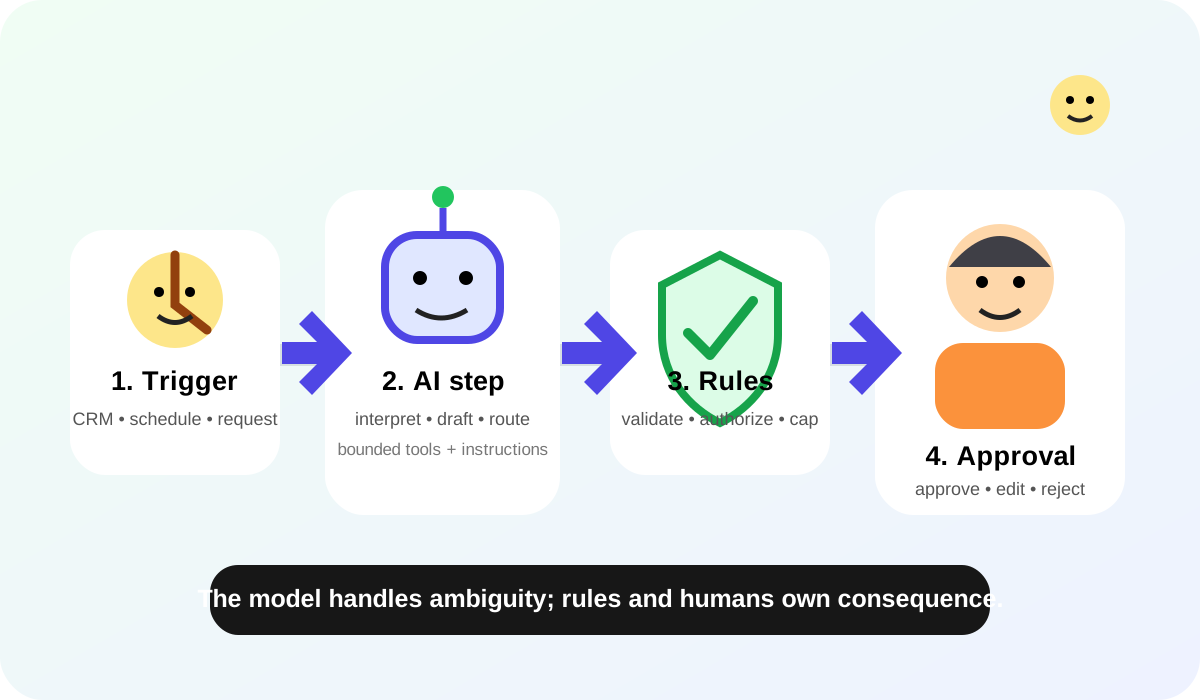
AI is strongest when the task is bounded: answer from approved product knowledge, ask a small number of qualification questions, summarize a conversation, enrich a CRM record from verified data, suggest the next relevant resource, or route a high-intent prospect to the right human. It is weaker when the task requires making unsupported promises, interpreting ambiguous commercial intent, handling sensitive edge cases, or pretending to be a human expert.
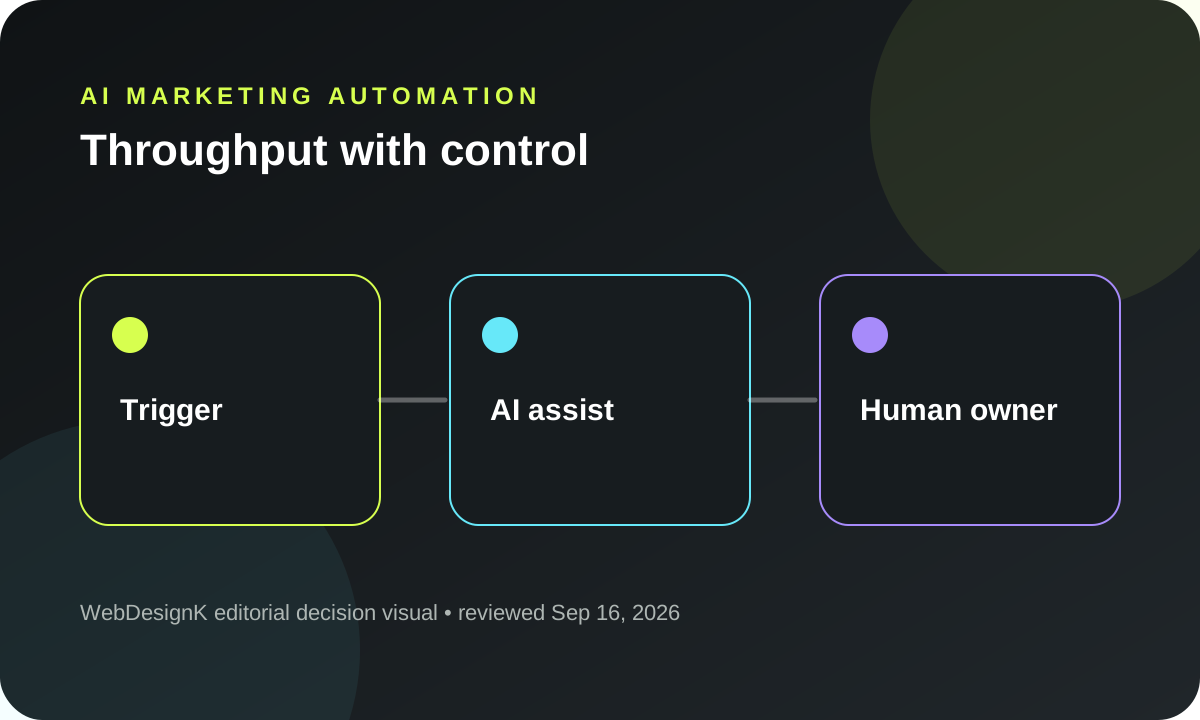
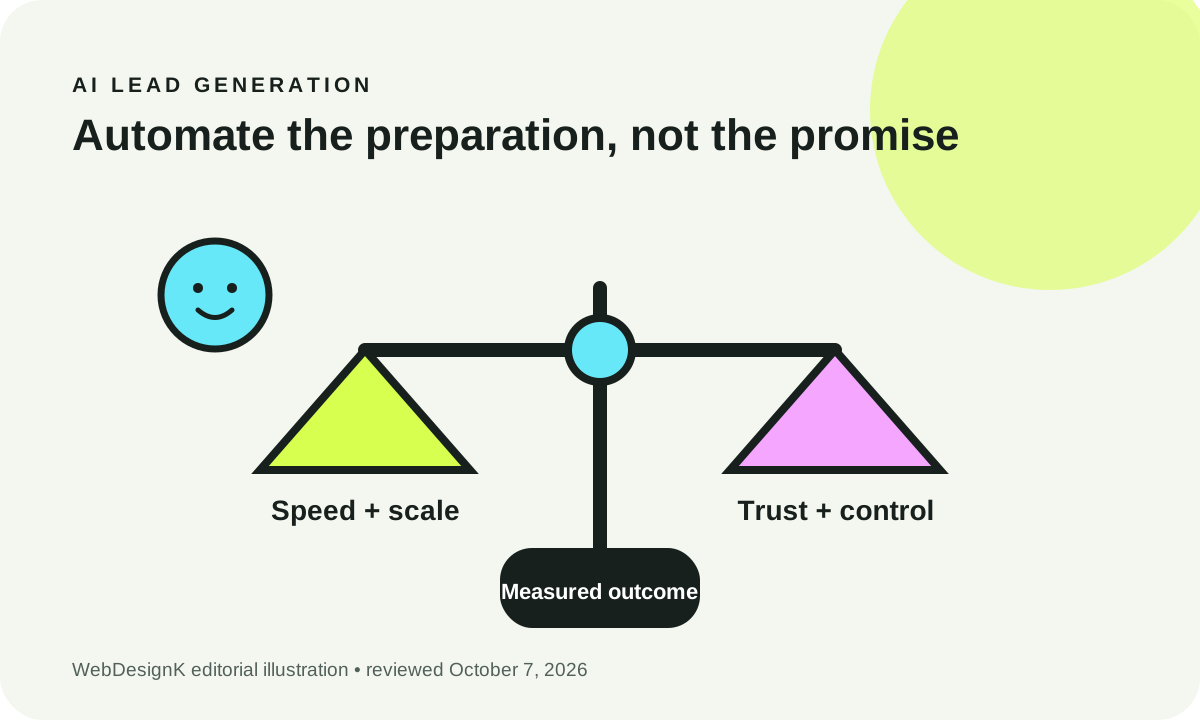
The main tradeoff is speed and scale versus confidence and control. A bot can respond instantly, but an instant wrong answer about price, integration support, security or contract terms can create more friction than a slower human response.
Use the revenue-impact calculator on this page only as scenario arithmetic. A modeled conversion rate is an input—not evidence that AI will produce that result.
Define the visitor decision and business outcome
Before adding a chatbot, scoring model or automated follow-up, write the visitor decision in plain English.
Examples:
- “Can this product integrate with our CRM?”
- “Is this service appropriate for a 200-person company?”
- “Can I get a realistic implementation conversation this week?”
- “Which plan fits our workflow?”
- “I am still learning—what should I read next?”
Those are different jobs. A single “AI lead generator” should not treat them as one funnel stage.
Define the conversion and the quality gate together
A lead-generation conversion should not stop at “form submitted.” If your sales team rejects half of those leads, increasing raw submissions may create negative value.
For a B2B flow, define:
Primary outcome: qualified meeting booked, accepted lead, demo request that meets agreed criteria, or another meaningful progression.
Guardrail: sales acceptance, spam rate, no-show rate, support burden, unsubscribe rate, complaint rate or downstream opportunity quality.
For ecommerce or lower-consideration offers, the primary outcome may be a purchase or checkout progression, while the guardrail may be refunds, cancellations, margin or support contacts.
Map AI to one buyer job
A practical AI lead-generation backlog separates jobs:
- Discovery: explain product/service fit from approved sources.
- Qualification: collect only the fields needed to route the prospect.
- Routing: send the prospect to sales, support, self-serve or a resource.
- Summarization: create a concise context packet for the human team.
- Follow-up: draft a relevant message from known conversation facts.
- Scoring/prioritization: assist review, but keep criteria transparent and auditable.
The tighter the job, the easier it is to measure whether AI helped.
Capture the baseline before changing anything
Do not compare an AI-enabled week with a pre-AI month unless the traffic mix, offer, campaign mix and funnel definition are comparable.
Start with the exact denominator. Examples:
- eligible sessions that viewed a pricing or service page
- visitors who opened the lead flow
- qualified conversations that reached a routing decision
- form starters
- authenticated users who reached an upgrade prompt
Google Analytics currently distinguishes events that matter to the business as key events, while ad-platform “conversions” are used for campaign measurement. Whatever tool you use, define the event and scope clearly before testing.
Segment the baseline
At minimum, separate:
- high-intent vs exploratory visitors
- mobile vs desktop
- paid vs organic/referral/direct where relevant
- new vs returning when behavior differs materially
- branded vs non-branded search when available
- geography or market when the offer changes by region
Google Analytics traffic-source dimensions such as source, medium and campaign are designed to help analyze where visitors came from. Use that context so an apparent AI uplift is not really a change in campaign mix.
Freeze the baseline definition
Record the measurement window, eligibility rule, primary metric, guardrail metrics and excluded traffic before launch. If you change the denominator halfway through the experiment, you no longer have a stable comparison.
Find the highest-friction moments
AI should solve observed friction, not create a new interface because the technology is available.
Look for evidence from:
- form abandonment and validation errors
- chat transcripts and support questions
- sales call notes
- page search queries
- CRM rejection reasons
- usability sessions
- mobile performance data
- repeated comparison or implementation questions
- long response delays before a human can engage
A useful friction hypothesis has a cause, not just a symptom.
Weak: “People do not convert.”
Better: “High-intent visitors repeatedly ask whether the product supports SSO before booking a demo, and the pricing/service page does not answer it.”
That hypothesis gives you several options: improve the page, add an FAQ, expose a comparison table, or let an AI assistant answer from approved documentation. AI is one implementation choice, not automatically the solution.
Where AI often helps
AI is useful when the friction is information retrieval, classification or context packaging:
- retrieve an approved answer from documentation
- classify the user’s job and route them
- summarize a long conversation for sales
- extract explicit requirements from a prospect’s message
- draft a follow-up using only verified conversation facts
- recommend the next content asset based on stated intent
Where AI often hurts
AI can add friction when:
- it opens before the visitor can read the page
- it asks qualifying questions before earning trust
- it blocks contact details or human access
- it produces vague, verbose answers
- it invents pricing, feature, security or legal claims
- it repeatedly asks for information the visitor already supplied
- it cannot recover when it misunderstands intent
- it adds enough JavaScript/network work to make mobile interaction slower
NIST’s Generative AI Profile specifically discusses “confabulation”—confidently presented false or erroneous content—as a risk. For lead-generation systems, that risk is commercial: a fabricated capability or policy can poison the conversation before sales sees the lead.
Message, proof, CTA and form/checkout design
AI does not fix a weak value proposition. If the page cannot explain who the offer is for, what problem it solves and why the company is credible, a chatbot often becomes a conversational wrapper around the same ambiguity.
Let the page do the persuasion
High-intent pages should expose critical proof without requiring a chat:
- relevant customer/use-case evidence
- implementation expectations
- security or integration information
- plan boundaries
- clear next-step expectations
- realistic contact response path
Then AI can help answer the long tail.
Keep qualification proportional
Ask only what changes the next step. A lead-routing assistant might need company size, use case, timeframe or current system. It probably does not need every CRM field before the prospect can speak to someone.
Progressive qualification usually creates a better interaction model:
- answer the user’s immediate question
- identify whether intent is exploratory or commercial
- ask one or two routing questions
- offer the appropriate human or self-serve next step
- pass the context forward so the user does not repeat it
Avoid synthetic proof
Do not fabricate testimonials, customer quotes, analyst statements, urgency, scarcity or usage numbers. The FTC has repeatedly warned about interface patterns that manipulate choices or hide material information. AI-generated personalization does not make deceptive design acceptable.
A generated sentence such as “Companies like yours usually save 40%” is not harmless filler if no evidence supports it. Remove unsupported performance claims and keep source provenance near changeable facts.
Mobile-specific friction
Mobile exposes every extra step. A lead flow that feels acceptable on desktop can become painful when the keyboard covers controls, the chat window consumes the screen or a long generated response pushes the CTA far away.
Test at a realistic mobile viewport and check:
- page-level horizontal overflow
- chat launcher overlap
- sticky header/toolbar collisions
- input focus and keyboard behavior
- validation placement
- tap target size
- scroll position after bot messages
- recovery from long answers
- the human/contact escape route
- load and interaction performance
Current Core Web Vitals include LCP, INP and CLS, with field-oriented thresholds used to classify user experience. Do not treat a good score as proof of conversion impact, but use performance as a guardrail so an AI widget does not degrade the experience you are trying to improve.
Compare mobile like-for-like
Mobile traffic often has different source and intent mix from desktop. Compare device performance within similar campaigns or landing-page groups before deciding the AI UI is the cause.
Segment by source and intent
AI lead generation should adapt the next action, not make invisible assumptions about the person.
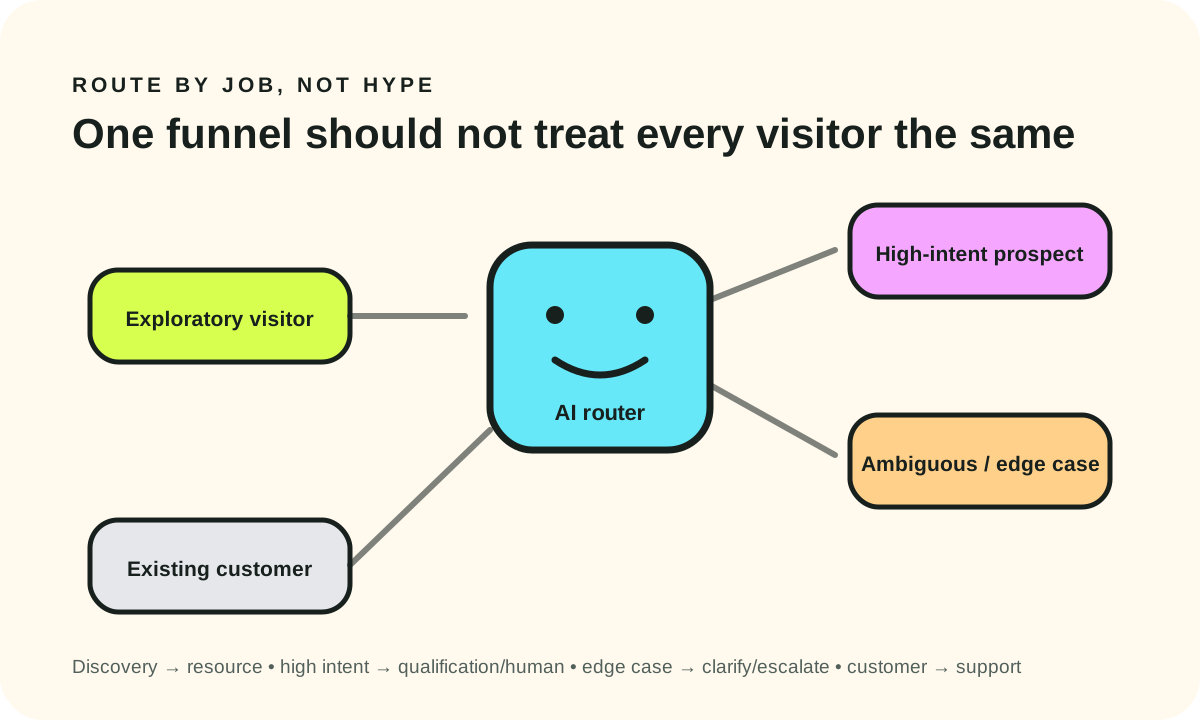
A visitor from a branded pricing query may be ready for implementation detail. A visitor reading an educational guide may need a next resource, not a sales interrogation.
Build a small segment matrix:
High intent + commercial page: expose proof, concise qualification and fast human access.
Exploratory + educational page: answer questions, recommend relevant content, avoid aggressive lead capture.
Existing customer/support intent: route away from sales and into authenticated support when appropriate.
Unknown/ambiguous intent: ask one clarifying question instead of guessing.
Do not over-trust AI scoring
If an AI model labels a lead “low quality,” understand which fields or behaviors influenced that decision before suppressing the lead. Keep the scoring criteria reviewable and periodically compare them with real sales outcomes.
For high-impact routing or eligibility decisions, AI should support accountable human processes rather than silently becoming the policy.
Prioritized experiment backlog
An experiment backlog should rank evidence-backed friction, not AI feature ideas.
Each row needs:
- friction hypothesis
- page or funnel step
- proposed change
- primary metric
- guardrail
- effort
- confidence
- stopping or learning rule
Examples are in the decision table below.
Write the hypothesis before the implementation
Example:
For high-intent pricing visitors who ask about integrations, showing an AI assistant that answers only from approved integration docs and offers a human handoff will increase qualified meeting progression without reducing sales acceptance or increasing support corrections.
Now the test has an audience, intervention, outcome and guardrails.
Predefine the stopping/learning rule
Do not stop when a chart “looks good.” Define the exposure window, minimum data needs and decision rule with your experimentation/analytics owner before the test.
Also define operational failure rules. If the bot produces unsupported commercial claims, routes prospects incorrectly or loses human handoff context, pause the experiment even if the raw conversion number rises.
Model revenue impact without promising uplift
The calculator on this page uses five inputs:
- eligible traffic or leads
- observed current conversion rate
- modeled conversion rate
- average order/deal value
- gross margin
It then performs arithmetic. It does not estimate the probability that your experiment will achieve the modeled rate.
Suppose you enter 10,000 eligible visits, 2% current conversion, 2.5% modeled conversion and a $200 average value. The calculator can show the mathematical difference between those scenarios. It cannot tell you whether AI causes the change.
Use the model for prioritization
Scenario arithmetic helps answer:
- Is this funnel step economically meaningful enough to prioritize?
- How sensitive is the outcome to conversion rate or deal value?
- Does a small modeled change justify expensive implementation work?
- Does margin materially change the business case?
It should not be used as a sales promise.
Track downstream quality
For B2B lead generation, model outputs become more useful when you separately measure accepted leads, meetings held, opportunities or another agreed quality signal. A higher top-of-funnel conversion with lower downstream acceptance can be a regression.
Measurement and guardrail metrics
A practical measurement stack has several layers.
Experience metrics
- form completion
- chat start/completion
- response latency
- error/recovery rate
- mobile performance
Lead-quality metrics
- sales acceptance
- meeting held
- qualified opportunity progression
- spam/duplicate rate
AI quality metrics
- grounded/verified answer rate from evaluation samples
- unsupported-claim rate
- successful human handoff
- escalation accuracy
- correction/review burden
Business metrics
- qualified conversion
- revenue or pipeline where measurement is appropriate
- margin
- support/sales workload
Instrument AI interactions as events, not outcomes
“Chat started” is behavior. It is not automatically a business success. A visitor may open chat because the page failed to answer a basic question.
Measure the meaningful downstream event and preserve the source/session context needed to interpret it.
Google Analytics currently lets businesses mark important events as key events. Use naming and event parameters that distinguish stages—such as lead_flow_started, qualified_route, meeting_booked and human_handoff—rather than one overloaded conversion event.
Monitor model errors independently
Do not wait for conversion data to reveal hallucinations. Build a QA sample of real intents and test:
- approved factual answers
- unknown/unsupported questions
- competitor comparisons
- pricing and contract questions
- security/legal questions
- hostile or manipulative prompts
- ambiguous intent
- human escalation
The business metric and the AI quality metric should meet before expansion.
90-day optimization roadmap
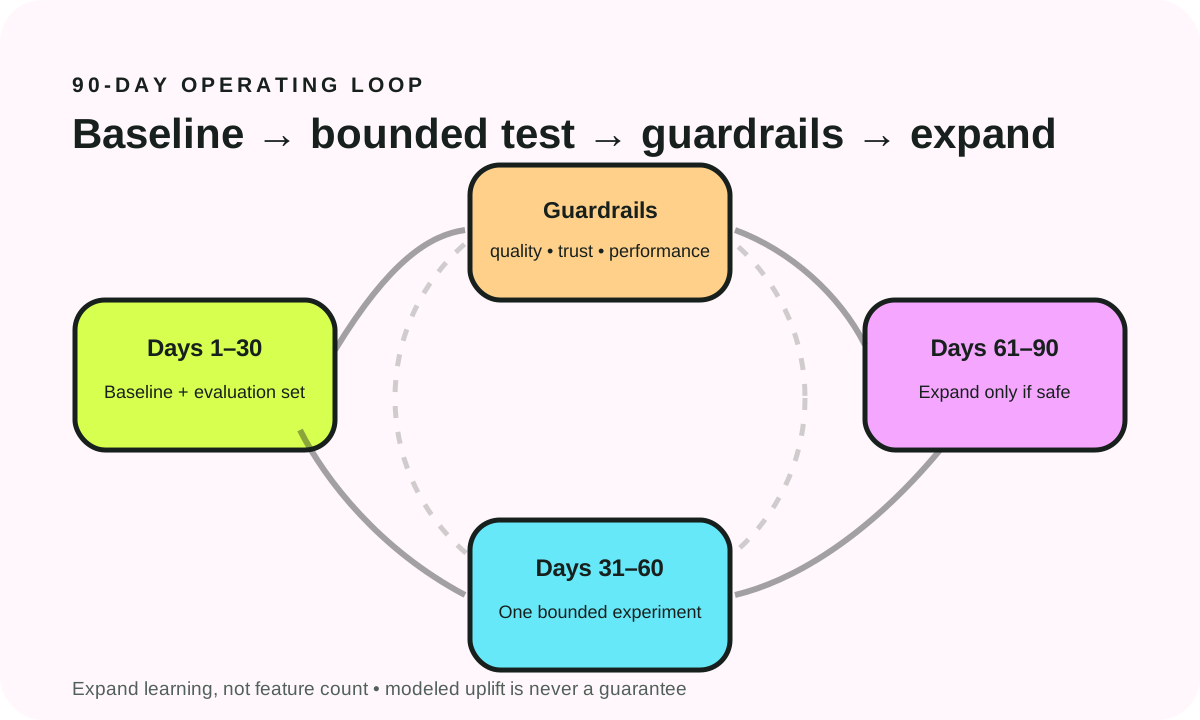
Days 1–30: define, instrument and diagnose
Choose one funnel step. Document the denominator, primary outcome and guardrails. Review transcripts, forms, sales rejection reasons and performance data.
Create an evaluation set for the proposed AI job. If the assistant answers product questions, include known-answer, unknown-answer and escalation cases.
Build the baseline by source, intent and device. Do not deploy broad personalization yet.
Days 31–60: run one bounded AI experiment
Pick the highest-confidence friction hypothesis.
Examples:
- approved-doc Q&A on a pricing/service page
- conversational qualification with immediate human escape
- sales handoff summary
- follow-up draft reviewed by a human
Instrument both business and AI-quality outcomes. Keep a manual review sample. Record operational incidents.
Days 61–90: expand only what survived guardrails
If qualified progression improves and guardrails remain acceptable, widen exposure carefully.
If raw conversion rises but sales acceptance, trust, correction burden or mobile performance worsens, treat the test as unresolved or negative.
Turn learnings into reusable components: approved knowledge sources, routing policies, handoff schema, evaluation cases and analytics definitions.
Build the post-90-day operating loop
A mature AI lead-generation system should have:
- a named owner for knowledge and routing rules
- regular review of unsupported-answer samples
- a stable experiment backlog
- source/intent/device segmentation
- human handoff QA
- model/vendor change review
- rollback criteria
- downstream lead-quality feedback
That operating loop matters more than the initial chatbot launch.
Practical AI lead-generation boundaries
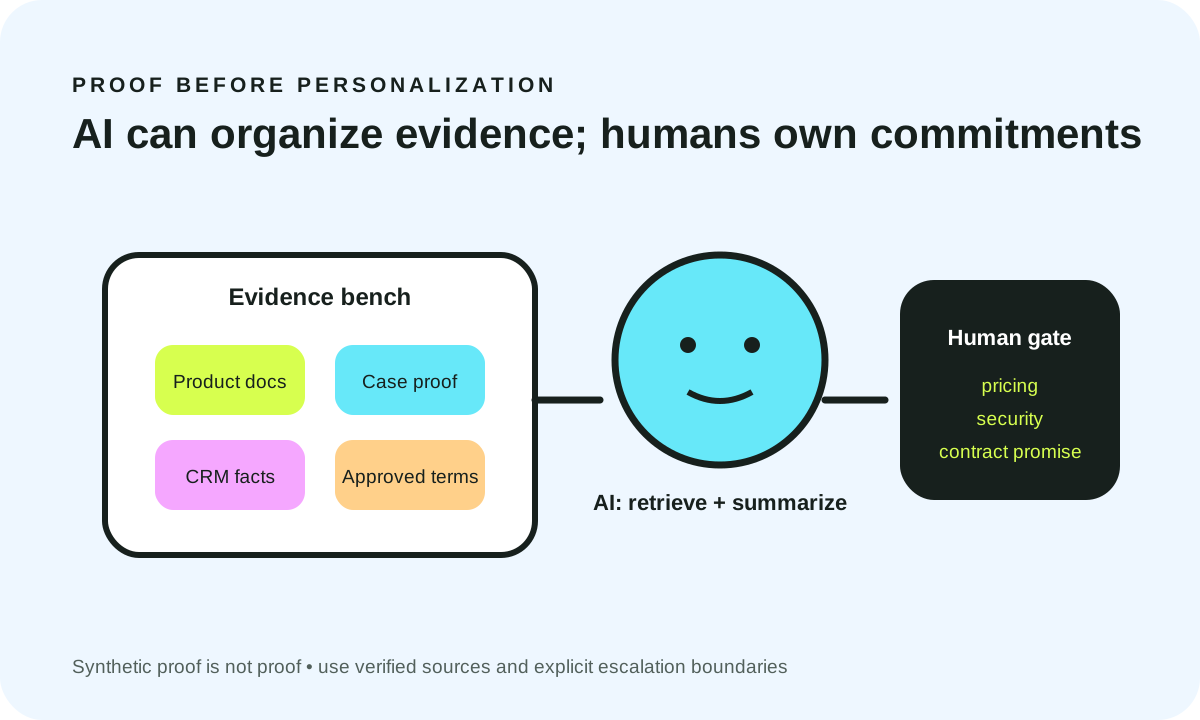
Use AI when it can reduce search, sorting or context-transfer work while staying inside approved facts.
Keep humans prominent when the buyer needs negotiation, nuanced diagnosis, trust-building, exception handling or accountable commitments.
A helpful rule is: automate the preparation before you automate the promise. Let AI find information, summarize context and suggest a route. Be much more cautious when it is about to make a commercial commitment on behalf of the business.
FAQ and next step
Use the experiment table and scenario calculator to define one measurable AI lead-generation hypothesis. Bring the current funnel, analytics definition, source/intent segments, knowledge sources and human handoff process.
WebDesignK can help map the experience, implement the AI boundary, instrumentation and routing, and turn the result into a prioritized implementation plan. See AI Marketing, then continue with AI Marketing Automation, AI Chatbot vs Live Chat, and What Is a Good Website Conversion Rate?.
Frequently asked questions
Does AI lead generation increase conversion?
It can remove specific friction, but there is no universal guaranteed uplift. Define the funnel step, baseline and guardrails, then test a bounded AI intervention against comparable traffic.
What should AI automate first in lead generation?
Start with bounded jobs such as approved-answer retrieval, lightweight qualification, routing, summarization and contextual drafting. Keep humans close to ambiguous commercial commitments and exception handling.
Should every website add an AI chatbot?
No. If the page already answers the buyer’s questions and human response is fast, a chatbot may add complexity rather than value. Add AI only when a measured friction hypothesis justifies it.
How do I measure AI lead-generation quality?
Combine a business outcome such as qualified progression with guardrails such as sales acceptance, unsupported-answer rate, human handoff success, correction burden, spam and mobile performance.
Can I use AI to score and reject leads automatically?
Be cautious. Keep scoring criteria transparent and validate them against real outcomes. For material routing or eligibility decisions, use accountable review and monitor false negatives rather than silently treating model output as policy.
How should I model revenue impact?
Use eligible volume, observed conversion, a clearly labeled modeled rate, average value and margin to size a scenario. The arithmetic is useful for prioritization but does not prove causality or forecast the experiment result.
Sources and assumption boundaries
This article uses current Google Analytics documentation for key-event and traffic-source terminology, Google/web.dev guidance for Core Web Vitals, the NIST Generative AI Profile for generative-AI risk context, and FTC consumer-protection material for dark-pattern risk. Sources were re-checked on October 7, 2026.
The calculator defaults are illustrative placeholders, not industry benchmarks. All revenue and gross-profit outputs are arithmetic based on reader-entered inputs. No section promises a conversion uplift, lead-quality improvement or revenue outcome.
Sources and assumption boundaries
Fast-changing platform, pricing and search claims were reviewed on 2026-10-07T00:00:00.000Z. Interactive scores and scenarios are clearly labeled planning models, not sourced market benchmarks.
- Google Analytics Help — Conversions vs. key events Official current terminology for key events and conversions, including lead-generation examples; reviewed October 7, 2026.
- Google Analytics Help — About traffic-source dimensions Official guidance for source, medium, campaign and acquisition context; reviewed October 7, 2026.
- Google Analytics Help — Key events attribution paths report Official attribution-path reporting documentation used for multi-touch measurement context; reviewed October 7, 2026.
- web.dev — How Core Web Vitals thresholds were defined Google web.dev guidance for current LCP, INP and CLS field thresholds and 75th-percentile methodology; reviewed October 7, 2026.
- NIST — Generative AI Profile (NIST AI 600-1) NIST cross-sectoral Generative AI Profile used for confabulation and AI risk-management context; reviewed October 7, 2026.
- FTC — Bringing Dark Patterns to Light FTC consumer-protection report on interfaces that can obscure or manipulate consumer choice; reviewed October 7, 2026.