Quick answer
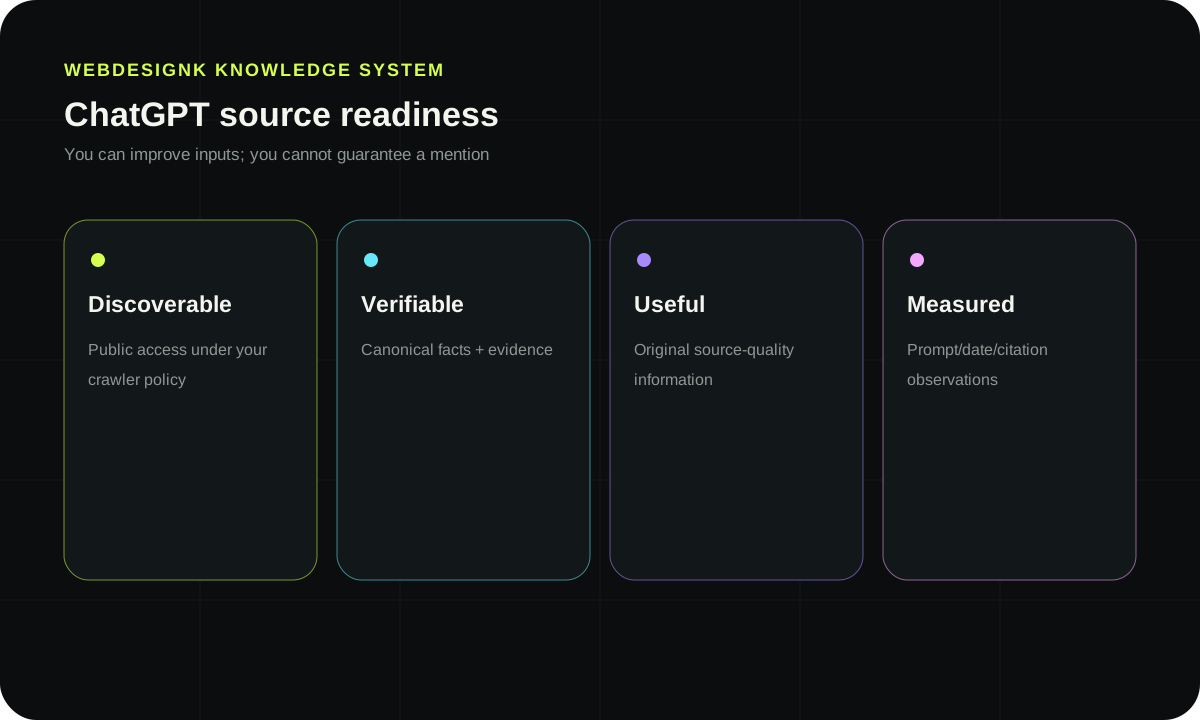
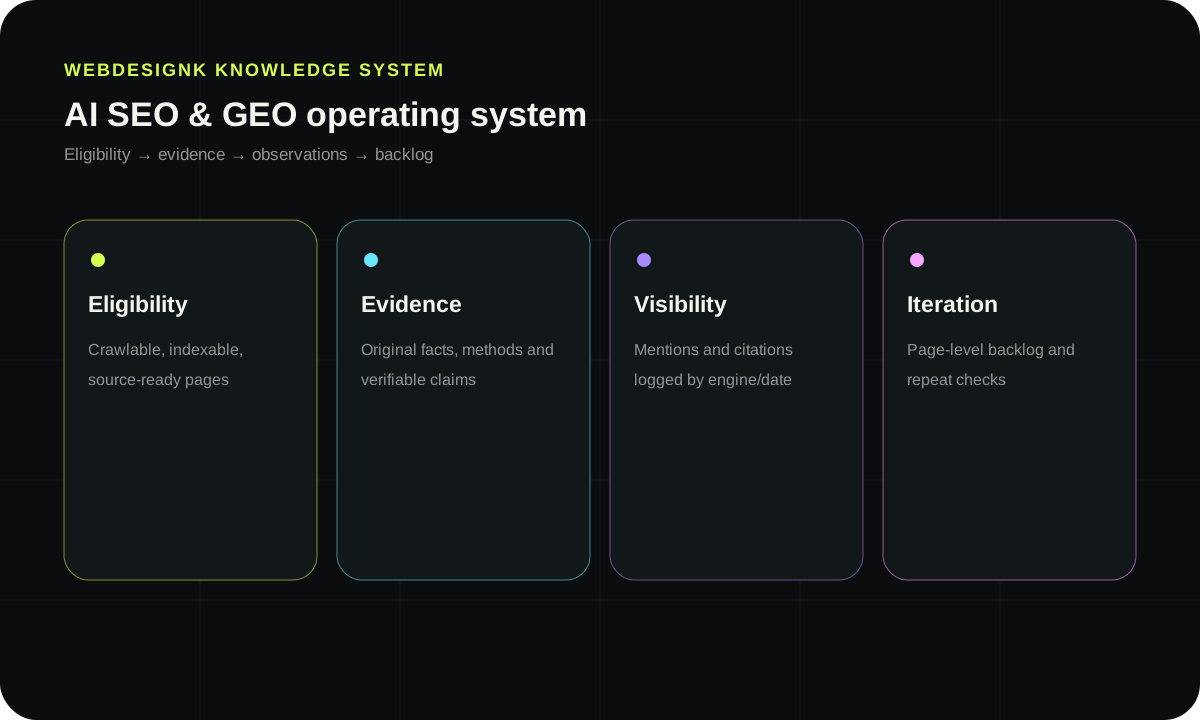
Start with normal Search eligibility and people-first content, then add a measurement layer: consistent entities, extractable evidence, a stable prompt set, per-engine/date observations and first-party Search Console generative AI data where available. Treat mentions, citations and impressions as different signals, and turn gaps into page-level actions rather than speculative GEO hacks.
Last reviewed: 2026-10-07T00:00:00.000ZAI visibility tracker
Add observations you checked yourself. Nothing below is prefilled with synthetic visibility data. Records stay in this browser via localStorage.
1. Visibility status by engine
Counts come only from the observations you added.
2. Presence trend by audit date
Presence = any non-missing status in your log; it is not an engine ranking.
3. Engine × status heatmap
Darker cells mean more records in that engine/status combination.
Observation log
| Prompt | Engine | Brand mentioned? | Status | Citation URL | Competitor / source cited | Page to improve | Checked date | |
|---|---|---|---|---|---|---|---|---|
| No observations yet. Add your first checked prompt above. | ||||||||
Source note: all chart values are user-entered observations stored locally. No benchmark, market share or engine behavior is manufactured.
Tables built for the buying decision
Primary decision table
| Prompt | Engine | Brand mentioned? | Citation URL | Competitor cited | Page to improve | Checked date |
|---|---|---|---|---|---|---|
| What is the best platform for a mid-market B2B team? | Google AI | Record after check | Record exact visible source URL | Record source/competitor | /category-or-solution-page | YYYY-MM-DD |
| How do I solve [core buyer problem]? | Google AI | Record after check | Record exact visible source URL | Record source/competitor | /problem-guide | YYYY-MM-DD |
| Brand A vs Brand B for [use case] | Google AI | Record after check | Record exact visible source URL | Record source/competitor | /comparison-page | YYYY-MM-DD |
| Alternatives to [category leader] | Google AI | Record after check | Record exact visible source URL | Record source/competitor | /alternatives-page | YYYY-MM-DD |
| [Brand] pricing / implementation / security | Google AI | Record after check | Record exact visible source URL | Record source/competitor | /authoritative-fact-page | YYYY-MM-DD |
| Best [service] for [specific context] | ChatGPT | Record after check | Record exact visible source URL | Record source/competitor | /service-page | YYYY-MM-DD |
| How does [technical approach] work? | Perplexity | Record after check | Record exact visible source URL | Record source/competitor | /technical-guide | YYYY-MM-DD |
Entity consistency table
| Entity / fact | Authoritative source | Pages that repeat it | Change owner | Review trigger | Validation |
|---|---|---|---|---|---|
| Organization name + canonical domain | Corporate site / organization settings | About, footer, schema, profiles | Brand / web owner | Brand/domain change | Visible text + Organization schema agree |
| Product name + category | Product documentation | Product, comparison, help center | Product marketing | Product/rebrand release | Same naming and scope across sources |
| Pricing / plan facts | Official pricing page | Pricing, FAQ, comparison guides | Product / finance | Pricing release | Dated manual review |
| Security / compliance facts | Trust center / approved policy | Security pages, RFP content, sales collateral | Security / legal | Certification or policy change | Qualified owner approval |
| Authors / experts | Author profile / HR-approved bio | Articles, schema, about pages | Editorial | Role or credential change | Visible bio + author markup agree |
| Locations / service areas | Operations / location source | Contact, local pages, profiles | Operations / marketing | Location change | Addresses and regional scope agree |
Turn this planning result into a scoped review.
Send the assumptions, constraints and result summary. WebDesignK can review the architecture/content/implementation boundary, identify missing discovery inputs and return a prioritized next-step scope.
- Bring: current site/product, constraints, integrations and your tool result.
- You get: a scoped recommendation, open questions and implementation priorities.
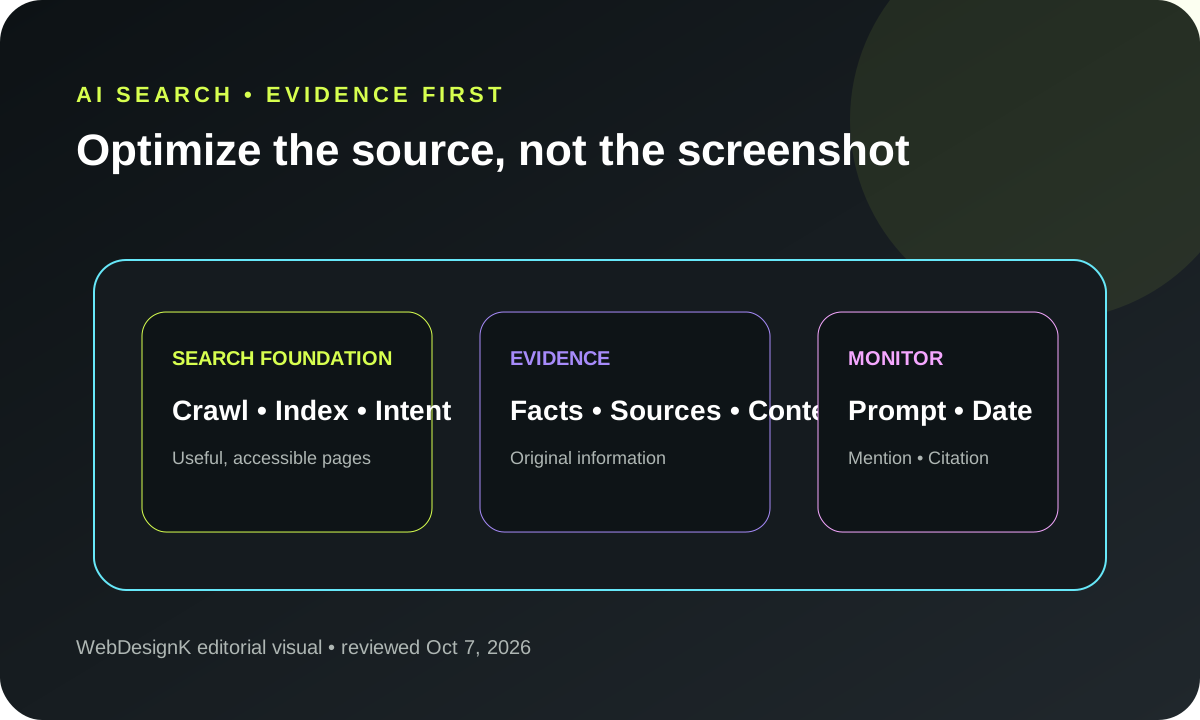
Optimizing for Google AI Overviews is not a separate trick-based SEO discipline. The reliable path is to make pages eligible for Google Search, publish original and useful information, keep important claims easy to understand in context, support them with evidence, and monitor how those pages appear in generative Search features over time. Google says normal SEO best practices remain relevant to AI Overviews and AI Mode, and there are no additional technical requirements just for those features.
What you'll learn / decide
- Which classic SEO practices still matter for Google AI Overviews
- How answer-style discovery changes what you should measure
- How to design extractable sections without writing robotic “AI bait”
- How to log mentions, citations, competitors and page-improvement actions
- How to build a 90-day improvement loop from real observations
Last reviewed: October 7, 2026. Google Search AI features, Search Console reports and inclusion controls can change, so re-check current official documentation before making policy or measurement decisions.
Decision snapshot for How to Optimize Content for Google AI Overviews
The core decision is not “SEO or AI optimization.” It is whether your existing content is strong enough that Google can crawl, index, understand and retrieve it, and whether your team has enough evidence to justify an additional monitoring layer for generative Search.
Google's current documentation says AI Overviews and AI Mode are rooted in core Search ranking and quality systems. A page must be indexed and eligible to appear in Search with a snippet to be eligible as a supporting link; Google does not describe a separate technical eligibility checklist for AI Overviews. That makes classic SEO foundations the first priority.
The additional work is operational: create content that is genuinely useful and distinctive, make sections understandable in isolation, keep entities and facts consistent, record which prompts and surfaces you check, distinguish a brand mention from a source citation, and turn gaps into page-level improvements rather than speculative “GEO hacks.”
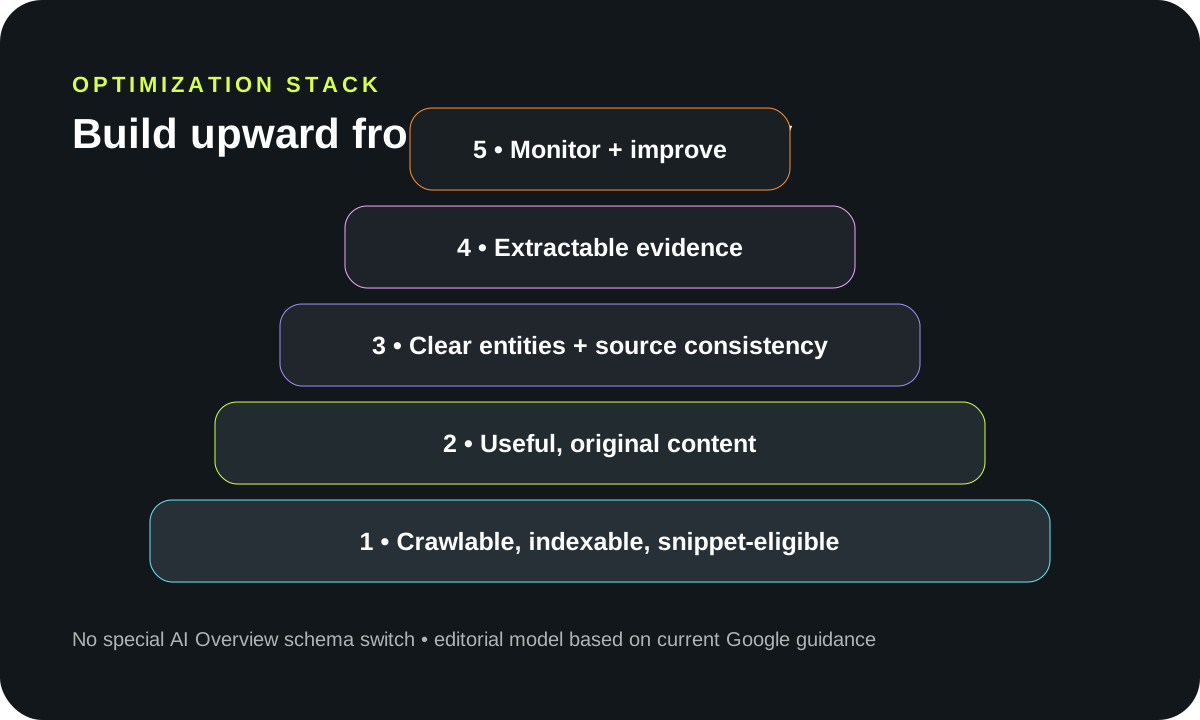
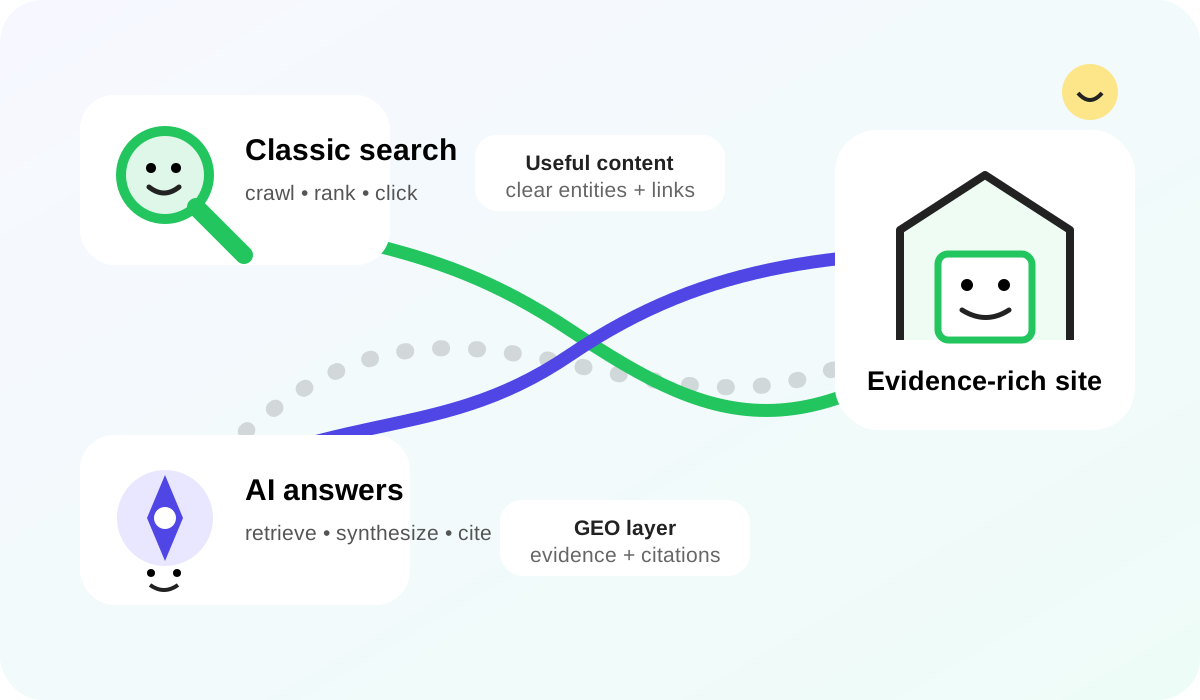
Classic search vs answer-engine discovery
Classic search often presents a list of results and lets the searcher choose which page to visit. Generative Search can synthesize information and surface supporting links inside a generated response. That changes the observable outcome, even when the underlying SEO foundation remains the same.
For classic search, teams commonly track queries, pages, impressions, clicks, position and conversions. For generative experiences, a useful observation log may also include:
- whether your brand was mentioned
- whether your URL was cited or linked
- which competing or third-party sources appeared
- which internal page is the best candidate to improve
- the engine/surface and date of the check
- whether the same prompt produces a materially different result later
Do not collapse those states into one “AI visibility score.” A brand mention without a citation is different from a citation to your page, and both are different from an impression reported inside Search Console.
Google now exposes more direct generative-Search measurement
As of August 31, 2026, Google says its generative AI performance insights have rolled out worldwide, subject to report availability and sufficient data. The Search report can show organic impressions from supported generative AI features, pages receiving those impressions, and dimensions such as device or country.
That first-party data is more valuable than pretending a manual prompt sample is a complete traffic measure. Use manual prompt monitoring to diagnose what appears and why a page might need work, while using Search Console and analytics for broader performance evidence.
How retrieval, synthesis and citation differ
A generative result can retrieve information, synthesize a response and choose supporting links. Those are separate stages from the publisher's perspective. A page may be relevant to a topic without appearing as the visible citation you expected.
Google's own AI-search guidance describes retrieval-augmented generation as one of the techniques used to ground generative responses with relevant, up-to-date pages from the Search index. That reinforces a practical rule: if your page is not technically accessible, indexable and useful enough to retrieve, no amount of formatting for “AI answers” fixes the foundation.
Do not infer one engine's behavior from another
Google AI Overviews, ChatGPT search experiences and Perplexity are different products with different systems, source policies and release cycles. The interactive tracker on this page includes all three because buyers use multiple surfaces, not because their retrieval or citation behavior is identical.
Record observations by engine and date. If your team operates across countries or languages, add locale to your internal monitoring process too. A visibility finding without the engine/date context becomes stale very quickly.
Entity clarity and source consistency
Generative systems need to resolve what a brand, product, person, location or service refers to. Your job is not to “add more entity keywords.” It is to keep factual identity consistent across the places you control.
Audit these basics:
- organization and product names
- official URLs
- product/category descriptions
- founder/author identity where relevant
- locations and service areas
- pricing or plan facts when publicly stated
- dates and version numbers on fast-changing material
- schema that accurately matches visible content
- linked primary sources for claims that need external evidence
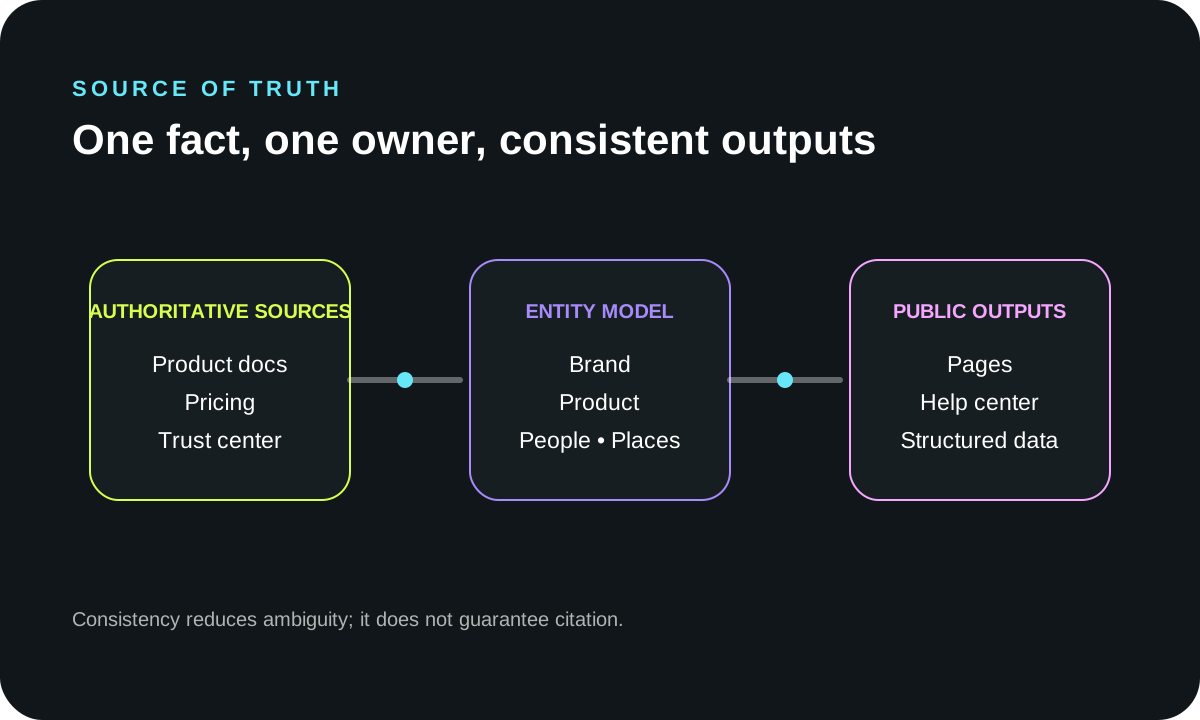
A product page, help center, press page and structured-data payload should not contradict each other about a core fact.
Build a source-of-truth map
For every fact that changes often, name its authoritative source. Product limits may live in product documentation; pricing may live on a pricing page; security claims may live in a trust center; company identity may live in the corporate site.
When a writer or AI drafting tool produces a page, validate those facts against the designated source rather than copying from another marketing page that may already be stale.
Extractable content structures
“Extractable” does not mean every paragraph should look like a featured snippet. It means a reader—or a system retrieving a passage—can understand an important claim without needing three unrelated sections for context.
Useful structures include:
- a direct answer followed by qualifications
- definitions with the term and boundary stated together
- comparison tables where columns use the same decision criteria
- numbered implementation steps
- question-and-answer sections for real user questions
- evidence blocks that put source, date and scope near the claim
- examples that show where an approach works and where it does not
Put qualifiers next to the claim
Bad: “This approach reduces cost by 40%.” Then, several paragraphs later: “The 40% came from one internal pilot.”
Better: “In our January 2026 internal pilot on X workflow, assisted handling time fell 40%; this is one company-specific result, not a market benchmark.”
The second version is more useful to humans and safer to extract because the scope travels with the claim.
Do not over-format weak information
A table of commodity summaries is still commodity content. A perfectly structured FAQ that merely restates other sites does not become distinctive because it uses headings and schema. The structure should expose original expertise, first-party facts, careful synthesis or a genuinely useful decision model.
Evidence, citations and original information
Google's people-first guidance continues to emphasize useful, reliable content created for people rather than pages produced mainly to manipulate rankings. Its generative-AI content guidance also warns that scaled AI-generated pages without added value can violate spam policies.
That means the strongest “AI Overview optimization” asset is often not a special markup pattern. It is information competitors cannot copy without doing the work:
- first-party research
- product documentation
- detailed methodology
- implementation screenshots
- original examples
- expert interpretation
- real constraints and failure modes
- transparent calculators or decision frameworks
- primary-source references
Cite primary sources for changeable facts
For platform behavior, specifications, rules or Search features, prefer the platform's current official documentation. For laws or regulated topics, use authoritative sources and qualified review appropriate to the jurisdiction.
For your own claims, distinguish measured evidence from opinion. Say “our dataset,” “our customer sample,” or “our planning assumption” instead of presenting a local observation as universal truth.
Technical crawlability and structured data
Google states that pages considered for supporting links in AI Overviews or AI Mode must be indexed and eligible to show in Search with a snippet. That makes ordinary technical SEO requirements non-negotiable.
Check that:
- Googlebot is not blocked
- important pages return the intended successful status
- canonical URLs are coherent
- internal links are crawlable
- main content is rendered reliably
- robots/snippet controls reflect your actual publication intent
- mobile experience is usable
- structured data matches visible content and uses supported types
Structured data is not an AI Overview switch
Structured data can help Google understand page information and can support eligible Search features, but Google does not document a magic AI Overview schema. Use structured data because it accurately represents the visible page, not as a citation guarantee.
Understand your generative-Search inclusion controls
Google introduced a Search generative AI control in Search Console, rolled out globally on August 31, 2026 according to its help documentation. It lets site owners manage inclusion in supported generative AI features such as AI Overviews and AI Mode.
Treat that control as a governance decision. If a site deliberately opts out, a content team should not interpret missing generative visibility as an editorial failure.
Build a monitoring prompt set
A useful prompt set represents buyer questions, not hundreds of tiny keyword permutations.
Start with five families:
- Navigational: questions explicitly naming your brand or product
- Category: “best platform for…”, “software for…”, “agencies that…”
- Problem: “how do I solve…”, “why is…”, “what causes…”
- Comparison: “X vs Y”, “alternatives to…”, “which is better for…”
- Recommendation: “what should a company like ours use for…”
Pick prompts that map to real buying or research decisions. Then assign the best internal page that should satisfy each prompt.
Record the exact observation
For every check, log:
- exact prompt
- engine
- date
- brand mentioned: yes/no
- citation URL
- competitor/other source
- page to improve
- short note on what the answer lacked
The interactive lab above stores this data locally in your browser and generates engine/status bars and a dated presence trend from only the records you enter.
Measure mentions, citations and assisted demand
Do not report “AI visibility increased” without defining the metric.
At minimum, separate:
Mention rate: the share of your checked prompts where the brand appears in the answer.
Citation rate: the share where your page or domain is visibly linked/cited.
Search generative impressions: first-party data from Google's Search Console generative AI performance reporting where available.
Assisted demand: downstream evidence such as branded searches, direct traffic, demo conversations, survey responses or CRM notes that suggest AI-assisted discovery. Treat this as supporting evidence unless your measurement design can establish causality.
Trend lines need a stable prompt set
If the prompt sample changes every week, the trend is hard to interpret. Maintain a core set for comparison and keep experiments in a separate bucket. When an engine changes significantly or you revise a prompt, note the change.
Avoid false precision
Ten manually checked prompts do not represent the entire market. Manual trackers are diagnostic tools. They help identify patterns and content gaps; they should not be presented as population-level market share.
Avoid spam, fake authority and synthetic facts
AI search creates incentives for bad optimization behavior: mass-producing thin pages, inventing statistics, adding fake expert quotes, fabricating citations, or creating pages solely to mirror prompt wording.
Those tactics undermine the exact trust and usefulness signals that strong search programs need.
Google's updated 2026 guidance on generative AI content emphasizes accuracy, quality, relevance and manual review, and warns that scaled content generation without user value can violate spam policies.
A safe publishing checklist
Before publishing AI-assisted material:
- fact-check every changeable claim
- verify URLs and citations
- remove invented examples presented as real
- label editorial scenarios and assumptions
- confirm author/reviewer information is truthful
- verify metadata and structured data too, not only body copy
- use AI for structure or drafting only where human review can support accuracy
Do not manufacture “authority”
A company does not become authoritative because a page says “expert” repeatedly or includes dozens of outbound links. Build authority through evidence, specific experience, transparent methods, accurate facts and useful original information.
90-day AI-search plan
A practical 90-day program should improve the website even if AI visibility changes slowly.
Days 1–30: establish the foundation
Audit technical eligibility, content quality, source consistency and the Search generative AI control. Build a small monitoring prompt set covering the five prompt families. Save baseline observations and identify the pages that should satisfy each prompt.
Prioritize fixes that help both classic Search and AI discovery: crawlability, page intent, content gaps, internal links, original evidence and factual consistency.
Days 31–60: improve high-value pages
For the highest-value gaps, improve one page at a time. Add missing comparison criteria, clearer definitions, primary-source evidence, original examples or stronger product facts. Do not publish duplicate “AI versions” of existing pages.
Recheck the same core prompt set on the same engines and record dated observations. Compare what changed, but avoid assuming one content edit caused an engine response change.
Days 61–90: connect visibility to business evidence
Review Google's generative AI performance report where available. Compare page-level generative impressions with normal Search Console and analytics signals. Ask sales/support teams whether prospects mention AI-assisted discovery.
Retire monitoring prompts that never map to a business or content decision. Expand prompts only where findings create actionable page work.
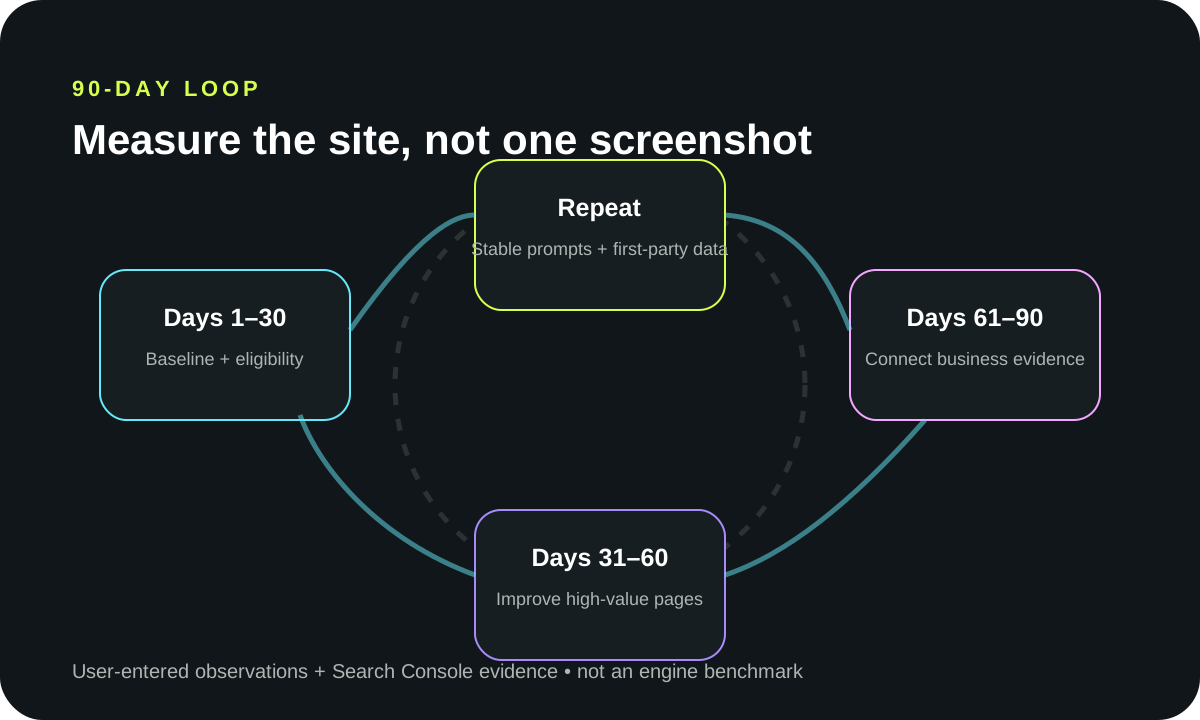
Build a repeatable monthly operating loop
After 90 days, the operating model should be simple:
- review first-party Search generative AI data
- recheck the core prompt set
- classify gaps by page and root cause
- improve the highest-value pages
- validate crawl/index/structured-data changes
- log the next observation date
- report outcomes without overstating causality
The goal is not to “game AI Overviews.” It is to make the website easier to retrieve, understand, trust and use while creating a measurement loop that can adapt as Google changes the product.
Turn visibility gaps into page-level actions
A monitoring dashboard only matters if a finding changes the backlog.
Use a simple diagnosis:
| Observation | Likely next investigation |
|---|---|
| Brand missing, competitors cited | Does the page satisfy the same intent with stronger evidence? |
| Brand mentioned, no citation | Is there a page with clear first-party evidence worth linking? |
| Wrong page cited | Are internal links, canonicals and content hierarchy clear? |
| Stale fact repeated | Is the authoritative source page current and consistently linked? |
| Generative impressions fall | Check Search Console by page/date/device/country before guessing |
| Manual prompt changes, first-party data stable | Treat manual prompt variance cautiously |
This framework does not claim to explain Google's ranking systems. It gives your team a disciplined next step instead of reacting to one screenshot.
FAQ and next-step checklist
Use the tracker, coverage table and entity-consistency table on this page to create a scoped backlog. A strong first brief includes your core prompt families, current pages, source-of-truth URLs, Search Console access, priority markets and the business outcomes that matter.
For implementation support, see AI SEO & AstraSEO. Related guides include SEO vs GEO, How to get your business mentioned in ChatGPT answers, and B2B SEO strategy.
Sources and assumptions
Google Search Central and Search Console documentation was re-checked on October 7, 2026. Google currently says standard SEO best practices remain relevant for AI Overviews and AI Mode, that supporting-link eligibility depends on normal Search index/snippet eligibility, and that no extra technical requirements are needed solely for these AI features.
Google's Search generative AI control and generative AI performance reporting were documented as globally rolled out from August 31, 2026, though individual reports can still depend on availability and sufficient data.
The interactive visibility tracker contains no prefilled benchmark data. All charts are generated from observations entered by the reader. Manual prompt samples are diagnostic, not market-share estimates and not guarantees of citation or ranking.
Frequently asked questions
Do I need special schema for Google AI Overviews?
Google does not document a special AI Overview schema requirement. Use supported structured data when it accurately represents visible page content and follows Google’s guidelines; eligibility for AI features still depends on normal Search requirements.
Does a page need to rank number one to be cited in an AI Overview?
Google does not publish a simple position threshold for supporting links. Treat normal Search quality and eligibility as the foundation and measure your own page-level generative Search visibility rather than assuming one ranking position guarantees citation.
Should I rewrite every page into short answer snippets?
No. Make important sections understandable and well qualified, but keep the page useful for humans. Thin or repetitive answer blocks are not a substitute for original evidence, depth and a satisfying page experience.
How should I measure AI Overview visibility?
Use Google’s first-party generative AI performance report where available, then supplement it with a stable manual prompt set that logs engine, date, mention/citation state, sources and the page to improve.
Can AI-generated content rank or appear in AI Overviews?
Google focuses on content quality and policy compliance rather than banning content solely because AI assisted its creation. Generated material still needs accuracy, usefulness, originality and human review; scaled low-value content can violate spam policies.
How often should I recheck prompts?
Use a cadence that matches how quickly your market and content change. Monthly is a practical starting point for a stable core prompt set, with additional checks after major page, product or Search feature changes.
Sources and assumption boundaries
Fast-changing platform, pricing and search claims were reviewed on 2026-10-07T00:00:00.000Z. Interactive scores and scenarios are clearly labeled planning models, not sourced market benchmarks.
- Google Search Central — Optimizing for generative AI features on Google Search Official Google guidance stating SEO best practices remain relevant for generative AI features and describing retrieval/grounding concepts; reviewed October 7, 2026.
- Google Search Central — AI features and your website Official Google documentation saying there are no additional technical requirements for AI Overviews or AI Mode beyond normal Search eligibility and policies; reviewed October 7, 2026.
- Google Search Central — Helpful, reliable, people-first content Official guidance for useful, original, trustworthy content created primarily for people; reviewed October 7, 2026.
- Google Search Central — Generative AI content guidance Official guidance emphasizing accuracy, quality, relevance and human review, and warning about scaled low-value content; reviewed October 7, 2026.
- Search Console Help — Search generative AI control Official help for managing inclusion in supported generative AI features; documented global rollout from August 31, 2026; reviewed October 7, 2026.
- Search Console Help — Generative AI performance report (Search) Official report documentation for generative AI Search impressions, pages and dimensions such as device/country; reviewed October 7, 2026.
- Search Console Help — Impressions, clicks and position including AI Overviews Official measurement definitions for AI Overview links inside Search Console; reviewed October 7, 2026.