Quick answer
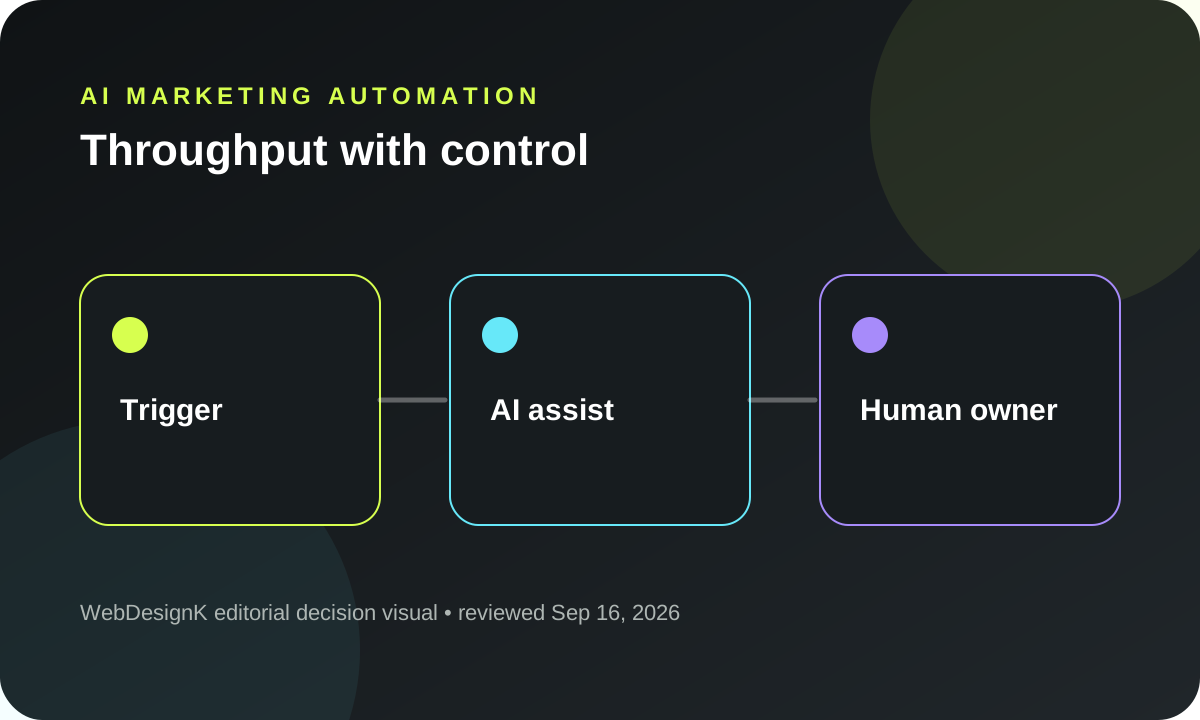
Start with workflow economics and control boundaries, not model capability. Map the current human process, choose one reversible pilot, keep arithmetic/business rules/permissions deterministic, require approvals for risky actions, and monitor quality after deployment. The interactive scorer ranks your own workflows from entered frequency, manual time, business value, risk and review requirements; its score is a planning aid, not an industry benchmark.
Last reviewed: 2026-09-19T11:02:00.000ZAutomation opportunity scorer
The three starting rows are labeled illustrative examples so the charts are understandable before input. Replace them with your workflows. “Human-led” is flagged when both error risk and review requirement are 4–5.
1. Impact vs effort scatter
Takeaway: high-impact, lower-effort workflows are better pilot candidates; high-risk/review work stays toward human control.
2. Manual vs modeled assisted hours
Takeaway: time savings are only useful after adding review overhead and your own reduction assumption.
3. Risk × review control map
Takeaway: workflows in the high-risk/high-review corner should remain human-led or require strict deterministic gates.
Ranked workflows
Assumption note: priority score is an explicit decision-aid formula, not an industry benchmark. Assisted-hours math uses each row’s own editable reduction assumption plus a review-overhead factor tied to the entered review requirement.
Tables built for the buying decision
Primary decision table
| Workflow | Trigger | AI step | Deterministic step | Human approval | Data | KPI | Risk | Impact / effort |
|---|---|---|---|---|---|---|---|---|
| Inbound lead enrichment | New qualified inbound | Summarize firm/account context | Identity validation, dedupe, territory rules | Exceptions + high-value accounts | CRM + approved public/business data | Routing time + accepted enrichment | Wrong entity / stale data | High / medium |
| Lead-routing packet | Lead reaches routing-ready state | Assemble context and concise rationale | Required fields, eligibility and owner rules | Ambiguous/strategic routes | CRM + account/activity data | Time to complete route + correction rate | Wrong owner/context | High / low-medium |
| Campaign brief first draft | Approved campaign request | Draft angles, audience questions and brief | Required claims/fields/brand rules | Strategist approval | Request + approved product evidence | Prep time + revision categories | Unsupported claim | Medium / low |
| Content research packet | Approved topic/brief | Organize sources, questions and evidence gaps | Source allowlist + URL/schema checks | Editor decides evidence/angle | Approved sources + research notes | Research prep time + source acceptance | Weak/unverified source | Medium / medium |
| Content repurposing draft | Source asset approved | Draft channel-specific variants | Required links, length/field validation | Editor/brand approval | Approved source asset + brand guide | Draft time + correction rate | Meaning drift / claim mutation | Medium / low |
| SEO/content refresh triage | Scheduled content review | Summarize stale facts and visibility changes | Metric retrieval + canonical/page rules | SEO/editor chooses action | CMS + analytics/search data | Triage time + useful actions | False causal story | Medium / medium |
| Event follow-up prep | Attendee reaches approved follow-up stage | Summarize context and draft next-step options | Consent/suppression/audience rules | Owner approves send/context | Event + CRM + consent state | Prep time + response quality | Consent/context error | High / medium |
| Lifecycle email draft | Approved lifecycle state | Draft message options from evidence | Eligibility, frequency caps, unsubscribe rules | Marketing approval for material changes | Lifecycle + product/brand facts | Draft time + revision rate | Wrong claim/audience | Medium / medium |
| ABM account research | Named account enters research queue | Synthesize account context and open questions | Account/entity validation | Marketer/sales validates outreach angle | CRM + approved business sources | Research time + accepted insights | Entity confusion | High / medium |
| Customer interview synthesis | Interview batch complete | Cluster themes and extract candidate evidence | Speaker/source IDs and transcript integrity | Researcher validates themes | Interview transcripts/notes | Synthesis time + theme corrections | Loss of nuance | Medium / medium |
| Voice-of-customer tagging | New qualitative feedback batch | Suggest taxonomy labels and rationale | Allowed taxonomy/schema validation | Ambiguous/high-impact labels | Feedback + taxonomy definitions | Tagging time + disagreement rate | Misclassification | Medium / low |
| Analytics commentary | Reporting close | Summarize changes and propose hypotheses | Metric calculations stay deterministic | Analyst validates explanation | Warehouse/BI outputs | Analysis time + correction rate | Invented causality | High / low-medium |
| Experiment readout prep | Experiment closes | Draft observed result narrative and caveats | Metric/significance/stop-rule calculation | Experiment owner approves | Experiment metadata + deterministic metrics | Readout prep time + error categories | Statistical misstatement | High / medium |
| Brand/social response suggestion | Mention or escalation | Suggest response options and context | Policy/escalation rules | Human required for public action | Social/support context + brand guide | Response prep time + review outcome | Brand/legal harm | High / high |
| Marketing-ops exception triage | Sync/job/validation failure | Summarize error and likely next steps | Retry, idempotency and write rules | Destructive/ambiguous recovery | Integration logs + object state | Resolution time + repeat incident rate | Duplicate/lost write | High / medium-high |
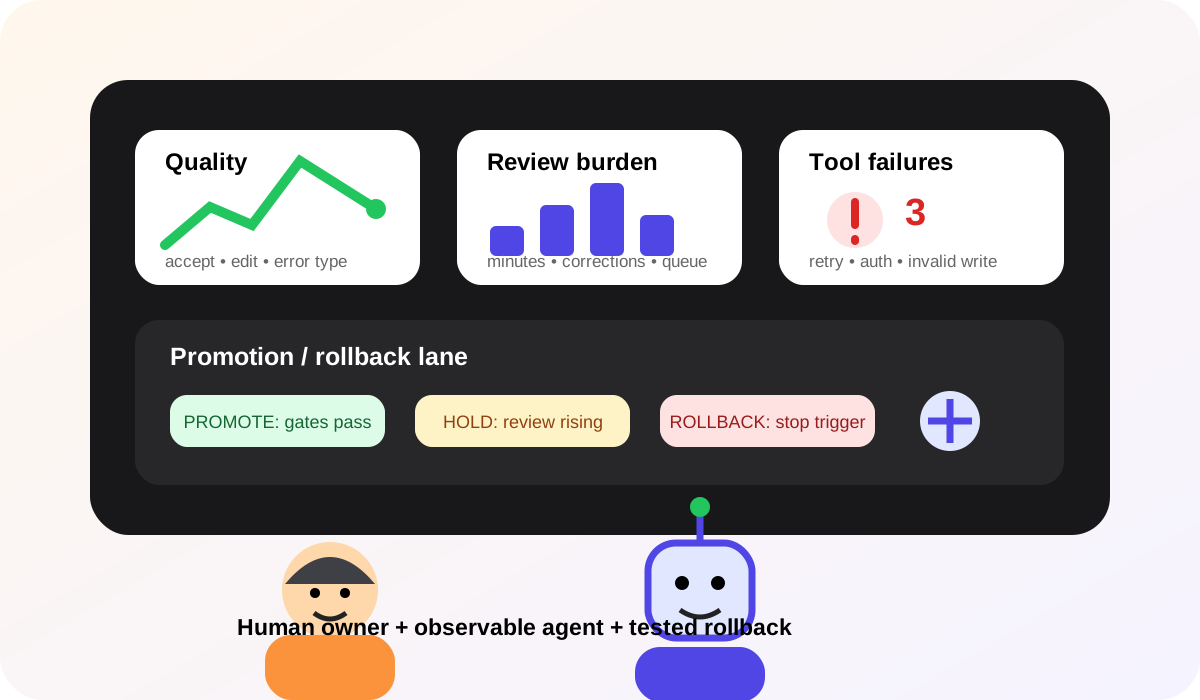
Pilot promotion and rollback gates
| Gate | Evidence before promotion | Rollback signal | Owner |
|---|---|---|---|
| Quality | Reviewed outputs categorized by failure type; approved tolerance defined for this workflow | Material error category exceeds agreed tolerance or new high-consequence failure appears | Business owner + QA |
| Review burden | Observed review + correction time leaves a real operating benefit | Review/correction time erases the baseline gain | Workflow owner |
| Integration reliability | Retries, idempotency, permission failures and reconciliation tested | Duplicate/lost writes, repeated auth failures or unresolved queue growth | Engineering / MarTech |
| Business outcome | No material negative downstream signal; KPI definition unchanged | Qualified-lead/content/customer/experiment quality degrades materially | Marketing + Analytics |
| Governance | Named owner, logs, source policy, approval boundary and rollback route documented | Unowned changes, untraceable actions or policy bypass | Marketing Ops + Security/Legal as needed |
| Rollback | Trigger disable/read-only fallback tested in the actual environment | Rollback cannot be completed safely or prior workflow is unavailable | Engineering + Business owner |
Sources and assumption boundaries
Fast-changing platform, pricing and search claims were reviewed on 2026-09-19T11:02:00.000Z. Interactive scores and scenarios are clearly labeled planning models, not sourced market benchmarks.
- OpenAI — A practical guide to building agents Official guidance on agent components, tool use, guardrails, human intervention and incremental orchestration; reviewed September 19, 2026.
- OpenAI Academy — Workspace agents Official workflow guidance covering triggers, tools/connectors, approvals, human-in-the-loop checkpoints and iterative testing; reviewed September 19, 2026.
- NIST — AI Risk Management Framework Cross-sector risk-management framework and link to the Generative AI Profile; reviewed September 19, 2026.
- NIST — Challenges to the monitoring of deployed AI systems 2026 publication explaining why post-deployment monitoring matters for real-world AI reliability and changing conditions; reviewed September 19, 2026.
- FTC — Air AI settlement Current U.S. enforcement example involving allegedly deceptive AI-related business growth and earnings claims; used only as a substantiation/governance caution, not legal advice; reviewed September 19, 2026.
Turn this planning result into a scoped review.
Send the assumptions, constraints and result summary. WebDesignK can review the architecture/content/implementation boundary, identify missing discovery inputs and return a prioritized next-step scope.
- Bring: current site/product, constraints, integrations and your tool result.
- You get: a scoped recommendation, open questions and implementation priorities.
Decision snapshot for AI Agents for Marketing
AI agents can increase marketing throughput when they operate inside a well-defined workflow: a clear trigger, bounded AI reasoning or generation, deterministic validation, explicit tool permissions and human review where the consequence of a mistake is high. The main tradeoff is autonomy versus control. Automate repetitive judgment and coordination only after you can measure the current process, define failure states and roll the change back safely.
What you’ll learn / decide: which marketing workflows are plausible agent candidates, which steps should stay deterministic, when a human must approve an action, what data/integrations are required, and how to score a reversible pilot without inventing ROI.
Start with the business outcome
Do not begin with “Where can we add an agent?” Begin with an outcome that already has an owner and a measurable baseline. The useful unit of analysis is a workflow, not a model. A workflow has an event that starts it, inputs, decisions, actions, outputs, exceptions and a definition of done.
For marketing, that can mean reducing the elapsed time from a qualified inbound lead to a complete routing packet, shortening the time needed to turn approved source material into campaign variants, or increasing the number of analytics anomalies an analyst can investigate without delegating final interpretation to a model.
Before adding AI, write the current human process on one page. Capture who receives the trigger, which systems they inspect, what they decide, what they copy or calculate, what needs approval, and what happens when information is missing. This makes “time saved” testable because you have a process to compare against.
Fifteen real marketing workflows worth evaluating
The following are workflow candidates, not claims that every company should automate them. Their suitability depends on your data quality, permissions, risk tolerance and review burden.
- Inbound lead enrichment: summarize account context while deterministic rules validate identity, deduplicate records and apply territory logic.
- Lead-routing packet creation: collect CRM fields, recent activity and relevant public context; a rules engine still owns routing eligibility and required fields.
- Campaign brief first draft: synthesize an approved request, product facts and prior learnings into a brief that a strategist approves.
- Content research packet: organize approved sources, open questions and evidence gaps before a writer starts; humans decide claims and editorial direction.
- Content repurposing draft: convert an approved long-form asset into candidate email, social or sales-enablement versions while preserving source links and brand constraints.
- SEO/content refresh triage: summarize dated pages, traffic/visibility changes and missing evidence so an editor can choose whether to update, consolidate or leave the page alone.
- Webinar or event follow-up preparation: group attendees by known intent signals and draft follow-up context; consent, suppression and sending rules stay deterministic.
- Lifecycle-email drafting: draft message variants from an approved lifecycle state while audience eligibility, frequency caps and unsubscribe handling remain rule-based.
- Account-research summaries for ABM: synthesize approved CRM and public business information into a concise account brief; sales or marketing decides the actual outreach.
- Customer interview synthesis: cluster themes and extract supporting passages from interview notes while a researcher validates whether the grouping reflects the source material.
- Voice-of-customer tagging: propose taxonomy labels for qualitative feedback, with deterministic schema validation and human review of ambiguous/high-impact categories.
- Analytics commentary draft: summarize deterministic metrics and suggest hypotheses; an analyst validates the explanation and never lets the model recalculate the source metrics.
- Experiment readout preparation: assemble test metadata, observed metrics and caveats into a draft narrative; significance calculations and launch/stop rules remain deterministic.
- Brand/social response suggestions: prepare candidate responses and context for a human; public publishing stays gated when legal, reputational or customer-specific risk is material.
- Marketing-operations exception triage: summarize failed syncs, missing fields or campaign-operation errors and suggest next steps; retries, writes and destructive actions remain permissioned and auditable.
A good first pilot is usually frequent enough to measure, repetitive enough to standardize, reversible if it fails and low enough in consequence that human review is practical.
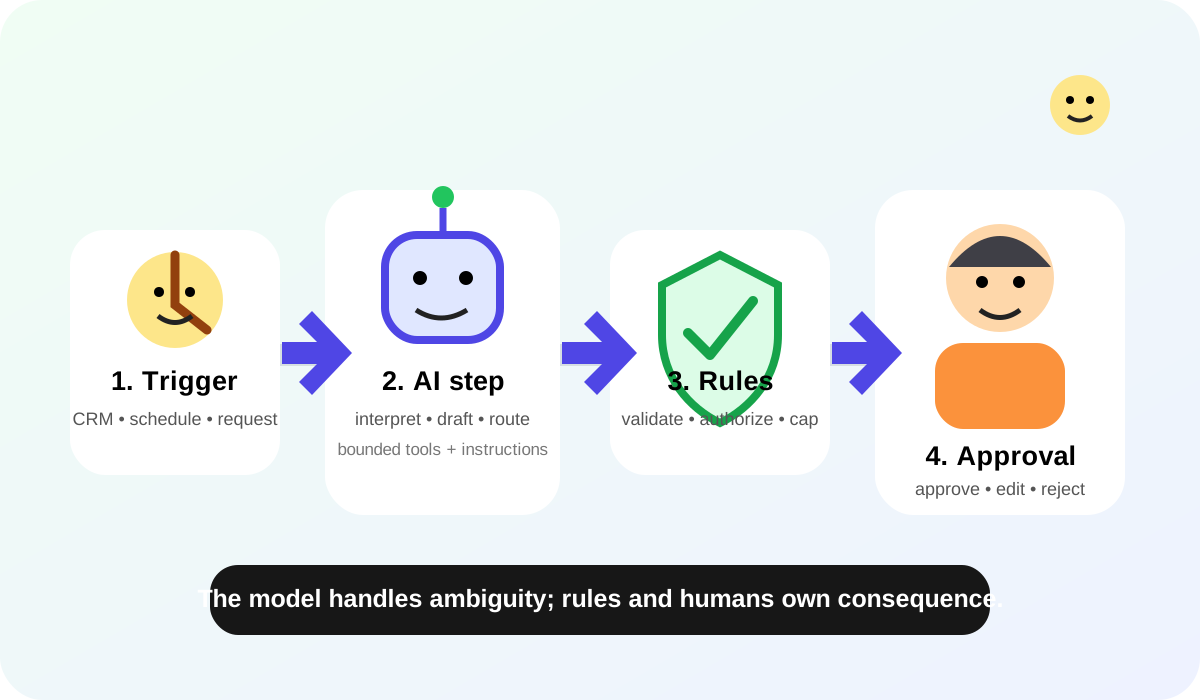
Map trigger → AI step → deterministic step → human review
A reliable agent workflow should make four boundaries visible.
Trigger: the event that starts work. It may be a new CRM record, a scheduled reporting close, an approved campaign request, a new support theme or a human request. The trigger should be explicit so the system does not “decide” to act on arbitrary data.
AI step: the part that benefits from interpreting unstructured information, synthesizing context, generating candidates, classifying ambiguous text or planning a sequence. OpenAI’s agent guidance describes agents as systems that manage workflow execution and use tools within defined instructions and guardrails; the useful implication for marketing is that the model should have a bounded job, not unrestricted access to the stack.
Deterministic step: validation and business logic that should produce the same answer for the same inputs. Examples include required-field validation, allowlists, consent checks, suppression lists, territory rules, budget ceilings, duplicate detection, URL validation, schema validation, arithmetic and idempotency keys.
Human review: the checkpoint for judgment, accountability or irreversible impact. Approval should be more than a decorative “looks good” button: show the source context, proposed action, changed fields, confidence/exception state and a clear reject/edit path.
Design the failure route before the happy path
For each step, define what happens when data is missing, a tool returns an error, the model produces invalid structure, an API times out or an approval expires. Useful workflows stop, retry within a bounded policy, queue for review or return to the originating system. They do not silently skip controls to preserve throughput.
The automation table on this page uses the same pattern for all 15 candidates so a reader can compare them without assuming the AI step owns the whole process.
Data and systems prerequisites
Agents amplify the quality of the systems they touch. If the CRM has duplicate accounts, product facts conflict across documents or campaign taxonomy is inconsistent, an agent can make the inconsistency travel faster.
Before a pilot, identify the source of truth for each required field. Separate read context from write authority. Many useful first pilots need broad read access but narrow write access: the system may read a lead and enrichment sources, then write only a draft note or a proposed field value instead of editing the authoritative record directly.
Minimum prerequisites usually include:
- a stable identifier for the customer/account/campaign/content object;
- documented required fields and data owners;
- approved knowledge sources with refresh ownership;
- scoped API credentials rather than shared administrator access;
- an event log that records trigger, tool calls, outputs, approvals and final action;
- a retry/idempotency policy for writes;
- a place to quarantine exceptions instead of forcing completion;
- a test dataset that includes normal and messy edge cases.
Retrieval context is not the same as authority
A source being available to an agent does not mean every sentence in it is approved for public use. Marketing teams often have research notes, sales call summaries, draft positioning and historical materials that can help reasoning but should not automatically become claims. Label sources by purpose: authoritative product facts, approved brand guidance, customer-provided context, internal hypothesis or unverified external material.
Where AI adds leverage vs simple rules
Use AI where the workflow contains meaningful ambiguity or unstructured information. Use conventional code where the rule can be stated exactly.
AI is useful for tasks such as summarizing a long account history, grouping qualitative feedback, drafting options from approved evidence, interpreting loosely structured requests, or deciding which approved tool to call next. Rules are better for “if lifecycle stage = X and consent = Y, then audience eligibility = Z,” arithmetic, date windows, access control and policy thresholds.
The distinction matters economically. A deterministic rule is cheaper to test and easier to audit. Replacing a reliable rule with model reasoning can add latency, cost and variation without adding value. Conversely, forcing a brittle decision tree onto a genuinely ambiguous task can create a maintenance maze that an agent can simplify.
Agent does not mean multi-agent
Do not add multiple specialized agents because the architecture sounds advanced. Start with one bounded workflow and one clear owner. Split responsibilities only when separate instructions, permissions, context or evaluation criteria create a real engineering boundary. OpenAI’s current agent guidance similarly recommends matching orchestration complexity to the task and expanding only when needed.
Human-in-the-loop and brand controls
Human review should scale with consequence. A low-risk internal summary may be accepted automatically after schema checks. A public claim, customer-specific recommendation, spend change, list import, deletion or external message may require human approval until reliability is proven—and some actions should remain permanently gated.
OpenAI’s agent guidance calls out human intervention for high-risk or irreversible actions and when failure thresholds are exceeded. NIST’s AI RMF and Generative AI Profile provide a broader lifecycle risk-management framework rather than a marketing-specific recipe. The practical pattern is layered control: authentication, authorization, rules-based validation, content guardrails, action-specific permissions, logs and human escalation.
Brand controls should be explicit data, not a vague prompt. Define prohibited claims, required qualifiers, approved product names, tone boundaries, regulated language, link policies and escalation categories. If a rule can be validated mechanically, validate it mechanically before a human sees the draft.
Keep claims tied to evidence
Marketing agents can create polished language faster than a reviewer can fact-check it. Require source references for factual or comparative claims where the workflow needs them. If evidence is missing, the desired output is an “evidence needed” state—not a plausible substitute. This is especially important for performance, savings, earnings, health, legal or security claims. FTC enforcement activity around deceptive AI-related marketing underscores the need for substantiation; your legal obligations depend on the claim and context, so qualified counsel should review high-risk use cases.
CRM/analytics/content/messaging integrations
Treat every integration as a capability with its own permissions and failure policy.
CRM: prefer create-note/propose-field patterns before broad update permissions. Validate IDs, ownership and deduplication deterministically. Log the before/after value for any write.
Analytics/warehouse: let the data system calculate metrics. The model can summarize a query result or suggest investigative questions, but it should not invent missing metrics or silently change attribution definitions.
CMS/content: make drafts, source packets or suggested edits easy to review. Preserve version history. Do not let an agent publish or rewrite large page sets without an explicit approval and rollback path.
Messaging: separate drafting from sending. Audience eligibility, suppression, consent, frequency limits and sender configuration should be enforced outside the language model. Start with draft-only integrations when the brand or compliance consequence is meaningful.
Tool permissions are product design
An agent with a read-only CRM tool is a different product from one that can alter opportunity ownership or send email. Model each permission as a product capability with an owner, tests and audit trail. “The agent has access to HubSpot/CRM/email” is too coarse to be a control model.
Quality, attribution and failure monitoring
Pre-launch test cases are necessary but not sufficient. NIST’s 2026 work on deployed-AI monitoring highlights the need to observe real-world systems after release because behavior can vary with changing inputs and operating conditions.
For a marketing agent, monitor at least four layers:
- Execution reliability: success, retry, timeout, invalid output, tool failure and duplicate-write rates.
- Output quality: review acceptance, edit/correction categories, unsupported-claim incidents and taxonomy disagreement.
- Control burden: review minutes, exception-queue age and escalation rate.
- Business outcome: the downstream KPI the workflow was designed to influence, kept separate from operational savings so correlation is not presented as causal proof.
Do not hide failures inside one “agent accuracy” number. A routing workflow can have perfect JSON formatting and still assign the wrong account. A content agent can reduce draft time while increasing reviewer effort. Keep the measures close to the actual failure modes.
Build an error taxonomy before the pilot
Create categories such as wrong entity, missing context, unsupported claim, incorrect tool selection, deterministic-validation failure, excessive review, duplicate action, stale source and permission denial. Review a sample of successes too—otherwise the team learns only from obvious failures and misses subtle quality drift.
Throughput/cost/ROI model
Do not begin with a vendor promise about hours saved. Measure your own baseline and build the model from observed workflow data.
For each candidate, record runs per month and current manual minutes per run. During the pilot, measure agent execution time separately from human review time and correction time. Add software/API cost if it is material, but avoid converting time into dollar ROI unless you have a defensible internal cost model and know whether saved time is actually redeployed.
A simple planning view is:
Current monthly effort = frequency × manual minutes
Assisted monthly effort = residual task time + review time + correction/exception time
Then compare quality and downstream outcomes before declaring success. A workflow that saves drafting time but doubles legal review is not an efficiency win. A workflow that saves little time but catches more high-value anomalies may still be valuable for a different reason.
The interactive scorer below intentionally uses only your entered frequency, manual time, business value, error risk, review requirement and an editable assisted-time assumption. Its ranking is a decision aid, not an industry benchmark.
Value can be risk reduction, not just speed
Some agent workflows are worthwhile because they make work more consistent or observable. An agent that creates a complete evidence packet for every campaign claim may not dramatically reduce minutes, but it can improve auditability. Keep the value dimension broad enough to represent quality, responsiveness, coverage or risk reduction—but state the chosen definition before scoring.
Pilot and rollout sequence
A reversible pilot should change as little of the production workflow as possible while producing enough evidence to make the next decision.
Step 1 — shadow mode: the agent processes real or representative inputs but does not write or send. Compare outputs with normal human work.
Step 2 — draft mode: the agent writes to a review queue or draft object. Humans approve, edit or reject, and the system records reasons.
Step 3 — bounded action: allow a narrow reversible action for low-risk cases that pass deterministic gates. Keep high-risk classes gated.
Step 4 — measured expansion: increase volume, tool permissions or workflow coverage only when quality, review burden and failure metrics remain within pre-agreed tolerances.
Define promotion and rollback before launch
Promotion criteria should include enough reviewed volume for your context, known error categories, acceptable review burden, integration reliability, an accountable owner and no material negative downstream signal. Do not invent a universal “95% accuracy” rule. Your tolerance depends on the consequence of each error.
Rollback triggers should be operationally executable: disable the schedule/trigger, remove write permission, route all actions to approval, restore the previous deterministic workflow or stop the integration. Test the rollback route before the pilot is considered live.
Governance and 90-day roadmap
A useful 90-day roadmap is staged around evidence rather than feature count.
Days 1–30 — map and baseline. Pick one workflow owner and one outcome. Diagram the current process. Collect frequency/manual-time baseline, identify source systems, classify risk, define deterministic controls, create a test set and decide exactly what the agent may read/write.
Days 31–60 — run the reversible pilot. Start in shadow/draft mode. Log tool calls and approvals. Review both failures and successes. Measure review/correction time, classify errors, tighten prompts/instructions only when the failure is actually model-related, and move rules into deterministic code when possible.
Days 61–90 — promote or rollback. Compare the pilot with the baseline. If quality and operations are acceptable, expand one dimension at a time—volume, use cases or permissions. If the review burden or failure pattern is not acceptable, reduce scope or return to the prior process. Document the decision so the next experiment starts from evidence rather than memory.
Governance checklist
Before an agent can act without a person on each execution, confirm:
- The workflow has a named business owner and technical owner.
- Trigger, allowed tools and write permissions are documented.
- High-risk/irreversible actions have explicit human or deterministic gates.
- Source-of-truth systems and stale-data behavior are defined.
- Model output is validated before deterministic systems consume it.
- Logs support investigation without unnecessarily exposing sensitive data.
- Review, correction and exception time is measured—not assumed away.
- Success and rollback criteria were agreed before expansion.
- Public/commercial claims are substantiated and routed for qualified review when needed.
- A kill switch or equivalent trigger-disable route has been tested.
FAQ: Should an agent replace a marketing-operations specialist?
Treat the agent as a workflow capability, not a job description. It can remove repetitive preparation, synthesis and coordination, while humans remain responsible for strategy, exception handling, system design, claims, relationships and accountable decisions. Whether staffing changes is an organizational decision that cannot be inferred from a workflow score.
FAQ: What should stay human-led?
Keep humans tightly involved when errors create material legal, financial, reputational or customer harm; when the evidence is incomplete; when exceptions dominate the work; or when the task is fundamentally about accountable judgment. The scorer flags high-risk/high-review candidates as human-led/gated for exactly this reason.
FAQ: Is a deterministic automation an “AI agent”?
Not necessarily. A fixed rules workflow can be the better solution when every decision can be expressed clearly. Use agentic reasoning where ambiguity, unstructured context or dynamic tool selection creates real leverage. Do not replace reliable code merely to add an AI label.
FAQ: How should we evaluate quality?
Use task-specific test cases and real reviewed pilot outputs. Measure error categories, acceptance/edit rates, review time, tool/action failures and downstream outcomes. A single generic accuracy score usually hides which failure matters.
FAQ: When should we use multiple agents?
Only when separate responsibilities, tools, permissions or evaluation criteria justify the extra orchestration. One bounded agent with clear tools and controls is easier to test and operate than a network of agents added for architectural novelty.
FAQ: What is the first workflow to pilot?
Choose a frequent, measurable, reversible workflow with reliable inputs and moderate consequence. Drafting an internal brief, preparing a research packet or summarizing deterministic analytics outputs is often easier to govern than autonomous public messaging, spend changes or destructive CRM actions. Score your own candidates rather than relying on a universal list.
Frequently asked questions
Should AI agents replace marketing-operations specialists?
Treat an agent as a workflow capability, not a job description. It can reduce repetitive preparation and coordination while people remain responsible for strategy, exceptions, systems, relationships and accountable decisions.
What marketing tasks should stay human-led?
Keep humans tightly involved when errors can cause material legal, financial, reputational or customer harm; when source evidence is incomplete; when exceptions dominate; or when the task requires accountable judgment.
Is deterministic automation an AI agent?
Not necessarily. Fixed rules are preferable when the decision can be expressed exactly. Use agentic reasoning where ambiguity, unstructured context or dynamic tool selection creates real leverage.
How should agent quality be evaluated?
Use task-specific tests plus reviewed production/pilot samples. Track error categories, acceptance/edit rates, review time, tool/action failures and downstream outcomes instead of relying on one generic accuracy score.
When should a marketing workflow use multiple agents?
Only when separate responsibilities, tools, permissions or evaluation criteria justify the added orchestration. Start with one bounded workflow and split it only when a real operational boundary appears.
What is a sensible first pilot?
Choose a frequent, measurable and reversible workflow with reliable inputs and moderate consequence. Draft preparation, research packets and summaries of deterministic analytics are generally easier to govern than autonomous public messaging or destructive system actions.