Quick answer
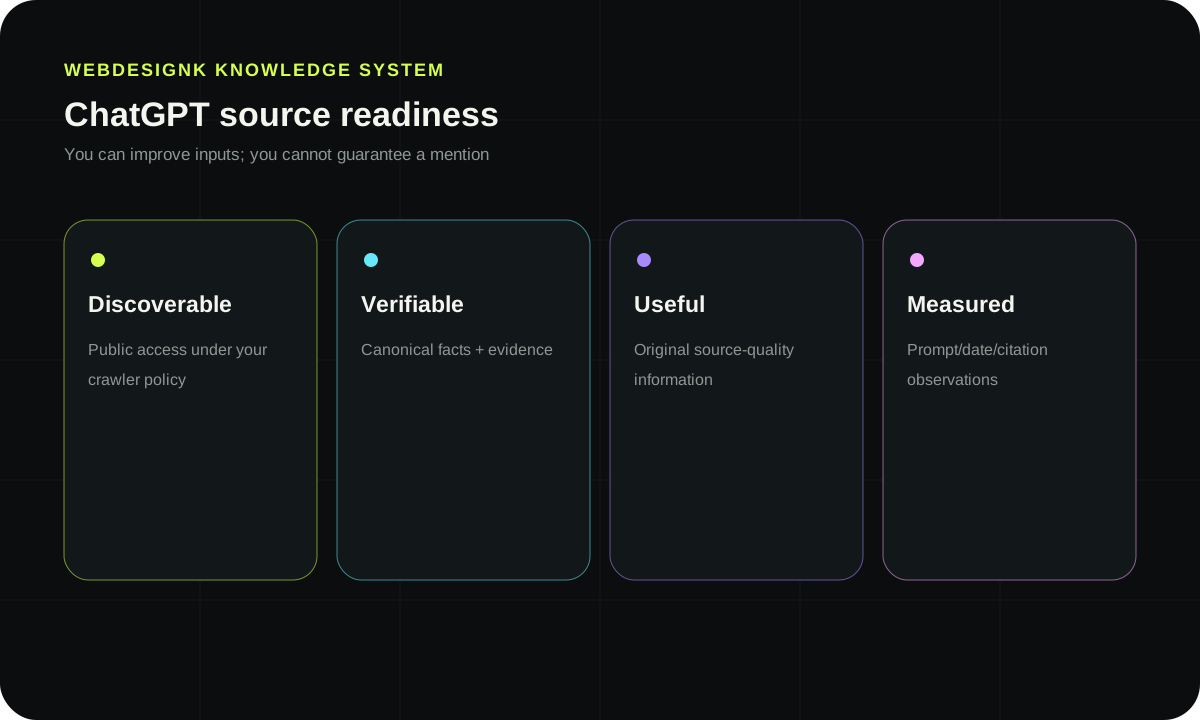
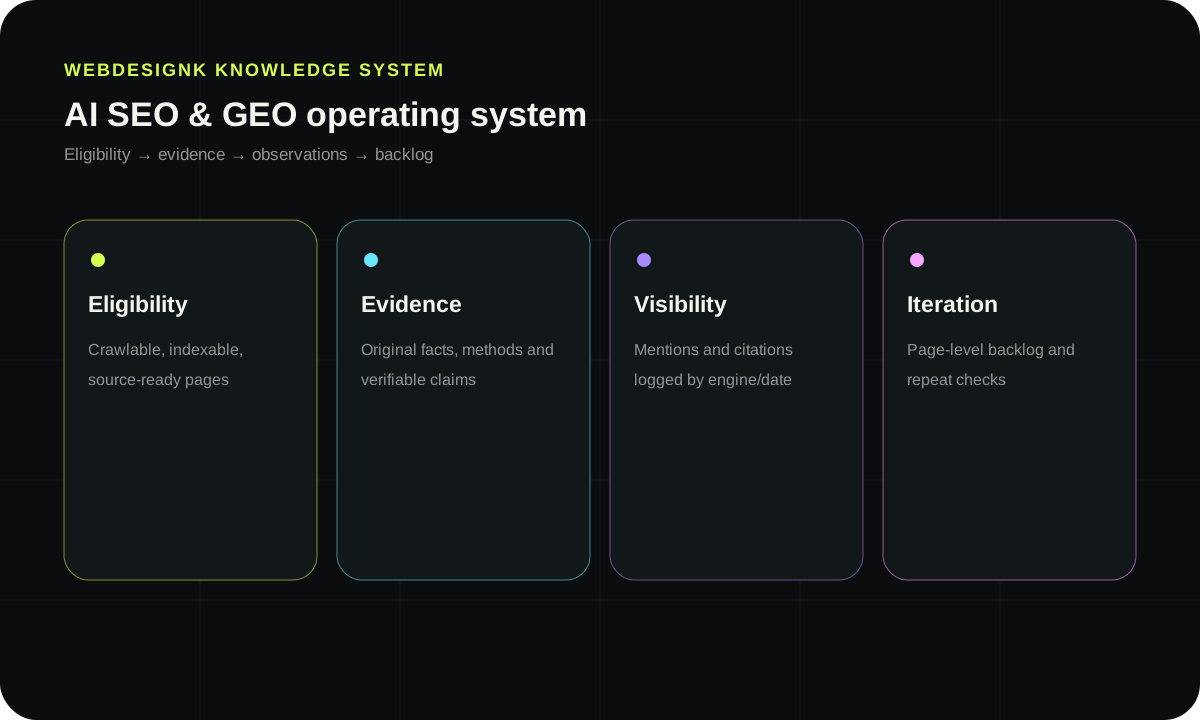
Build an evidence loop, not an “AI ranking score.” Keep entity facts consistent, make important pages crawlable, structure answers so they are understandable out of context, attach provenance to fast-changing claims, and monitor the same high-value prompts separately across ChatGPT, Google AI and Perplexity. Record mention and citation states independently, map gaps to the exact page that should improve, and re-check by date. The tracker below stores only observations you enter and never manufactures benchmark visibility.
Last reviewed: 2026-09-19AI visibility tracker
Add observations you checked yourself. Nothing below is prefilled with synthetic visibility data. Records stay in this browser via localStorage.
1. Visibility status by engine
Counts come only from the observations you added.
2. Presence trend by audit date
Presence = any non-missing status in your log; it is not an engine ranking.
3. Engine × status heatmap
Darker cells mean more records in that engine/status combination.
Observation log
| Prompt | Engine | Brand mentioned? | Status | Citation URL | Competitor / source cited | Page to improve | Checked date | |
|---|---|---|---|---|---|---|---|---|
| No observations yet. Add your first checked prompt above. | ||||||||
Source note: all chart values are user-entered observations stored locally. No benchmark, market share or engine behavior is manufactured.
Tables built for the buying decision
Primary decision table
| Prompt | Engine | Brand mentioned? | Citation URL | Competitor cited | Page to improve | Checked date |
|---|---|---|---|---|---|---|
| Navigational: “What is [brand/product]?” | Run separately per engine | Record Yes/No after audit | Paste the exact cited URL or leave blank | Record any alternative source/entity surfaced | Organization / product overview | Record audit date |
| Category: “Which tools help with [category job]?” | Run separately per engine | Record Yes/No after audit | Paste exact source URL | Record cited competitor/source | Category / solution page | Record audit date |
| Problem: “How should a team solve [problem]?” | Run separately per engine | Record Yes/No after audit | Paste exact source URL | Record cited source that answers the task | Problem/guide page | Record audit date |
| Comparison: “[A] vs [B] for [context]?” | Run separately per engine | Record Yes/No after audit | Paste exact source URL | Record cited comparison/source | Comparison / alternatives page | Record audit date |
| Recommendation: “What should [persona] use for [job]?” | Run separately per engine | Record Yes/No after audit | Paste exact source URL | Record recommended/cited alternatives | Buyer guide / service page | Record audit date |
Entity consistency operating table
| Entity field | Canonical source | Surfaces to align | Typical drift risk | Review trigger |
|---|---|---|---|---|
| Brand / organization name | Legal + brand system | About, contact, schema, profiles, press assets | Abbreviations or old naming | Rebrand / acquisition |
| Primary domain + canonical URLs | Web platform / SEO config | Canonical tags, sitemap, profiles, docs | Staging domains or redirects | Migration / CMS change |
| Product names + descriptions | Product source of truth | Product pages, docs, schema, comparisons | Legacy names or inconsistent scope | Product release / rename |
| Author / expert identity | Editorial system | Bylines, author pages, Article schema | Missing ownership or stale role | Team / responsibility change |
| Contact / location facts | Operations / CRM | Contact, local pages, organization schema | Old phone, address or service area | Office / service change |
| Claims + proof | Evidence register | Landing pages, articles, sales enablement | Unsupported “best/leading” language | Source expiry / new research |
Sources and assumption boundaries
Fast-changing platform, pricing and search claims were reviewed on 2026-09-19. Interactive scores and scenarios are clearly labeled planning models, not sourced market benchmarks.
- OpenAI — Publishers and Developers FAQ Primary OpenAI publisher guidance for ChatGPT search discovery, OAI-SearchBot access and citation/link behavior; reviewed September 19, 2026.
- OpenAI — Advertiser guidance for allowing web crawlers Primary OpenAI guidance stating that its crawlers respect robots.txt and describing crawler access / bot-mitigation considerations; reviewed September 19, 2026.
- Google Search Central — AI features and your website Primary Google Search documentation for AI features and website visibility; reviewed September 19, 2026.
- Google Search Central — Search appearance and structured data Primary Google overview explaining that structured data helps Google understand page content and listing supported search appearance features; reviewed September 19, 2026.
- Google Search Central — Introduction to structured data Primary Google guidance for implementing and validating structured data that represents visible page content; reviewed September 19, 2026.
- Perplexity — Bot and crawler guidance Primary Perplexity documentation for PerplexityBot / user-agent behavior and website-owner crawler controls; reviewed September 19, 2026.
Turn this planning result into a scoped review.
Send the assumptions, constraints and result summary. WebDesignK can review the architecture/content/implementation boundary, identify missing discovery inputs and return a prioritized next-step scope.
- Bring: current site/product, constraints, integrations and your tool result.
- You get: a scoped recommendation, open questions and implementation priorities.
Decision snapshot for AI Search Optimization
AI search optimization is the practice of making a brand, page and claim easy for answer engines to discover, interpret, verify and cite. It does not replace classic SEO. The operating tradeoff is breadth versus evidence: you can publish more answer-shaped content, but citation eligibility depends on crawlability, entity clarity, source consistency and verifiable information—not on repeating AI-friendly phrasing. Measure each engine separately and treat every result as a dated observation.
What you'll learn / decide: how answer-engine discovery differs from a ranked results page; how retrieval, synthesis and citation create different failure modes; which entity and evidence signals to clean up; how to build extractable content; what technical controls matter; how to design a monitoring prompt set; how to convert visibility gaps into a page-level backlog; and what to do over the next 90 days.
For a broader operating-model comparison, see SEO vs GEO: what changes when people search with AI. For ChatGPT-specific discovery work, use How to get your business mentioned in ChatGPT answers. The parent topic hub is AI SEO.
The rule that prevents most wasted work
Do not optimize for an imagined universal “AI ranking factor.” Build a repeatable evidence and monitoring system instead. The same prompt can produce different source sets across products, modes, dates, locations, accounts and model versions. Your job is to make trustworthy pages available and then record what actually happens. That is why the interactive tracker on this page stores your observations rather than shipping with fabricated benchmark data.
Classic search vs answer-engine discovery
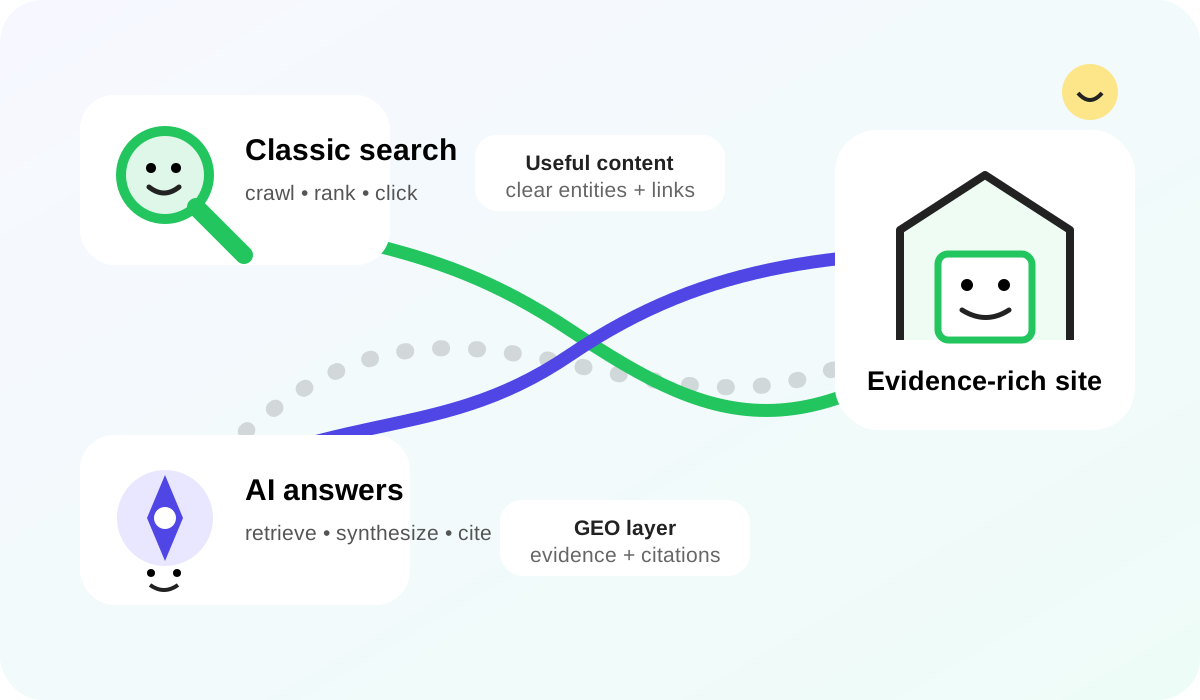
Classic web search and answer engines share important foundations: pages still need to be discoverable, technically accessible, understandable and useful. But the user experience changes the unit you are monitoring. In a conventional results page, a click often begins with a ranked URL. In an answer interface, a model may retrieve several sources, synthesize a response, mention a brand without linking it, cite a page, or omit the brand even when the page is indexed.
That means “visibility” needs more precise labels. A mention tells you the brand or entity appeared in the answer. A citation tells you a specific URL was exposed as supporting material. A competitor/source citation tells you another source won that evidence slot. Missing means your audited prompt did not surface the brand in the observation you recorded. None of those states, by itself, proves long-term preference by an engine.
Keep classic SEO measurements; add answer-level observations
Do not throw away Search Console, analytics, crawl diagnostics, conversions or branded search demand. Add a second layer: prompt, engine, mode where relevant, observed answer state, citation URL, competitor/source, page to improve and checked date. The interactive lab above uses exactly that model so repeated checks can become a timeline rather than screenshots in a slide deck.
The practical goal is not “rank #1 in AI.” It is to know which buyer questions matter, where your brand has evidence, where another source is preferred and which page change you can responsibly test next.
How retrieval, synthesis and citation differ
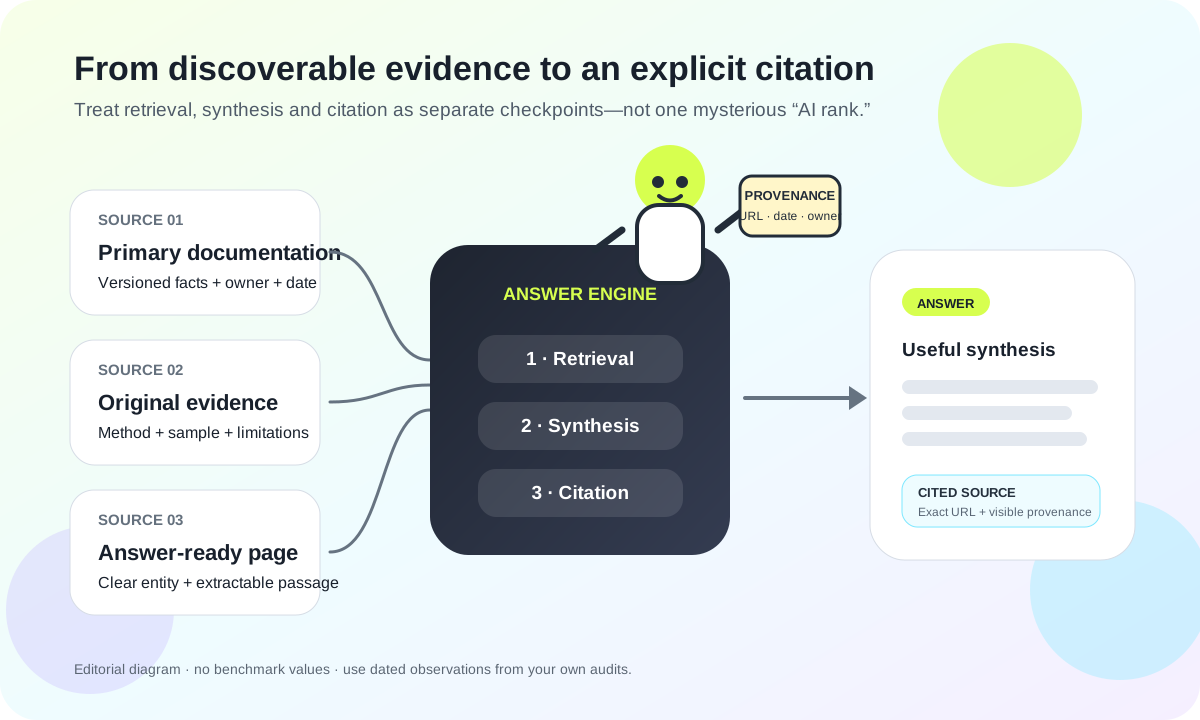
Treat an answer-engine result as at least three conceptual stages. Retrieval is the system finding candidate information. Synthesis is the system composing an answer from available context. Citation is the product exposing one or more sources to support or contextualize that answer. The exact implementation is product-specific and can change, so use this model for diagnosis—not as a claim about hidden algorithms.
A page can fail at each stage for different reasons. If the crawler cannot access it, retrieval is constrained. If the page buries the answer under vague marketing language, the information can be harder to extract or reconcile. If a claim has no source, date, method or ownership, another page may provide a clearer evidence trail. And a brand can still be mentioned without its own URL being cited, which is why “mentioned” and “cited” must be separate fields in your audit.
Diagnose the stage before rewriting the page
When a target prompt misses your brand, do not immediately add more copy. First ask: can the relevant page be crawled? Is the entity named consistently? Does the page answer this exact task? Is the important fact visible in HTML? Is there a primary source or original evidence? Is the citation-worthy passage self-contained enough to understand out of context? Does a competitor or third-party page provide clearer proof?
That sequence turns “AI optimization” from a vague content request into a testable backlog.
Entity clarity and source consistency
Answer systems need to resolve who or what a page is talking about. Help by keeping the organization name, product names, authorship, contact information, canonical URLs and core descriptions consistent across first-party surfaces. Consistency does not mean copying one paragraph everywhere. It means avoiding contradictory facts about the same entity.
Create an entity source-of-truth sheet. For each important field—legal or public brand name, product name, primary domain, organization description, founder/author identity where relevant, location, support/contact endpoint, logo and social/profile references—record the canonical owner and which pages consume it. When a fact changes, update the source of truth first and then the dependent surfaces.
Separate identity from marketing claims
“WebDesignK is a web development company” is an entity description. “WebDesignK is the best web development company” is an evaluative claim that needs evidence and may not be appropriate as a factual statement. The same principle applies to “leading,” “most trusted,” “fastest,” “#1” and other superlatives. Replace unprovable authority language with concrete capabilities, scope, methodology, credentials, customer evidence or original data that a reader can inspect.
The entity-consistency table below is intentionally operational: it gives a team a place to decide who owns each fact and where drift can occur.
Extractable content structures
Citation-friendly writing is not a special machine dialect. It is good information design. Put a direct answer near the question it answers. Use descriptive H2/H3 headings. Define terms before using them as shorthand. Keep lists parallel. Make comparison rows explicit. Put caveats beside the claim they constrain. Add dates where freshness matters. Link to primary documentation rather than laundering a claim through several secondary summaries.
A useful test is to copy one paragraph into a blank document. Can a reader still tell what the subject is, what the claim means, what assumptions apply and where the evidence came from? If not, the paragraph may be too dependent on surrounding marketing context.
Design passages for verification, not just extraction
An extractable statement should also be easy to verify. If you publish original research, include methodology, sample, collection dates, exclusions and definitions. If you compare vendors, state the criteria. If you describe platform behavior, cite the current official documentation and record the review date. If you present a planning scenario, label it as your own model instead of letting it look like a market benchmark.
Tables are especially useful when the underlying facts are truly comparable. They let readers and machines see the same labels, units and caveats. Avoid giant tables built only to target keyword variants; every row should help a decision.
Evidence, citations and original information
Original information can make a page useful beyond paraphrasing what already exists. Examples include a documented test, anonymized aggregate data with methodology, a reusable template, a decision framework, a maintained compatibility matrix, screenshots of a reproducible process, or a clearly labeled expert interpretation grounded in sources.
The strongest evidence stack usually has layers: a primary source for platform facts; first-party product or operational evidence for your own capabilities; third-party evidence where independence matters; and a transparent explanation of what you infer from those inputs. Keep those layers distinct.
Provenance should survive the editorial workflow
For every fast-changing claim, retain the source URL, the date reviewed and a note about what the source supports. Do not rely on an internal document that simply says “verified.” Future editors need to know where it was verified. If the source disappears or changes, the claim should enter a re-review queue.
This article's source list follows that rule. OpenAI's publisher guidance currently says public sites can appear in ChatGPT search and advises publishers not to block OAI-SearchBot when they want content included in summaries and citations. Google's Search documentation explains that structured data helps Google understand page content and documents AI features as part of Search appearance. Perplexity documents its own crawler behavior separately. Those are product-specific sources, which is exactly why the monitoring table keeps engine and checked date as separate fields.
Technical crawlability and structured data
Start with boring technical fundamentals. A citation strategy cannot rescue a page that returns the wrong status, requires an unsupported login, is blocked from the crawler you expect to access it, has an accidental noindex, points canonical elsewhere, or renders the important content only after a broken client-side request.
Review robots.txt and bot controls intentionally. OpenAI publishes guidance for OAI-SearchBot and states that its crawlers respect robots.txt. Perplexity publishes crawler guidance for PerplexityBot and related agents. Google maintains its own crawler and AI-feature documentation. Do not copy one engine's rule to another. Record the product, user-agent policy, owner, change date and business decision.
Structured data is a supporting clarity layer, not a citation switch. Use schema that matches visible content and the actual entity or page type. For an editorial article, Article/BlogPosting and BreadcrumbList are normal foundations. Organization and author data should agree with visible information. FAQ markup should only exist when the FAQ is visibly rendered and applicable. Google's documentation explicitly frames structured data as a standardized way to provide information about a page; it does not guarantee a search feature or AI citation.
Build a technical evidence check
For an important page, capture: final status code, indexability, canonical, rendered title/H1, main-content presence, structured-data types, image accessibility, robots policy and whether the relevant crawler is intentionally allowed. Re-run after framework, CDN, WAF or CMS changes. Bot mitigation can silently create a different website for crawlers than for human QA.
Build a monitoring prompt set
A useful prompt set represents buyer journeys, not a bag of keywords. Start with five prompt families and write prompts in natural language:
- Navigational: “What is [brand/product]?” or “Where is the documentation for [product]?”
- Category: “Which platforms help a B2B team solve [category problem]?”
- Problem: “How should a company fix [specific operational/search problem]?”
- Comparison: “[Option A] vs [Option B] for [context]—what are the tradeoffs?”
- Recommendation: “What should a [company type] use for [job] given [constraints]?”
Keep the wording stable enough to compare checks, but add realistic variants when they represent genuinely different intent. Tag prompts by persona, funnel stage, product, market and priority outside the engine if your monitoring system supports it.
Do not collapse engines into one score
Run the same priority prompt against the products you actually care about and store separate rows. The engine field matters because source selection, UI and product behavior are not interchangeable. Date matters because results can change. Mode or account context may matter too; if it materially changes your test, add it to your own monitoring notes even if this lightweight lab does not model every field.
Use the coverage log as evidence, not as a leaderboard. One cited answer does not prove durable visibility; one miss does not prove exclusion. Repeated, controlled observations are more useful than a single percentage with false precision.
Measure mentions, citations and assisted demand
Your primary monitoring layer should count observations by status and engine. That is what the tool visualizations do. The second layer connects observations to business outcomes without pretending attribution is perfect.
Track referrals where available, branded search changes, direct traffic context, assisted conversions, sales-call mentions, copied campaign parameters and on-site behavior from AI-referred sessions. OpenAI's publisher FAQ documents referral tracking behavior for ChatGPT links, but analytics setups and privacy controls differ, so verify what reaches your own analytics rather than assuming every answer-engine visit is identifiable.
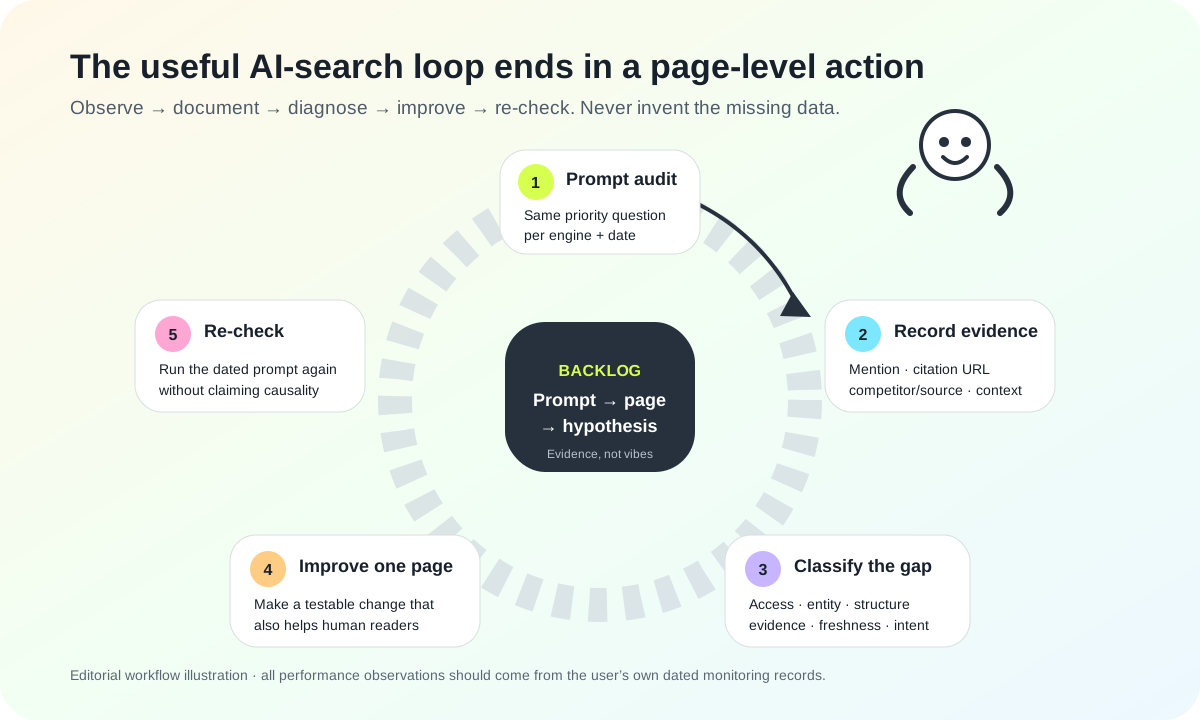
Turn every miss into a page-level hypothesis
A useful backlog item is not “improve GEO.” It is “For category prompt X on engine Y, source Z is cited for implementation steps; our page /guide lacks an extractable checklist and current primary references. Add checklist, source notes and review date; re-check on [date].” That tells a writer, SEO, engineer or product marketer what can change and how the change will be evaluated.
Prioritize gaps where the prompt matters commercially, the missing information is legitimately yours to provide, and the page change improves human usefulness even if no AI engine ever cites it. That last condition protects the site from becoming a collection of speculative machine-targeted edits.
Avoid spam, fake authority and synthetic facts
AI visibility pressure can create bad incentives: publish hundreds of near-duplicate definitions, invent statistics, create fake expert quotes, simulate reviews, cite low-quality sources that cite each other, or produce “research” whose sample never existed. Those tactics weaken the exact evidence layer citation systems and human buyers need.
Set editorial red lines. No fabricated numbers. No synthetic customer stories presented as real. No fake awards or credentials. No author personas created only to imply expertise. No claim that an engine “prefers” a format unless the engine documents it or your statement is clearly labeled as a limited observation with date and method.
Keep machine assistance visible in the process, not as fake evidence
AI can help cluster prompts, summarize source material, propose outlines, flag inconsistent terminology or draft transformation code. It cannot turn an unsupported claim into a sourced fact. A human owner should review high-impact claims, platform behavior, legal/privacy material and original-data methodology before publication.
For regulated or legally sensitive content, get qualified advice appropriate to the jurisdiction and subject. Search optimization is not a substitute for legal, medical, financial or compliance review.
A 90-day AI-search plan
Days 1–30: establish the baseline. Choose 20–50 priority prompts across the five prompt families, depending on your product complexity. Record separate observations for the engines you care about. Audit crawler access, canonical/indexability, entity consistency and top commercial pages. Build a source register for fast-changing claims. Do not chase percentages yet; make the dataset trustworthy.
Days 31–60: fix evidence and extraction gaps. Group misses by root cause: technical access, ambiguous entity, weak answer structure, absent proof, stale source, missing comparison, or competitor page with stronger evidence. Improve the pages where the change also helps a human buyer. Add clear definitions, tables, original evidence, methodology, dates and primary citations where appropriate. Keep a changelog so you know what changed before the next audit.
Days 61–90: re-check and operationalize. Re-run the same priority prompt set, compare dated observations, and investigate meaningful changes without overclaiming causality. Connect referral/assisted-demand signals to the visibility log. Set a review cadence by business importance and volatility—more frequent for rapidly changing product/platform topics, less frequent for stable evergreen material. Assign owners for entity data, source review and technical bot controls.
What success looks like after 90 days
Success is not a vanity “AI visibility score.” It is a system: a maintained prompt set, dated observations, known source provenance, a page-level improvement backlog, technical crawler ownership, cleaner entity data and editorial rules that prevent unsupported claims. If citations improve, you can see where and after which changes. If they do not, the work still leaves you with clearer, more useful and more verifiable content.
Use the tracker on this page to maintain the evidence. When you have a real observation set and backlog, WebDesignK's AI SEO / AstraSEO service can help scope the technical, content and monitoring implementation. Bring the prompt set, important pages, known crawler constraints and your exported/copyable result summary so discovery starts from evidence rather than guesses.
Frequently asked questions
Is AI search optimization the same as SEO?
No. It shares SEO foundations such as crawlability, helpful content, internal linking and structured data, but adds answer-level monitoring: whether a brand is mentioned, whether a URL is cited, which alternative source appears and how those observations change by engine and date.
Can schema markup make ChatGPT, Google AI or Perplexity cite my page?
No guaranteed citation switch exists. Structured data can improve machine-readable clarity for systems that use it, and Google documents structured data as a way to help Google understand page content, but citation behavior is product-specific. Use schema that matches visible content and measure actual outcomes.
Should I allow every AI crawler?
That is a business and governance decision. Review each provider’s current official crawler documentation, your content/licensing policy, security controls and desired discovery behavior. Do not assume one robots rule applies to every product.
How often should I re-check AI visibility prompts?
Use a cadence based on importance and volatility. High-value, fast-changing categories may justify frequent checks; stable evergreen topics can be checked less often. Keep the prompt wording, engine and date so changes are interpretable.
What is the difference between a brand mention and a citation?
A mention means the brand or entity appears in the answer. A citation means the interface exposes a specific source URL. A brand can be mentioned without its site being cited, so monitor the two states separately.
What should I do when a competitor is cited instead?
Inspect the cited page and classify the gap: technical access, entity clarity, answer structure, evidence, freshness, original data or a task your page simply does not cover. Create a page-level hypothesis and improve only when the change also helps human readers.