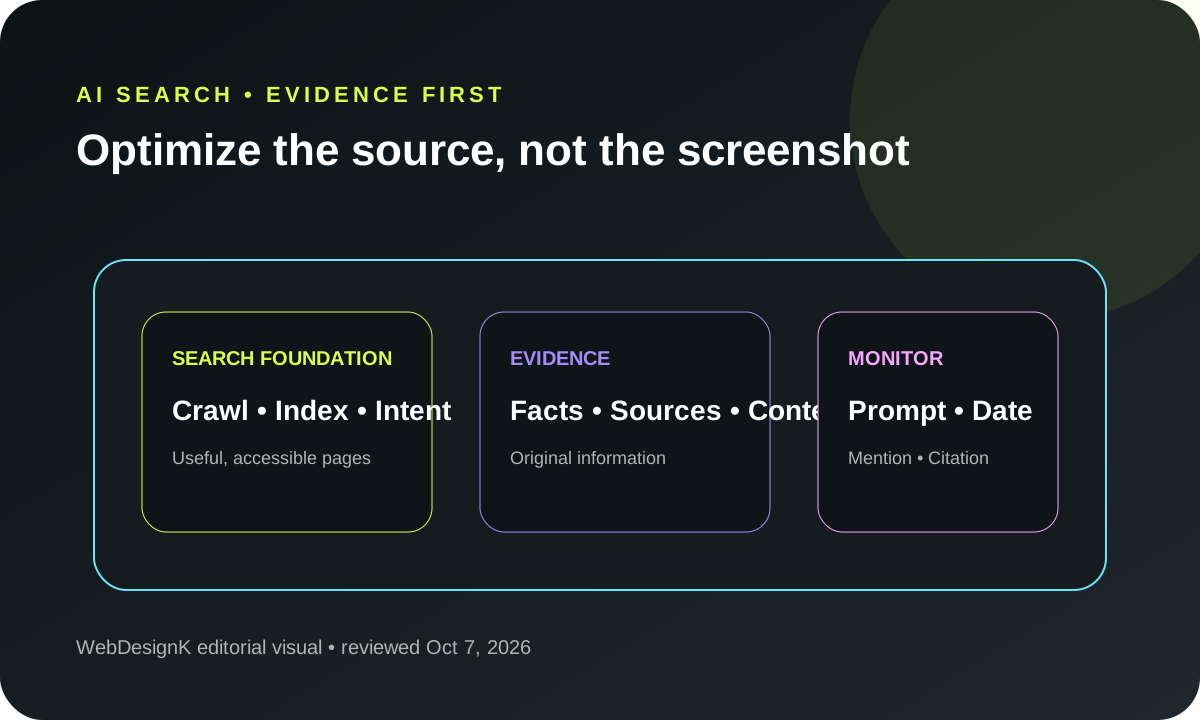
Entity SEO for AI search means making a real organization, its products, its people and its verified sources easier to distinguish and understand. Start with a consistent company identity, accurate owned pages, appropriate Organization markup and evidence for material claims. Then monitor whether different answer engines mention the brand, cite its pages or cite competing sources. Neither structured data nor repetition guarantees an AI citation.
What you'll decide: which identity facts need correction, what evidence deserves publication, which pages should be discoverable and how dated AI-search observations become an actionable backlog.
Last editorial review: October 19, 2026. Search experiences evolve. All sample brands and outcomes here are illustrative; no search-engine inclusion is promised.
0. Decision snapshot: entity clarity versus manufactured authority
The most consequential trade-off is between a consistent, substantiated identity and filling the web with repetitive mentions. A company may have a legal name, public trading name, product label and social handles. These are not necessarily contradictions, but their relationships must be understandable and supported. Ten copies of an unsupported claim do not make it true.
Start with an entity ledger: canonical brand name, permitted aliases, official website, stable identifier, controlled profiles, current product and author relationships, and authoritative sources. Assign an owner and review date to each material field. This ledger informs visible site copy and structured data; it is not an instrument for inventing external endorsements.
For a software firm, explaining how a company and its product are related is often more valuable than adding another "best provider" blog post. A useful reader should be able to identify who makes a product, who wrote its documentation and where each important claim can be checked.
1. Classic search versus answer-engine discovery
Conventional organic search usually supplies links that people can inspect and compare. AI-assisted search can synthesize an answer, mention a brand, cite its site, cite a third party or show no visible citation. A conventional search impression is not the same observation as a brand mention inside an AI-generated answer.
Google states in its AI features and your website documentation that foundational SEO remains relevant for AI Overviews and AI Mode, and there are no separate mandatory optimizations. That does not mean every indexed page appears in AI results. Interfaces and source selection change, and different systems should be tested separately.
OpenAI's publisher guidance explains that allowing OAI-SearchBot can help eligible public pages appear in ChatGPT search. This is not a citation guarantee. Other providers have their own systems, and a single crawler setting cannot be assumed to govern them identically.
Don't mistake content volume for authority
Publishing dozens of lightly rewritten pages optimized for similar prompt wording can cause conflicting claims, thin editorial value and maintenance debt. Focus on correct source records, a useful website, clear product relationships and genuine evidence. Compare what a reader can learn, not how many times the brand is repeated.
2. Retrieval, synthesis and citation are different events
Keep four observations separate. Retrievability means a relevant public page is technically accessible to the applicable crawler or search provider. Synthesis means an answer uses available information to address a question. Brand mention means the organization or product is explicitly named. Citation means a visible URL is offered as a source, and even then you must check what that linked page actually supports.
A brand can be named without its domain being cited. A competitor can be cited when your brand is not mentioned. A cited third-party profile may mention a brand without endorsing a quality claim. Record engine, prompt, date, observed answer, brand mention, visible citation URL and supporting claim separately.
Worked example: a fictional scheduling product
Assume Harborstone Scheduling sells Harborstone Meet. Its About page documents the company; its product page lists current capabilities; its integration guide explains supported APIs; and an authorized independent directory entry lists the product. These sources establish different facts.
If ChatGPT search cites the integration page for a technical question, preserve that URL and what it supports. If another interface mentions the product but cites a comparison page, record both the mention and that particular citation. If a recommendation prompt does not mention the company, do not conclude that one missing markup property caused the absence. Evaluate available evidence and the prompt's intent first.
3. Entity clarity and source consistency
Create a controlled, reviewable fact ledger. For each brand, record the public name, legal name when relevant, aliases, canonical HTTPS homepage, primary product names, real profile URLs and references that back material facts. For local businesses, genuine address and phone information may matter. For an online-only business, inventing a physical storefront address is inappropriate.
Google's Organization structured-data documentation supports name, alternateName, url, sameAs and relevant business attributes. It says that this data can help with disambiguation. It does not promise a knowledge panel, ranking improvement or AI answer placement.

Entity consistency matrix
| Attribute | Authoritative owned source | Site schema | External record | Decision |
|---|---|---|---|---|
| Organization name | About/legal page | Organization name | Partner/listing | Distinguish true conflict from approved trading alias |
| Homepage | Canonical HTTPS page | URL and stable identifier | Official profiles | Fix wrong origin or impersonating links |
| Product relationship | Visible product/service pages | Appropriate brand/product references | Authorized listing | Confirm real owner and current scope |
| Author | Verified byline and author page | Appropriate author reference | Actual credentials | Never invent reviewer or experience |
| Location, if applicable | Legitimate public contact record | PostalAddress when appropriate | Directory | Do not fake premises or present remote work as retail |
| Evidence | Original research or source documentation | Reflect only visible claims | Independent corroboration | Remove unsupported metrics or endorsements |
The matrix is a list of checks, not an audit of any real brand. A public profile may confirm identity without proving commercial results.
4. Extractable content structures
Write pages that answer one real question directly, then show method, limits, evidence and a useful next action. Stable descriptive headings, clear definitions, genuine comparison tables and contextual links help readers check meaning and may help retrieval systems distinguish one page from another.
A product comparison should specify the comparison dimensions and what was tested. A study should identify the methodology, period, denominator and source. Instead of many near-duplicate AI-search "snippets", maintain a strong integration page, product specification and practical implementation documentation linked from the appropriate brand entity.
Avoid making private business records public for the sake of extractability. Retrieval eligibility is not permission to expose customer information, personal contact data or confidential documents.
5. Evidence, citations and original information
A citation is only as strong as the proposition it actually substantiates. A partner page may confirm a collaboration, but not leadership in a market. Technical documentation may establish compatibility, but not return on investment. A social profile can identify an organization without independently verifying the company's own performance claims.
For quantitative claims, identify data source, method, date, scope and limitations. For self-published research, show a reproducible approach where appropriate. For external references, confirm they genuinely refer to the same company and not a similarly named firm or unauthorized copy.
A sameAs URL indicates another source about an entity; it does not turn the source into proof of every advertised claim. Do not associate unrelated profiles to increase apparent authority.
Build an auditable source ledger
For each fact, record attribute, current value, canonical source URL, exactly what that source says, whether it is owned or independent, when it was checked and the person responsible for updates. Give conflicts a visible status rather than replacing them silently.
6. Technical crawlability and structured data
A well-formed JSON-LD snippet cannot overcome a page that is inaccessible, blocked to the relevant crawler, accidentally noindexed or missing meaningful rendered content. Test real HTTP responses, robots directives, rendered metadata, canonical destinations, sitemap inclusion and internal discovery for the most important entity and product pages.
Choose the right markup types for the real content. The organization homepage may contain an Organization definition with a stable identifier built from the canonical domain and an internal fragment, for example an organization fragment identifier. Product and author pages can reference appropriate objects when they accurately reflect visible content. Do not add every schema type you can find merely to produce a large graph.
Google's structured-data general guidelines require that marked-up content be representative and not misleading. Its Organization guidance recommends applicable properties rather than a minimum number of social handles. A stable schema identifier is valuable as an internal entity reference, but is not an official registration number or a guarantee that third parties agree with your identity model.
Check crawl and index settings by provider
Google's AI features documentation covers how eligibility connects to ordinary Google Search requirements. OpenAI's publisher FAQ explains OAI-SearchBot and the need for allowed crawling when page-level exclusion signals are to be read. Test the intended crawler behavior for each surface separately, including CDN and firewall access.
Do not use robots directives as security controls. An authenticated product contract or private dashboard needs proper access control, not just search exclusion. A page with noindex may be appropriately excluded regardless of how many entity references it contains.
7. Build a monitoring prompt set
An AI-search monitoring plan should reflect real buyer questions, not only the brand's own name. Build a stable set spanning five intentions:
| Prompt type | Sample fictional prompt | What to observe | Typical improvement destination |
|---|---|---|---|
| Navigational | Where is Harborstone Scheduling's official API guide? | Correct domain, product identity, cited document | About, docs and canonical entity links |
| Category | What tools support team appointment scheduling? | Category fit, brand mention, credible sources | Product category and positioning page |
| Problem | How do I handle booking conflicts for multi-office teams? | Useful explanation and technical evidence | Specific workflow/how-to guide |
| Comparison | Harborstone Meet versus another named tool for shared calendars? | Accurate comparison and source quality | Transparent, dated comparison page |
| Recommendation | Which appointment platform fits a U.S. service company? | Eligibility, limitations, cited support | Buyer criteria and verified product details |
Do not make only brand-containing prompts your measurement set. Those are useful navigational checks but can overstate broader discoverability. Balance head terms with actual buyer questions and narrow contexts where a product is legitimately relevant.
AI-search observation ledger
| Prompt | Engine | Brand mentioned? | Citation URL | Competitor cited | Page to improve | Checked date |
|---|---|---|---|---|---|---|
| Fictional platform official API | Manual engine observation required | Not yet tested | — | — | Technical docs | Pending |
| Tools for service team scheduling | Manual engine observation required | Not yet tested | — | — | Category landing page | Pending |
| Shared-calendar conflict issue | Manual engine observation required | Not yet tested | — | — | Implementation guide | Pending |
| Product versus alternative | Manual engine observation required | Not yet tested | — | — | Dated comparison | Pending |
This table intentionally contains no invented engine results. When you run tests, capture a timestamp, exact prompt and interface, location or language constraints where relevant, screenshots/export as allowed, and the citation URLs actually shown. Recheck whether the cited page supports the relevant statement. Do not compare one logged-in personalized answer with a different anonymous or dated environment and call it a controlled experiment.
8. Measure mentions, citations and assisted demand separately
Establish a fixed prompt set and run observations at an agreed cadence. For each answer, tag brand mentioned yes/no, owned citation yes/no, independent citation yes/no, competitor citation yes/no, correctness of cited claim and any notable variation. Save the observed engine/interface and date; results can vary by prompt wording, user context, location and time.
Visibility rate for a selected prompt set can be defined as prompts with brand mentions divided by prompts actually checked. Owned citation coverage is checked prompts with at least one owned-domain cited URL divided by checked prompts. These ratios describe the observed sample, not all real AI usage. They should not be presented as market share or causal SEO lift.
Monitor outcomes outside the AI interface: branded search patterns, referral visits where reliably identifiable, assisted conversions and customer-reported discovery sources. Many visits may not expose a distinct AI referral label; do not manufacture attribution based on a guess. Discuss privacy and consent controls with the relevant data owner.
Turn each gap into a page-level action
For a missing brand mention, first ask whether the brand is genuinely a fit for the question. For a wrong name, inspect the owned entity ledger and public directory records. For a competitor citation, read what independent evidence the cited competitor page supplies before deciding how to improve the relevant page. For a source that cites stale specs, fix the primary public documentation and clearly date the revision.
An AI-search observation is a hypothesis generator, not a command to publish a keyword landing page. Assign an editor, source owner, next action and follow-up observation date; preserve before/after evidence without asserting causality from a single change.
9. Avoid spam, fake authority and synthetic facts
Do not create synthetic interviews, fabricated awards, invented experts, made-up research, purchased endorsements disguised as independent coverage, or fake local addresses to influence retrieval systems. It can mislead people, conflict with platform rules and create significant reputational risk.
The Google spam policies address misleading and scaled content abuse. These policies are not a complete description of every answer engine, but their emphasis on useful content and avoiding manipulation is compatible with a durable entity strategy.
Do not treat schema as a license to state hidden facts that do not appear on the page. If the brand operates several legal entities, document which one sells each service. If product names changed, preserve a clear transition and redirect/alias strategy rather than overwriting history or linking several distinct brands to one incorrect identifier.
What evidence should not be collected here
The checker below is for public business facts only. Do not paste private personnel records, passwords, customer contracts, unpublished financial results or private profile URLs. It runs locally inside this article's isolated component and makes no network requests. A green bar means input fields are structurally consistent—not that an external platform has verified them.
10. A 90-day implementation and verification plan
Days 1–15 — inventory and ownership. Identify the primary company and product pages, public brand names, aliases, author pages, official profiles, organization markup, canonical URLs and existing citations. Create a fact ledger with owners and review dates. Capture a small baseline prompt set across the answer interfaces relevant to your market, recording exact outputs without making broad claims from limited samples.
Days 16–30 — correct contradictions. Fix the most consequential name/domain/product mismatches. Update visible About and product pages before corresponding structured data. Audit that sameAs URLs actually identify this entity and that stated offerings are still current. Check published HTML, bot access, canonicals and redirects. Preserve a versioned audit trail.
Days 31–45 — improve useful evidence. Publish or revise genuine documentation, product specifications, independently verifiable explanations and support pages. Add specific authorship and methodology where relevant. Avoid redundant thin AI-prompt pages. Have a responsible product or legal owner approve any substantive claims, certifications or personal details.
Days 46–60 — stabilize technical delivery. Validate a representative set of company, product, author and category URLs. Test JSON-LD against visible facts, metadata and crawl eligibility for the relevant providers. Correct broken source references. Ensure links between organization, brand and product reflect actual relationships.
Days 61–75 — compare prompt observations. Reuse the same prompt set and carefully log each engine/date. Tag brand mentions and citations separately and open page-level tasks for substantiated gaps. Recognize that outputs can change without any website edit. Document environment and sample limitations.
Days 76–90 — prioritize durable fixes. Review entity consistency, URL health, source freshness and qualitative buyer usefulness. Compare assisted demand only where instrumentation provides real evidence. Establish a quarterly ownership schedule and response procedure for important changed facts.
Interactive consistency and evidence checker
Use this tool before scheduling changes. It checks public brand names, website/schema identity and independently documented references. It is not a crawler, rich-result validator or automatic AI-search rank tracker. The synchronized evidence bars and conflict messages show exactly which inputs deserve human review.
Brand identity and AI-search evidence lab


Next step and related resources
For a scoped technical review, WebDesignK's AI SEO and AstraSEO service can assess your organization/source ledger, structured data, page crawlability and a sensible monitoring prompt set. Bring only public company identifiers, owned pages, available approved sources and a list of the buyer questions you want to answer. The outcome should be a prioritized, verifiable implementation backlog, not a promised citation count. You can copy the checker summary and use it to brief your SEO or product team before contacting WebDesignK.
Related reading: B2B SEO strategy and organic demand, technical SEO audit fundamentals and programmatic SEO without thin content.
Official references reviewed October 19, 2026: Google Organization structured data, Google AI features and your site, Google spam policies, OpenAI publishers FAQ, and ChatGPT Search source-review guidance.
The checklist, coverage matrix and examples are editorial planning models. AI citation inclusion, visibility improvements and business outcomes are not guaranteed.