Quick answer
Optimize for qualified progression, not vanity conversion rate. A shorter form that doubles low-quality leads can make the business worse. Pair the primary website action with downstream guardrails such as sales acceptance, opportunity creation, activation, retention signals, support burden and acquisition cost context.
Last reviewed: 2026-09-19T00:00:00.000ZRevenue-impact scenario calculator
Enter your own eligible traffic or leads, observed conversion rate, modeled conversion rate, average order/deal value and margin. The defaults are illustrative placeholders only—not market benchmarks. Results are arithmetic scenarios, not promised uplift.
1. Conversion scenario across traffic checkpoints
Takeaway: the gap scales with your eligible volume only because the modeled rate is applied consistently to your own traffic input.
2. Baseline vs modeled revenue
Takeaway: revenue follows conversions × your average order/deal value; no extra uplift assumption is added.
3. Modeled revenue composition
Takeaway: margin changes the economic value of a conversion without changing the conversion count itself.
Scenario table generated from your inputs
| Measure | Current | Modeled | Difference |
|---|---|---|---|
| Conversion rate | 2% | 2.5% | 0.5 pp |
| Conversions | 200 | 250 | 50 |
| Revenue | $40,000 | $50,000 | $10,000 |
| Gross profit | $20,000 | $25,000 | $5,000 |
Important: this calculator does not estimate causality or probability. A modeled conversion rate is a planning assumption until a valid experiment or other evidence supports the change.
Tables built for the buying decision
Primary decision table
| Hypothesis | Journey step | Evidence | Change | Primary metric | Quality guardrail | Effort |
|---|---|---|---|---|---|---|
| ICP cannot tell the product is for them | Hero / first screen | Interviews + low qualified progression | Clarify audience, problem and outcome | Qualified CTA progression | Sales acceptance | Low |
| Proof arrives after the decision point | Service/product page | Sales objections + scroll behavior | Move relevant evidence beside claim | Qualified CTA completion | Opportunity quality | Low |
| Demo form asks for unused fields | Lead form | CRM field audit + abandonment | Remove/defer nonessential fields | Qualified submit rate | Missing qualification data | Low |
| Pricing/packaging language is ambiguous | Pricing | Sales questions + plan confusion | Define plan boundaries and buyer fit | Pricing-to-CTA progression | Wrong-plan pipeline | Medium |
| Security questions block enterprise buyers | Evaluation | Repeated security objections | Add accurate security/process evidence | Qualified enterprise progression | Security accuracy | Medium |
| Mobile CTA/form flow is hard to use | Mobile | Errors + viewport QA | Fix controls, keyboard, focus and errors | Mobile qualified completion | Spam/quality | Medium |
| Landing page promise mismatches ad/search intent | Acquisition | High exits by source | Align message to source intent | Qualified next-step rate | Lead quality | Medium |
| Case studies are generic rather than decision-useful | Proof | Sales requests for specifics | Add problem/constraints/process/outcome context | Proof-to-CTA progression | Claim accuracy | Medium |
| Page is slow before useful interaction | Performance | Field performance + interaction timing | Reduce/defer heavy dependencies | Qualified task completion | Analytics completeness | High |
| Multiple CTAs compete without hierarchy | Journey | Click dispersion + user tests | Define primary/secondary action by intent | Primary qualified action | Useful self-serve paths | Low |
B2B/SaaS measurement map
| Stage | Eligible population | Primary outcome | Downstream guardrail | Useful segment |
|---|---|---|---|---|
| Awareness to evaluation | Intent-relevant landing sessions | Meaningful product/service exploration | Engaged qualified accounts | Source + query intent |
| Evaluation to contact | Visitors reaching decision pages | Qualified CTA/form completion | Sales acceptance | Company/use case |
| Contact to pipeline | Submitted qualified leads | Accepted opportunity | Pipeline quality/cycle | Source + landing page |
| Signup to activation | Eligible trials/signups | Defined activation event | Retention/expansion signal | Plan/use case |
Sources and assumption boundaries
Fast-changing platform, pricing and search claims were reviewed on 2026-09-19T00:00:00.000Z. Interactive scores and scenarios are clearly labeled planning models, not sourced market benchmarks.
- Google Analytics — Ecommerce measurement Official GA4 guidance for ecommerce actions, value and currency; reviewed September 19, 2026.
- Google Analytics — Traffic acquisition report Official acquisition-report definitions used for source and intent segmentation; reviewed September 19, 2026.
- web.dev — Core Web Vitals Official performance guidance for user-centered web performance signals; reviewed September 19, 2026.
- W3C WAI — Forms tutorial Accessibility guidance for labels, instructions, validation and usable forms; reviewed September 19, 2026.
Turn this planning result into a scoped review.
Send the assumptions, constraints and result summary. WebDesignK can review the architecture/content/implementation boundary, identify missing discovery inputs and return a prioritized next-step scope.
- Bring: current site/product, constraints, integrations and your tool result.
- You get: a scoped recommendation, open questions and implementation priorities.
For B2B and SaaS websites, conversion optimization should improve the path from qualified intent to a meaningful next step—not maximize raw form fills at any cost. Define the business outcome and qualification criteria, segment visitors by intent, diagnose message and proof gaps, reduce interaction friction, and test changes against downstream quality. Use revenue modeling to understand possible economic impact, but never treat the modeled uplift as a forecast.
What you'll learn / decide
- How to define a conversion that maps to B2B/SaaS value
- How to diagnose message, proof, CTA and form friction by intent
- How to prioritize experiments without sacrificing lead quality
- How to model pipeline/revenue scenarios transparently
Decision snapshot for Website Conversion Optimization
The decision boundary is quality: optimize the website for meaningful progression by the right visitor, not the largest possible count of shallow actions. Define what qualified means with sales/product stakeholders before changing forms or CTAs.
A useful decision here starts with evidence from your own funnel, product or delivery environment rather than an industry average. Define the user or business outcome first, document the current state, and name the constraint that would make a recommendation change. This keeps the work falsifiable: the team can point to the observation behind a priority and can later check whether the change solved the intended problem.
Treat the plan as a sequence of reversible decisions. Separate facts you can verify now from assumptions that need measurement, then assign an owner, validation method and guardrail. Avoid turning a planning scenario into a promise. A model can show arithmetic consequences, effort or dependency order, but it cannot prove future conversion, revenue or delivery speed before the work is shipped and observed.
For implementation, prefer the smallest change that can answer the next important question without creating avoidable migration or maintenance debt. Record the baseline, ship with instrumentation, inspect the result by meaningful segments, and keep the next action tied to what the evidence actually says.
Define the visitor decision and business outcome
Map each important page to the decision it should help a visitor make—understand fit, trust a claim, compare options, evaluate implementation, start a trial, request a demo, or contact sales. Attach an observable business outcome so the page is not judged by clicks alone.
A useful decision here starts with evidence from your own funnel, product or delivery environment rather than an industry average. Define the user or business outcome first, document the current state, and name the constraint that would make a recommendation change. This keeps the work falsifiable: the team can point to the observation behind a priority and can later check whether the change solved the intended problem.
Treat the plan as a sequence of reversible decisions. Separate facts you can verify now from assumptions that need measurement, then assign an owner, validation method and guardrail. Avoid turning a planning scenario into a promise. A model can show arithmetic consequences, effort or dependency order, but it cannot prove future conversion, revenue or delivery speed before the work is shipped and observed.
For implementation, prefer the smallest change that can answer the next important question without creating avoidable migration or maintenance debt. Record the baseline, ship with instrumentation, inspect the result by meaningful segments, and keep the next action tied to what the evidence actually says.
Capture the baseline before changing anything
Document event definitions, routing logic, source attribution, eligible populations and downstream CRM/product signals. Reconcile website submissions with accepted leads or activated accounts so the baseline reflects quality, not just front-end success messages.
A useful decision here starts with evidence from your own funnel, product or delivery environment rather than an industry average. Define the user or business outcome first, document the current state, and name the constraint that would make a recommendation change. This keeps the work falsifiable: the team can point to the observation behind a priority and can later check whether the change solved the intended problem.
Treat the plan as a sequence of reversible decisions. Separate facts you can verify now from assumptions that need measurement, then assign an owner, validation method and guardrail. Avoid turning a planning scenario into a promise. A model can show arithmetic consequences, effort or dependency order, but it cannot prove future conversion, revenue or delivery speed before the work is shipped and observed.
For implementation, prefer the smallest change that can answer the next important question without creating avoidable migration or maintenance debt. Record the baseline, ship with instrumentation, inspect the result by meaningful segments, and keep the next action tied to what the evidence actually says.
Find the highest-friction moments
Look for repeated unanswered questions, qualification drop-offs, invalid form states, unclear implementation/security information, inconsistent pricing language and mobile dead ends. Interview sales/support/product teams because operational evidence often explains behavior that analytics alone cannot.
A useful decision here starts with evidence from your own funnel, product or delivery environment rather than an industry average. Define the user or business outcome first, document the current state, and name the constraint that would make a recommendation change. This keeps the work falsifiable: the team can point to the observation behind a priority and can later check whether the change solved the intended problem.
Treat the plan as a sequence of reversible decisions. Separate facts you can verify now from assumptions that need measurement, then assign an owner, validation method and guardrail. Avoid turning a planning scenario into a promise. A model can show arithmetic consequences, effort or dependency order, but it cannot prove future conversion, revenue or delivery speed before the work is shipped and observed.
For implementation, prefer the smallest change that can answer the next important question without creating avoidable migration or maintenance debt. Record the baseline, ship with instrumentation, inspect the result by meaningful segments, and keep the next action tied to what the evidence actually says.
Message, proof, CTA and form/checkout design
A strong page creates a coherent sequence: audience/problem, differentiated outcome, believable mechanism, proof, constraints and next step. Place proof close to the claim it supports. Make CTA wording describe the next experience and make forms recoverable, accessible and proportional to intent.
A useful decision here starts with evidence from your own funnel, product or delivery environment rather than an industry average. Define the user or business outcome first, document the current state, and name the constraint that would make a recommendation change. This keeps the work falsifiable: the team can point to the observation behind a priority and can later check whether the change solved the intended problem.
Treat the plan as a sequence of reversible decisions. Separate facts you can verify now from assumptions that need measurement, then assign an owner, validation method and guardrail. Avoid turning a planning scenario into a promise. A model can show arithmetic consequences, effort or dependency order, but it cannot prove future conversion, revenue or delivery speed before the work is shipped and observed.
For implementation, prefer the smallest change that can answer the next important question without creating avoidable migration or maintenance debt. Record the baseline, ship with instrumentation, inspect the result by meaningful segments, and keep the next action tied to what the evidence actually says.
Mobile-specific friction
Verify sticky navigation, CTA placement, form labels, keyboard types, focus, error visibility, comparison tables and embedded schedulers at real mobile widths. Mobile traffic may also have different source intent, so diagnose interaction friction separately from traffic quality.
A useful decision here starts with evidence from your own funnel, product or delivery environment rather than an industry average. Define the user or business outcome first, document the current state, and name the constraint that would make a recommendation change. This keeps the work falsifiable: the team can point to the observation behind a priority and can later check whether the change solved the intended problem.
Treat the plan as a sequence of reversible decisions. Separate facts you can verify now from assumptions that need measurement, then assign an owner, validation method and guardrail. Avoid turning a planning scenario into a promise. A model can show arithmetic consequences, effort or dependency order, but it cannot prove future conversion, revenue or delivery speed before the work is shipped and observed.
For implementation, prefer the smallest change that can answer the next important question without creating avoidable migration or maintenance debt. Record the baseline, ship with instrumentation, inspect the result by meaningful segments, and keep the next action tied to what the evidence actually says.
Segment by source and intent
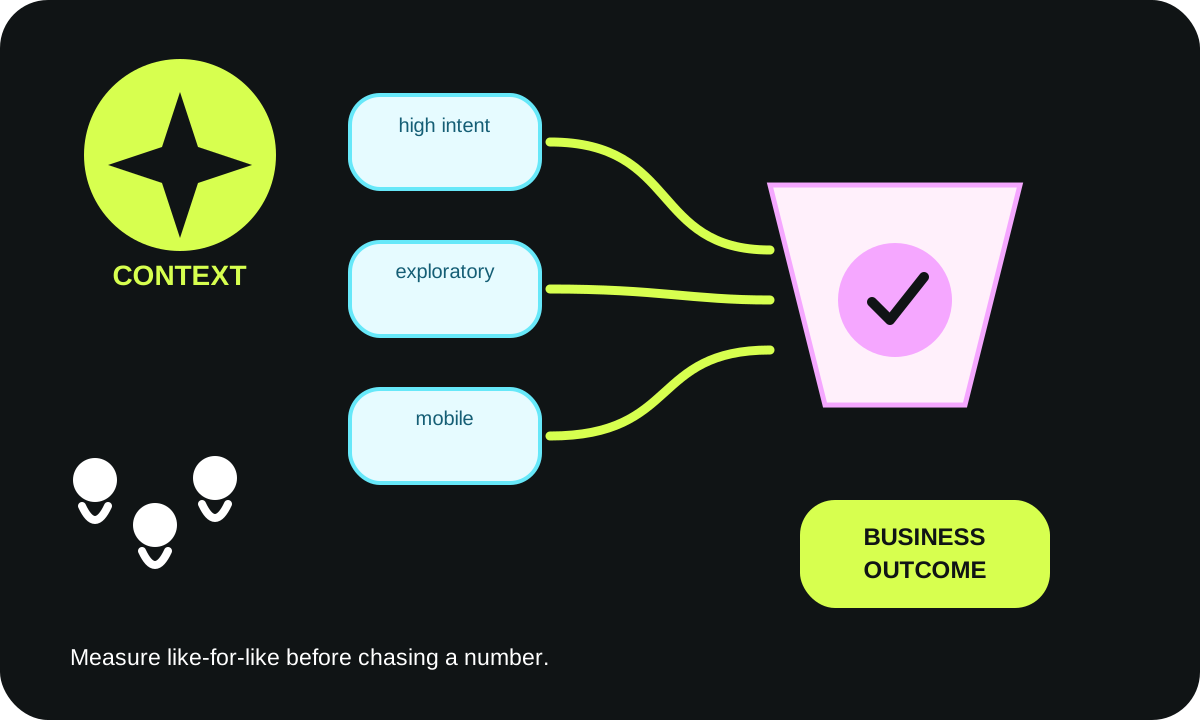
Group visitors by acquisition context and page purpose rather than averaging everyone. Branded search, partner referrals, category discovery, paid campaigns, comparison queries and customer logins can have fundamentally different goals.
A useful decision here starts with evidence from your own funnel, product or delivery environment rather than an industry average. Define the user or business outcome first, document the current state, and name the constraint that would make a recommendation change. This keeps the work falsifiable: the team can point to the observation behind a priority and can later check whether the change solved the intended problem.
Treat the plan as a sequence of reversible decisions. Separate facts you can verify now from assumptions that need measurement, then assign an owner, validation method and guardrail. Avoid turning a planning scenario into a promise. A model can show arithmetic consequences, effort or dependency order, but it cannot prove future conversion, revenue or delivery speed before the work is shipped and observed.
For implementation, prefer the smallest change that can answer the next important question without creating avoidable migration or maintenance debt. Record the baseline, ship with instrumentation, inspect the result by meaningful segments, and keep the next action tied to what the evidence actually says.
Prioritized experiment backlog
Rank work using impact, confidence, effort and strategic risk, but keep the inputs explainable. A hypothesis supported by customer interviews, CRM outcomes and reproducible UX evidence deserves more confidence than one based on aesthetics or a competitor screenshot.
A useful decision here starts with evidence from your own funnel, product or delivery environment rather than an industry average. Define the user or business outcome first, document the current state, and name the constraint that would make a recommendation change. This keeps the work falsifiable: the team can point to the observation behind a priority and can later check whether the change solved the intended problem.
Treat the plan as a sequence of reversible decisions. Separate facts you can verify now from assumptions that need measurement, then assign an owner, validation method and guardrail. Avoid turning a planning scenario into a promise. A model can show arithmetic consequences, effort or dependency order, but it cannot prove future conversion, revenue or delivery speed before the work is shipped and observed.
For implementation, prefer the smallest change that can answer the next important question without creating avoidable migration or maintenance debt. Record the baseline, ship with instrumentation, inspect the result by meaningful segments, and keep the next action tied to what the evidence actually says.
Model revenue impact without promising uplift
Translate a modeled rate change into additional qualified actions, opportunities or revenue only after defining each stage and its assumptions. Make currency and period explicit. For long B2B sales cycles, separate website contribution from causal attribution.
A useful decision here starts with evidence from your own funnel, product or delivery environment rather than an industry average. Define the user or business outcome first, document the current state, and name the constraint that would make a recommendation change. This keeps the work falsifiable: the team can point to the observation behind a priority and can later check whether the change solved the intended problem.
Treat the plan as a sequence of reversible decisions. Separate facts you can verify now from assumptions that need measurement, then assign an owner, validation method and guardrail. Avoid turning a planning scenario into a promise. A model can show arithmetic consequences, effort or dependency order, but it cannot prove future conversion, revenue or delivery speed before the work is shipped and observed.
For implementation, prefer the smallest change that can answer the next important question without creating avoidable migration or maintenance debt. Record the baseline, ship with instrumentation, inspect the result by meaningful segments, and keep the next action tied to what the evidence actually says.
Measurement and guardrail metrics
Pair conversion with quality: sales acceptance, opportunity progression, activation, retention proxy, support load, spam, unsubscribe or cancellation. Keep technical guardrails too—performance, errors, accessibility and tracking integrity—so a visual win does not conceal operational harm.
A useful decision here starts with evidence from your own funnel, product or delivery environment rather than an industry average. Define the user or business outcome first, document the current state, and name the constraint that would make a recommendation change. This keeps the work falsifiable: the team can point to the observation behind a priority and can later check whether the change solved the intended problem.
Treat the plan as a sequence of reversible decisions. Separate facts you can verify now from assumptions that need measurement, then assign an owner, validation method and guardrail. Avoid turning a planning scenario into a promise. A model can show arithmetic consequences, effort or dependency order, but it cannot prove future conversion, revenue or delivery speed before the work is shipped and observed.
For implementation, prefer the smallest change that can answer the next important question without creating avoidable migration or maintenance debt. Record the baseline, ship with instrumentation, inspect the result by meaningful segments, and keep the next action tied to what the evidence actually says.
90-day optimization roadmap
Use the first phase to repair measurement and obvious defects, the second to test high-confidence message/proof/journey hypotheses, and the third to consolidate learning. Keep a changelog with hypothesis, evidence, release, result and next action so optimization becomes cumulative rather than cyclical redesign.
A useful decision here starts with evidence from your own funnel, product or delivery environment rather than an industry average. Define the user or business outcome first, document the current state, and name the constraint that would make a recommendation change. This keeps the work falsifiable: the team can point to the observation behind a priority and can later check whether the change solved the intended problem.
Treat the plan as a sequence of reversible decisions. Separate facts you can verify now from assumptions that need measurement, then assign an owner, validation method and guardrail. Avoid turning a planning scenario into a promise. A model can show arithmetic consequences, effort or dependency order, but it cannot prove future conversion, revenue or delivery speed before the work is shipped and observed.
For implementation, prefer the smallest change that can answer the next important question without creating avoidable migration or maintenance debt. Record the baseline, ship with instrumentation, inspect the result by meaningful segments, and keep the next action tied to what the evidence actually says. That final review loop is what turns a one-time project into an operating system the team can maintain.
Sources and assumptions
The source list below is used for platform and measurement definitions. Planning ranges, prioritization language and scenarios in this guide are editorial frameworks, not promised performance. Re-check vendor pricing, plan limits, legal requirements and product documentation before committing budget or architecture.
Frequently asked questions
What conversion should a B2B website optimize?
The action that represents meaningful qualified progress for the business, measured with downstream quality guardrails.
Should a SaaS site optimize signups or demos?
It depends on sales motion, product complexity and buyer intent. Different segments may need different primary actions.
Is form shortening always good?
No. Remove fields that create friction without operational value, but keep information that is genuinely needed for routing, security or qualification.
How do I know whether messaging is the problem?
Combine source intent, interviews/sales notes, page behavior and task testing; do not infer a message problem from bounce rate alone.
Can the calculator predict revenue?
No. It models arithmetic from your assumptions and is useful for scenario planning, not forecasting uplift.
What should stop an experiment?
A material guardrail deterioration, broken instrumentation, technical defect or a confounding change that makes the result uninterpretable.