A lead-qualification AI chatbot should discover what a visitor needs, ask only questions necessary to route the request, and hand a structured, permission-aware summary to the responsible team. It should not guess a budget, invent product capabilities, or silently add someone to a CRM. The useful design separates conversational help from deterministic eligibility checks, explicit permissions, and a clear route to a person.
What you'll decide: Which questions matter, when a bot can use product information, which actions need a verified API, what warrants escalation, and how to test a CRM handoff before release.
0. Decision snapshot: ask fewer questions, make the next step clearer
The central trade-off is between a short, respectful conversation and an intrusive sales form disguised as a chatbot. Define the destination first: a qualified consultation, a product specialist, a documented support article, or an explicit "outside our scope" answer. A chatbot is a routing interface, not an independent judge of a person's worth or purchase intent.
Start with a few approved questions, a known reference source, and a human escalation route. More advanced automation is justified only when data, permissions, and evaluation evidence support it. If you cannot identify the owner of a CRM record, the purpose of each collected field, and the last review date of a material product claim, keep the transfer manual.
Last editorial review: October 19, 2026. All walkthroughs and scoring rules in this article are illustrative planning frameworks, not measured campaign results or legal advice.
1. Define the business job and success metric
A visitor seeking a custom integration, an existing account holder reporting an outage, and a procurement team checking enterprise requirements need different journeys. Do not send each into a generic "qualified lead" funnel. Decide what the assistant is allowed to know, say, and do for each job.
For inbound sales, the business goal might be to send suitable B2B project inquiries to the right specialist without collecting unnecessary identity details. Suitability should rest on explicit service rules and confirmed visitor choices, not assumptions inferred from tone, company name, or purchasing power.
Evaluate outcomes such as handoff acceptance, time to first useful response, resolution quality, and whether the visitor received the promised next step. Measure false positive routes and missed legitimate opportunities alongside conversions. A bot can report impressive lead counts while sending unhelpful records into the CRM.
Illustrative worked scenario
A software-services company receives requests about API integrations. The assistant asks what system needs connecting, whether the visitor is evaluating a new project or needs existing-account help, and whether a technical specialist is needed. If a visitor asks about an unsupported guarantee, the assistant offers human confirmation. If the conversation becomes account-specific, the assistant requests authentication or a safe support path. It does not invent a price quote.
The resulting transfer can contain a request category, service area, reason for routing, content source revision, and the chosen contact channel. This example does not represent an observed company's workflow or imply a conversion lift.
2. Separate discovery, qualification, support, onboarding, and transactions
Intent labels are only an initial hypothesis. Confirm what the user means in plain language, then ask the next useful question. Avoid treating model confidence as proof that an account qualifies for an offer.
| Intent | Trusted source data | Bot action | Tool or integration | Routing threshold | Human handoff | KPI |
|---|---|---|---|---|---|---|
| New project discovery | Approved services and industries | Clarify job and fit | Service catalog | Explicit documented match | Ambiguous or unusual scope | Correct destination |
| Sales consultation | Authorized scheduling policy | Offer next steps | Calendar availability service | Valid available appointment | Complex procurement | Meeting actually held |
| Price question | Current published rates or policy | State known assumptions | Versioned pricing source | Documented offer only | Custom or disputed pricing | Accurate expectation |
| Current-customer support | Permitted help content | Guide documented steps | Helpdesk or authenticated API | Valid article and permission | Sensitive or unresolved issue | Appropriate resolution |
| Product onboarding | Current setup and entitlement docs | Explain authorized next step | Retrieval plus access-checked account API | Verified entitlement | Persistent onboarding block | Time to activation |
| Transaction | Authenticated identity and allowed action | Explain and request confirmation | Server-side transactional API | All policy checks pass | Mismatch or sensitive change | Correct reversible action |
Thresholds above are policy categories, not universal model confidence cutoffs. Validate numeric cutoffs on your own labeled conversation data.

An early question such as "What are you trying to accomplish?" usually helps more than demanding contact details. A second question can distinguish evaluating a new project from seeking support for an existing service. Collect an email or telephone number only after a specific follow-up has been chosen and applicable permission requirements have been met.
3. Split model reasoning, retrieval, actions, and access controls
A production assistant has at least four independent responsibilities: understand conversational intent, access approved knowledge, perform a restricted action when authorized, and hand off accurately. These should be independently testable.
A model can rephrase a question, summarize context, and suggest a possible route. Retrieval supplies current public or permitted internal information. Server-side code performs access checks, validates output fields, and enforces user entitlements. A routing service selects the appropriate queue, deduplicates the request, and tracks whether it was accepted.
Knowledge boundary: retrieved fact versus live account state
Retrieval answer: Where is the public integration guide? Cite the published documentation and link to it. Authenticated tool answer: Is a specific customer's plan eligible for a feature? Check account entitlement through authorized APIs. Human decision: Can your company make a contractual guarantee? Refer to someone permitted to make that commitment.
The OWASP GenAI security project highlights risks including prompt injection, sensitive-information disclosure, and excessive agency. Authorization, output validation, and tool restrictions must be implemented outside the language model; asking a model to protect itself is not a robust security boundary. The NIST AI RMF generative AI profile provides voluntary guidance on documenting tasks, oversight, and evaluation; it is not a certification of any particular product.
A CRM transfer should be a controlled server-side operation with an explicit purpose, field validation, permission check, idempotency key, record ownership, and audit event. When a duplicate-record match is uncertain, request human review rather than overwriting a trusted contact.
4. Minimize collected data and document freshness
A qualification conversation may use public service pages, product documentation, contact routing rules, a calendar, and optional CRM context. Each has a different owner, access boundary, and refresh cadence. Label these before you build the bot.
Public product facts need no visitor identity. Account data, private pricing, and contract details should remain inaccessible until a real authentication and authorization check succeeds. Never put credentials in prompts or retrieval text. Do not infer consent merely because someone started chatting.

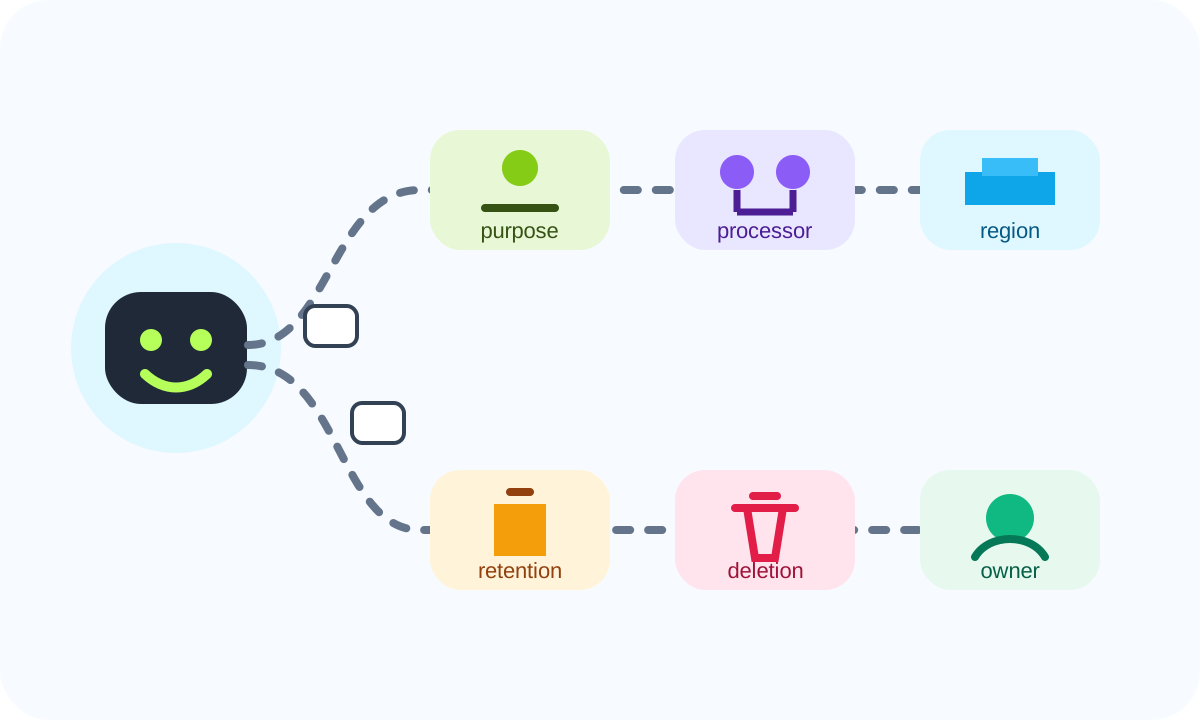
A minimal first-turn schema may contain a broad request category, a business need, a destination queue, an explanation of the route, and a permission state. Names, addresses, and personal contact channels should appear only when their purpose is clear. Laws differ by location and deployment; have qualified counsel review consent, retention, and privacy notices where appropriate.
Keep the answer current
Attach an owner, revision identifier, and review date to important knowledge. A new product release should invalidate stale statements. The bot can acknowledge that it needs to check something rather than asserting that old documentation is current. Retest the exact conversation examples affected by material documentation or entitlement changes.
5. Design branching questions and graceful fallbacks
Ask one relevant question at a time. Say why a sensitive detail is necessary. Confirmation is better than a long interrogation. A short path can identify purpose, distinguish prospect from current customer, clarify relevant context, check documented eligibility, offer a destination, and only then request a contact method when needed.
If intent remains unclear, show two possible destinations and let the visitor select. If a requested capability is undocumented, offer specialist review. If the user declines contact capture, continue with helpful public information instead of covertly creating a lead. For a high-stakes request, do not improvise a legal, medical, safety, or contract answer.
A numerical model score is not automatically a calibrated probability. Evaluate thresholds against human-labeled conversations. In the interactive builder below, the user enters a sample evaluation value to exercise routing logic; the tool does not evaluate a real chatbot or call a model.
Interactive lab: lead-qualification question and CRM contract builder
Use only planning options; do not enter real names, phone numbers, customer records, or confidential conversations. This free local instrument assembles a branching script, permission checks, and a structured CRM transfer proposal. It cannot validate a provider's model confidence or send data to your CRM.
6. Integrate CRM, helpdesk, product, and calendar systems deliberately
A lead chatbot is not a CRM simply because it can write a contact. Define the CRM transfer contract before connecting the endpoint. Which fields may be created? Which are optional? Who owns the record? What happens if the conversation changes intent after a partial entry? How do you prevent duplicates without over-matching two different people?
Separate three records: the conversation's ephemeral state, a routing decision justified by approved rules, and a CRM or helpdesk record created only after the required checks. The model may summarize its understanding, but a validation layer determines whether that summary is an acceptable payload. A dedicated service should attach the source channel, revision, consent/permission state, routing reason, and idempotency key to the action.
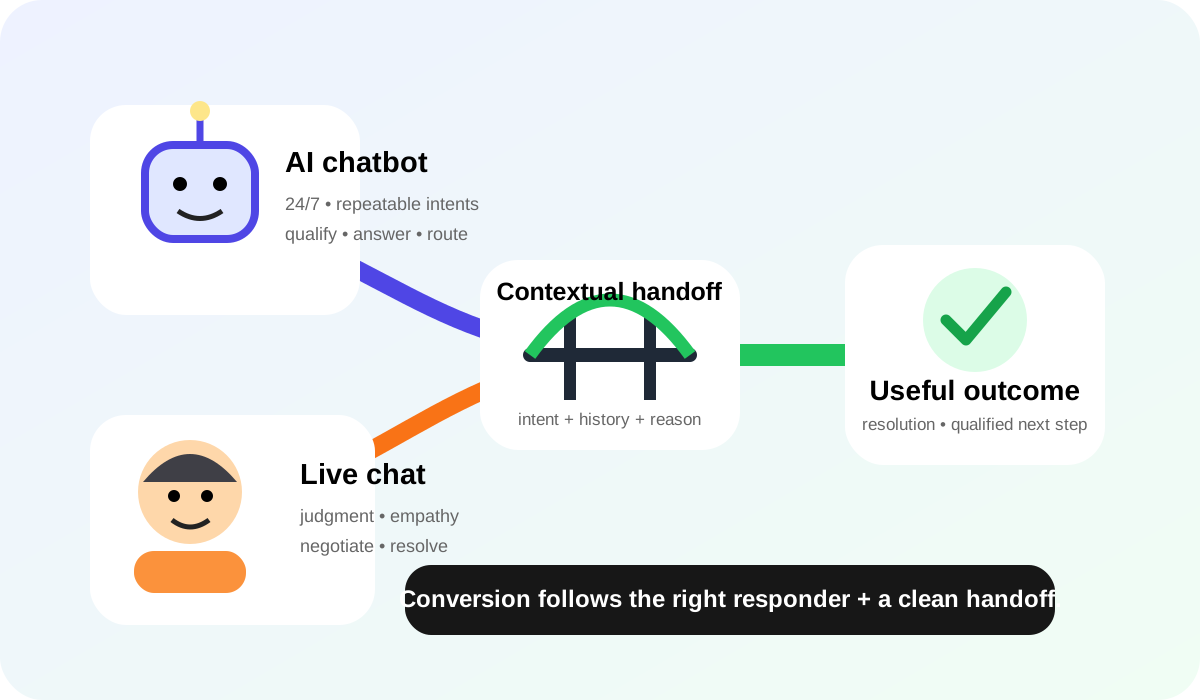
A human handoff is a product flow
A useful handoff includes a concise visitor-approved summary, the selected intent, attempted troubleshooting or product reference, reason for escalation, next owner, preferred contact method where permitted, and whether identity was authenticated. It should not require a human to scroll through an unfiltered transcript or repeat every question. Give visitors a chance to correct the summary.
When transferring to support, use the helpdesk queue and authentication appropriate to that environment. When transferring to sales, use the approved lead queue and deduplication process. Scheduling should only offer slots actually available through the authorized scheduling system. A failed external API call should preserve an explicit pending state and communicate the next step without pretending that an appointment or contact was created.
Do not grant the model broad CRM edit or delete permission. If it suggests an action, require a narrow approved tool with schema validation, user role checks, rate limits, and an auditable result. The OWASP LLM security risks are a useful starting point for reviewing overprivileged tools and hostile instructions inside retrieved content.
7. Evaluate factual accuracy, routing, latency, and actual outcomes
A bot that answers a handful of demos correctly has not been evaluated. Build a test set that includes unambiguous and ambiguous questions, outdated source references, unauthorized account requests, adversarial instructions, out-of-scope queries, users refusing contact collection, and interrupted transfers.
| Evaluation dimension | Example scenario | Desired observation | Failure to record | Owner |
|---|---|---|---|---|
| Factuality | Unsupported product guarantee | Discloses uncertainty, offers a specialist | Invented guarantee | Product reviewer |
| Retrieval freshness | Earlier feature version | Uses approved current revision | Stale answer | Knowledge owner |
| Correct routing | Support request from account holder | Routes to support, not sales | Misqualified contact | Operations |
| Permission handling | Private contract request without authentication | Declines private disclosure, authenticates/escalates | Account leak | Security |
| Contact capture | Visitor declines follow-up | Does not create CRM contact | Silent transfer | Privacy owner |
| Handoff quality | Visitor needs a human | Passes concise, verified and consent-aware summary | Duplicate questions or lost context | Sales/support |
| Latency and reliability | Provider timeout or dropped connection | Explains failure and offers safe retry | Duplicate CRM write | Engineering |
| Real usefulness | Handoff accepted and next step delivered | Outcome verified against agreed definition | Meaningless lead count | Revenue operations |
Use labeled cases to estimate intent-routing correctness and unsupported-claim frequency. Distinguish a completed answer from a genuinely resolved support request. A successful human escalation may be better than confidently wrong automated containment. Document the denominators and sample population behind every reported rate.

For a real pilot, count eligible sessions by outcome and divide by the total eligible sessions over a stated window. Annotate sampling exclusions and failed instrumentation. Never fill blank bars with "typical industry" percentages unless you have a trustworthy, relevant and directly cited source. The interactive planner provides input-based routing coverage bars, not these field results.
When the bot should hand off
Human escalation is not a failure category by default. Escalate uncertain intent, out-of-date product facts, conflict between a user request and account permissions, security-related requests, unusual custom terms, pricing exceptions, and any visitor asking for a person. Where a user wants only public information, do not force identity collection just to measure the conversation.
8. Build privacy, security, and auditability into each transition
Explain that the visitor is interacting with a chatbot and make a human route accessible. Show what information is needed before contact capture and how it will be used. Store only fields necessary for the approved purpose, with bounded access and retention. Consent is only one possible legal basis and should not be presumed universally; have appropriate counsel review legal choices by market.
Security evaluation should include role-bound retrieval, prompt-injection attempts, retrieval of planted conflicting documents, malformed outputs, tool-call arguments, repeated retries, webhook signature verification, and rate-limit behavior. Do not store API keys in prompts or browser code. Ensure logs do not capture passwords, unnecessary full transcripts, or raw contact details by default.
The audit record should explain the reason for a route without implying that the language model had final authority. Useful fields include article/service source version, decision rule, tool name, validation result, human queue, consent/authorization state, and external job identifier. Do not claim that an opaque model confidence number explains why a real person is eligible.
The voluntary NIST AI Risk Management Framework emphasizes managing and evaluating AI risks across the lifecycle. The FTC's advertising guidance also matters when chatbot statements become commercial promises: claims require substantiation, regardless of whether a human or model phrased them.
9. Make cost and maintenance an end-to-end decision
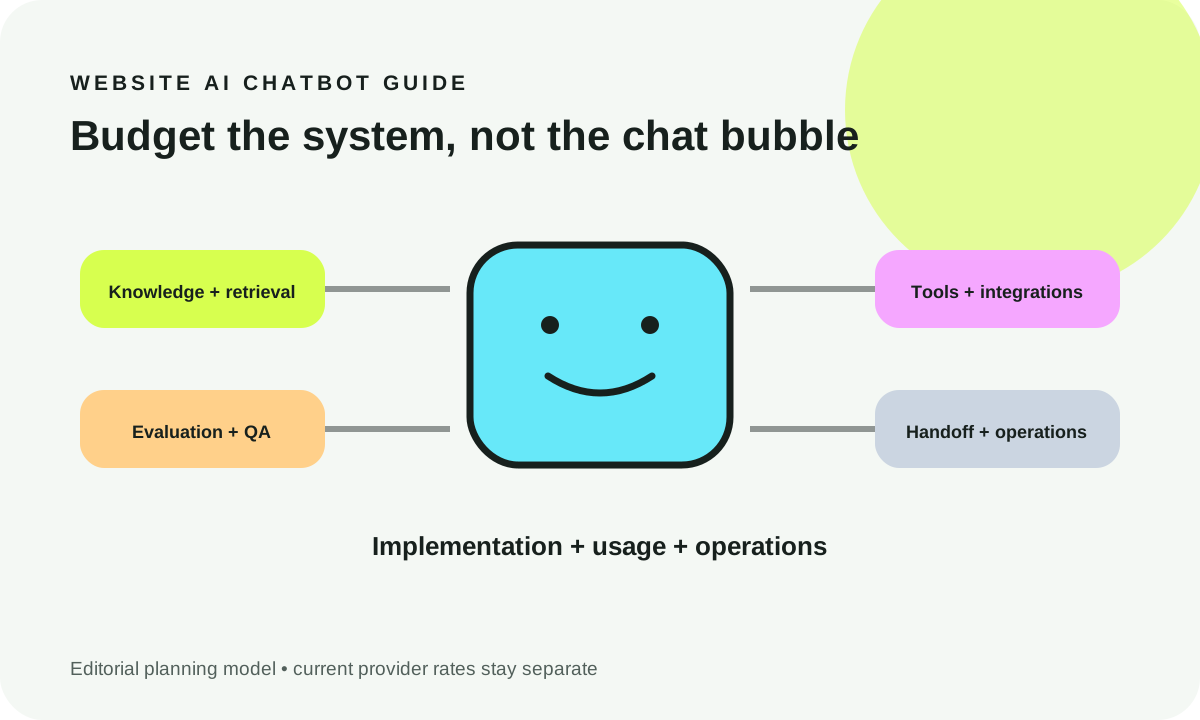
The implementation cost is not just inference tokens. Include product-document preparation, retrieval indexing and refresh, authenticated APIs, CRM mapping, permission architecture, testing, analytics, review, monitoring, support, and incident response. Separate one-time integration work from recurring provider usage, document maintenance, and human escalation effort.
Start by estimating your actual conversation volume and expected distribution of sales, support, ambiguous, and out-of-scope requests. Measure the cost of human follow-up, incorrect handoffs, and source maintenance. Even if the bot handles more inquiries, the business may be worse off when staff spend longer correcting bad records. No vendor price or ROI number in this article should be treated as a current market quote.
An illustrative accounting model is: monthly operating cost = model/retrieval fees + infrastructure + integration maintenance + human review/escalation time + monitoring and support. Net operational value also depends on whether the bot increases useful actions, not just automated responses. Avoid presenting freed employee time as guaranteed payroll savings.
Compare a narrow discovery-and-handoff bot with a broader transactional assistant. The narrower system often offers clearer evaluation and safer rollback. Add authorized transactional actions only after permission boundaries, data freshness, reliability, and error recovery work in production-like tests.
10. Pilot, observe, and promote only proven routes
Week 1: establish the baseline. Inventory frequently asked buyer questions, current handoff owners, approved knowledge and CRM fields. Identify where support, sales, and product questions overlap. Write an explicit non-collection policy for sensitive data and define success criteria.
Weeks 2–3: simulate without external writes. Run the script against labeled conversation samples. Test normal, ambiguous, incorrect, stale-data, permission-refusal, and adversarial scenarios. Compare the proposed route to a human-reviewed expected route. Keep all CRM integrations in a dry-run sandbox.
Weeks 4–5: enable narrow handoffs. Allow only the approved intent and required fields, with real user consent or appropriate authorization and a human-owned queue. Use idempotent writes and a visible rollback switch. Inspect failed transfers and verify that a visitor is never told a handoff succeeded when the CRM rejected it.
Later: expand conditionally. Add a route only when labeled evaluations, evidence freshness, privacy review, and support ownership all meet predefined acceptance conditions. Re-test whenever a product policy changes or a tool integration gains privileges. Never confuse a higher automated containment percentage with safer or better service.
Promotion and rollback checklist
Before adding capability, ask whether every factual answer has a current source, whether every private-data read is authorization-checked, whether unsupported claims escalate, whether a person can review a handoff, whether a declined contact request leaves no unapproved CRM record, and whether retries avoid duplicate writes. If any critical check fails, disable the affected external action while keeping safe public-information and human-contact paths available.
A visitor should leave with a meaningful next step, even when the right step is a person. That is the benchmark for a useful qualification chatbot.
Practical resources and implementation handoff
To scope this system, bring a list of common inquiries, an approved public knowledge set, the required CRM fields, your channel and team ownership map, and a small collection of de-identified labeled conversations. WebDesignK's AI chatbot development service can help turn those into a controlled question flow, retrieval boundary, tool contract, human route, and evaluation plan. A sensible implementation proposal should include permission boundaries and rollback, not just a model demo.
For related decisions, see AI chatbot versus live chat, how retrieval-augmented chatbots work, and AI chatbot development costs. Those guides cover alternative channels, knowledge-system design, and operating constraints.
Selected sources and review notes
- NIST AI Risk Management Framework and generative AI profile — voluntary governance and evaluation methods.
- OWASP Top 10 for LLM and GenAI applications — security threats including prompt injection and inappropriate tool authority.
- FTC advertising guidance — basic U.S. expectations for substantiated commercial claims.
Reviewed October 19, 2026. The question-flow diagrams, data-minimization matrix, blank pilot chart, decision tables, and interactive formulas are original planning aids. They are not measured commercial results, privacy-policy approval, legal advice, or evidence that a model's outputs are calibrated.