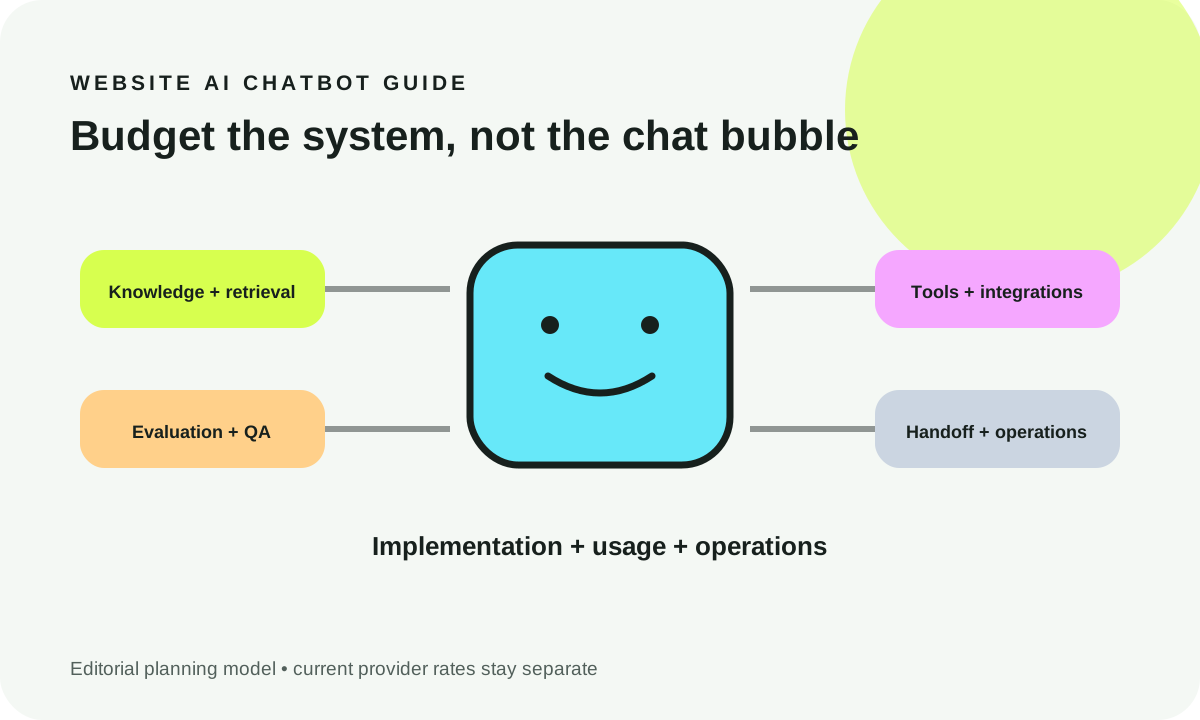
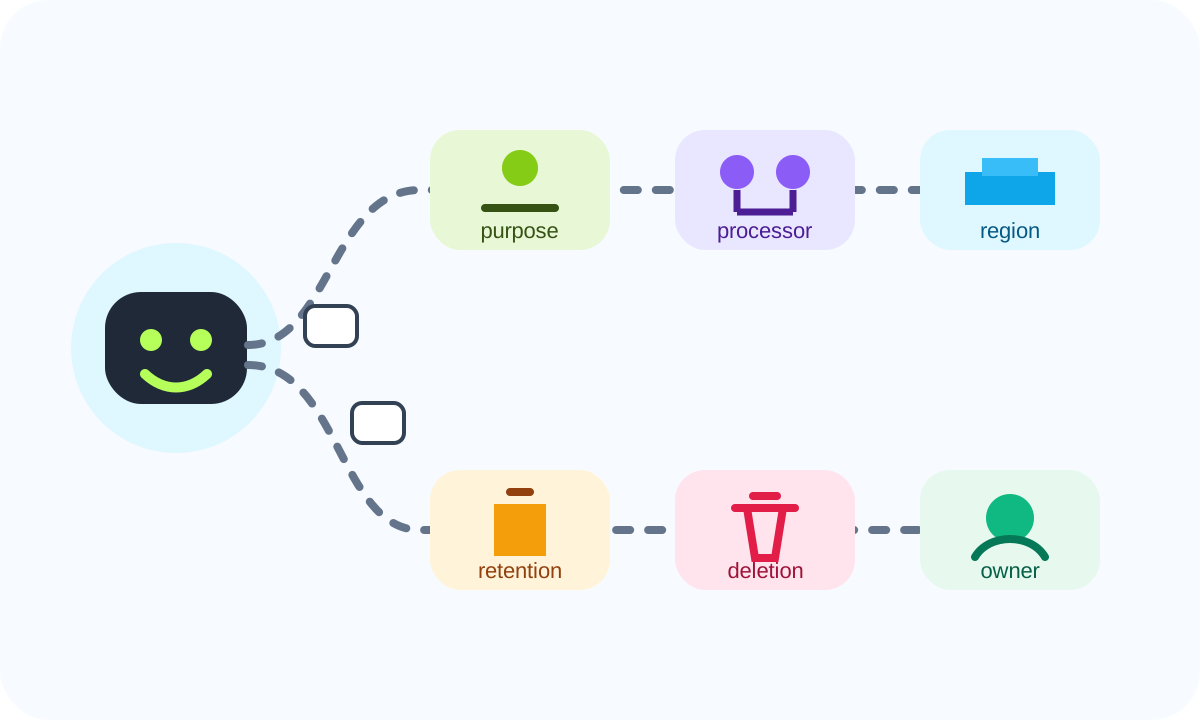
An AI chatbot for ecommerce is useful when it helps shoppers identify suitable products from verified catalog information, answers only supported service questions, and transfers uncertainty to a human before making risky promises. Start with accurate SKU attributes, availability and policy sources; then test recommendation quality and completed outcomes against an unchanged shopping experience. A conversational interface without reliable product truth can increase frustration rather than conversion.
You'll decide: which questions the assistant may answer, which facts must come from the catalog, when it should ask a clarifying question or hand off, and how to evaluate its effect without inventing revenue lift.
Editorial review: October 19, 2026. All stores, catalog rows, numeric scenarios and illustrative diagrams here are models, not audited client results. Current retailer policies, inventory and vendor capabilities must be checked at implementation time.
0. Decision snapshot: build a trustworthy product finder, not a sales impersonator
The main trade-off is more convenient shopping guidance versus confident but unsupported answers. A chatbot that recommends a waterproof jacket can help if it knows the actual SKU, size, price and stock record. If it does not, it should ask a question, offer a truthful browse path or send the customer to support. A made-up delivery guarantee, price, compatibility claim or return exception creates real purchase risk.
A sound pilot starts narrow: one product category, one catalog feed owner, two or three predictable questions, an explicit answer boundary and a human escalation process. Use an ordinary storefront as the control, not a chatbot with its recommendations disabled and a broken journey. Compare the same buyer decision under a defined population and period.
Good first use cases: guiding shoppers to a matching product category, comparing two variants with documented differences, explaining a sourced return-policy excerpt, or collecting a nonpersonal summary for human support. Poor first use cases: negotiating hidden discounts, promising stock or delivery from stale records, diagnosing medical suitability, generating prohibited product recommendations, or pretending to process a refund or purchase.
1. Define the visitor decision and business outcome
A shopper may arrive asking, "Which rain jacket works for a commute?", "Does this filter fit my model?", "Is size M in stock?", or "Can I return an opened item?" These are different intent classes. The first needs product discovery; the second needs compatibility evidence; the third needs variant-level live inventory; the fourth needs a versioned policy and possibly an account-specific human action. They should not all be answered with the same generative prompt.
Map the intent to a job and source of truth before creating chatbot dialogue. A practical design contract specifies: user intent, required catalog attributes, whether the answer changes with time, allowed wording, restricted claims, source freshness and the fallback when evidence is insufficient. This is more actionable than a vague objective such as "increase chatbot engagement."
Intent and response ownership
| Visitor question | Safe source | Allowed first response | Escalate when | Owner |
|---|---|---|---|---|
| Help me choose a jacket | Category and SKU specifications | Ask about use case, budget and necessary attributes | No comparable products match | Merchandising |
| Does accessory A fit device B? | Approved compatibility table | Quote exact supported models and matching SKU | Compatibility record is missing or ambiguous | Product support |
| Is this color/size available? | Fresh variant-level stock API | Display verified availability with timestamp or caveat | Feed stale, conflicting, zero stock or unknown | Inventory operations |
| When will it arrive? | Checkout shipping estimator with destination and actual options | Link to accurate shipping estimate | No permitted live quote | Fulfillment |
| Can I return this order? | Versioned public policy and authorized order system | Explain public policy and direct to account support | Order-specific status or exception needed | Customer care |
| Can you place or refund an order? | Authorized transactional backend | Only perform actions after explicit approved controls | No secure transaction tool or permission | Ecommerce engineering |
The business outcome should be a completed order, a verified helpful resolution, or a qualified assisted selection—not the number of chatbot turns. Define the exact denominator. An "assisted conversion rate" among users who opened chat can be selected toward stronger buyers, so it does not establish a causal chatbot benefit.
2. Capture the baseline before changing anything
Measure where shoppers already struggle: searches returning zero results, product cards clicked after repeated filtering, size-related returns, support escalations, order completion and cart errors. Build a short baseline from the same category and time window you plan to test. Identify traffic source and device because search-driven high-intent buyers may behave differently from casual browsers.
Define a funnel carefully: eligible category visits → product discovery or comparison → product detail view → added-to-cart with selected variant → checkout start → completed paid order. For support flows, track the separate result: valid resolved inquiry or human handoff completed. Do not merge a customer-service deflection count with completed sales.
The baseline has to include failure states
A sample should deliberately include:
- an in-stock variant, and an out-of-stock variant whose sibling color is available;
- a product with a missing attribute that the shopper explicitly requests;
- a catalog update during the session;
- a product with a low-margin restriction or channel exclusion;
- an ambiguous model or compatibility request;
- a return request that needs an actual account authorization.
For each, record the expected safe answer and a reviewer. Count unsupported claims independently of purchase clicks. A chatbot that appears to increase conversations while making incorrect stock promises is not launch-ready.
A tiny sample with ten chatbot users does not justify a confident revenue claim. Establish a reasonable sample and review plan with an analyst, and keep observed outcomes separate from scenario assumptions in every report.
3. Find the highest-friction moments in product discovery and support
Many buyers have a decision problem, not a chat problem. They cannot compare technical attributes, find the right size or see which compatible accessory is actually available. A guided question such as "Which device model do you have?" may be useful—provided the recommendation can be checked against a product compatibility list.
A generative answer that describes a non-existent product is not helpful personalization. A safe architecture should choose products from a bounded catalog query and formulate the explanation from actual returned attributes. If nothing qualifies, the assistant should avoid substituting a lower-quality product as though it met the requirements.
The query-to-catalog path

A robust flow is: classify the shopper's task → collect only necessary specifications → query approved product fields → filter for hard requirements and stock truth → apply merchandising restrictions → verify the exact SKU/variant → answer with a link to its product page or fall back. The final answer should distinguish "not in the sample" from "not available anywhere"; a missing record is not proof that the item does not exist.
When a customer asks about order history, payments or account-specific refunds, an anonymous product finder should switch to a separate authenticated workflow or support channel. Do not paste account data into a general discovery chat.
4. Message, proof, CTA and checkout design
The chatbot must be clear about its identity and limitations. "I can help compare products from the current catalog, but I cannot guarantee delivery or change your order" is better than an assistant that falsely implies full account authority.
A grounded recommendation should contain the product name, exact option where relevant, why it matches, what could not be verified, an accessible product link and one useful next action. If the user wants only a public policy explanation, link to the actual policy. Don't use synthetic testimonials, unverified ratings or invented urgency.
Product data contracts: keep source and page aligned
Google Search Central's merchant listing structured-data documentation describes Product/Offer price and availability fields, while its product variant guidance describes variant identity and group relationships. These are search-page markup references, not a guarantee that a conversational assistant is correct. A chatbot requires fresh backend catalog and inventory sources appropriate to its request.
| Data element | Why it matters to a shopper | Safe system behavior | Failure policy |
|---|---|---|---|
| Exact SKU and option | Distinguishes color, size or model | Match the returned variant identifier | Ask for option rather than guessing |
| Required use-case attributes | Proves product fit | Quote approved catalog fields | Do not assert undocumented compatibility |
| Real-time or bounded-freshness stock | Prevents false availability claims | Verify before purchase recommendation | Say stock cannot be verified |
| Effective current price and currency | Avoids misleading offers | Use authorized offer or product endpoint | No fabricated price or discount |
| Margin, promotion and merchandising restrictions | Prevents impermissible recommendations | Filter with explicit business constraints | Do not expose internal margin data to shopper |
| Returns, shipping and support | Sets true service expectations | Cite policy and actual checkout choices | Human handoff if case-specific or ambiguous |
The checkout boundary deserves special attention. Clicking a suggested product should lead to a product or cart path where price, variant and availability are checked again. An LLM text response alone is not an authorized order placement, refund, cancellation or inventory reservation.
Transparent trust block before an implementation request
A useful implementation plan identifies which catalog tables and APIs are authoritative, who owns stock freshness, which policies the assistant can quote, who accepts human handoffs and what happens when a backend is unavailable. Avoid demanding a contact form before a shopper can browse products or see why a recommendation was made.
5. Mobile-specific friction and graceful degradation
A mobile shopper may have limited bandwidth and little patience for a full-screen chat that hides the product grid. Test the normal storefront with chat closed: search, filters, prices, product pages and checkout must remain accessible.
Use a labeled chat launcher, predictable keyboard focus, readable transcript, clear close control and reduced-motion support. Avoid automatically shifting focus for every new assistant token. A chat overlay must not obscure the cart or submit button. Keep a complete, ordinary product browse path available to everyone.
Mobile fallback scenarios
Test slow load, catalog API timeout, canceled chat request, keyboard send, screen-reader labels, stock changes during the conversation and an unavailable support agent. If stock cannot be checked on a weak connection, a truthful caveat and product link beat an animated but false assurance. Analyze control and treatment outcomes by device rather than assuming a generic mobile lift.
6. Segment by shopping source and intent
High-intent shoppers may arrive with an exact model or SKU. Exploratory shoppers may want a category overview and two qualifying questions. Existing customers may need support rather than discovery. Define these segments by explicit task or permitted context and analyze device separately.
Intent changes the conversation: a precise SKU request should verify variant stock, while a broad shopper question should clarify hard attributes and budget. Support questions requiring account authorization should route to authenticated workflows. Avoid inferred sensitive-profile targeting and hidden differences in basic product access.
Randomize eligible visitors consistently if testing the chatbot. Do not compare voluntary chat users with the unassisted population and claim the resulting correlation proves a chatbot's causal benefit.
7. Prioritized experiment backlog
Write one falsifiable hypothesis, one change, primary metric, guardrail, owner, cost and learning rule per experiment. These confidence labels are editorial planning assumptions, not results.
| Friction hypothesis | Page/step | Proposed change | Primary metric | Guardrail | Effort | Confidence |
|---|---|---|---|---|---|---|
| Shoppers struggle with sizing | Category/product finder | Clarify size and match verified SKU | Correct variant reached per eligible visitor | Wrong stock/fit claims | Medium | Medium pending catalog review |
| Accessories appear compatible when they are not | Product detail | Check approved compatibility attributes | Valid compatible accessory selected | Unsupported technical claims | Medium–high | Low until data tested |
| Policy questions clog support | Help entry | Ground answers in versioned policy | Correctly resolved public policy inquiries | Incorrect exceptions; lost human handoff | Medium | Medium |
| Promotions violate restrictions | Offer selection | Exclude disallowed SKU or margin tier | Completed permitted orders | Margin breach, unfair prices | Medium | Low |
| Chat diverts buyers away from cart | Variant recommendation | Link to exact verified product option | Completed paid orders | Checkout friction and complaints | Medium | Medium |
Evaluate refusals as successes when appropriate
Build labeled test cases for a missing SKU attribute, unavailable variant, stale stock, unknown shipping destination, undocumented compatibility and an item excluded by margin policy. Classify the correct behavior as supported match, clarification, human handoff or refusal. A safe abstention can be a better outcome than a confident wrong answer.

8. Model the product-finder conversation and possible revenue impact
The interactive lab below accepts a fictional or public catalog with SKU, category, attributes, inventory, price in USD, gross-margin percentage and catalog evidence status. You set shopping intent, a hard product requirement, budget, allowed margin, confidence threshold and handoff policy. It produces an auditable recommendation, clarification or escalation path.
It never calls a live ecommerce store. Its "evidence fit" score is a transparent rule-based planning value, not model confidence, conversion prediction or proof that a SKU will be available tomorrow. Changing stock from verified in-stock to unknown should immediately block a stock assurance.
Worked scenario: fictional rain jackets
A catalog includes an in-stock waterproof commuter jacket, a sold-out rain shell and a fleece without documented waterproofing. A shopper asks for waterproof outerwear. A safe product finder can recommend the matching in-stock jacket only if price and margin also satisfy the rules. It must not substitute the fleece while still calling it waterproof.
If the only matching item's inventory becomes unknown, the dialog changes to "I cannot verify stock" and a safe browse or human support route. This changed path should also appear in the live metric bars and unsupported-answer/handoff matrix.
Ecommerce product assistant scenario lab
Interactive catalog-grounded product assistant

Revenue scenarios cannot promise uplift
For a fictional store with 10,000 eligible category visits monthly, a change from an assumed 2.0% paid-order rate to assumed 2.4% would represent 40 more hypothetical monthly orders. At an assumed USD 80 average order value, that is USD 3,200 modeled additional gross sales, not proven incremental revenue. It excludes returns, margin, attribution, technical costs and uncertainty.
An actual rollout should compare properly assigned control versus treatment across similar source/device/intent groups. Count paid orders and correct product selections, not chatbot turns. The product assistant lab prioritizes grounded recommendations and escalation rather than conflating recommendation quality with revenue.
9. Measure answer quality, business outcomes and failure guardrails
Report four distinct categories: grounded answer quality, shopping progression, actual completed outcomes and potential harm. A rise in clicks is not automatically an increase in paid orders, and a high rate of human handoff is not automatically bad when the bot lacks authoritative data.
| Metric | Denominator | Evidence | Failure signal |
|---|---|---|---|
| Grounded recommendations | Verified correct matches / reviewed recommendation cases | SKU snapshot and labeled transcript | Claimed attribute absent from catalog |
| Correct handoffs | Escalations / cases requiring human help | Support rules and independently labeled examples | Guess on account-specific request |
| Selected right variant | Correct variant clicks / eligible assigned shoppers | Product/variant events with permitted tracking | Wrong size/model/availability |
| Paid conversion | Paid orders / assigned eligible visitors | Order system and trial assignment | Engagement rises without real orders |
| Unsupported assertions | Unsafe product/policy claims / reviewed answers | Independent QA and source history | Invented stock, delivery or discounts |
Set thresholds to match risk. There is no universally appropriate chatbot confidence number for all categories. An explicit unknown stock → no stock guarantee rule matters even when generated prose sounds persuasive.
The NIST Generative AI Profile offers a voluntary risk-management reference, and the FTC's dark-patterns report encourages examination of misleading commerce interactions. Neither certifies a vendor assistant. Apply appropriate privacy, accessibility and consumer-protection review.
A human handoff that resolves the issue
The handoff should preserve a short, nonsensitive summary of the shopper's declared need, not private order or payment data. State what remains unknown and the next authorized step: "This sample does not verify stock for size M. Check the product page or ask support for the current variant." A general product finder should not claim it processed an account-specific refund.
10. Ninety-day roadmap: launch with evidence, not hype
Days 1–15: select one category; define a SKU and variant source of truth, inventory freshness, permitted price/promotion rules, public policy references and support owner. Establish control funnel and correct-answer examples.
Days 16–30: build two or three deterministic question paths, catalog retrieval, explicit exclusions and a human fallback. Make the default storefront usable without chat.
Days 31–45: test mismatched attributes, unavailable stock, stale pricing, undocumented compatibility, mobile keyboard, screen readers and catalog outages. Verify that suggested links reach the correct variant before purchase.
Days 46–60: start a small randomized comparison against existing product discovery, with precommitted conversion metric, risk guardrails and cancellation rule. Document assignment and exposure rather than inferring usage.
Days 61–75: examine completed orders, returns, refunds, support resolution, gross margin and product-source correctness. Analyze high-intent and exploratory traffic separately. Do not treat a model as a causal experiment.
Days 76–90: expand only if evidence supports usefulness without harmful claims. Otherwise repair the source contracts or keep human routing. Document changes, repeat the catalog/source QA, and retain rollback.
Practical implementation handoff
WebDesignK's AI chatbot development service can scope the catalog contract, product finder conversation, current stock integration, human support, accessibility and evaluation plan. Bring a sanitized sample catalog, common public product questions and policies, merchandising exclusions and the tool's copyable scenario summary. The useful deliverable is a tested implementation plan, not a promised conversion lift. You can contact WebDesignK with that brief.
Related guides: AI chatbots for lead qualification, AI chatbot versus live chat, ecommerce technical SEO checklist and ecommerce redesign and checkout.
Reviewed October 19, 2026. Official references: Google merchant listing documentation, Google product variants, NIST Generative AI Profile, FTC dark patterns report.
All scenarios and diagrams are original planning models, not audited shopping outcomes. No real store or customer account is accessed by the example instrument.