Quick answer
Budget a website AI chatbot by capability boundaries: user jobs, knowledge sources, integrations, tool actions, human handoff, evaluation depth and ongoing operations. Separate implementation from usage-sensitive platform cost and recurring operating work. Compare proposals on equivalent scope, and apply current provider rates to measured workload assumptions rather than using an unsourced universal chatbot price.
Last reviewed: 2026-10-07T00:00:00.000ZChatbot cost-driver estimator
Model relative implementation and recurring cost pressure from your own scope. This does not output a market price: provider token, storage, tool and hosting rates change, so apply current vendor rates after you understand the workload.
1. Illustrative Lean / Growth / Complex workstream mix
Takeaway: deeper integrations and evaluation shift more implementation effort toward engineering, integrations and QA rather than conversation UI alone.
2. Your implementation workstream profile
Takeaway: this mix changes directly with your sources, integrations, handoff and evaluation inputs.
3. Recurring operating-load sensitivity
Takeaway: conversation volume matters, but retrieval, tool execution, human handoff and evaluation can keep recurring work material even at lower traffic.
Recurring cost-driver map from your inputs
| Driver | Relative share | What changes it |
|---|---|---|
| Model inference | 15% | Conversation volume, prompt/context size, model choice and tool loops |
| Retrieval / storage | 21% | Knowledge volume, indexing/storage design and retrieval frequency |
| Tools / integrations | 20% | Integration count, tool-call rate, retries and third-party API fees |
| Human handoff | 13% | Escalation rate, staffing model and context-transfer quality |
| Evaluation / observability | 32% | Evaluation depth, observability, sampling and review cadence |
Assumption note: tier thresholds, workstream shares and recurring-load coefficients are WebDesignK editorial planning assumptions. Current platform pricing belongs to the cited official sources and should be applied to your measured token, storage, tool and infrastructure usage.
Tables built for the buying decision
Primary decision table
| Scope tier | Deliverables | Team | Timeline framework | Major cost drivers | Best fit |
|---|---|---|---|---|---|
| Lean | One primary use case; approved public knowledge; focused retrieval; basic analytics; human/contact fallback | Product/conversation owner; full-stack/AI engineer; UX/content; QA part-time | Short pilot-to-production sequence after sources and acceptance criteria are ready | Knowledge cleanup; retrieval; conversation UX; baseline evals | Public product/docs Q&A or simple lead routing without sensitive write actions |
| Growth | Multiple knowledge domains; CRM/help-desk integration; structured tools; authenticated context; contextual handoff; admin/content workflow | Product; UX/content; AI/application engineer; integration engineer; QA/eval; operations owner | Multi-phase build with integration sandbox, evaluation and staged rollout | Integrations; permissions; tool recovery; handoff; larger eval set; observability | Support, qualification or account-aware assistants with bounded actions |
| Complex / enterprise | Multi-tenant/role-aware retrieval; several transactional tools; multilingual/regional variants; audit/security; formal change governance | Product; UX; AI/backend; integrations; security/privacy; QA/eval; SRE/operations; data/content owners | Program delivery with architecture, pilots, security review and phased production rollout | Authorization; data boundaries; transactional actions; governance; reliability; multilingual evaluation | Assistants embedded in core operations or enterprise customer workflows |
12-month recurring cost and operating-cost map
| Item | Why it exists | Cadence | Control lever |
|---|---|---|---|
| Model usage | Generate, classify, route and reason over conversation/context | Per request / usage | Model selection, prompt/context size, caching, routing, response length |
| Retrieval / vector storage | Index and retrieve controlled knowledge | Storage + query/update activity | Source volume, chunk/index strategy, freshness, hosted vs self-managed architecture |
| Tool / third-party APIs | Read or change business-system data | Per action / provider plan | Tool-call rate, batching, retries, provider selection, action scope |
| Hosting / runtime | Run orchestration, APIs, queues and state | Continuous / usage | Architecture, autoscaling, region, reliability target |
| Observability | Debug failures, latency and tool behavior | Continuous | Sampling, retention, redaction, log detail |
| Human handoff | Handle exceptions, sensitive cases and complex conversations | Per escalation / staffing | Handoff rate, routing quality, context preservation, staffing model |
| Evaluation / regression | Test knowledge, model and workflow changes | Release + recurring sampling | Eval depth, automation, production-sample review, change frequency |
| Knowledge/content maintenance | Keep answers current and owned | Weekly/monthly/change-driven | Source ownership, publishing workflow, stale-content detection |
| Security/privacy operations | Review data flow, incidents, access and vendor changes | Release + periodic | Data minimization, retention, vendor governance, permission boundaries |
Turn this planning result into a scoped review.
Send the assumptions, constraints and result summary. WebDesignK can review the architecture/content/implementation boundary, identify missing discovery inputs and return a prioritized next-step scope.
- Bring: current site/product, constraints, integrations and your tool result.
- You get: a scoped recommendation, open questions and implementation priorities.
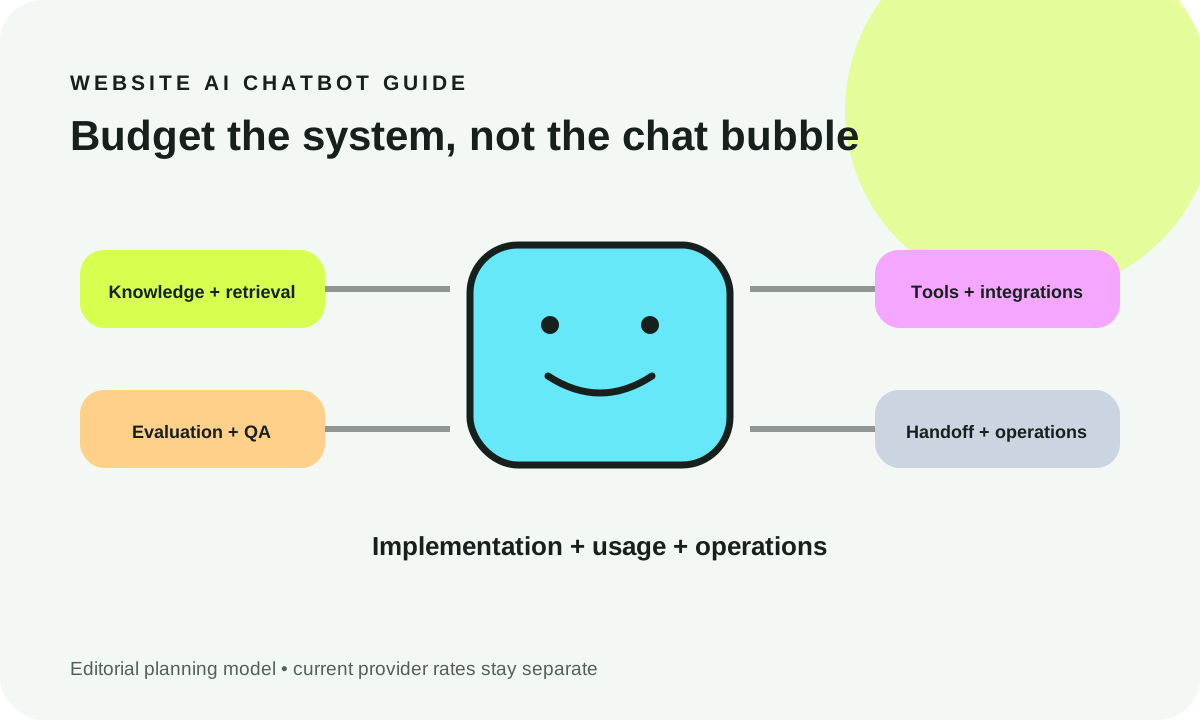
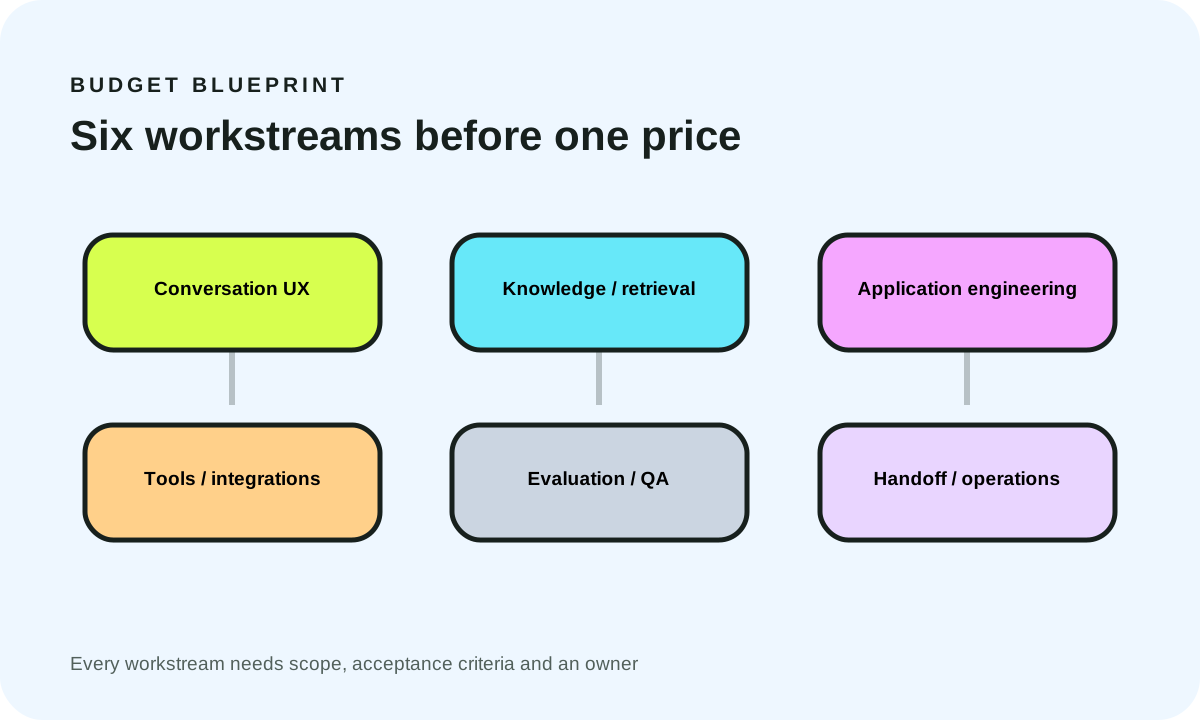
A website AI chatbot is not one line item. Its cost and delivery risk come from six different jobs: conversation design, knowledge/retrieval, application engineering, integrations/tool calls, evaluation/QA and ongoing operations. A lean FAQ/RAG assistant can stay narrow; a production assistant that reads customer data, invokes tools, hands off to humans and serves multiple markets is a different system. Compare scope and operating assumptions before comparing vendor totals.
What you'll learn / decide
- how to separate lean, growth and complex/enterprise chatbot scope
- which requirements move implementation effort most
- how architecture, knowledge, integrations and human handoff affect cost
- how to compare proposals on equivalent deliverables rather than headline price
- what recurring costs exist after launch
- which KPIs belong in the operating plan
- how to use the estimator without treating editorial planning points as a vendor quote
Last reviewed: October 7, 2026. Model, retrieval, storage and tool pricing changes quickly. Verify current vendor documentation before approving a production budget.
Decision snapshot for Website AI Chatbot Guide
A useful chatbot budget starts with the jobs the assistant must perform, not a generic “chatbot package.” The important boundary is whether the system only answers from approved public knowledge or whether it must also authenticate users, retrieve account data, invoke business tools, update systems, preserve permissions and escalate safely.
The single most important tradeoff is scope breadth versus operational confidence. Every new knowledge domain, tool, integration and autonomous action expands not only build work but also evaluation, observability, security and change-management work.
A chatbot is easiest to budget when each capability has four labels:
- user job — what the visitor is trying to accomplish
- evidence/data — what information the bot can use
- action boundary — what it may read, write or trigger
- failure path — what happens when confidence is insufficient
The interactive estimator on this page converts those scope choices into a relative implementation tier and recurring cost-driver map. It intentionally does not invent a market price.
Direct answer and planning range framework
Do not ask “What does an AI chatbot cost?” before deciding what you are buying.
A better planning range has three layers:
Implementation scope: discovery, conversation design, architecture, retrieval, integrations, UX, evaluation, analytics, security and launch work.
Usage-sensitive platform cost: model input/output, cached context where applicable, storage/retrieval, tool calls, third-party APIs and infrastructure.
Operating cost: content updates, evaluation, transcript/sample review, prompt/policy maintenance, human handoff, incident handling, analytics and iteration.
OpenAI's current API pricing documentation separates model input, cached input and output rates and also documents separate pricing for some tools and hosted resources. The important budgeting lesson is structural: actual run cost depends on the model and workload you choose, not on a universal “per chatbot” price.
Build the budget from measurable units
Before procurement, estimate:
- monthly conversations
- typical conversation length
- typical retrieved context
- percentage of conversations using tools
- percentage requiring human handoff
- number and change frequency of knowledge sources
- number of integrations
- number of languages/markets
- evaluation sample size and cadence
- retention/observability requirements
These units let you apply current provider rates later without rewriting the entire business case.
Keep price evidence separate from planning scenarios
A vendor's official current token or tool rate is a sourced fact. A statement such as “this integration will take 40 hours” is an estimate. A statement such as “a Growth chatbot is usually $X” is a market claim that needs evidence.
This guide therefore avoids unsourced market ranges. The estimator uses transparent relative coefficients so you can identify which parts of the scope deserve real vendor estimates.
Scope tiers: lean, growth and complex/enterprise
Scope tiers are useful only if they describe capabilities.
Lean scope
A lean assistant usually has:
- one primary use case
- public or low-risk approved knowledge
- limited source count
- no account-specific data or only a very simple lookup
- zero or one light integration
- clear human/contact fallback
- a focused evaluation set
- one market/language or a deliberately constrained launch
Examples include a product-information assistant, documentation Q&A assistant or lead-routing assistant that does not make transactional changes.
Lean does not mean “no engineering.” Retrieval quality, citations/source boundaries, fallback behavior, analytics and mobile UX still need production work.
Growth scope
A Growth system adds meaningful operational complexity:
- several knowledge domains
- CRM/help-desk or commerce integration
- structured tool calls
- authenticated context
- richer qualification/routing
- human handoff with context preservation
- larger eval sets
- admin/content update workflows
- stronger monitoring
The difference from Lean is not only conversation volume. It is the number of systems and failure modes the assistant must coordinate.
Complex / enterprise scope
Complex systems may include:
- multiple business units or tenants
- role/permission-aware retrieval
- several transactional tools
- regional or language variants
- policy/approval workflows
- audit and security requirements
- sensitive-data boundaries
- high availability and formal incident handling
- change governance for prompts, models and knowledge
- large recurring evaluation programs
At this tier the chatbot becomes part of the application/control plane rather than a marketing widget.
What drives cost more than page count alone
Website page count is often a poor chatbot cost driver.
A ten-page site with three business systems and authenticated actions can be harder than a thousand-page documentation site with clean public content.
Knowledge source quality
Ten clean, stable documents may be easier than two sprawling repositories with duplicates, stale versions and weak ownership.
Knowledge work includes:
- inventory
- source-of-truth decisions
- permissions
- chunking/indexing choices
- metadata
- freshness
- deleted/stale content handling
- conflict resolution
- citation/source presentation
OpenAI's current Retrieval and File Search documentation describes vector stores and hosted search over uploaded knowledge. Whether you use hosted retrieval or your own stack, content governance remains part of the project.
Tool-call complexity
A tool call that retrieves order status is different from a tool that changes an address, cancels a subscription or issues a refund.
Each write action adds questions:
- who is authorized?
- what validation is required?
- what happens on partial failure?
- is confirmation needed?
- can the action be retried safely?
- how is it audited?
- can it be reversed?
- when must a human approve?
That is application engineering, not prompt writing.
Human handoff quality
A bot that hands off badly can create duplicate work.
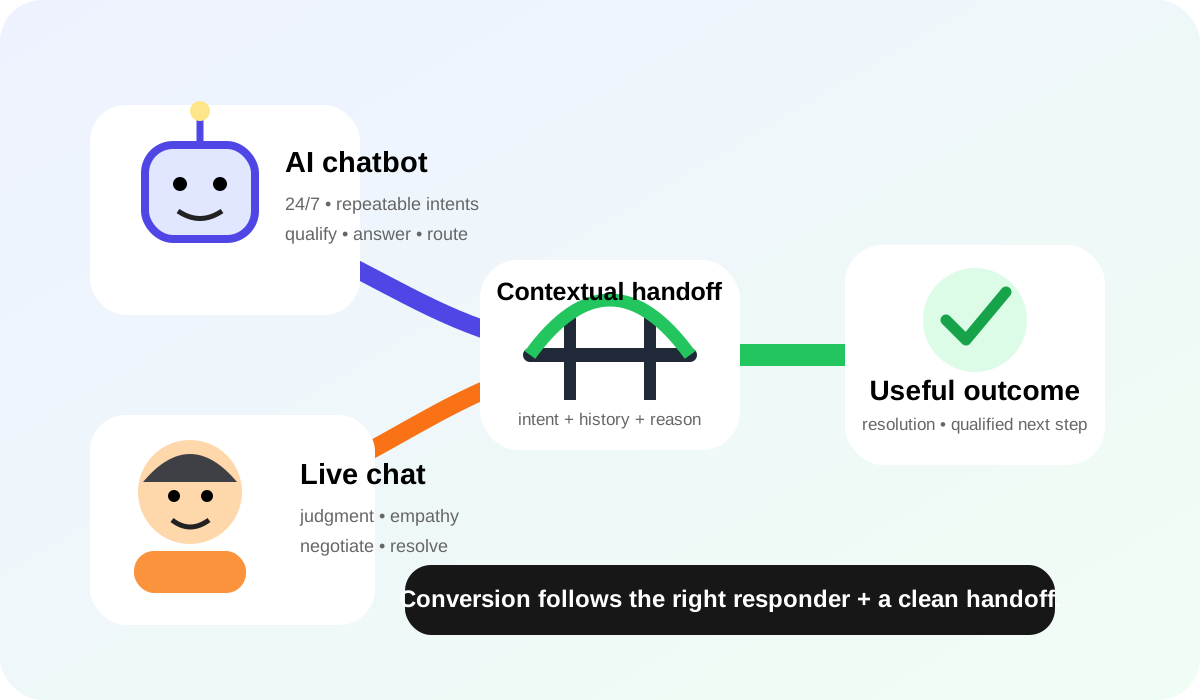
The handoff should carry the user's goal, verified identity context where appropriate, relevant conversation facts, tool actions already attempted and the reason for escalation. The human should not have to ask the user to start again.
Current Intercom and other support-platform documentation treats escalation/handoff as a first-class workflow rather than a failure afterthought. Budget the integration and UX needed to make it usable.
Team roles and delivery model
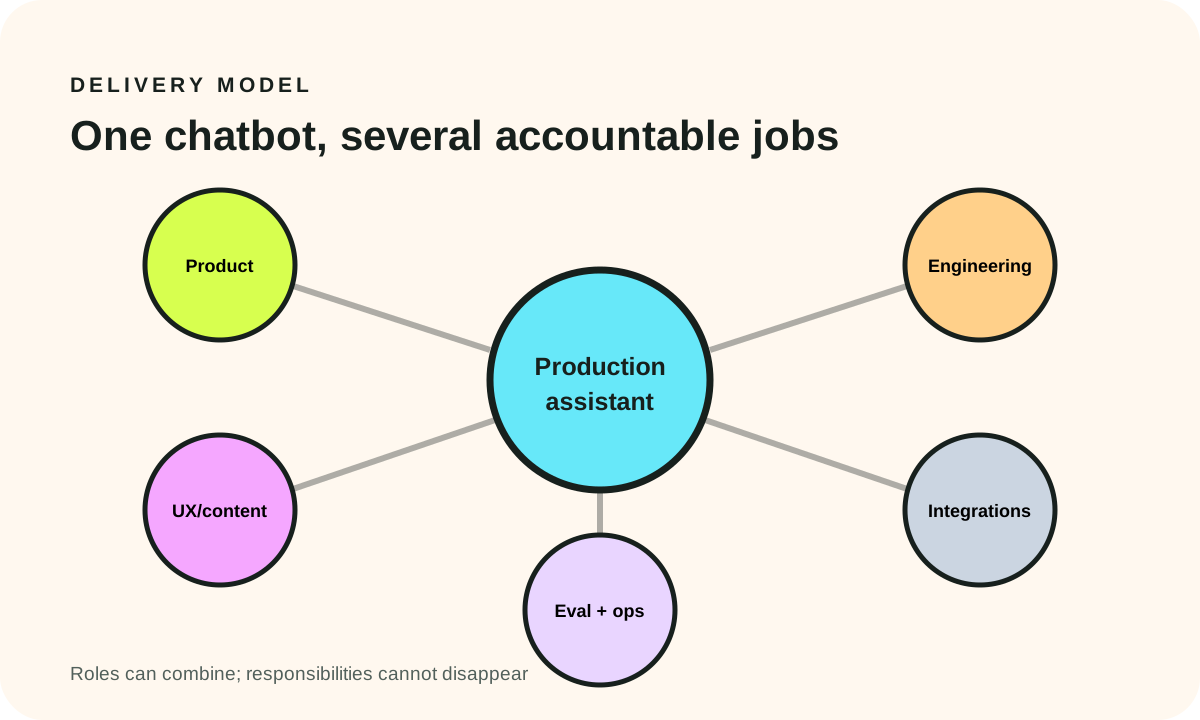
A production chatbot crosses disciplines.
Product / conversation strategy
Defines use cases, user jobs, success criteria, escalation policies and business boundaries.
UX / content
Designs conversation structure, entry points, fallback messages, source presentation, mobile behavior and human handoff.
AI / application engineering
Implements model calls, retrieval, tool orchestration, state, caching, routing, guardrails and backend authorization.
Integration engineering
Connects CRM, help desk, ecommerce, account, identity, scheduling or internal services.
Evaluation / QA
Builds test cases, regression sets, red-team cases, tool-action checks and release gates.
Operations / content ownership
Maintains knowledge, monitors incidents, reviews unresolved queries, updates policies and evaluates model/provider changes.
A small team can combine roles. The work does not disappear because one person wears several hats.
Agency vs internal vs hybrid
Agency-led: useful when internal engineering capacity is limited and there is a clear product owner.
Internal: useful when the chatbot touches proprietary systems deeply and the company already has AI/application capability.
Hybrid: common when an external team accelerates architecture/build while internal product, data/security and operations owners retain system knowledge.
Compare delivery models by ownership after launch, not only implementation price.
Integrations, migration and data complexity
Integrations are often the point where a demo becomes a system.
Classify each integration as:
- read-only public: documentation/catalog data
- read-only authenticated: account/order/ticket information
- write action: CRM update, scheduling, subscription change
- sensitive/high consequence: finance, identity, regulated or irreversible action
The class should affect architecture, test depth and review.
Migration is more than moving files
If an organization already has chatbot transcripts, intents, macros or help-center content, migration may involve:
- cleaning historical knowledge
- preserving source ownership
- transforming metadata
- mapping intents
- removing obsolete flows
- importing evaluation cases
- deciding what should not be migrated
Do not pay to reproduce obsolete conversation trees inside a generative system.
Permission-aware retrieval
Enterprise assistants may need different answers depending on user/tenant/role.
That requirement changes retrieval architecture, data partitioning, authorization and QA. A chatbot that can retrieve private content but cannot prove access boundaries is not ready for production.
Timeline and how urgency changes staffing
A chatbot timeline should be tied to release risk.
Discovery and architecture
Confirm use cases, boundaries, data sources, integrations, success metrics and risk cases.
Pilot build
Implement the narrowest end-to-end path that exercises real retrieval/tool/handoff behavior.
Evaluation and hardening
Test known questions, unknown questions, stale/conflicting sources, permission boundaries, tool errors, handoff, mobile UX and abuse cases.
Production rollout
Add monitoring, runbooks, content ownership, change controls and phased exposure.
Urgency can compress calendar time only by increasing staffing or accepting less scope. It cannot remove integration dependencies or evaluation needs.
A rushed chatbot often defers the exact work that catches expensive failures: permissions, failure recovery, evaluation and operations.
One-time vs recurring operating costs
Separate implementation from the 12-month operating view.
One-time implementation categories
- strategy and use-case design
- conversation UX
- architecture
- retrieval/knowledge setup
- application engineering
- integrations
- analytics
- evaluation setup
- security/privacy review
- deployment and launch
Recurring platform categories
- model usage
- retrieval/storage
- third-party API/tool usage
- hosting/runtime
- observability/logging
- support platform or CRM costs where applicable
Current provider pricing should be applied to measured workload assumptions. Do not freeze today's model rate into a multi-year budget without a review mechanism.
Recurring operating categories
- knowledge maintenance
- unresolved-question review
- evaluation/regression testing
- model/provider upgrade testing
- incident response
- prompt/policy maintenance
- human handoff staffing
- analytics and optimization
These can exceed platform usage cost when the workflow is operationally complex.
Hidden costs and scope-change traps
The expensive surprises are often not “more conversations.”
Undefined source of truth
If product, legal, support and sales documents disagree, the chatbot project inherits an information-governance problem.
“Just one integration”
A new integration may introduce authentication, rate limits, retries, sandbox environments, permissions, webhooks and incident ownership.
Autonomous writes added late
Moving from answers to actions is a meaningful architecture change. Budget it as such.
No evaluation owner
OpenAI's current evaluation guidance emphasizes task-specific evals, production-relevant datasets and continuous evaluation. The broader lesson applies across providers: a chatbot needs a maintained test set because generative systems are variable and system behavior changes as knowledge, tools and models change.
Hidden human workload
If 30% of conversations escalate and the handoff is poor, automation may increase total support effort. Measure handoff rate and post-handoff resolution effort.
Unlimited transcript retention
Storage, privacy, access control and deletion complexity can grow quietly. Retention should be an explicit policy input, not an accidental default.
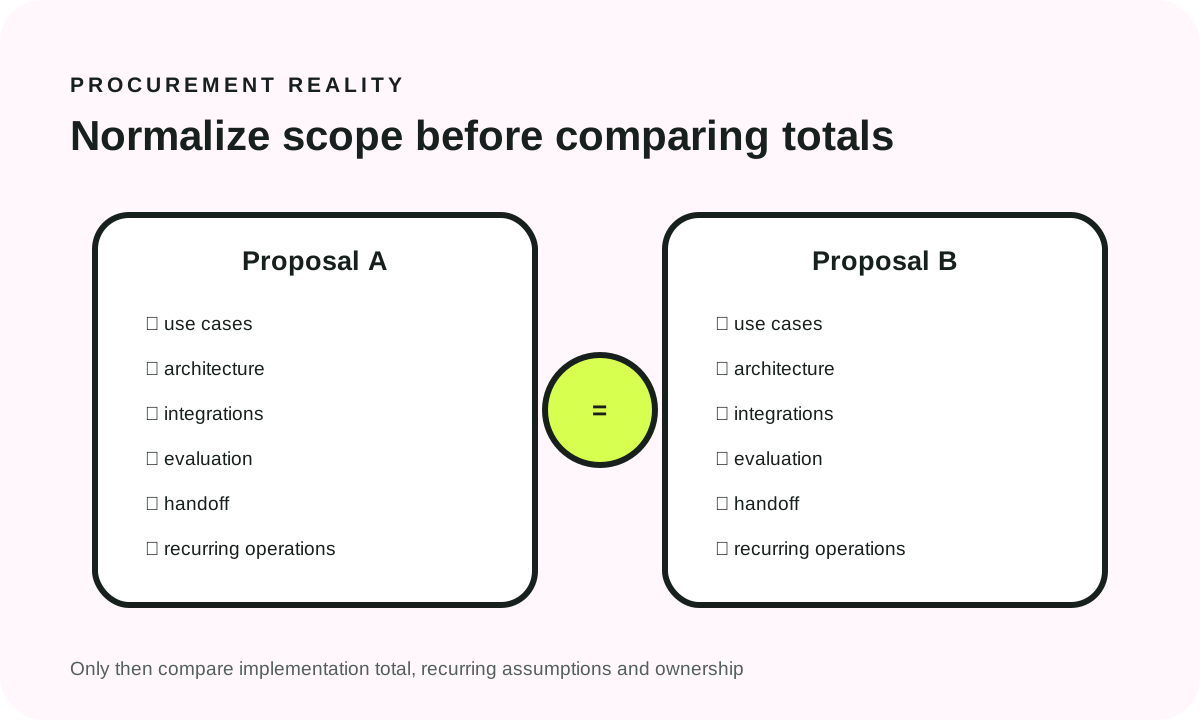
How to compare proposals on equivalent scope
A cheaper proposal is not cheaper if it excludes half the system.
Request a comparable statement of work.
Scope definition
The proposal should name:
- use cases
- channels
- languages/markets
- knowledge sources
- integrations
- read vs write actions
- authentication requirements
- human handoff
- admin/content management
- analytics
- evaluation scope
- security/privacy responsibilities
Technical architecture
Ask what runs where and who owns it:
- model/provider
- orchestration
- retrieval/vector store
- data storage
- integration layer
- identity/authorization
- logging/observability
- deployment environment
Acceptance criteria
Examples:
- supported user intents
- required sources
- maximum unsupported-answer tolerance defined by your team
- tool success/recovery tests
- permission tests
- handoff tests
- mobile/accessibility acceptance
- performance/error budgets where relevant
Avoid vague “95% accurate” commitments unless the proposal defines dataset, scoring method, sample, failure categories and decision rule.
Change control
A proposal should explain what happens when you add:
- a knowledge domain
- a language
- an integration
- a write action
- a new user role
- a regulated workflow
- a larger evaluation requirement
This makes later scope changes visible instead of turning them into disputes.
Budget FAQ and next-step brief
Which chatbot KPIs should I include?
Use metrics that connect system quality to the user job.
Experience: task completion, abandonment, response latency, error recovery.
Answer quality: supported-answer rate, source quality, unresolved rate, correction rate.
Retrieval: retrieval success, stale/conflicting source cases, permission failures.
Tool use: tool success, retries, partial failures, unsafe/invalid requests blocked.
Handoff: escalation rate, context preserved, time to human, post-handoff resolution.
Business: qualified lead progression, support deflection where valid, purchase/task completion, downstream quality.
Do not treat “messages sent” as success.
How much conversation volume is enough to change architecture?
There is no universal threshold. Volume affects run cost and infrastructure, but integration count, permissions, context length, tool complexity and evaluation can dominate before traffic is large. Use the estimator to see which driver is moving your planning tier, then obtain provider-specific sizing.
Should I choose the cheapest model?
Model price is one variable. A lower-cost model can be economical if it meets your evaluated quality and tool-use requirements. A more capable model can sometimes reduce retries, routing complexity or human correction. Test candidate models on your actual workload rather than selecting only from price tables.
Do we need RAG?
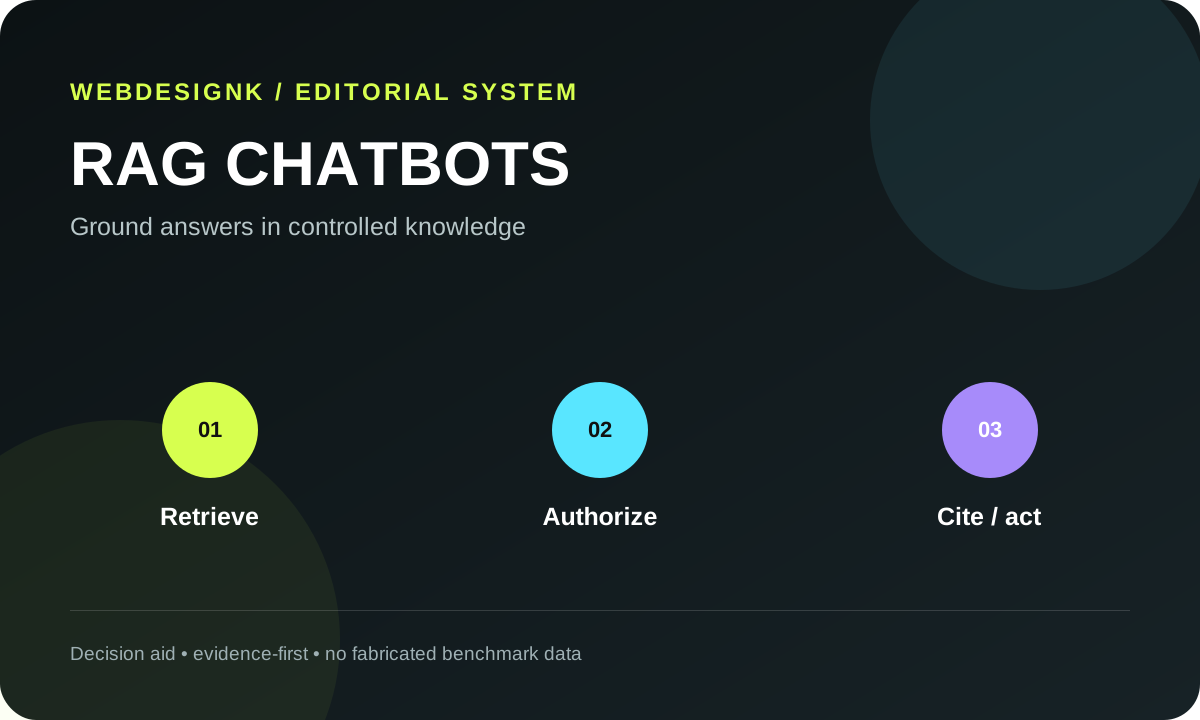
Use retrieval when answers depend on proprietary or frequently updated knowledge that should be grounded in controlled sources. If the bot only handles a small fixed workflow, deterministic content or direct APIs may be simpler.
What should the next-step brief contain?
Bring:
- top user jobs
- monthly conversation estimate
- knowledge-source inventory
- integration list
- read/write action boundaries
- expected handoff rate
- privacy/security constraints
- current support/sales workflow
- evaluation examples
- target launch window
That is enough to create a scoped architecture conversation without pretending the first meeting can produce a fixed final price.
A practical architecture and cost rule
Use this rule when deciding whether a proposed feature belongs in phase one:
Every new autonomous capability must pay for its own evaluation, observability and failure recovery.
If a team wants the chatbot to cancel subscriptions, the estimate must include authorization, confirmation, API integration, idempotency/retry design, auditability, negative tests and recovery. The feature is not just “one tool call.”
If a team wants the assistant to answer security questions, the estimate must include approved sources, escalation boundaries and a process for updating facts.
If a team wants multilingual support, the estimate must include language-specific evaluation and content governance rather than assuming translation alone solves quality.
This principle keeps the implementation budget connected to production responsibility.
Use the estimator as a procurement brief
Change the inputs above until they resemble your planned launch.
If the result moves from Lean to Growth because you added integrations and deeper evaluation, that is useful. It shows which capability changed the planning burden.
Copy the summary into your vendor or internal discovery brief, then replace the relative indices with:
- current provider rates
- internal/agency labor estimates
- infrastructure estimates
- human staffing assumptions
- expected knowledge-maintenance cadence
WebDesignK can help translate the scope into an architecture, implementation plan and evaluation/operations model. See AI chatbot development, and continue with RAG chatbots explained, AI chatbot vs live chat, and GDPR and AI chatbots.
Sources and pricing boundary
This guide uses current official OpenAI documentation for API pricing structure, retrieval/file search and evaluation practices, plus current vendor handoff documentation and NIST AI risk guidance. Sources were checked on October 7, 2026.
No WebDesignK tier or estimator index is a published market price, quote, benchmark delivery hour or guaranteed cost. Current U.S.-market vendor rates, model rates, storage/tool prices and staffing costs must be sourced at procurement time.
Frequently asked questions
How much does a website AI chatbot cost?
There is no defensible universal price without scope. Separate implementation work from model/retrieval/tool usage and recurring operations, then apply current provider and delivery rates to measured assumptions.
What makes a chatbot project expensive?
Integrations, write actions, authenticated/permission-aware data, weak knowledge quality, multilingual scope, formal evaluation, security requirements and complex human handoff usually add more complexity than the number of website pages.
What should I compare between chatbot vendors?
Compare use cases, sources, integrations, read/write actions, authentication, handoff, analytics, evaluation, architecture ownership, security responsibilities, recurring operations and acceptance criteria before comparing totals.
Which chatbot KPIs matter?
Use task completion, supported-answer quality, retrieval success, tool success, human handoff quality, latency/error recovery and downstream business outcomes relevant to the use case.
Do I need RAG for a website chatbot?
Use retrieval when answers depend on controlled or frequently changing knowledge. A small deterministic workflow may be simpler with direct content or APIs.
Should recurring AI cost be estimated from today's model price?
Use current official rates for the initial estimate, but keep model/tool/storage rates as variables because providers and model choices change. The workload model should survive a pricing update.
Sources and assumption boundaries
Fast-changing platform, pricing and search claims were reviewed on 2026-10-07T00:00:00.000Z. Interactive scores and scenarios are clearly labeled planning models, not sourced market benchmarks.
- OpenAI API — Pricing Official current API pricing structure for model input, cached input, output and related platform/tool pricing; reviewed October 7, 2026.
- OpenAI API — Retrieval Official current vector-store and semantic retrieval documentation; reviewed October 7, 2026.
- OpenAI API — File search Official current hosted file-search documentation for Responses API knowledge retrieval; reviewed October 7, 2026.
- OpenAI API — Evaluation best practices Official current guidance on task-specific evals, production-relevant datasets and continuous evaluation; reviewed October 7, 2026.
- Intercom — Hand over Fin AI Agent conversations Official documentation for preserving context when AI conversations hand off to human/external support; reviewed October 7, 2026.
- NIST — AI Risk Management Framework Cross-sector AI risk-management framework used for governance and operating-risk context; reviewed October 7, 2026.